Lake Tahoe · United States · Freshwater · Night
Carnelian Bay
The lake's most popular summer night dive, free and shallow
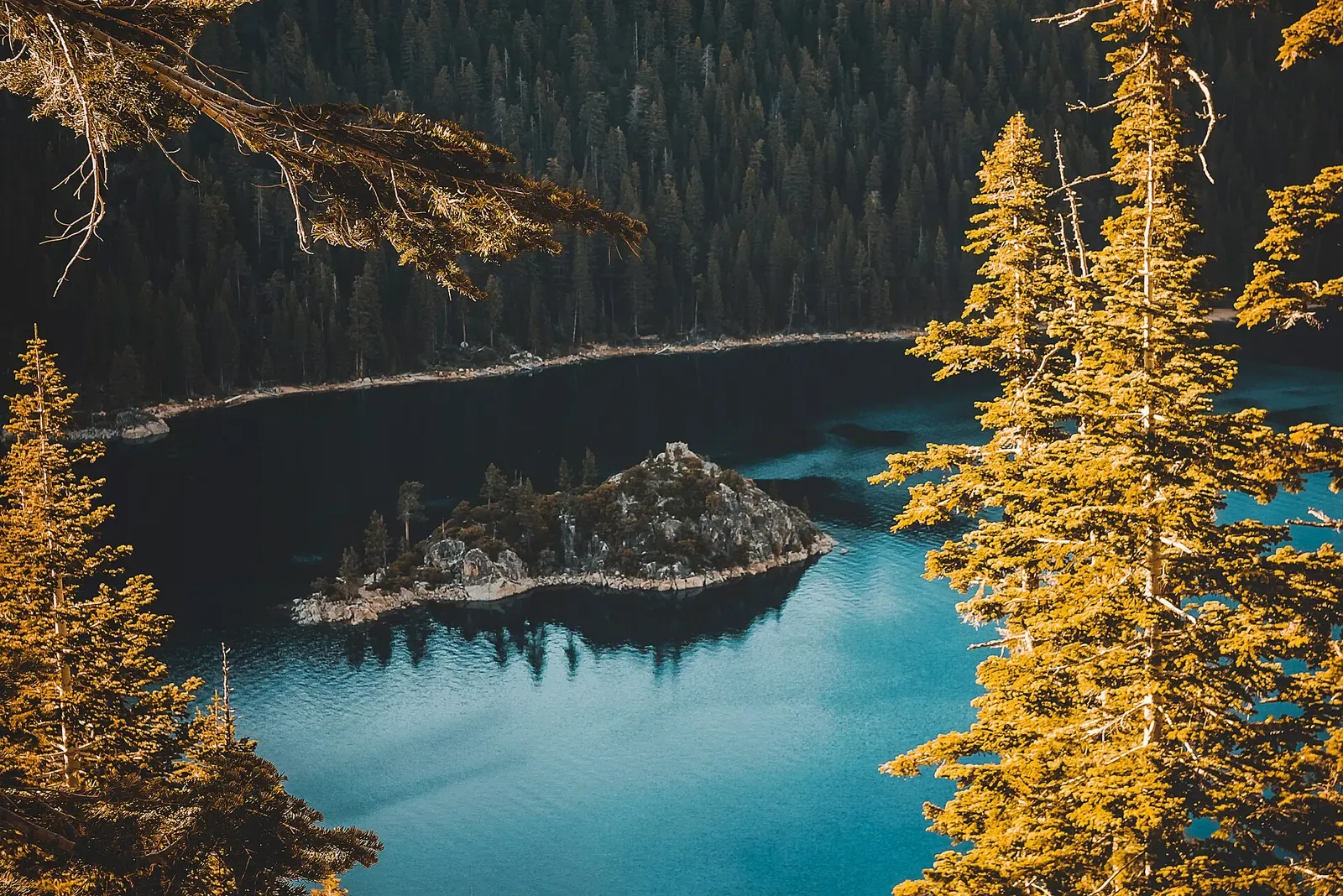
Area photo: Jeff Hopper jeffhopper · CC0
Carnelian Bay, entered from Patton Beach on Lake Tahoe's north shore, is free to dive and shallow: an average depth of 6 to 8 m over sand, breaking further out into rock-ledge steps with small canyons between them. Old motor blocks, deteriorated fishing boats, submerged logs and a sunken barge lie scattered across it. It is the lake's most popular summer night dive.
Also known as Patton Beach.
Where it is and how deep
39.2262° N, 120.0796° WApproximate position — the dashed circle shows where the site lies; your operator's briefing has the mooring.
Site maps published elsewhere
The dive
Parking is in the large open lot and the site itself is free, with porta-potties through the summer and a grocery store and a pizza restaurant across the highway — small things that matter when you are waiting for dark. The entry is through small rocks, so it is worth walking in carefully with fins in hand; a short way out the bottom turns to sand. Shallow depths run for about the first 1,000 ft (300 m) from the beach, and that is the ground the site is normally dived on.
Average depth is 6 to 8 m (20 to 25 ft) and visibility runs 15 to 18 m (50 to 60 ft), which is why the site works for divers straight out of a course and for the night dives local shops run as part of certification training. The sand is not empty: old motor blocks, deteriorated fishing boats, large submerged logs and a sunken barge are scattered across it, and further out the bottom breaks into a series of rock-ledge steps with small canyons in between. Crawdads and rainbow trout are here in numbers.
Under a torch the cast changes — crawdads and fish come out, along with bottom sculpins that are not normally seen in daylight. Navigation is the skill this site asks for: familiarity with a compass is a must, and the ground beyond the shallow first 305 m (1,000 ft) should be left to more experienced divers. Swim out, work a slow arc across the sand, and come back on a reciprocal toward the lights on the beach.
Background
A survey party named Carnelian Bay in 1860, after the semi-precious stones found along its shoreline. Carnelian belongs to the chalcedony group and is composed primarily of quartz; the translucent stone ranges from milky or greyish to a reddish type, and it is still used to make many kinds of jewellery. Divers enter the bay from Patton Beach, in the small community that took the same name.
Marine life and season
- Freshwater fish
| Jan | Feb | Mar | Apr | May | Jun | Jul | Aug | Sep | Oct | Nov | Dec |
|---|---|---|---|---|---|---|---|---|---|---|---|
| Off-season | Off-season | Off-season | Off-season | Fair | Good | Prime | Prime | Prime | Fair | Off-season | Off-season |
Season follows Lake Tahoe: Prime months run July to September; shore access such as D.L. Bliss State Park closes to vehicles once snow sets in, and deep water stays near 4°C even at the height of summer.
Know before you go
- The shallows run for about the first 1,000 ft (300 m); the ground beyond is for experienced divers, and compass navigation is a must before you leave the beach.
Questions divers ask
Why is it called Carnelian Bay?+
A survey party named the bay in 1860 after the semi-precious stones, carnelians, that were found along its shoreline. Divers usually enter from Patton Beach at the edge of the bay.
Is Carnelian Bay good for a first night dive?+
It is the lake's most popular summer night dive, and local dive stores run night dives here as part of certification training. Average depth is 6 to 8 m over sand, with parking and facilities on the beach.
Sources
- Lake Tahoe Dive Sites — Sierra Diving Center
- Patton Beach, Carnelian Bay — OpenStreetMap
More dive sites in Lake Tahoe
Freshwater
Submerged trees, some 6,400 years old, at 4 to 6 m
Freshwater
Flat granite pitted with round craters, in 6 m of water
Freshwater
An artificial reef under the red marker buoy at 9 m
Freshwater
A trail of resort-era barges and boats sunk in California's first underwater park
Freshwater
Sunken trees from 12 to 30 m, with no surface swim
Freshwater
Sand slope off the swim buoys to a rock ledge at 18 m
Wall
A granite cliff face that keeps dropping long past recreational depths
Freshwater
Easy boulder swim-throughs and a sand slope off a Nevada beach
Similar dives elsewhere
A one-way drift over popcorn springs in 30 m (100 ft) of visibility

A 15-to-20-foot (6 m) spring pool, entered by stairs from the park
Drift through three linked limestone ponds on an Open Water certificate alone
.jpg)
The fissure opens into a hall floored with car-sized boulders