Three reef sharks, three different dives
Most divers meet their first shark on a reef, and it is almost never one of the heavyweights. It is one of the three most common sharks on Indo-Pacific coral: the whitetip, the blacktip and the grey reef. In the Caribbean it is usually their Atlantic cousin, the Caribbean reef shark. Many of the listicles that answer “where to dive with sharks” rank places by how many sharks turn up. That tells a newly certified diver very little, because a new diver cannot book every dive on those lists.
What decides whether you can book a shark dive is the water the shark lives in, and each species lives in different water. We went through the sites in our records whose own highlight names a reef shark and sorted them by the rating each site carries. The pattern is plain. No grey reef shark site is rated beginner. Most are rated advanced, and several of the intermediate ones are channels or slopes where the current runs. Among the dives built around a whitetip, most are rated intermediate or advanced, with a single beginner-rated cave. Two of the blacktip reefs are rated beginner, and the other beginner-rated dives that name a reef shark are Caribbean, one of them a baited feed. Widen the search to every line of every site record and the finding still holds. Whitetips and blacktips turn up on beginner-rated reefs from Maui to Phi Phi, but no beginner-rated site names a grey reef shark at all.
So the species tells you the difficulty before the site page does. A whitetip can lie still. Other requiem sharks, the family that includes the grey reef and the blacktip, rely on ram ventilation: they have to keep swimming for water to pass over their gills. The whitetip can pump water over its gills while it lies on the bottom, so it spends much of the day resting in caves, under ledges or on sand. A blacktip keeps moving, but it does it in water only a few metres deep. A grey reef shark gathers at drop-offs and in channels where the current runs. Your first reef shark should be one that is resting or one in the shallows. The grey reefs in a Maldivian channel can wait for a later trip.
| Whitetip | Blacktip | Grey reef | Caribbean reef | |
|---|---|---|---|---|
| Breathing | Can pump water over its gills and lie still | A requiem shark: keeps swimming to breathe | A requiem shark: keeps swimming to breathe | Swims, but sometimes rests motionless on the bottom |
| By day | Resting in caves, under ledges, on sand | Patrolling reef ledges and sand flats | Groups of five to 20 near drop-offs, often in channels with current | Near drop-offs at the reef edge |
| Where most are found | 8 to 40 m | A few metres deep | Mostly shallower than 60 m | Mostly shallower than 30 m |
| Beginner-rated dives built around it | A cave on Isla del Caño | Two shallow reefs in Malaysia and Thailand | None, and no beginner site names one | A baited feed in Nassau and a reef in Sint Maarten |
| IUCN Red List | Vulnerable | Vulnerable | Endangered | Endangered |
The depths in the third row are where each species is most often found, from the species accounts. They are not the depth of any dive.
Whitetips: the shark that lies still
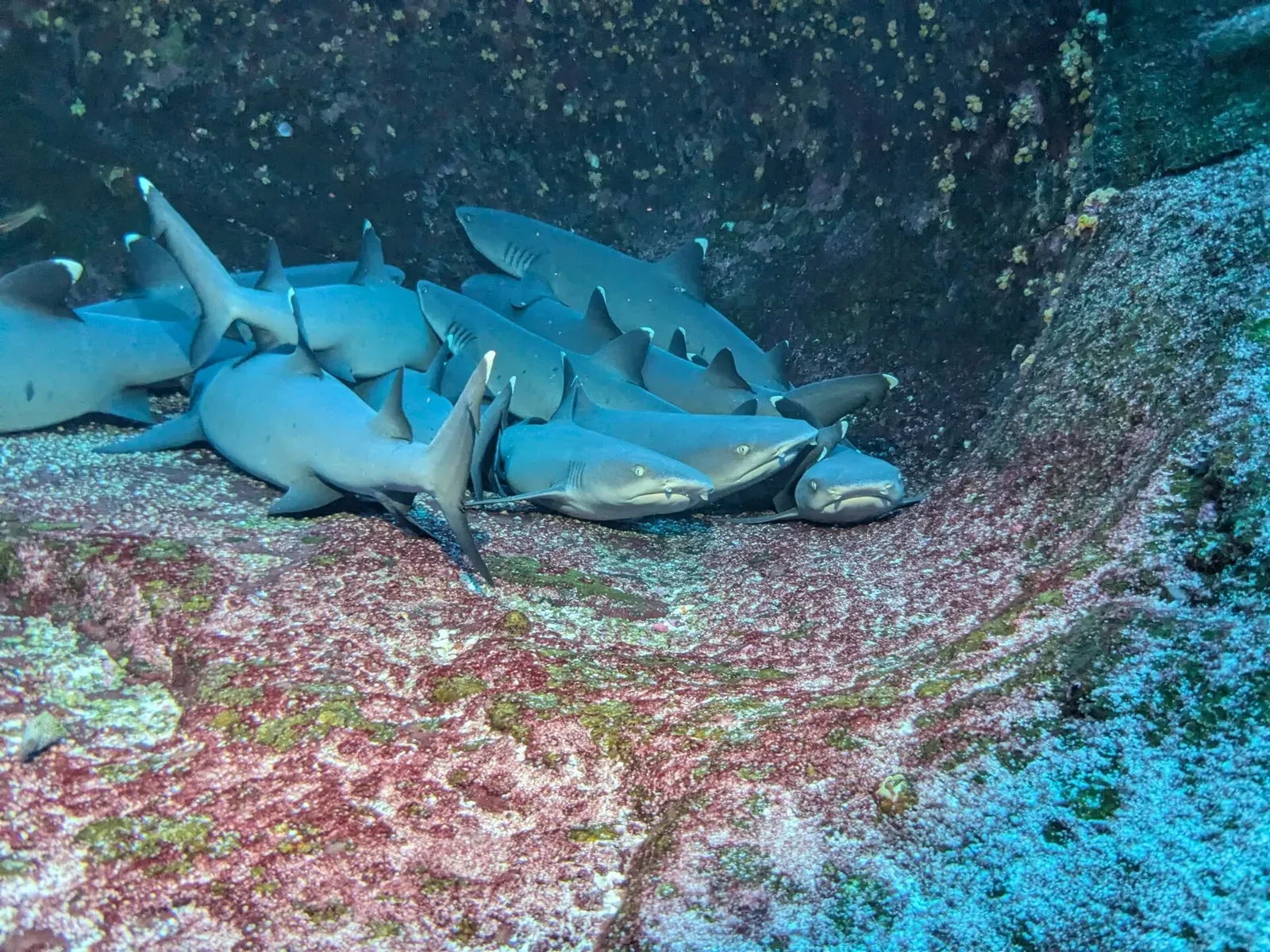
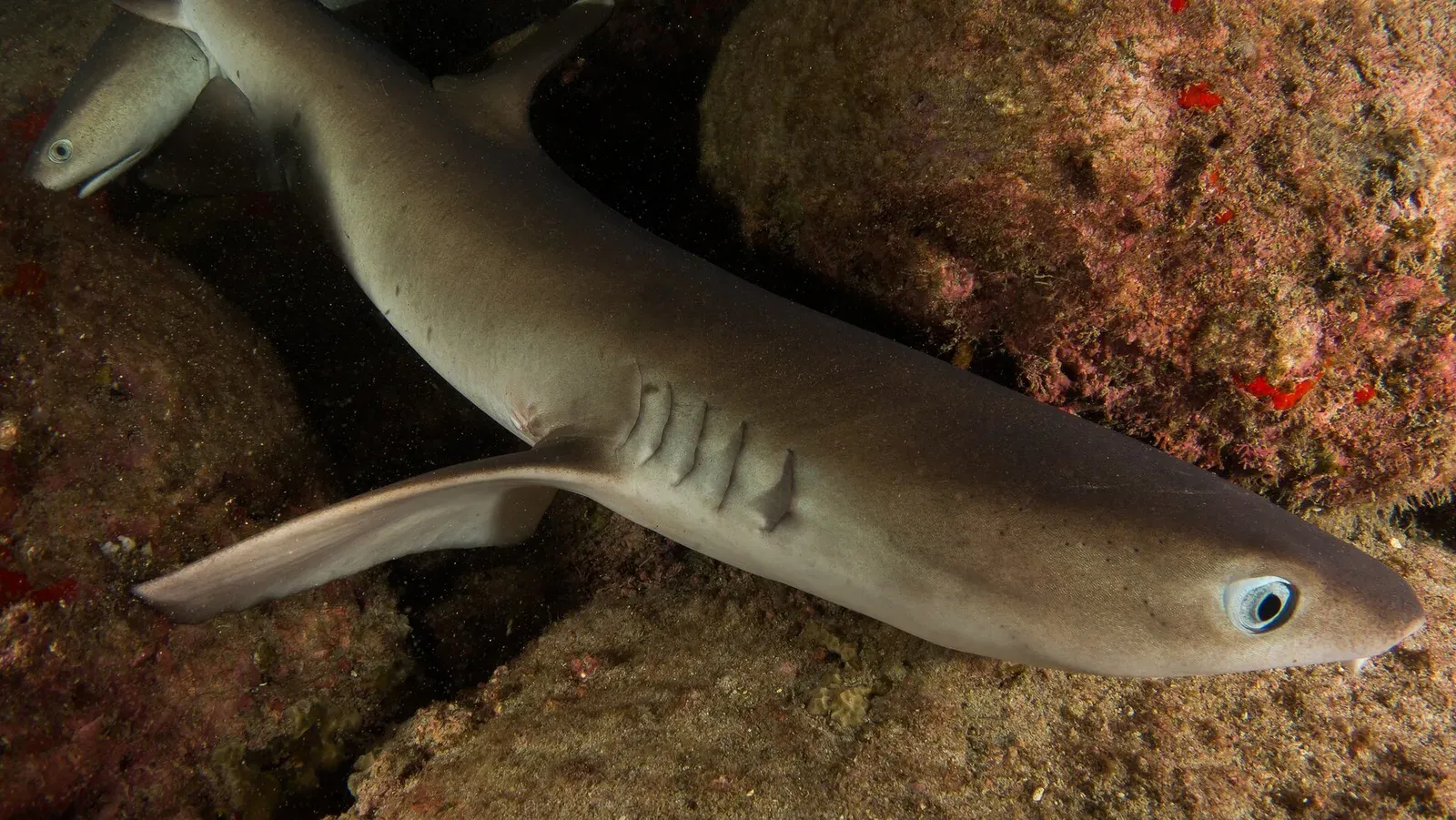
The whitetip is the most forgiving shark a new diver can look for. It rests through the day in caves, alone or in small groups lying side by side or stacked on top of each other, and it becomes active at night or at slack tide. It also keeps an address. Individuals stay on one part of a reef for months or years and often come back to the same shelter, which is why a site record can promise a particular cave. It is rarely aggressive towards people, though it may come close to look at a swimmer.
The best first-shark dive in our records is Cueva del Tiburón off Isla del Caño in Costa Rica. The dive is 10 to 15 m (33 to 50 ft) in calm water, and the draw is a rock recess where about ten resident whitetips lie up through the day. It is rated beginner. The one thing it asks of a diver is discipline: groups hold outside the cave mouth, because resting sharks in a confined space will bolt past you if the exit is blocked. Off Costa Rica, whitetips are also often seen lying in the open on sand, and the island’s area notes put them on close to every dive, in every month. On the same island, Coral Garden is a hard-coral shelf in 5 to 12 m with whitetips crossing it. It is rated intermediate, with a moderate current over it.
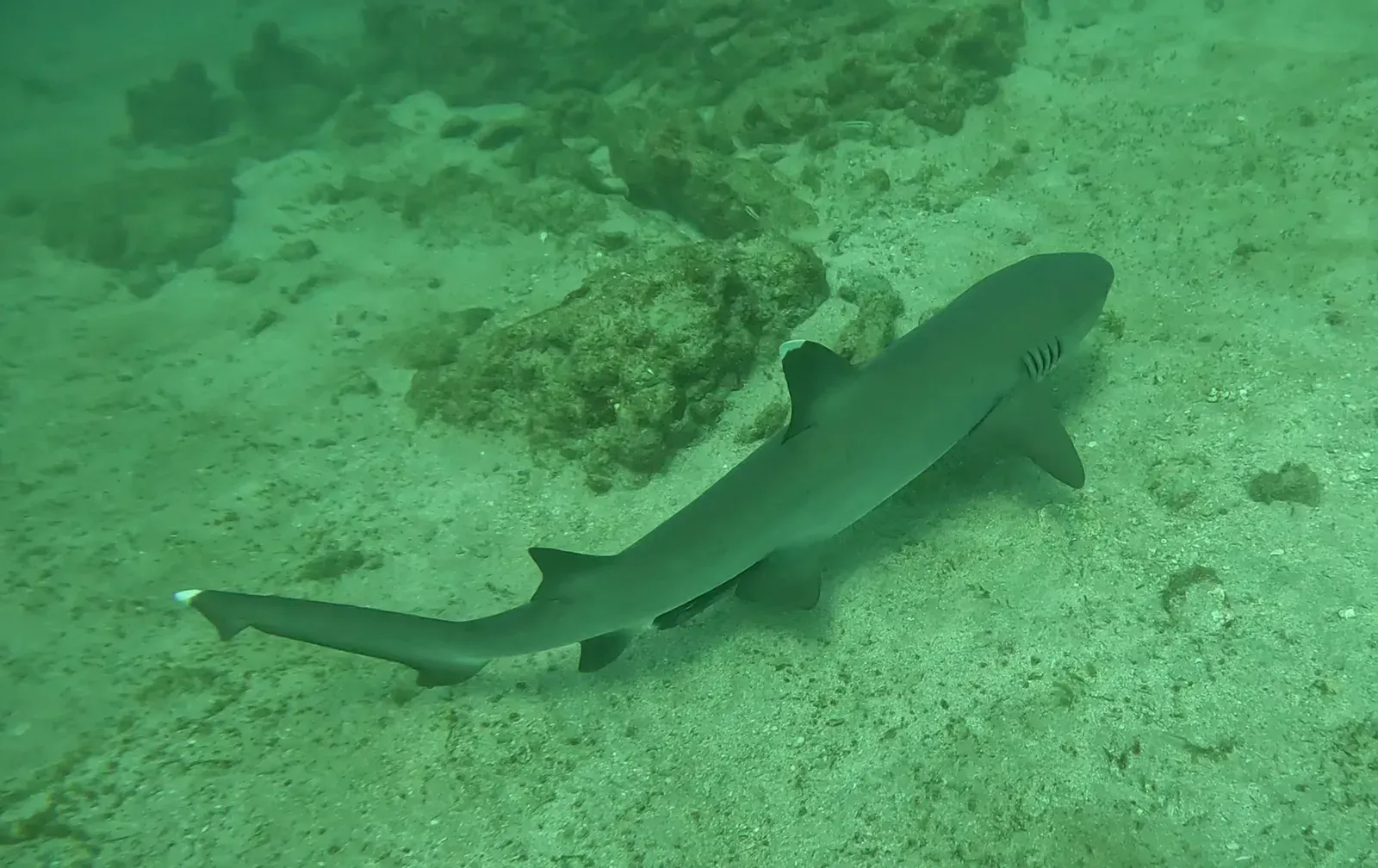
In the Philippines, Shark Apartment is a field of huge boulders on white sand with a maximum depth of 20 m. Full-grown whitetips lie up between the rocks. The site is rated intermediate because a current runs across the boulders, though it is not strong enough to make the dive a hold-on. Two wall dives show the classic setting: caves cut into coral where the sharks rest. At South Point on Cabilao, whitetips lie on the sand inside the caves with their heads towards the entrance. The site is rated intermediate, but its own notes say the 30 m wall and the current around the point suit an advanced diver, and a 5 to 12 m ledge on top is the easy part. At Sachiko's Point in Bunaken the resting whitetips are in the deeper caves of an exposed wall. It is rated advanced, because the current there ranges from none to strong.
The easiest whitetip dive of all is a shore dive in Hawaii where the shark is a bonus rather than the headline. Mala Wharf off Lahaina is a storm-wrecked concrete pier in 6 to 12 m, entered from the beach beside the boat ramp. It is rated beginner, and whitetip reef sharks lie up in the shade beneath the broken slabs.
Two more whitetip addresses are worth knowing. At Halik off Gili Trawangan, juvenile whitetips tuck into small caves along a drifting coral slope. Its record calls it suitable for all levels, but the current picks up around the full and new moon, so check the moon before you book. In the Maldives, Dharavandhoo Thila is a quiet pinnacle whose summit sits at about 10 m. Open Water covers the summit, and whitetips rest in the small caves on its flanks, which fall away past 30 m.
A cave full of resting sharks is not the same as an easy dive, and the records say so. At Pala Pala in Indonesia, the record says reef sharks are always inside a large cave, lying on the sand, but the cave is at 36.8 m and needs a decompression stop. At Turtle Patch the water is usually still and whitetips cruise over the table corals, but the dive runs 25 to 40 m. At Shark Airport there can be several whitetips in view at once on one terrace at 20 m, but only liveaboards reach it, while the park is open from mid-March to mid-June. At Shark's Cave on Layang-Layang, whitetips rest under an undercut in the wall at about 25 m, and the dive runs to 40 m with open water below. All four have resting sharks, and the depth and the access are what put them out of reach.
Blacktips: the shark in the shallows
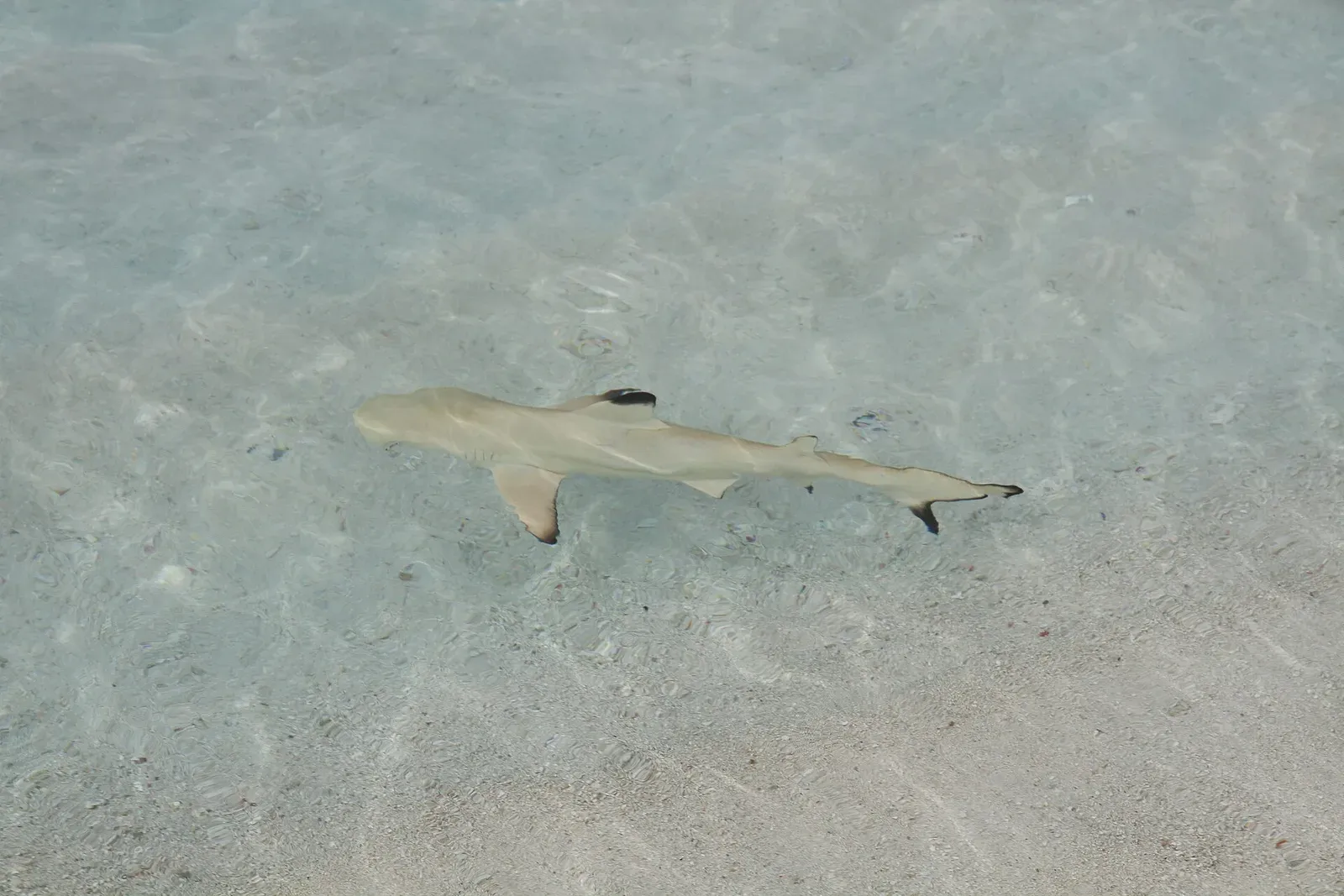
The blacktip reef shark is the one you can see from the beach. It usually lives in water only a few metres deep, often close to shore with its first dorsal fin out of the water. Young blacktips keep to shallow sand flats and older ones to reef ledges. It has one of the smallest home ranges of any shark, around 0.55 km² in a tracking study at Palmyra Atoll, so a reef that has blacktips tends to keep them. The catch is temperament. Blacktips are timid and skittish and hard to approach. A first blacktip is usually a shape crossing the edge of the reef rather than a portrait.
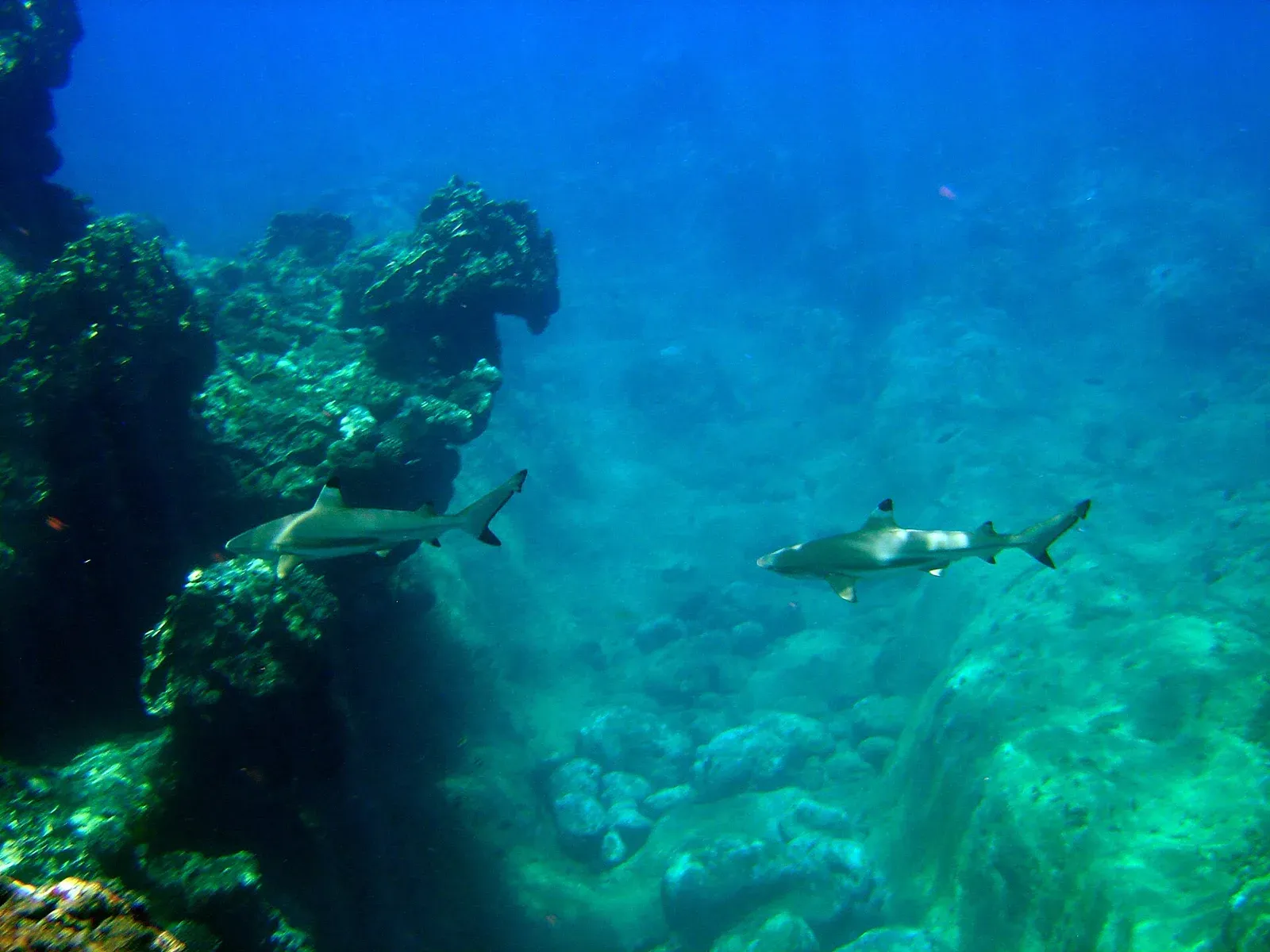
Two reefs built around blacktips are rated beginner. Renggis Island is a small rock island off Tioman’s west coast in Malaysia: 0 to 16 m, mostly no current, good visibility, and blacktip reef sharks and green turtles seen there very often. It doubles as the island’s night dive and a snorkelling stop. Across Tioman as a whole the area notes call blacktips an occasional shallow sighting, so Renggis is the reef to ask for. In Thailand, Pileh Wall on Phi Phi Leh drops to 20 m under soft corals and gorgonian fans, and the blacktips are along the shallow top of the wall. Divers sometimes watch them over the overhang before they have even descended. Neither site guarantees a shark. “Very often” and “turn up” are the records’ words, and they are the honest odds. Nearby, Koh Bida Nai is a beginner-rated rock with normally no current and swim-throughs from 10 to 25 m, where leopard sharks and blacktips are the regular sightings.
Renggis Island - The Most Magical Dive Site in Tioman · Mastershifuu on YouTube
The advanced blacktip dives are the offshore versions of the same animal. At Stork Island/Koh Chi in Thailand’s Surin Islands, blacktips are a reliable sighting over a granite slope to 22 m, but the current can be strong and unpredictable. Tiger Reef is an open-water pinnacle from 10 to 22 m west of Tioman where the current can become strong. Operators there ask for Advanced Open Water. In the Seychelles, Marianne is a granite drift at 12 to 25 m where blacktips and whitetips come in numbers. It is rated intermediate. You need to be comfortable being carried along rather than holding a position.
Grey reef sharks: the shark that needs current
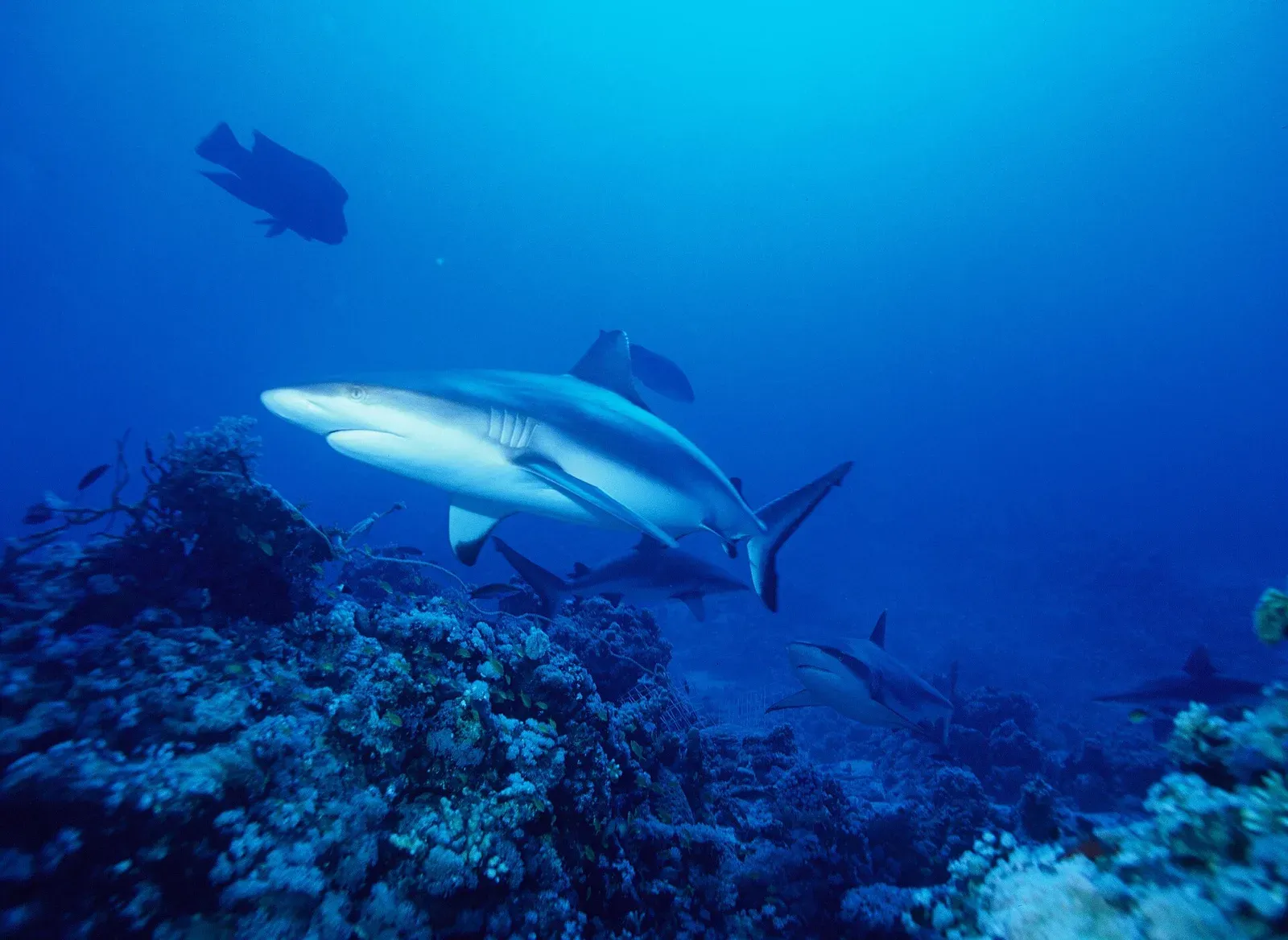
The grey reef shark is the one in the famous photographs: a pack hanging in blue water off a reef edge. It is most often seen near drop-offs, particularly near reef channels with strong currents, and less often inside lagoons. By day grey reefs often gather in loose groups of five to 20 near the drop-off. Where tidal currents run strong, they swim against the flow, towards shore on the ebb and back out on the flood, possibly to pick up the scent of prey or to hunt in murkier water. The current is where they hunt, so the current is where you go to see them. It fits that none of our grey reef sites is rated beginner.
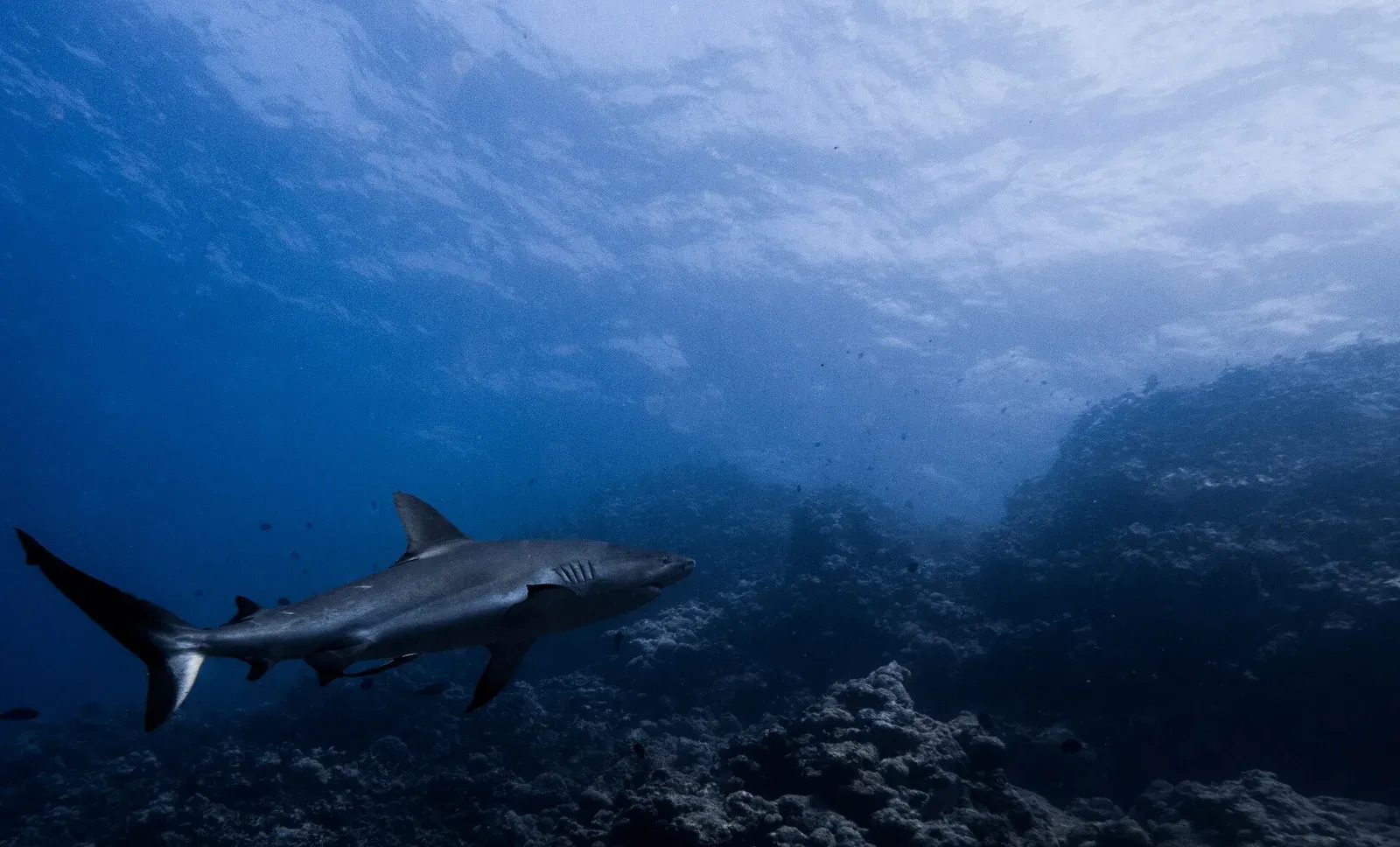
The biggest grey reef gathering on record is an intermediate dive. South Pass (Tumakohua) at Fakarava, in French Polynesia, is a channel about 200 m wide, dived as a drift timed to the incoming tide, down to a gully at about 27 m (89 ft). A 2016 study found that the pass hosts an average of 600 reef sharks, two to three times the biomass per hectare of any other reef shark gathering on record, and hunting groups of up to 700 grey reefs have been observed at the atoll. The pass cannot feed them. The researchers estimated that the sharks need about 90 tonnes of fish a year, while the pass produces about 17. What closes the gap is spawning. Camouflage groupers gather at the ocean end of the pass to spawn over the June and July full moons, and the sharks feed on them. That is why the area’s rating peaks in those months, and it is the one shark calendar in this guide. At 27 m the dive is past the 18 m (60 ft) an Open Water card allows.
Shark TV - Fakarava, Diving the South Pass with Sharks, tons of Fish and the Famous Napolean Wrasse · underWATERcam - Your Window to the Ocean & Nature on YouTube
The Maldivian channels are the grey reef’s home ground, and most of them are current dives. Fish Head in Ari Atoll is a small protected pinnacle from 10 to 35 m with an estimated sixteen resident grey reefs. The current there can be strong enough to need descent and ascent lines. At Moofushi Kandu, on good days more than a hundred grey reefs patrol the mouth of a channel that falls to 40 or 50 m. Kuredu Express is a drift through a channel to 30 m where grey reefs gather in schools of 20 or more on an incoming tide. Embudu Channel was made a marine protected area for its grey reef and whitetip sharks, which sit at about 30 m on the drop-off in a current rated above two knots. Further east, the pattern holds on Mur aux Loches in New Caledonia, where a school of about 70 holds on a drifting wall, and at Tiputa Pass, where the classic route stops at a hollow at about 35 m before riding the tide into the lagoon.
There is one exception, and it shows how the rule works. Maava Kandu in Laamu has a channel floor at only 14 to 16 m, with grey reef and whitetip sharks reported over it. When the current is slight, divers of all levels can join. When it runs harder, the site belongs to divers used to moving water. So even the one grey reef channel a new diver can reach depends on the tide. At Sharks Tongue in Meemu, a slope described as a shark dormitory where grey reefs and silvertips rest at 15 to 25 m, the sharks come in on an incoming current, and the site asks for drift experience.
One more thing is specific to this species. The grey reef shark was the first shark known to make a threat display: it raises its snout, drops its pectoral fins, arches its back and swims with a stiff side-to-side motion. It usually does this when a diver follows or corners it. A grey reef shark is often curious on a diver’s first entry and is not typically dangerous. Give it room, and never chase one across a channel for a photograph.
The Caribbean way: fed, and shallow
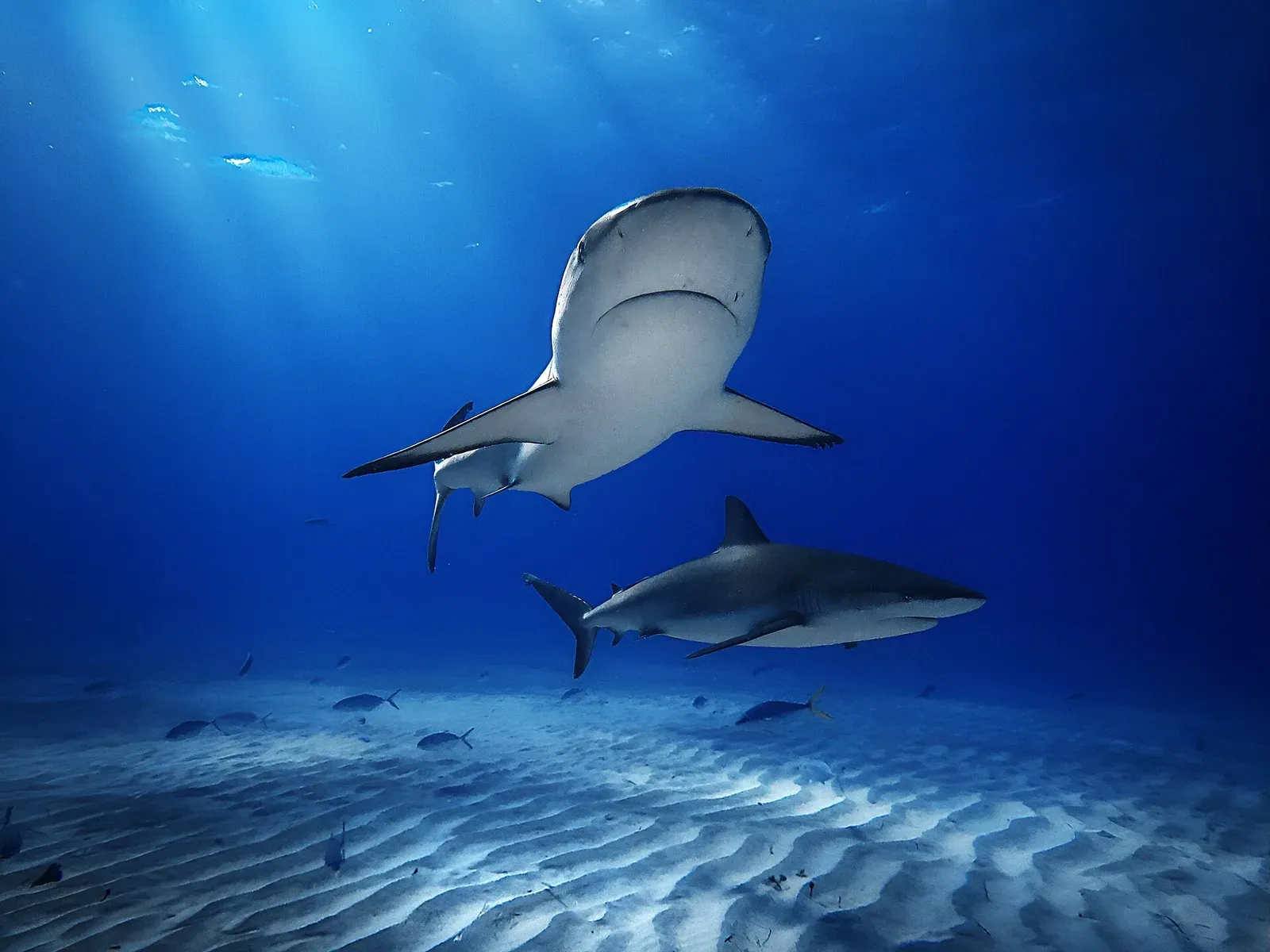
The Caribbean reef shark is the reef shark most divers meet in the Atlantic, and the easiest ways to meet it are built around bait. This species is usually on the move, but it has been seen resting motionless on the sea floor or inside caves. It was the first active shark known to do that, at the “sleeping shark” caves off Isla Mujeres that Eugenie Clark studied in 1975. The easiest Caribbean dives in our records, though, are about sharks drawn in or kept close by feeding.
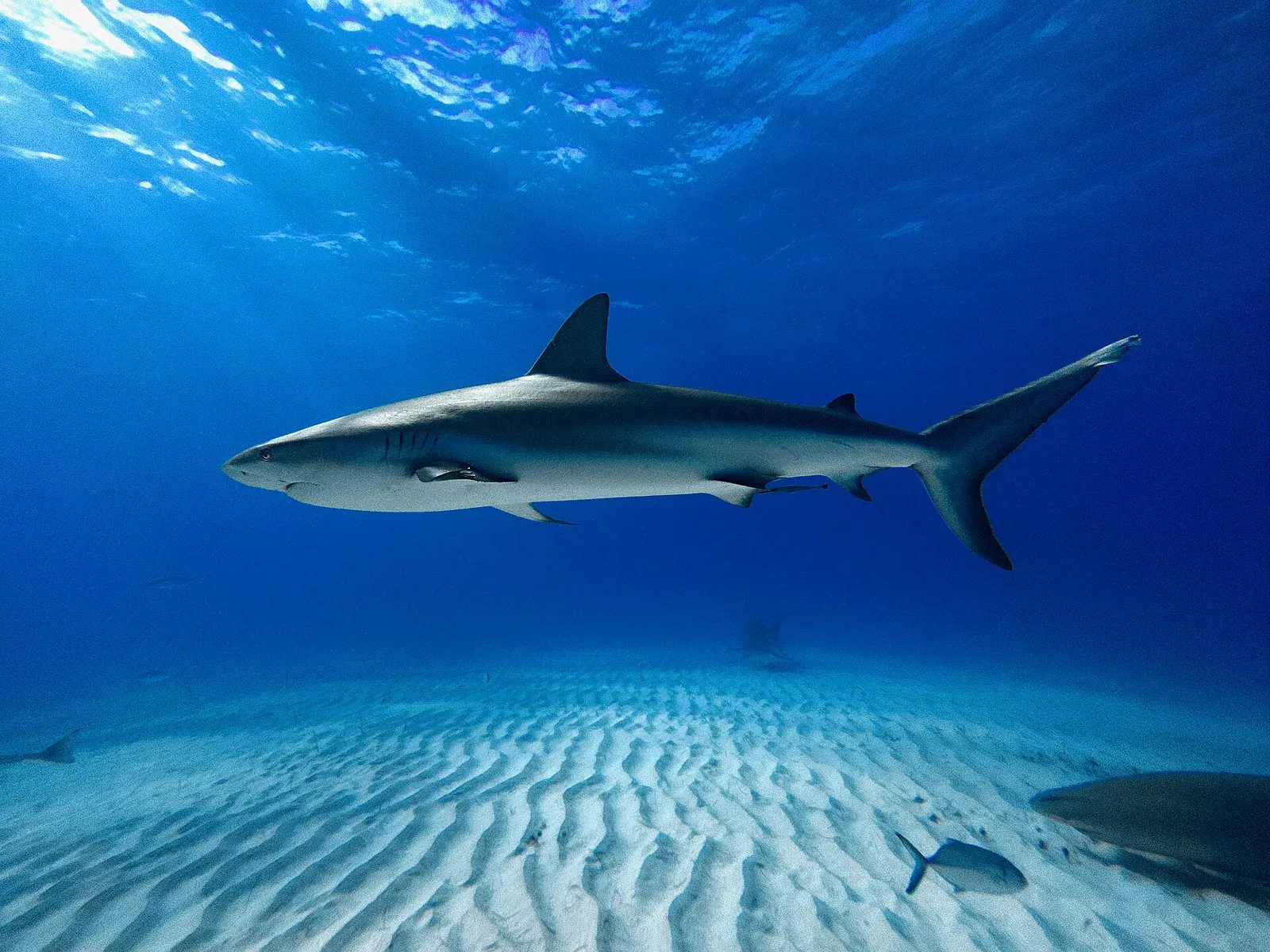
Shark Arena off New Providence in the Bahamas is a baited feed on a sand shelf at 12 m (40 ft). Divers kneel in a line, the bait goes down, and dozens of good-sized Caribbean reef sharks close in and pass at arm’s length. It is rated beginner: the depth is shallow, the bottom is flat, and the rules of the feed keep everyone still. Calling it a natural encounter would be wrong. It is a staged one, and it is honest about that. Amberjack Reef in the Exuma Cays is the next step: up to ten Caribbean reef sharks and nurse sharks over a patch reef at 15 m. Sharks were fed there in the past and are not any more, but they still come to that part of the park. The site is rated intermediate. The reef itself is a shallow dive, and the rating is for staying calm and neutral with several sharks close in. That is about nerve, not skill, and a new diver who knows that about themselves can decide. At Bull Run, a former liveaboard feeding site off Bimini, three to eight female Caribbean reef sharks still hang around coral heads at 10 to 18 m.
Shark Arena, Bahamas · MBsAdventures on YouTube
Away from a feed, the sighting can be less certain. Shark Hotel is a beginner-rated reef at 18 m, exactly the Open Water limit, in Sint Maarten’s Man of War Shoal Marine Park. The ledges are where to look for Caribbean reef sharks, and the record says plainly that a sighting is not guaranteed. On the walls, Shark Hotel in the Turks and Caicos has small reef sharks on a wall that drops from 14 m to a plateau at 24 to 30 m and is rated advanced, and Cuba’s Black Coral I and II are the reserve’s signature shark dives at 25 to 30 m.
The feeds are run shallow and on flat sand, with every guest kneeling still, and at Shark Arena those rules are the dive’s safety system. The Bahamas protects its reef sharks because shark tourism is worth more than a shark landed. What feeding does to the sharks, and how baited, provisioned and natural encounters differ, is covered in our guide to tiger, bull and white shark dives.
Reading the site page before your first shark dive
The rating on every site page describes the conditions of the dive, not the shark, and four fields decide whether you can book it.
Difficulty is the rating for the dive as a whole. A beginner rating means shallow, calm and simple. It does not mean the site has sharks for beginners.
Depth is the one to check against your card. The standard Open Water certification lets you dive to 18 m (60 ft), and Advanced Open Water is what opens sites deeper than that. Pileh Wall is rated beginner and its record says Open Water is enough, but the wall reaches 20 m. The blacktips are along the top anyway, so the right plan is to stay above 18 m, which is where they are most often seen. South Pass (Tumakohua) is rated intermediate, but its gully is at about 27 m. That is past the Open Water limit, whatever the current does on the day.
Current is the field that sorts the sharks. None or mild current, a whitetip or blacktip highlight and a depth your card covers make a first-shark dive. Moderate or strong with a grey reef highlight is a dive for after your first drifts, and our drift diving guide covers how those are run.
The certNote is the sentence that says who the site is for, and it often says more than the rating does. Cueva del Tiburón’s certNote says its only demand is staying outside the cave mouth. Amberjack Reef’s says its rating is for composure. Sachiko’s Point’s says the site is fine for beginners when the current is light, which is the kind of hedge you only get from reading the whole record.
Where this sits in the Logbook
The heavyweights, tigers, bulls and great whites, are in our guide to tiger, bull and white shark dives, which also sets out what the feeding science says. Despite the name, the oceanic whitetip is a different animal from the reef whitetip in this guide: an open-ocean species. Whitetips are the night hunters of the reef, and our night diving guide covers Manuelita at Cocos Island, where they sweep the coral garden by torchlight. Threshers have their own guide.
The reef shark dives in our records, by difficulty
These are the sites whose own highlight names a reef shark, sorted by rating and then by maximum depth, so the shallowest dives come first. The Best months column is the area’s diving rating by month. It rates what divers come to that area for, which is not always the shark, so it is not a calendar for reef sharks. Each area page’s wildlife notes say whether the sharks are there all year.
| Site | Depth | Current | Level | Best months |
|---|---|---|---|---|
| Shark Arena Nassau & New Providence · Bahamas | 12 m | Mild | Beginner | Nov–May |
| Cueva del Tiburón Isla del Caño · Costa Rica | 10–15 m | Mild | Beginner | Jan–Mar |
| Renggis Island Tioman · Malaysia | 0–16 m | None | Beginner | May–Jul |
| Shark Hotel Sint Maarten · Sint Maarten | to 18 m | Mild | Beginner | Dec–May |
| Pileh Wall Phi Phi & the King Cruiser · Thailand | to 20 m | Mild | Beginner | Nov–Apr |
| Site | Depth | Current | Level | Best months |
|---|---|---|---|---|
| Mala Wharf Maui, Molokini & Lānaʻi · United States | 6–12 m | Mild | Beginner | Apr–Oct |
| Buck Island St. Croix · U.S. Virgin Islands | 9–12 m | Mild | Beginner | Dec–May |
| Koh Bida Nai Phi Phi & the King Cruiser · Thailand | 10–25 m | None | Beginner | Nov–Apr |
| Site | Depth | Current | Level | Best months |
|---|---|---|---|---|
| Coral Garden Isla del Caño · Costa Rica | 5–12 m | Moderate | Intermediate | Jan–Mar |
| Amberjack Reef Exuma Cays · Bahamas | to 15 m | Mild | Intermediate | Jan–Mar |
| Maava Kandu Laamu Atoll · Maldives | 14–16 m | Strong | Intermediate | Jan–Apr |
| Austin Smith Wreck Exuma Cays · Bahamas | to 18 m | Mild | Intermediate | Jan–Mar |
| Bull Run Bimini · Bahamas | 10–18 m | Moderate | Intermediate | Jan–Mar |
| Chuckles Seychelles · Seychelles | to 20 m | Moderate | Intermediate | Mar–Apr |
| Shark Apartment Donsol & Ticao Pass · Philippines | to 20 m | Mild | Intermediate | Feb–May |
| Aride Bank Praslin & La Digue · Seychelles | 12–22 m | Moderate | Intermediate | Mar–Apr |
| White Bank Praslin & La Digue · Seychelles | 15–22 m | Moderate | Intermediate | Mar–Apr |
| Dredger Rock Seychelles · Seychelles | to 24 m | Mild | Intermediate | Mar–Apr |
| Utheemu Reef Haa Alif & Haa Dhaalu Atolls · Maldives | to 25 m | Moderate | Intermediate | Jan–Apr |
| Mike's Point Bunaken · Indonesia | 10–25 m | Mild | Intermediate | May–Oct |
| Marianne Praslin & La Digue · Seychelles | 12–25 m | Moderate | Intermediate | Mar–Apr |
| Sharks Tongue Meemu Atoll · Maldives | 15–25 m | Strong | Intermediate | Dec–Apr |
| South Pass (Tumakohua) Fakarava · French Polynesia | to 27 m | Moderate | Intermediate | Jun–Jul |
| Two Mile Reef Bazaruto Archipelago · Mozambique | to 30 m | Moderate | Intermediate | May–Oct |
| Ujung Nunukan Derawan & Sangalaki · Indonesia | to 30 m | Mild | Intermediate | Apr–Jul |
| South Point Cabilao · Philippines | 5–30 m | Moderate | Intermediate | Nov–May |
| Halik Gili Islands · Indonesia | 5–30 m | Moderate | Intermediate | Apr–Oct |
| Dharavandhoo Thila Baa Atoll & Hanifaru Bay · Maldives | 10–30 m | Moderate | Intermediate | May–Oct |
| Shark Ridge Apo Reef · Philippines | 15–30 m | Moderate | Intermediate | Dec–May |
| Site | Depth | Current | Level | Best months |
|---|---|---|---|---|
| Navy Pier Ningaloo Reef · Australia | 0–10 m | None | Advanced | Apr–Sep |
| Shark Airport Tubbataha Reefs · Philippines | to 20 m | Strong | Advanced | Apr–May |
| Stork Island/Koh Chi Surin Islands · Thailand | to 22 m | Strong | Advanced | Dec–Apr |
| Tiger Reef Tioman · Malaysia | 10–22 m | Moderate | Advanced | May–Jul |
| Shark Point Gili Islands · Indonesia | 18–24 m | Strong | Advanced | Apr–Oct |
| Twilight Zone Saba · Caribbean Netherlands | 23–24 m | Moderate | Advanced | Jan–Apr |
| Mur aux Loches New Caledonia · France | 5–25 m | Strong | Advanced | Sep–Nov |
| Boulder City Similan Islands · Thailand | 10–25 m | Mild | Advanced | Dec–Apr |
| Sachiko's Point Bunaken · Indonesia | 10–25 m | Moderate | Advanced | May–Oct |
| Yellow Wall Komodo · Indonesia | 10–25 m | Moderate | Advanced | Jul–Sep |
| Kuredu Express Lhaviyani Atoll · Maldives | to 30 m | Moderate | Advanced | Dec–Apr |
| Abu Kafan Safaga · Egypt | 10–30 m | Strong | Advanced | Apr–Jun |
| Babylon Saba · Caribbean Netherlands | 14–30 m | Moderate | Advanced | Jan–Apr |
| Shark Hotel Turks & Caicos · Turks & Caicos Islands | 14–30 m | Moderate | Advanced | Jan–Apr |
| Shark Bank Seychelles · Seychelles | 18–30 m | Moderate | Advanced | Mar–Apr |
| Seulako Drift Pulau Weh · Indonesia | 20–30 m | Strong | Advanced | Oct–Apr |
| Black Coral I and II Jardines de la Reina · Cuba | 25–30 m | Mild | Advanced | Dec–Apr |
| Embudu Channel South Malé Atoll · Maldives | 18–31 m | Strong | Advanced | Dec–Apr |
| Ibel D'Orange Takabonerate & Selayar · Indonesia | 18–32 m | Moderate | Advanced | Apr–Jun |
| Tiputa Pass Rangiroa · French Polynesia | to 35 m | Strong | Advanced | Dec–Apr |
| Shark Point Addu Atoll · Maldives | 5–35 m | Moderate | Advanced | Jan–Apr |
| Fish Head Ari & Rasdhoo Atolls · Maldives | 10–35 m | Strong | Advanced | Dec–May |
| Manuelita Cocos Island · Costa Rica | 22–35 m | Strong | Advanced | Jun–Oct |
| Pala Pala Derawan & Sangalaki · Indonesia | to 36.8 m | Mild | Advanced | Apr–Jul |
| Bilhifeyshi (Hook Box) Fuvahmulah · Maldives | to 40 m | Strong | Advanced | Dec–Apr |
| Fotteyo Kandu Vaavu Atoll · Maldives | 8–40 m | Strong | Advanced | Dec–Apr |
| Habili Ali St John's Reefs · Egypt | 10–40 m | Strong | Advanced | Apr–Jun |
| Turtle Patch Sipadan · Malaysia | 25–40 m | Mild | Advanced | Mar–May |
| Shark's Cave Layang-Layang · Malaysia | 25–40 m | Mild | Advanced | Closed |
| Moofushi Kandu Ari & Rasdhoo Atolls · Maldives | to 50 m | Strong | Advanced | Dec–May |
| Nick's Place Providencia & San Andrés · Colombia | to 60 m | Moderate | Advanced | Dec–Apr |