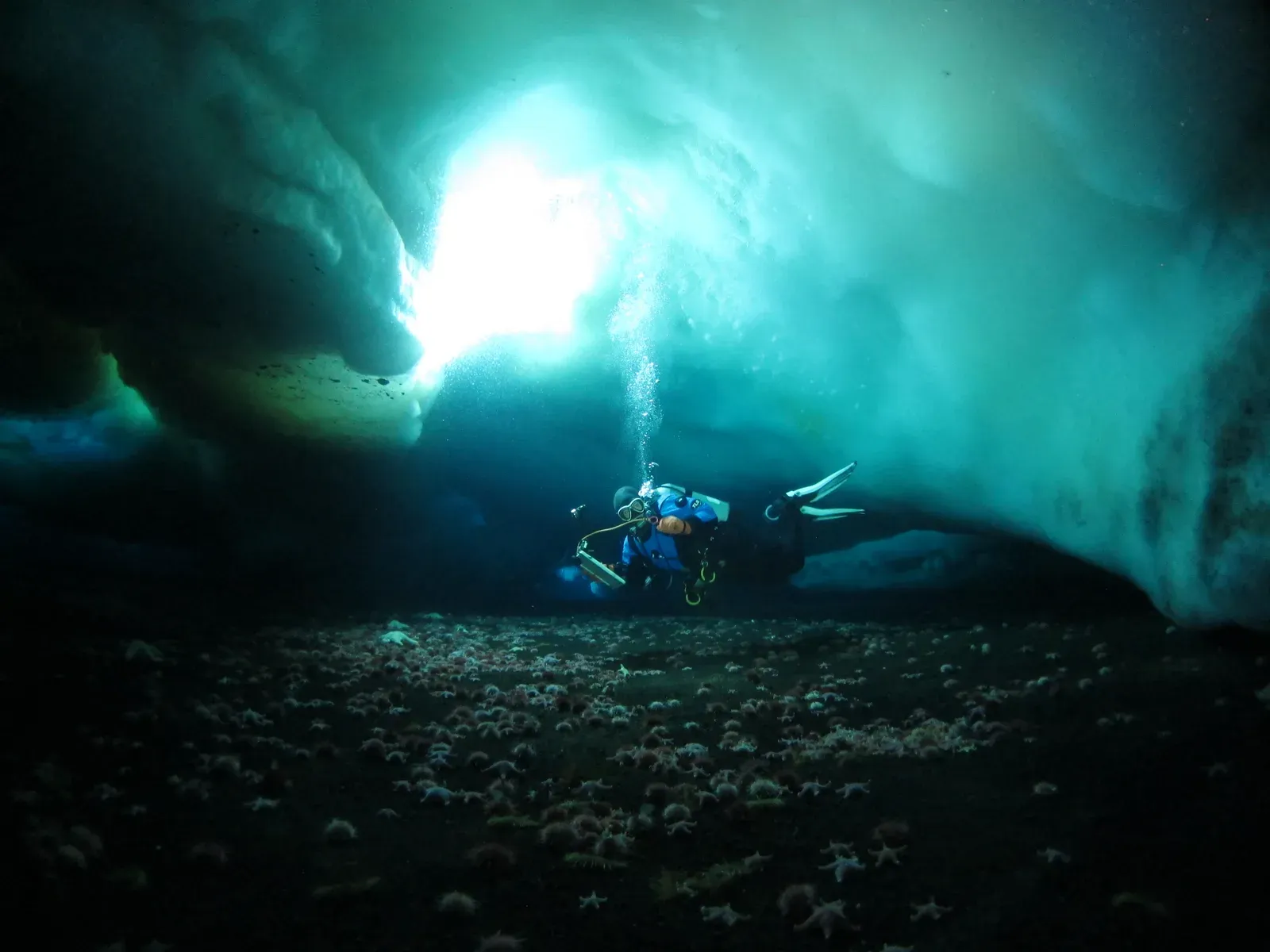
A dive with a ceiling
Every other dive on this site ends the same way: you go up. An ice dive is the one where you cannot, or not wherever you happen to be. Once a lake or a bay has frozen over, the surface is a lid, and the only place it opens is the hole the team cut that morning. That makes ice diving a form of penetration diving, the same family as caves and wreck interiors, with the same defining rule: there is one way out, and the entire dive is organised around never losing it.
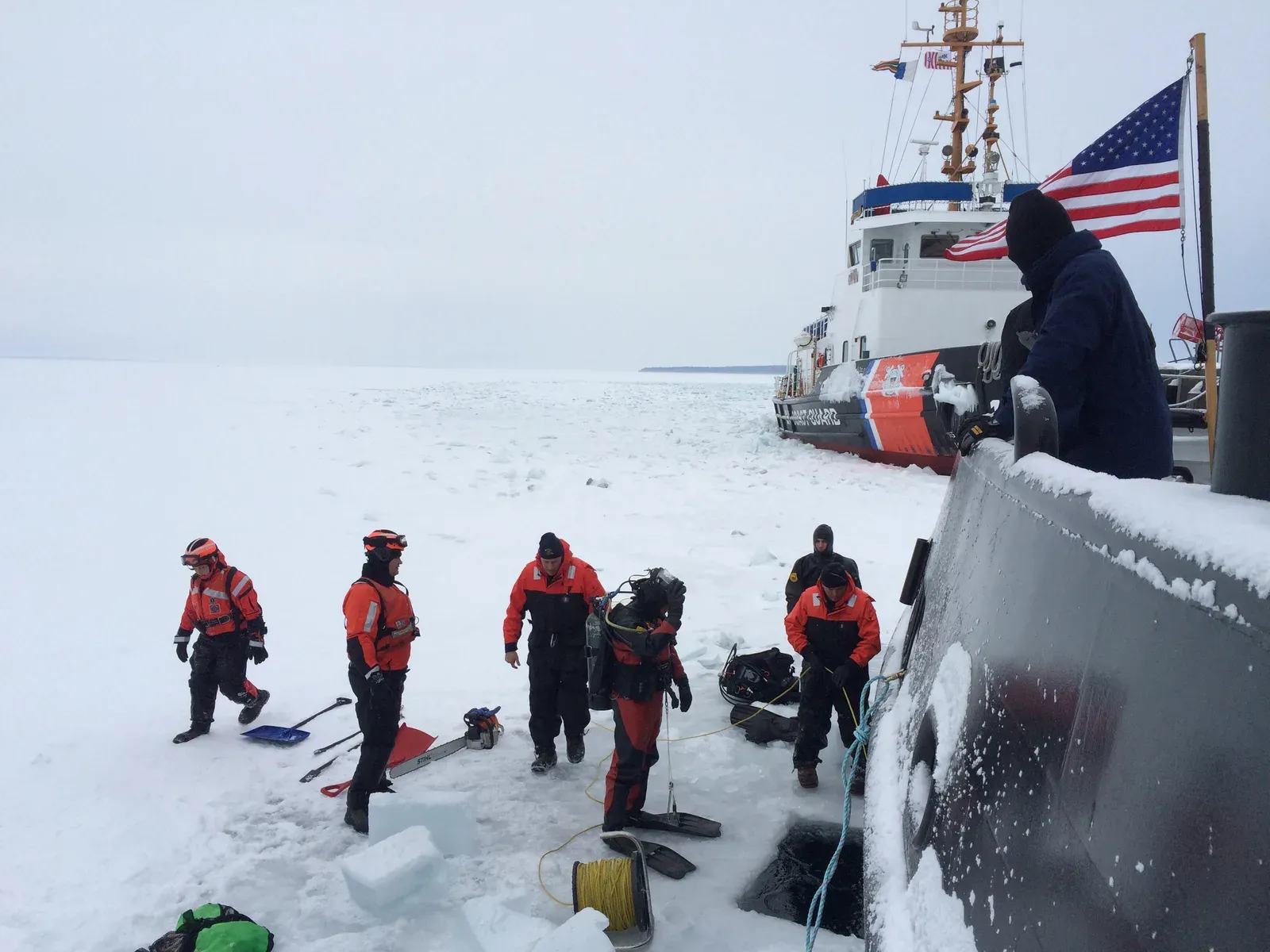
The hole is cut with an ice saw or a chainsaw after the snow has been shovelled off, and the blocks are lifted clear. Beside it the team sets up somewhere out of the wind to kit up, because the air is usually far colder than the water. Then comes the part that distinguishes the dive from anything else in recreational diving: the diver puts on a harness, a line is secured to it, and the other end of that line is held above the surface by a tender who never lets go of it.
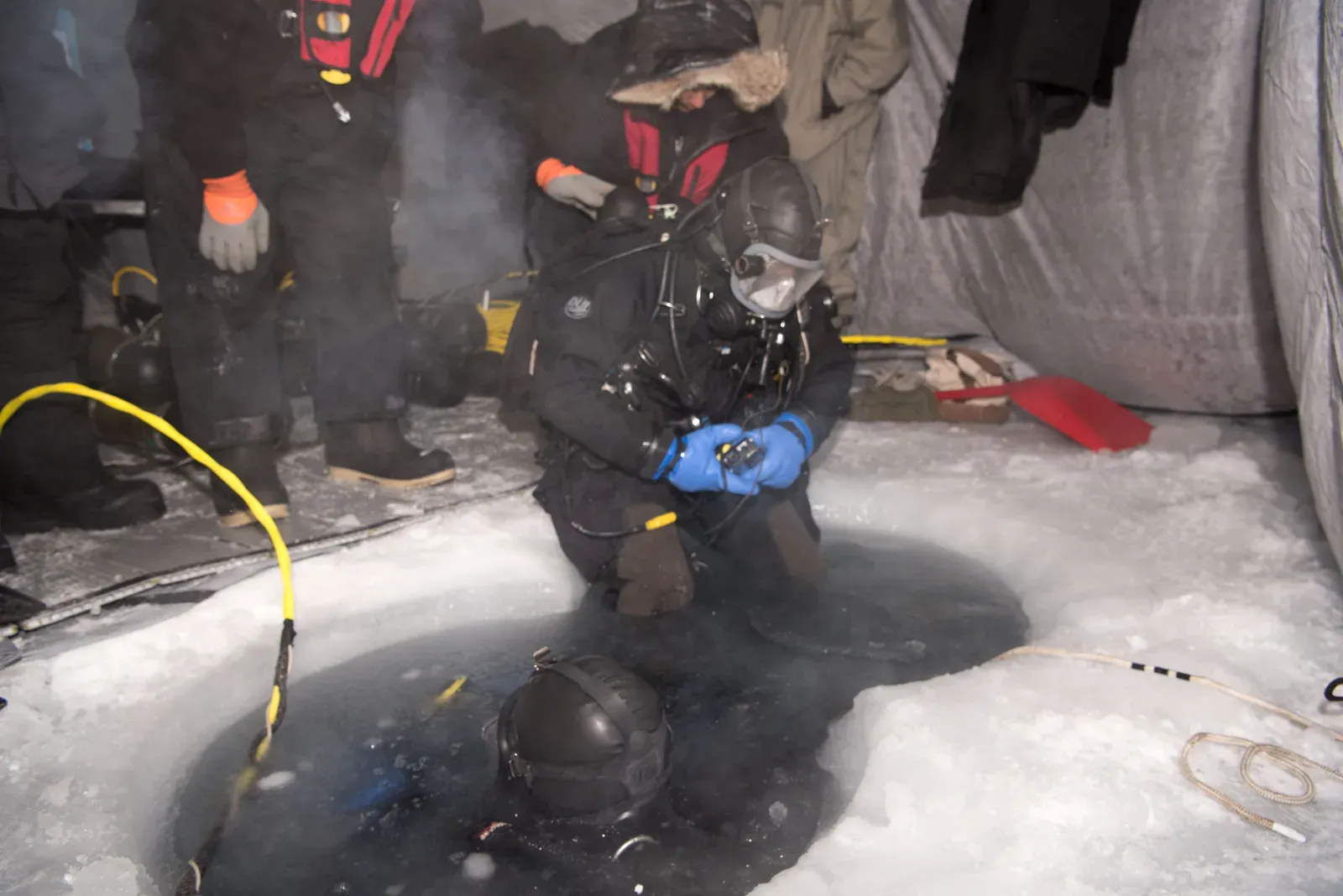
The tender’s job is not decorative. They pay line out as the diver swims away and take it in as they come back, so it never goes slack enough to tangle, and they talk to the diver through it in pulls. One agreed signal, usually five or more tugs, means pull me back to the hole now. If the regulator fails or the visibility goes, the line is the dive plan. Some teams run a fixed guideline from the hole instead, cave style, and follow it back, but that asks for guideline training and is the less common choice for sport divers. Professional teams add a standby diver, kitted and waiting at the hole.
Because a tender is doing half the work, ice diving is a team activity in a way most diving is not, and the training reflects it. One agency’s ice-diver course teaches the roles and responsibilities of the support crew, the tenders and the safety divers alongside the dive itself, and it takes divers from Advanced Open Water and age 18. The course is not a formality. The people on the surface are the ones who bring you home.
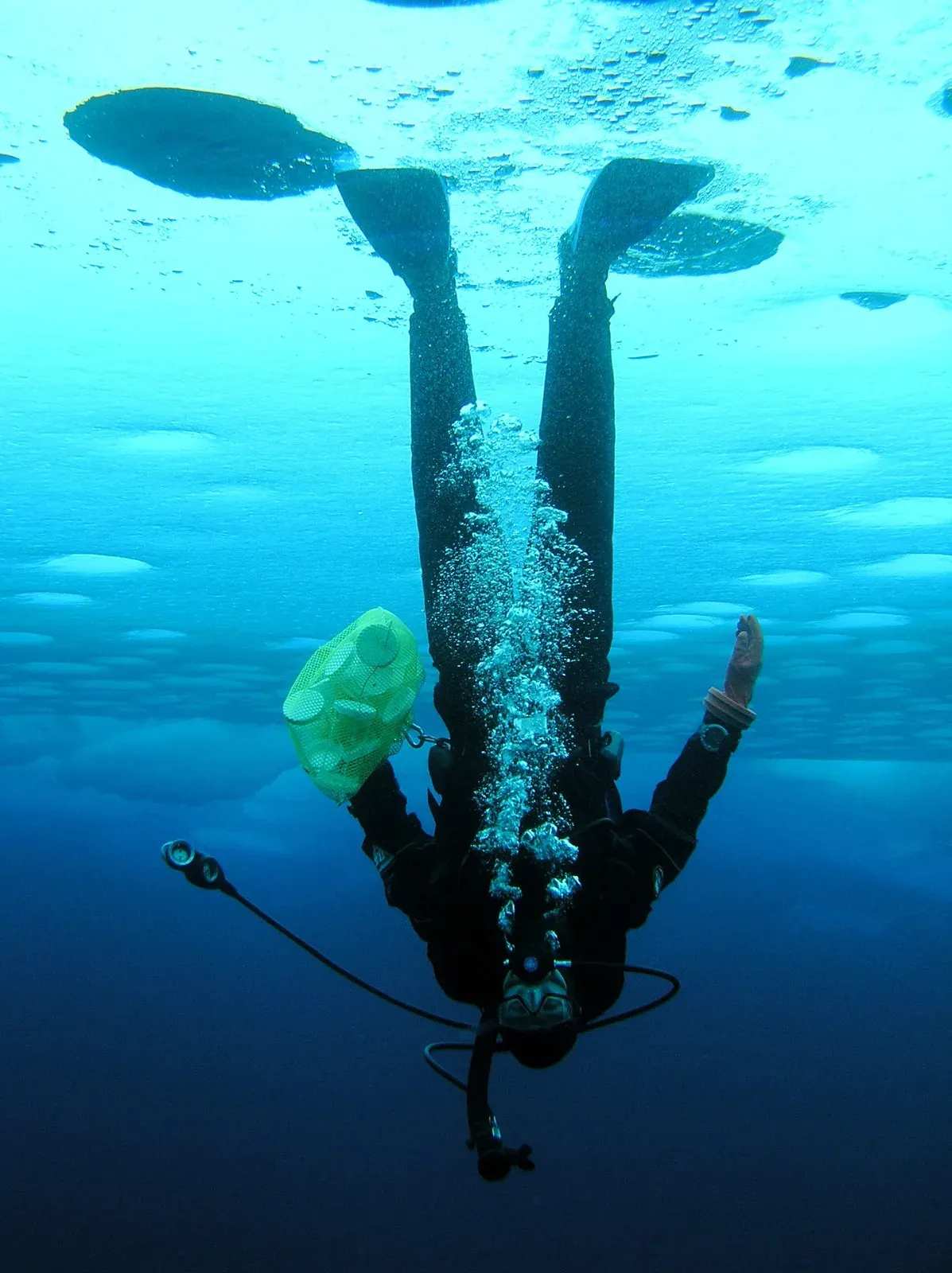
The reward for all of this is a place that behaves like nowhere else. The underside of the ice is a ceiling you can push off and stand on, upside down, with your fins against it. Every breath you let go collects there in silver pools that shiver when you touch them. Light comes through the ice as a blue glow, and the hole is a bright disc you can see from a long way off, which is the whole point of keeping it in sight.
Warmer below: fresh ice and sea ice
Here is the thing nobody expects on a first ice dive in a lake: the water gets warmer as you go down.
Fresh water is at its densest at 3.98 °C (39.2 °F), not at freezing. Cool a lake below four degrees and the colder water becomes lighter, not heavier, so it floats. By the time the surface reaches zero and freezes, the lake has sorted itself into a column with the coldest water touching the ice and the warmest water the lake can hold, up to four degrees, lying some distance below. Descend from the hole and you leave the coldest water behind. Lake Baikal, the largest freshwater lake on earth by volume and one of the classic ice-diving destinations, is described exactly this way: once the ice is on, the temperature slowly increases with depth, coldest near the ice at around freezing.

Embed this diagram
<figure>
  <img src="https://reefwander.com/og/diagrams/under-ice.svg" alt="Where water freezes and where it is densest, against salinity. Fresh water is densest at 3.98 °C, so under a frozen lake the warmest water sinks to the bottom; the two lines meet at 24.6 g/kg, and past that, in the White Sea and the open ocean, the water under the ice is at the freezing point through the depths a diver uses." loading="lazy">
  <figcaption>Diagram by Reefwander, licensed under CC BY 4.0.</figcaption>
</figure>
Sea ice does not do this, and the reason is salt. Dissolving salt in water pulls the temperature of maximum density down faster than it pulls the freezing point down. At 24.6 g/kg of salt, the two lines meet. Anything saltier than that never reaches a density maximum while it is still liquid: it just keeps getting heavier as it cools, the heavy water sinks, the column turns over, and the whole thing ends up at the freezing point before any of it can freeze. Ocean water at 35 g/kg freezes at about −1.9 °C (28.5 °F), and under sea ice that is the temperature of the water at the ice and through the depths a diver uses, with nothing warmer to descend into.
The dive feels different because of it. Under a frozen lake the coldest minute is the first one, at the hole, and the deeper part of the dive is a degree or three kinder. Under sea ice there is no kinder part. Two degrees below zero at the ice is two degrees below zero for the whole dive. Sea ice removes the one comfort a frozen lake offers, and the kit and the drills in the next section apply under both.
That crossing salinity turns out to matter for real places. The open Baltic runs 3 to 9 g/kg at the surface, brackish enough that a frozen Baltic bay behaves like a lake: our model still puts its warmest water about three degrees above the water at the ice. The White Sea, another of the traditional ice-diving grounds, sits at 24 to 26 parts per thousand in its centre, almost exactly on the line, and its winter water is reported at −1.3 to −1.7 °C in the middle and −1.9 in the north. It is a sea, and it dives like one. Our guide to the layered sea goes through what that same density curve does to a diver’s buoyancy in summer.
The kit that freezes
Water conducts heat away from a diver about 23 times faster than air does, which is the subject of why the water steals your heat, and there is no wetsuit answer to water at zero; our suit-thickness guide runs out of chart before it gets there. A drysuit with proper undergarments, a hood, dry gloves and often a full-face mask are the standard, and the exposure kit is the least of the problems. The interesting failures are mechanical.
The regulator. Gas expanding through a regulator’s first stage cools, and in cold water that cooling can freeze the mechanism. The reference on the subject is blunt about the trigger: in water colder than 10 °C (50 °F), purging a regulator underwater for a few seconds, or using it to fill a lift bag, will start many regulators free-flowing, and they will not stop until the gas supply to them is shut off. A frozen-open second stage can empty a cylinder in minutes, and a first stage frozen open can only be stopped by shutting the cylinder valve. The same source lists the factors that make it worse: high cylinder pressure, high breathing rate, depth. Breathing calmly at a moderate rate is protective, and everything that spikes the flow, a purge, a shared regulator, a hard swim, is not.
The response is procedural rather than clever. The standard advice is a fully redundant second regulator on its own first stage. When one freezes and free-flows, the diver shuts the valve feeding it, switches to the other, and the dive is over: the frozen one is left to thaw. Some divers fit a sliding shut-off between hose and second stage for the same reason. If you are on a tether, the emergency signal goes up the line while you sort it out, and the tender does the rest. The Svalbard ships put it in their prerequisites, asking for two freeze-protected regulator sets per diver before you board.
The inflators. The valve that puts gas into a drysuit or a wing can freeze for the same reason, and if it freezes open it inflates you towards a ceiling made of ice. The drill is to disconnect the low-pressure hose while dumping gas, which is why ice divers practise finding that connector with numb hands, and why a weight belt is worn with two buckles or replaced by a harness: a dropped belt under ice is an uncontrolled ascent into a solid lid, and the standard training includes how to hit that lid if it happens.
The hands, and the surface. Wet kit freezes the moment it meets the air. Zips jam, the rings on dry gloves lock, a regulator left out of the water frosts. The surface team is colder than the divers and has its own hazards, from thin ice to a slip in fins on a polished surface. Buoyancy control, meanwhile, is the skill polar diving experience has shown to be the one that actually decides safety under ice, because the ceiling punishes an ascent the way a sea floor never does.
Drift ice at Shiretoko
Most ice diving happens through a hole in fast ice, the lid frozen to a shore. Shiretoko, on the Sea of Okhotsk coast of Hokkaidō, is the famous exception: there the ice arrives.
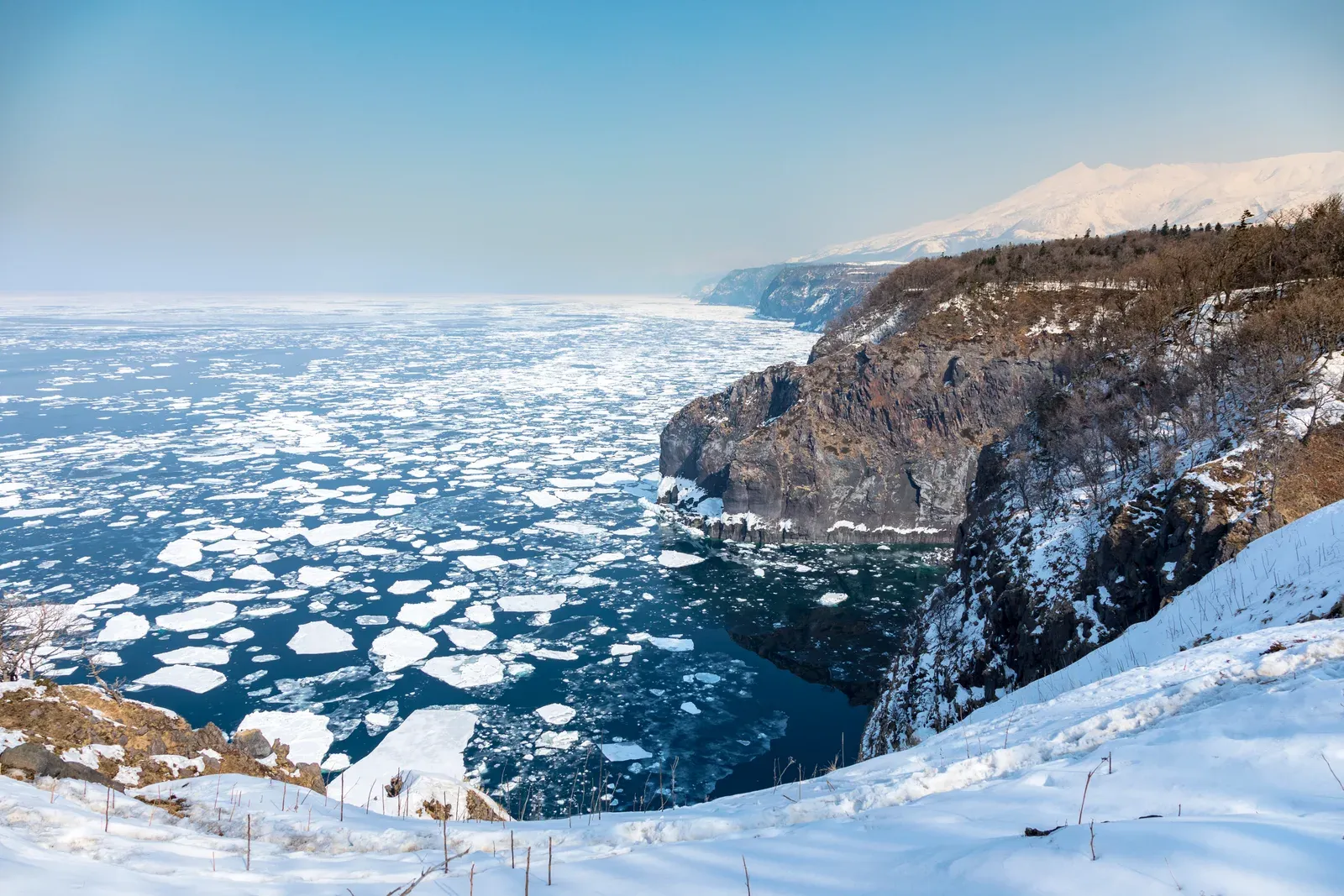
The Sea of Okhotsk is the southernmost sea in the Northern Hemisphere that freezes every year. Its ice forms in the north-west under Siberian air, and in winter the currents carry it south until it jams against the west side of the Shiretoko Peninsula, at 43° north, the lowest latitude on earth where sea ice forms regularly. That ice is why the peninsula is a World Heritage site: UNESCO’s listing credits the seasonal sea ice with the productivity of the whole ecosystem, from the plankton bloom it feeds in spring to the salmon and the bears. On the Okhotsk coast the ice is normally first sighted from shore in the middle or the second half of January and reaches the beach between late January and early February; the sightseeing icebreakers run from mid-January to the end of March.
The dive is done from a beach or a short boat run at Utoro, everyone tethered, under whatever the ice is doing that day: loose pans with light between them, or a solid sheet that closes the dive down to a dim vault and makes the line the only reliable way back. The area record puts the water at −1 to 4 °C with eight to 20 m of visibility. The reason to be there is small. Clione, the sea angels, are shell-less pelagic snails a couple of centimetres long that hunt the shelled sea butterflies drifting beside them, and under Shiretoko’s floes they are the target, worked with a torch and a close-focus lens. The underside of the ice grows algae, amphipods gather on it, and spotted seals, which raise their pups on the Okhotsk floes, occasionally pass beneath; most seal sightings are from the surface.
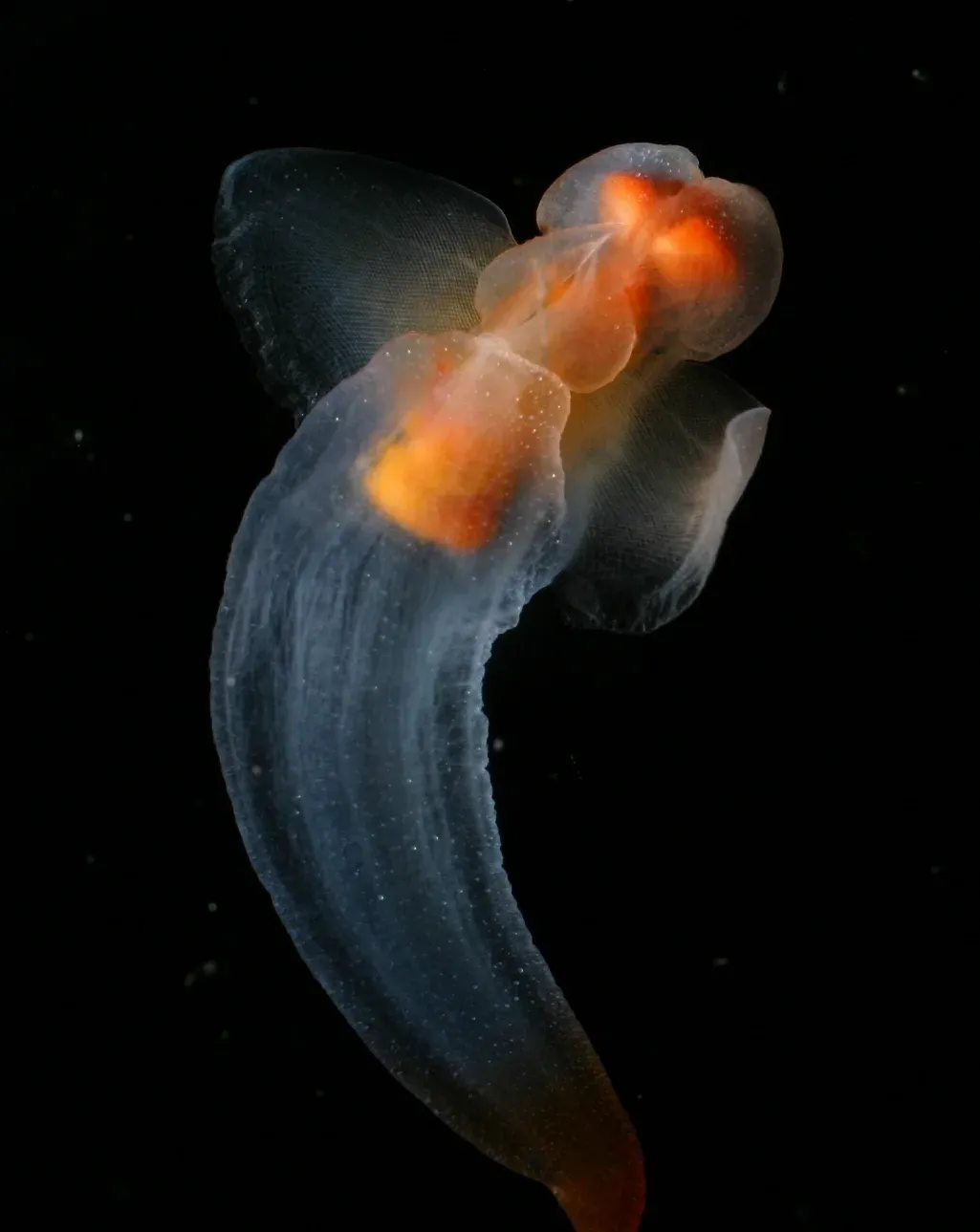
Two honest cautions. The season is a window, not a calendar: drift ice only reaches the coast when the currents and the wind deliver it, and outside that window the dive does not exist. And moving ice is its own hazard, separate from the cold, because floes shift with the wind and the gap you came in through can close. The Sea of Okhotsk has warmed in places by as much as 3 °C since pre-industrial times, faster than the global average, and warming inhibits the ice. The window is not getting longer.
Lakes and the Baltic
The bulk of the world’s ice diving happens where the summer’s dive sites freeze over in winter, in North America and northern Europe, on ordinary lakes with ordinary dive clubs. Few people travel for them, which is why they are easy to overlook, and why the famous names are the ones with mountains or a border attached.
Lake Baikal in Siberia is the extreme case. It is ice-covered from early January to early May or June, the ice reaching 0.5 to 1.4 m (1.6 to 4.6 ft) and more than 2 m where it has been pushed up into hummocks; by the tourist season, from mid-January to mid-April, it carries vehicles. The ice itself is clear to about a metre. It is also the lake that shows the inverted temperature column of the section above, coldest at the ice and warmer beneath.
In the Alps the model is the resort lake. At Tignes in France, divers use the lake for ice diving in winter under professional supervision, and an ice-diving school that trains polar expedition divers is based there. Weissensee in Carinthia, at 930 m, freezes over completely in winter and is better known for its speed skating, and for having hosted the first underwater ice hockey world championship in February 2007, which tells you what the ice is like.
Then there is the Baltic, which as we said above is close enough to fresh water to behave like a lake under ice. The Gulf of Finland is one of the freshest arms of it, diluted by the Neva, which supplies two thirds of its river water, and parts of it freeze from late November to late April, from the east westwards, with complete freezing usually by late January and not at all in a mild winter. The gulf’s summer draw is its wrecks, and one of the shallow ones, the Kronprins Gustav Adolf, lies at about 20 m off Helsinki inside an underwater park. Our area notes put the gulf’s ice diving in February to April, once the sea has frozen hard enough to stop the boats, but no site record of ours describes an ice dive there and we will not invent one. Further west, between Finland and Sweden, the Åland archipelago is one of the regions the reference literature names for ice diving.
Two of our other Baltic and Norwegian areas carry the ice tag for a narrower reason. Bornholm’s notes say only that the Baltic can ice over in hard years, and that late winter gives the clearest water; the Arkona and Bornholm basins around it are the saltiest part of the Baltic surface, at 7 to 9 g/kg, still well under the line. Narvik’s notes say winter diving happens under the polar night with heavy ice on the fjord edges. Neither is an ice-diving destination in the sense of this guide, and we do not present them as one.
Icebergs and glaciers are a different dive
Diving among ice is not the same as diving under it, and it is worth keeping the two apart when you plan.
At Bell Island in Newfoundland, icebergs drift into Conception Bay early in the season, best in June, and the operator’s charters run from 4 May to 11 November. The wrecks are the point, and the ice is a hazard as much as a spectacle: the Saganaga, torpedoed in 1942 and lying between 18 and 26 m, sits shallow enough to be in the path of icebergs drifting through the bay, and the record says to check the day’s ice with the charter rather than assume the site is on. Nobody dives under an iceberg on purpose. They roll.
The polar ship trips are the same idea at the two ends of the earth. Svalbard’s Kongsfjorden, Hornsund and Smeerenburgfjorden are glacier-front dives from expedition tenders in the June-to-September summer, in water of −2 to 6 °C, worked well clear of any calving face among grounded and drifting blocks rather than under one, and every one of them asks for thirty logged drysuit dives and two freeze-protected regulator sets. On the Antarctic Peninsula, ships reach Paradise Harbour only in the austral summer, but the tidal current there keeps the bay from freezing even in winter, moving the ice through at up to 3 knots: open water and loose ice, the dive decided on the morning from where the ice happens to be, in water of −1 to 2 °C. This is ice diving in the sense that the water is at the freezing point and the regulators are chosen accordingly. It is not diving under a lid.
| Site | Depth | Current | Level | Best months |
|---|---|---|---|---|
| Kongsfjorden Svalbard · Norway | to 20 m | Mild | Advanced | Jun–Aug |
| Hornsund Svalbard · Norway | to 20 m | Mild | Advanced | Jun–Aug |
| Smeerenburgfjorden Svalbard · Norway | to 20 m | Mild | Advanced | Jun–Aug |
| Paradise Harbour Antarctic Peninsula · Antarctica | to 20 m | Moderate | Advanced | Dec–Feb |
| SS Saganaga Bell Island & Conception Bay · Canada | 18–26 m | Mild | Intermediate | Jun–Aug |
Our cold-water guide covers those ship trips in full, along with what a drysuit costs you and where to learn to use one. The freshwater guide covers the lakes in summer, when the same water is a training pond again.


