Why you cannot tell where it is coming from
Every diver has done it: heard a boat, looked up, and found nothing but blue in every direction — then turned a full circle and found the engine had no direction at all. The usual explanation is the one every dive course gives. Sound travels about 343 m/s in air and roughly 1,500 m/s in seawater, some 4.4 times faster, so the tiny delay between a sound reaching one ear and then the other — the cue the brain uses to place things left or right — shrinks by the same factor and the brain loses it.
That is true as far as it goes, but on paper the speed change alone does not erase the cue.

Embed this diagram
<figure>
  <img src="https://reefwander.com/og/diagrams/sound-arrival.svg" alt="The delay between a sound reaching one ear and the other, against its angle off dead ahead, for a 21.5 cm head. In air the delay reaches 627 μs at 90°; in seawater at 1,500 m/s it reaches 143. The dashed line is the 10 μs the brain can resolve — even the water curve peaks fourteen times above it." loading="lazy">
  <figcaption>Diagram by Reefwander, licensed under CC BY 4.0.</figcaption>
</figure>
Your ears are about 21.5 cm apart, and a sound from directly beside you has that much further to travel to the far ear: 627 microseconds at the speed of sound in air, which is why the localisation literature quotes a maximum delay in the 600s. In water the same path takes 143 microseconds. Small — but the brain can detect a difference between the ears of just 10 microseconds, so the water figure is still fourteen times above the threshold. The finest angle the timing cue could resolve in front of you goes from about 0.9° in air to 4° in water. Divers do far worse than any of that. When Feinstein tested them in the 1970s, the smallest angle they could reliably tell apart was 21.5° for a 3.5 kHz tone and 9.8° for white noise, improving with training to 11.3° and 7.3°. Those are angles for real stimuli, not for the bare timing cue the calculation isolates, so the honest comparison is the one Feinstein drew himself: he “determined that sound localization underwater is on average around three times poorer than comparable studies conducted in air.”
So the speed of sound is not the whole story. The rest of it is how you hear underwater at all.
Your skull is the ear
In air, hearing is a chain of impedance matching. The outer ear catches sound and funnels it to the eardrum; the eardrum and the three tiny bones behind it are a lever system built to pass vibration from thin air into the fluid of the cochlea. It works because your head is a hard, dense object in a thin medium: sound bounces off it and pours into the two small holes.
Water removes the whole arrangement. As Casper and Babina put it in their survey of the field, “The acoustic impedance of the human head is very similar to that of water, which is unsurprising because most human soft tissues are close to 80% water. When surrounded by air, the high acoustic impedance of our heads reflects most sound energy, whereas underwater, sound travels through our heads instead of being reflected off them.” The ear canal is now full of water and the middle ear is still full of air, so the eardrum sits on the wrong side of a water-to-air mismatch and does almost nothing. “Instead, sound energy is conducted through the skull directly to the ossicles and cochlea.” You hear underwater by bone conduction: the whole head vibrates, and the cochleae ride along.
The evidence for this is old and rather elegant. Hollien and Brandt plugged divers’ ear canals in 1969 and found their underwater hearing thresholds “were no different between tests with and without ear plugs.” The plugs trapped air, so they moved the water-to-air mismatch rather than removing it, but the result points the same way. Smith, testing US Navy divers the same year, found that “the divers with reduced bone conduction thresholds also had reduced underwater hearing thresholds.” And Hollien and Feinstein showed that a neoprene hood raises thresholds significantly even when tubes keep the ear canals open to the water — a hood does not block the ears, it damps the skull. Depth, incidentally, made no measurable difference: Hollien and Brandt “failed to find a significant difference of thresholds for depths ranging between 3.7 m and 32 m.”
There is a cost in sensitivity, too. Reviewing seventy-odd years of studies in tanks, ponds and springs, Casper and Babina conclude that underwater hearing is “around a 30-60 dB” less sensitive than in air, with a U-shaped curve — best between 500 Hz and 1 kHz, worsening quickly above 10 kHz. The benchmark thresholds still used today come from British work in the 1990s (Al-Masri; Parvin and Nedwell), done in a tank isolated to a background of about 44 dB re 1 µPa, which produced thresholds “15-20 dB lower at many frequencies” than anything before them. The scatter between earlier studies tells you how hard the measurement is; the range is honest, a single number would not be.
The speed of sound, and why it barely matters to you
The 1,500 m/s figure is a round number. The real value comes from an oceanographer’s fit — Mackenzie’s 1981 equation, nine terms in temperature, salinity and depth — and it moves with the water you are in: 1,466 m/s at 4 °C, 1,534 at 25 °C, 1,545 at 30 °C. Forty metres of depth adds 0.65 m/s. Five extra grams of salt per kilogram, the Red Sea’s surplus over the open ocean, adds about 5 to 6. From 2 °C to 30 °C, which covers everything from cold-water diving to the tropics, the ratio to air stays between about 4.25 and 4.5, so nothing in the localisation story changes from site to site. Where the speed does matter is at the seams: sound bends towards slower water, so a thermocline refracts sound the way glass refracts light, and a sharp enough density step reflects part of it as well. Between them, that is why submarines like to sit beneath one, and one reason a boat’s engine can fade and swell as you cross the layer.
What the speed also does not change is how loud you are to yourself. “There is one kind of noise that divers cannot avoid: the sound of their own breathing. The bubbles produced during respiration in Scuba and surface-supplied air are quite noisy” — noisy enough that subjects in hearing tests are made to hold their breath, and, the same authors note, one of the reasons the rebreather was developed. Every exhalation leaves the regulator a few centimetres from your jaw, which is why your own breathing is the one sound on a dive you can never get away from.
What the sea keeps, and what it throws away
Now the other half of the question: why an engine or a whale is audible for kilometres while your buddy’s tank banger barely crosses the reef. Seawater absorbs sound, and it absorbs it with a violent preference for high frequencies. The standard description is Thorp’s formula — an empirical fit that sums the relaxation losses of boric acid and magnesium sulphate dissolved in the sea with the viscosity of the water itself. It circulates in more than one form: everything here uses the four-term version reproduced by Lucani, Stojanovic and Médard, which keeps a small low-frequency floor that the older two-term version leaves out, and below a few hundred hertz the two disagree by a lot. Either way the shape of the story is the one told by why the sea is blue: the medium takes one end of the spectrum and lets the other through.

Embed this diagram
<figure>
  <img src="https://reefwander.com/og/diagrams/sound-reach.svg" alt="What seawater absorbs from each sound per kilometre, on log scales, with the distance absorption alone takes to remove 20 dB. A blue whale’s 20 Hz call keeps going for thousands of kilometres, a 2 kHz tank banger for 148 km, a dolphin’s 40 kHz clicks for 1.5. Below about 100 Hz the formula is extrapolated, so read the lowest bars as orders of magnitude. Absorption only: spreading loss, not drawn, is what limits sound at the ranges a diver cares about." loading="lazy">
  <figcaption>Diagram by Reefwander, licensed under CC BY 4.0.</figcaption>
</figure>
Read the chart from the bottom left. A blue whale’s 20 Hz call loses about three thousandths of a decibel per kilometre to absorption, so losing 20 dB takes thousands of kilometres; so does the low hum of an engine at 100 Hz. Down here the formula is at the edge of what it was fitted to, and its versions disagree, so read those two bars as “thousands” rather than as exact figures. A low humpback note at 300 Hz has about 1,530 km. Then the curve turns upward. By 1 kHz — the whine of an outboard’s higher harmonics — 20 dB is gone in 290 km; a tank banger’s clang, taken here as 2 kHz, in 148; a higher humpback note at 3 kHz in 100; the peak of a snapping shrimp’s crackle at around 4 kHz in 71. A dolphin’s echolocation clicks, up at 40 kHz, are down 20 dB in 1.5 km. From one end of the chart to the other is a difference in reach of thousands of times, and it is the reason the ocean sounds the way it does: whales, ships and surf are the low notes, and the low notes are what survives.
Two honesty clauses. The frequencies for the engine, the humpback notes, the tank banger and the shrimp are representative picks, not measurements: humpback song runs from about 20 Hz to above 20 kHz — an engine has harmonics right across the chart, a knock on aluminium is broadband, and a shrimp’s snap is a broadband click that merely peaks somewhere in the low kilohertz. And the chart is absorption only. At the ranges you can actually see, absorption is nothing: a tank banger 30 m away has lost 0.004 dB to the water and 29.5 dB to plain geometric spreading, the sound weakening as it spreads over an ever-larger sphere. At a kilometre, spreading has cost 60 dB and absorption 0.13; at ten kilometres, a humpback’s 300 Hz note has spent up to 80 dB on spreading — less in shallow water, where the sound is trapped between surface and seabed and spreads as a cylinder rather than a sphere — and still only 0.13 on absorption. Spreading limits every sound a diver makes. Absorption decides which sounds the ocean can make carry — and that is a low-frequency privilege.
Whales, engines and shrimp
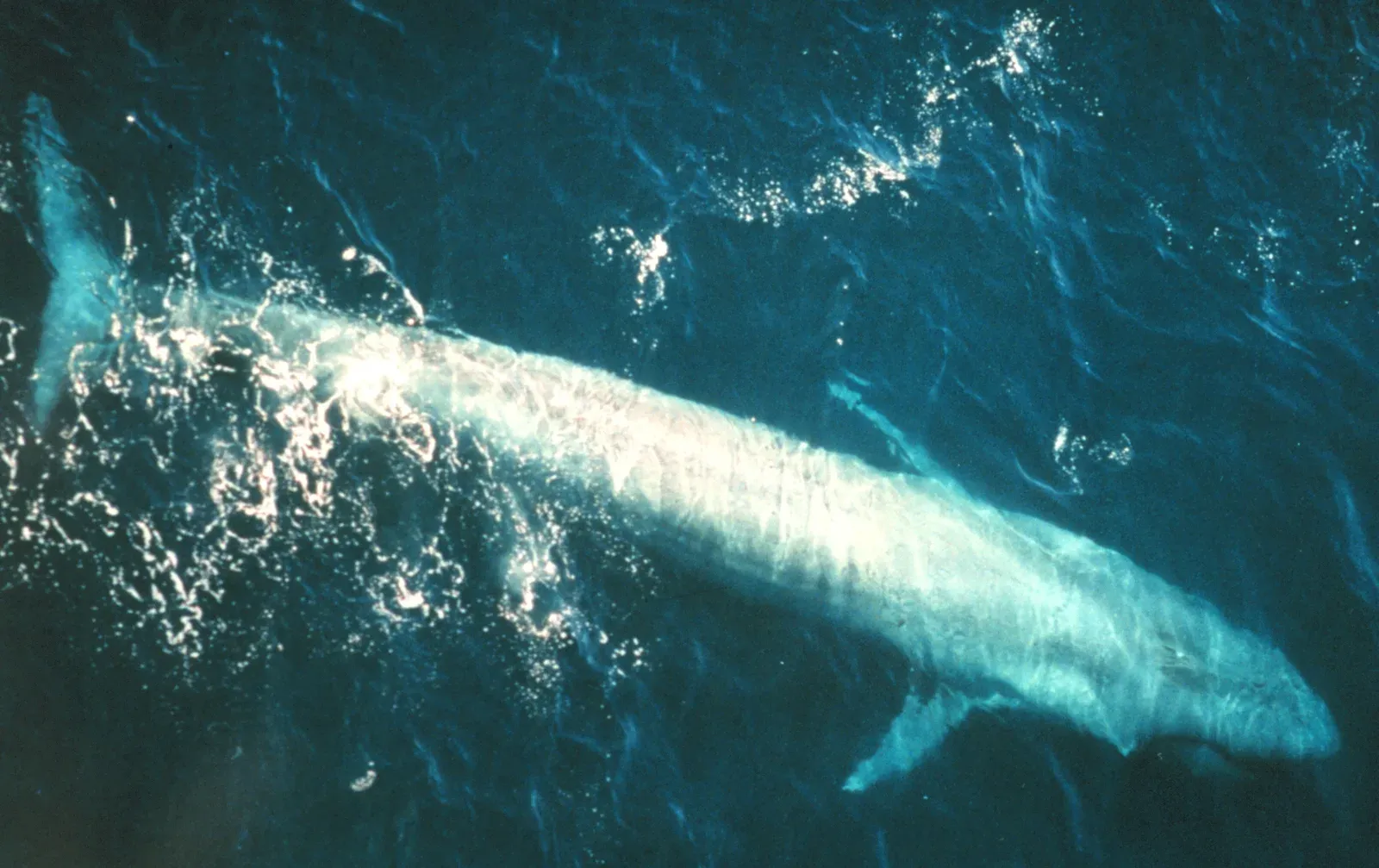
Humpback song ranges “from 20 Hz to upward of 24 kHz”, and the sounds of baleen whales as a group run “from 10 Hz to 31 kHz”; blue whale moans are catalogued at 155–188 dB re 1 µPa at a metre, fin whale moans at 155–186. Combine those source levels with the absorption floor at the bottom of the chart and you get the finding associated with the Cornell acoustician Christopher Clark: whale calls can travel thousands of kilometres, and before modern shipping a call may have crossed an ocean. Be careful with the scale of that claim, though. It belongs to the deep sound channel, a layer where sound bends back on itself and permits “guided propagation of underwater sound for thousands of kilometers.” A diver at 20 m on a reef is in a shallower, lossier, noisier place. What you hear on a Vava’u wall in August is a whale within kilometres, sometimes tens of them; that is plenty, and it is real. Our Vava’u record says the song “carries into ordinary dives long before anyone spots a blow, though you hear them from a dive rather than meet them on one.” On Niue the whales “pass close enough to hear singing underwater from July through October”, though meeting them in the water there is snorkel-only. And at Bait Reef, a two-tennis-court patch off Trial Bay Gaol, the humpbacks “are very rarely spotted underwater, but whole dives can be made to the accompaniment of male humpbacks singing.” Where you are allowed to get closer than a song is a separate matter, covered in swimming with whales.
Scuba Diving Molokini Crater Maui Hawaii · Nick Vanderbilt on YouTube
Engines sit on the same low-frequency shelf as whales, and add the localisation problem on top. A boat’s propeller and diesel put most of their energy in the tens and hundreds of hertz, the part of the chart where absorption is negligible, so a working boat is audible across a bay; and because your skull receives it as one signal in both cochleae, it has no direction. It is why the rule in our records at Torre de Malpique — “Boat traffic passes over the site, so carry a surface marker and listen carefully before ascending” — and at Japanese Garden, where snorkelling and glass-bottom boat tours “run directly over the reef, so ascend along the coral rather than in open water and listen before surfacing.” Listening tells you a boat exists. It does not tell you where, which is what the surface marker and the reference line are for. At Ponta da Piedade the “heavy boat traffic over the headland keeps the site to the low season”, and Cueva de los Órganos, where divers surface briefly in an air-filled cave, is best dived “in the low season, when boat traffic is light.” The contrast is a bay like Naama Bay, “a protected area with no boat traffic over it”, where a boat you hear is not one above you.
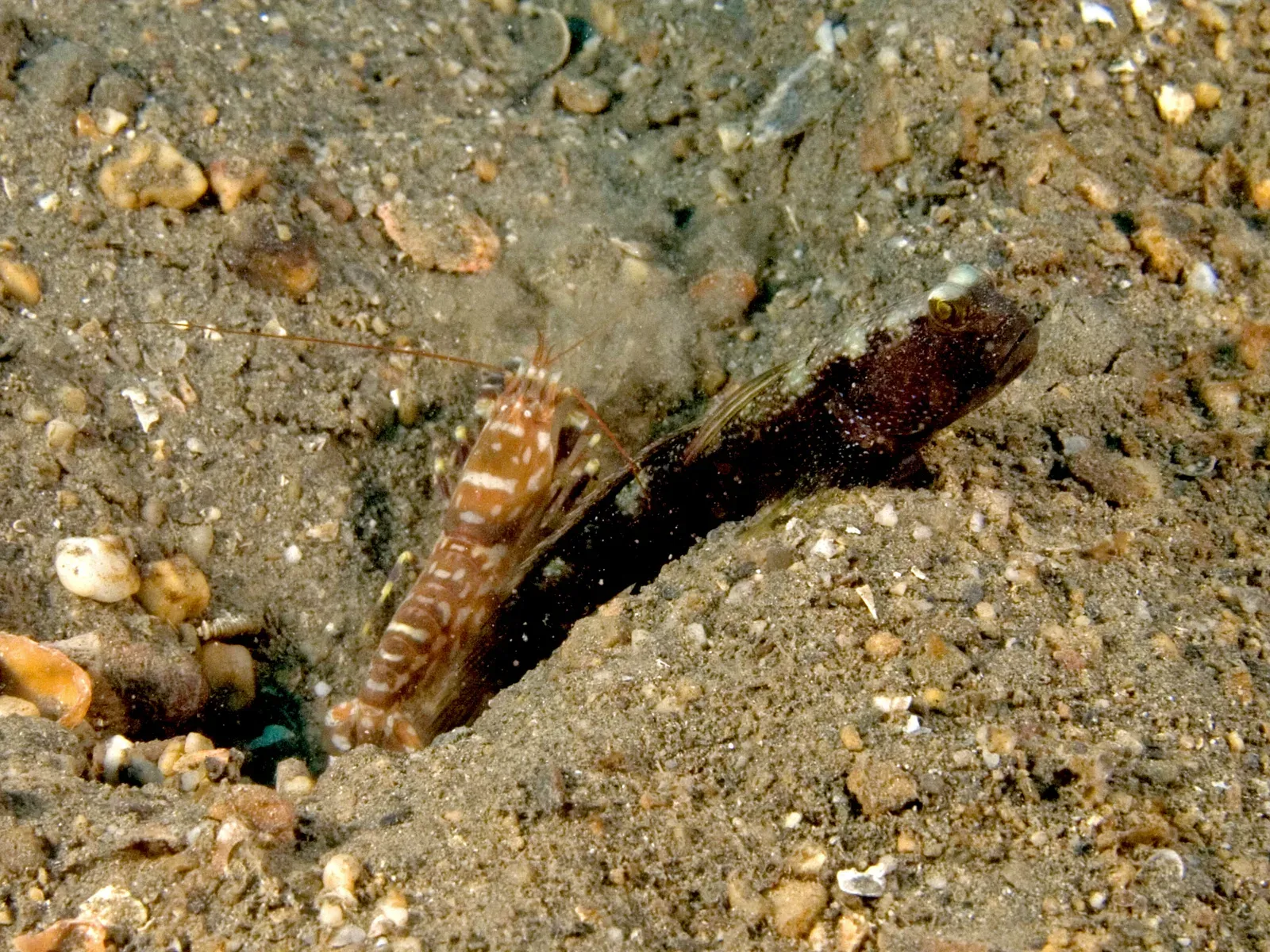
The crackle is shrimp. A snapping shrimp cocks its oversized claw and fires it shut so fast that the jet tears a cavitation bubble open, the bubble leaving the claw at 25 m/s; the bubble’s collapse is the snap — a peak of “218 decibels relative to one micropascal” measured four centimetres from the claw, “equivalent to a zero to peak source level of 190 dB re 1 μPa m”, which sits alongside Au and Banks’ peak-to-peak measurements of 185 to 190. The collapse even emits a faint flash of light: “If the light were of thermal origin, a temperature of the emitter over 5,000 K would be required.” One shrimp is a click. A reef of them is a continuous frying sound loud enough that “the shrimp are a major source of noise in the ocean and can interfere with anti-submarine warfare.” What keeps that a local sound for you is not absorption — at 4 kHz the sea takes 0.28 dB out of a kilometre, against 60 to spreading — but the fact that every snap is a point source. What a diver hears is the shrimp close by. Beneath it all is the thing the chart cannot show: ambient noise from boats has been reported “doubling with each decade, reducing the range at which whale sounds can be heard”.
The signalling kit, and what it can and cannot do
All of this reshapes what dive signalling gear is for. A tank banger — a rubber loop with a hard ball that you snap against the cylinder — makes a sharp knock in the low kilohertz, and a shaker or rattle, a tube of loose beads, makes a distinctive burr that stands apart from a single bang. The chart says a knock like that carries, in principle, for a hundred-odd kilometres before absorption takes 20 dB. The chart is not the limit. Spreading has taken 30 dB inside 30 m, the reef is crackling underneath, a boat may be humming over the top, and — the point of the whole article — your buddy will hear the knock and have no idea which way to look. Bang, wait, then bang again while they turn: the sound gets their attention, and only their eyes find you.
Two things help more than volume. Attention: the diver who checks for a buddy every minute never needs the banger to carry. And knowing what a hood does: it damps the skull by as much as 20 to 30 dB from 500 Hz upward, so a hooded diver hears less, worth knowing on a cold-water boat dive where the briefing says listen for engines. The same researchers call a hood “the only effective method of hearing protection underwater”, since earplugs “have little value” against noise that comes in through the bone, but it does little below 500 Hz, which is where boat engines sit.
The electronic backstop is not acoustic at all. A Nautilus LifeLine is a waterproof GPS beacon, rated by its maker to 425 feet (130 m); opened at the surface it sends your position as a DSC distress alert and an AIS target to any DSC-equipped VHF radio or AIS receiver in range. The maker claims 100 hours of transmit time and a “54 km demonstrated range to an elevated antenna”. An earlier version added a handheld VHF and put “your GPS coordinates on other vessels’ marine radios within an eight-mile radius”. It solves the problem underwater sound cannot: being found once you have drifted out of any range at which a knock on a cylinder means anything.
Where the sea is loud
The ears guide covers what pressure does to the same organ on the way down; this table is about what reaches it once you are there — reefs where whale song is part of the dive, and sites whose records tell you to listen before you surface because the boats are overhead.
| Site | Depth | Level | Best months |
|---|---|---|---|
| Bait Reef South West Rocks · Australia | 5–10 m | Intermediate | Jun–Oct |
| Lua Tofua'a Vava'u · Tonga | 2–8 m | Beginner | Jul–Oct |
| Coral Gardens Vava'u · Tonga | 2–15 m | Beginner | Jul–Oct |
| Snake Gully Niue · Niue | 5–30 m | Intermediate | Jul–Sep |
| Molokini Crater Maui, Molokini & Lānaʻi · United States | 6–15 m | Beginner | Apr–Oct |
| Molokini Back Wall Maui, Molokini & Lānaʻi · United States | to 9 m | Advanced | Apr–Oct |
| Kona Blackwater Dive Kona · United States | to 15 m | Advanced | Dec–Apr |
| Roca Partida Revillagigedo (Socorro) · Mexico | to 40 m | Advanced | Jan–Mar |
| Torre de Malpique La Palma · Spain | 20–45 m | Advanced | Sep–Nov |
| Japanese Garden Aqaba · Jordan | 2–20 m | Beginner | May–Sep |
| Ponta da Piedade Caves Algarve · Portugal | to 12 m | Intermediate | Jun–Sep |
| Cueva de los Órganos Costa Blanca · Spain | 8–30 m | Advanced | Jun–Sep |
| Naama Bay Jolie Ville Sharm El Sheikh · Egypt | 2–40 m | Intermediate | May–Oct |