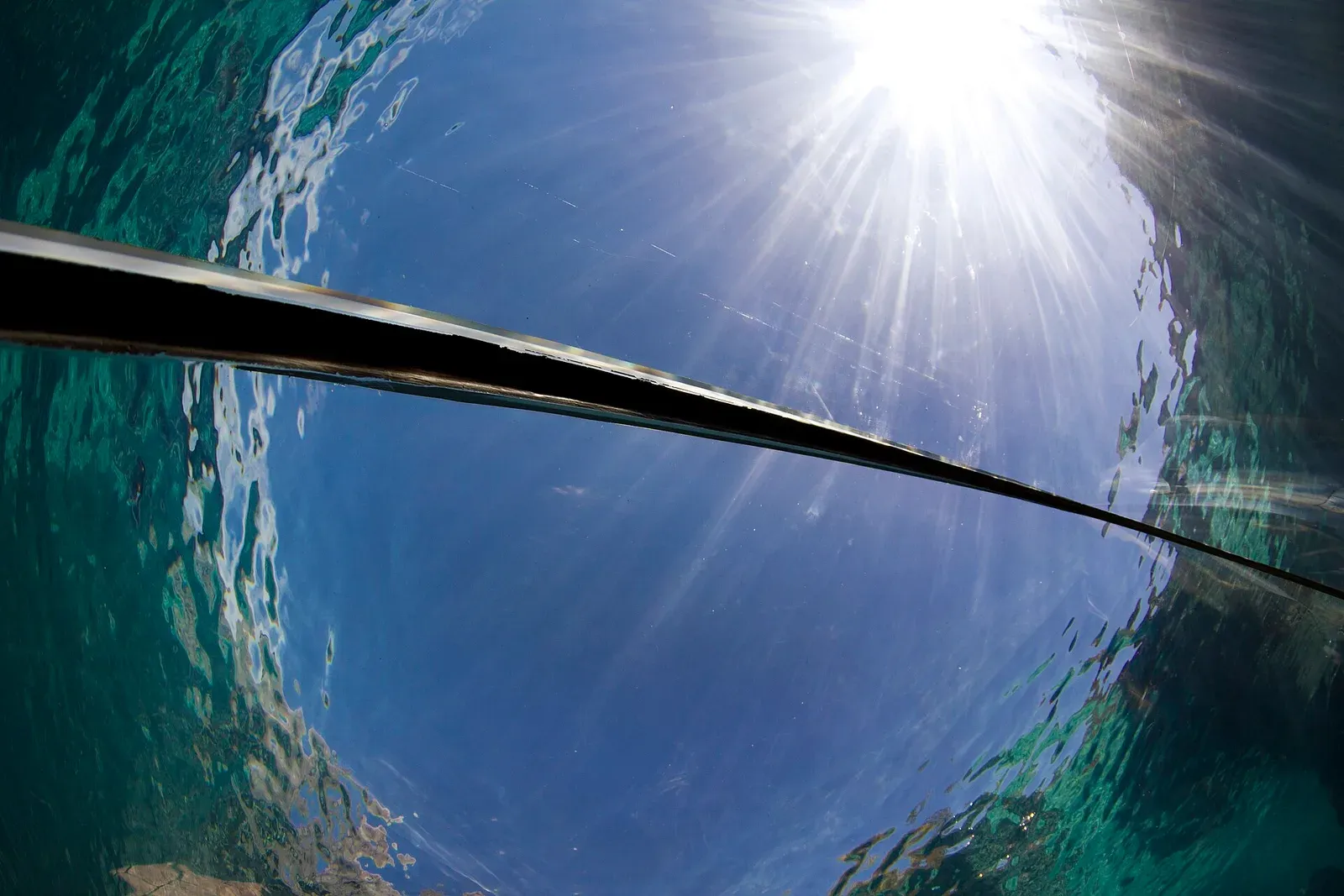
A third bigger, a quarter closer
Put a flat mask on and the sea is rescaled. Everything in it appears about a third larger than it is and about a quarter nearer. The standard figure, from Adolfson and Berghage’s 1974 work on underwater perception, is that “objects underwater will appear 33% bigger (34% bigger in salt water) or 25% closer than they actually are.” Those are not three effects. They are one ratio, read three ways.
The ratio is the refractive index of water: 1.333 for water at 20 °C and the sodium yellow line at 589 nm, the textbook value, and a shade higher, 1.34, for seawater. Light crossing from water into the air behind the glass of a mask bends away from the perpendicular, and for rays near the centre of your view the angle a ray makes with your line of sight is multiplied by that index. A fish subtends 4/3 of the angle it should. A visual system that has spent a lifetime in air has two ways to account for that: either the fish is 4/3 as long as it is, or it is sitting at 3/4 of its real distance. The perception studies find both readings, which is why the rule comes in two halves.

Embed this diagram
<figure>
  <img src="https://reefwander.com/og/diagrams/mask-magnification.svg" alt="A 60 cm fish 3 m beyond the flat glass of a mask, traced ray by ray. In the water it subtends 11.3°; crossing into the air behind the glass the rays bend outward and the eye gets 15.1°, so the fish reads as 80 cm at 3 m — or, the eye’s own guess, a 60 cm fish 2.24 m away. A third bigger in fresh water, 34 per cent in the sea." loading="lazy">
  <figcaption>Diagram by Reefwander, licensed under CC BY 4.0.</figcaption>
</figure>
Trace it for a real fish and the rule holds to the second decimal. A 60 cm fish 3 m beyond the glass sends the rays from its nose and tail in at 5.66° from your line of sight; they leave the glass at 7.55°, so the fish subtends 15.1° instead of 11.3°. Extend the bent rays straight back, as your eye must, and the fish sits 2.24 m away — the small-angle rule, distance divided by 1.333, says 2.25 — and is still 60 cm long. Or keep it at 3 m and it has grown to 80 cm. Which reading you get depends on what else is in view; what never changes is that the two readings are the same 4/3, and that a wall really 1 m away looks 75 cm away.
Why you need the glass at all
Open your eyes without a mask and the sea is a blur, and the reason is the same index. Most of the eye’s focusing is done not by the lens but by the cornea, about 43 dioptres in all, and most of that happens at its front surface. It works only because there is air, index 1.0, pressed against tissue with an index of 1.376. Replace the air with water at 1.333 and the step in index across that surface shrinks from 0.376 to 0.043: the front of the cornea keeps about 11 per cent of its bending, the image forms far behind the retina, and you are profoundly long-sighted. Water, in the textbook phrasing, has “approximately the same refractive index as the cornea (both about 1.33), effectively eliminating the cornea’s focusing properties.” Fish never had the problem: in aquatic vertebrates generally “the cornea plays no role in focusing light, since it has virtually the same refractive index as water.”
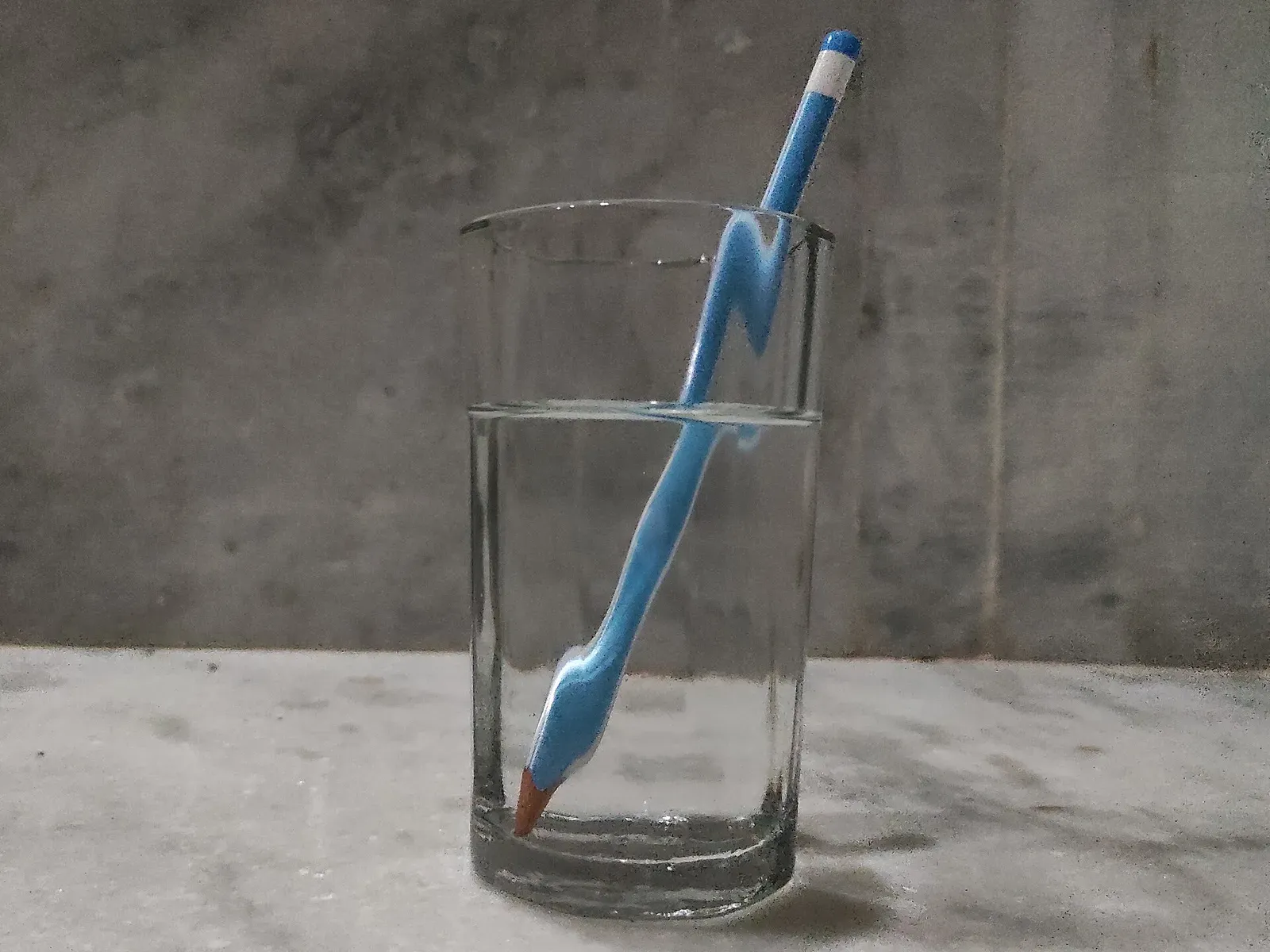
A mask fixes this by putting the air back. The flat window does almost nothing itself — light crossing a parallel-sided plate leaves at the angle it entered — but the pocket of air behind it restores the air–cornea interface, and with it your 43 dioptres. The price is the bend at the outer face of the glass, where water meets air: the same bend that breaks the pencil in the photograph, applied now to everything you look at. There is no way to have the focus without the magnification, unless the window is curved, and we will come to that.
Two ways to be wrong about a fish
Divers are famous for overestimating fish, and the geometry above is only half of that story. The perception literature, going back to Luria and Kinney’s work in the 1970s, separates two regimes: “At very short range in clear water distance is underestimated, in accordance with magnification due to refraction through the flat lens of the mask, but at greater distances - greater than arm’s reach, the distance tends to be overestimated to a degree influenced by turbidity.”
Close in, it is pure optics. The gauge on your chest, the wall of a fissure, a buddy’s hand: all placed at three quarters of their true distance, which is why new divers grab short, and why the walls of Silfra’s Big Crack, which our record puts both within reach at once beside its islands, sit nearer to the eye than the fingertips find them. Judged by size instead, a 1.5 m reef shark reads as 2.0 m. That figure is the same in Silfra’s hundred metres of visibility and in a silty harbour; the index does not care about the clarity.
Further out, contrast takes over. Water scatters and absorbs, the far end of a scene fades, and a brain that uses haze as a cue for distance in air reads a fish seen through a lot of water as further away than it is — and therefore, for the angle it subtends, bigger. “Stereoscopic acuity, the ability to judge relative distances of different objects, is considerably reduced underwater,” and a narrow field of view makes it worse. So the near-field error is fixed at 4/3 and the far-field error floats with the visibility. Neither is a matter of experience or excitement. Both are physics, and both push the same way.
What the mask’s volume does and does not do
Low-volume masks are sold on many things, and magnification should not be one of them. The bend happens at the outer face of the glass, and its size is set by the two indices alone. Moving the eye a little further from the glass changes the picture only in that the eye now compares distances lengthened by the air gap: at 1 m the magnification is 1.33 with the glass 1.5 cm from the eye and 1.32 at 2.5 cm, and even an object 10 cm from the glass, well inside touching range, still reads 1.26 times its size. What a small internal volume actually buys is that “less breath is wasted to equalise” for freedivers, and for everyone else “less tendency to press up under the nose due to buoyancy.”
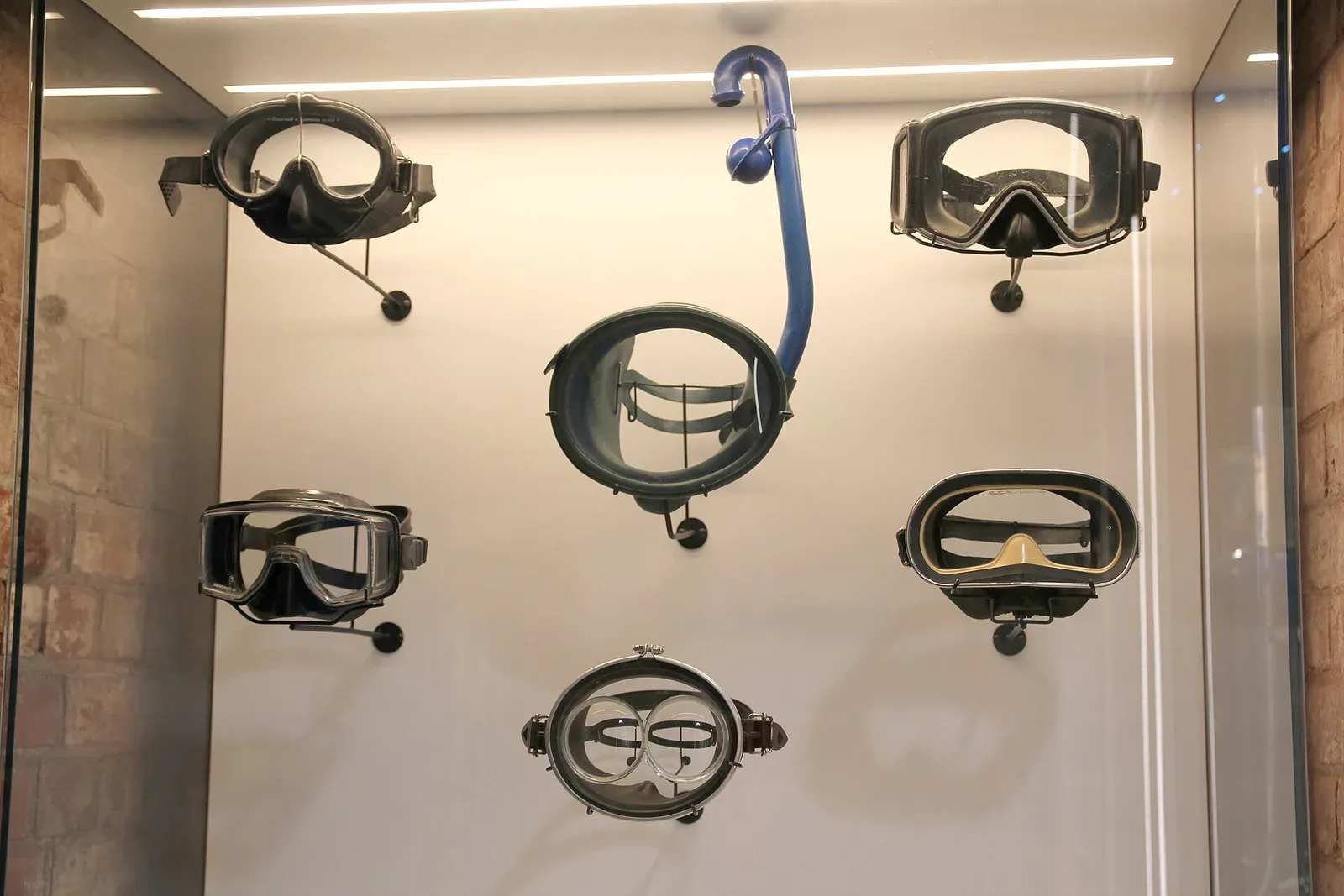
What the flat glass does change is the field of view, and it changes it the same way. Snell’s law runs in both directions: a ray that leaves the glass at 45° to your line of sight came through the water at only 32.0°, one at 60° came in at 40.5°, and at the extreme — a ray skimming along the glass at 90° — the water-side angle is 48.6° and no more. Whatever the window’s shape or size, a flat interface cannot deliver anything from beyond that cone; the wide-open feel of a big mask is the same view, 4/3 too large. The one design that escapes is the double-dome mask, with a curved window centred on each eye. Double-dome masks “allow a wider field of view and avoid the refraction error in perceived distance and size of objects” — but because a curved water–air surface makes the eye “effectively more hyperopic,” the diver “must wear special contact lenses to compensate,” and with them in “the diver’s vision will become myopic when they put their head out of water.”
Flat ports, dome ports and an image three radii out
Camera housings face the same choice, and photographers carry their own rounder number. “Underwater images are magnified by 25 percent, and the dome will correct for that,” David Doubilet said of his half-in, half-out split shots. Twenty-five is the vision literature’s “closer” figure rather than its 33 per cent “bigger”, but it is the same ratio seen from the other side. Behind a flat port a lens loses field, gains the magnification — which macro shooters welcome, since “refraction through a flat port increases the magnification of a macro lens” — and picks up two aberrations that grow toward the corners. “Pincushion distortion and lateral chromatic aberration are noticeable”: pincushion because the bend grows with angle, so the edges of the frame are stretched more than the middle; chromatic because the index of water, like any index, is slightly different for each colour, so the edges are fringed. Wide lenses behind flat glass are soft in the corners for that reason, not for lack of a good lens.
A dome port restores the field of view and the true size, and the way it does so is worth deriving. A dome is a spherical water–air surface with its centre of curvature inside the housing. Apply the single-surface refraction formula, n₂/v − n₁/u = (n₂ − n₁)/R, to a distant subject, with water on the outside and air within: the image distance comes out at v = R/(1 − n), which for n = 1.333 is −3.0 dome radii. The minus sign means virtual, on the water side. The dome takes the whole ocean in front of it and lays it out as a virtual image between the glass and a point three radii out. A 1999 paper on domes for underwater photographers reaches the same place in words: all of real object space “is compressed into a ‘virtual image’ space extending from the front of the dome to less than 3 dome radii away,” with a subject at infinity at the far limit and closer subjects nearer the glass. For a dome of 100 mm radius that is 300 mm for a distant reef, 214 mm for a subject a metre away and 167 mm for one at half a metre; in seawater the far limit tightens to 2.94 radii. The lens is then focused not on the reef but on that close virtual image, which is why wide lenses behind domes need close-focus ability or a dioptre, and why the dome’s radius, not its diameter, is the number to know.
That is what “corrects” means. Rays aimed at the centre of a sphere meet its surface square-on and do not bend, so a lens whose pupil sits at that centre sees the water at true size and true distance — the whole 4/3 gone. It is why wide-angle shooters on a wall like Great Wall West, whose sheer face our record says photographers have shot piece by piece and stitched into one image, carry domes. A macro site is the opposite case: Frederiksted Pier is a 7 m shore dive of seahorses and frogfish that our record says photographers run day and night, and for small subjects like those the flat port’s magnification is welcome.
The surface is a mirror, except overhead
Lie on your back in still water and look up, and the sky is a bright disc with the horizon folded into its rim; everywhere else the surface is a mirror of the reef beneath you. That is Snell’s window, and it is the same law run to its limit.

Embed this diagram
<figure>
  <img src="https://reefwander.com/og/diagrams/snells-window.svg" alt="Why the surface is a window overhead and a mirror everywhere else. Every ray from the sky bends toward the vertical on entering the water, so the whole 180° of sky arrives inside a cone 97.2° across — 48.6° each side of straight up. Sky 45° above the horizon lands 32.0° from the vertical; 20° lands at 44.8°, 10° at 47.6°, the horizon on the rim. Past 48.6° light from below cannot leave, and the surface reflects the reef back down." loading="lazy">
  <figcaption>Diagram by Reefwander, licensed under CC BY 4.0.</figcaption>
</figure>
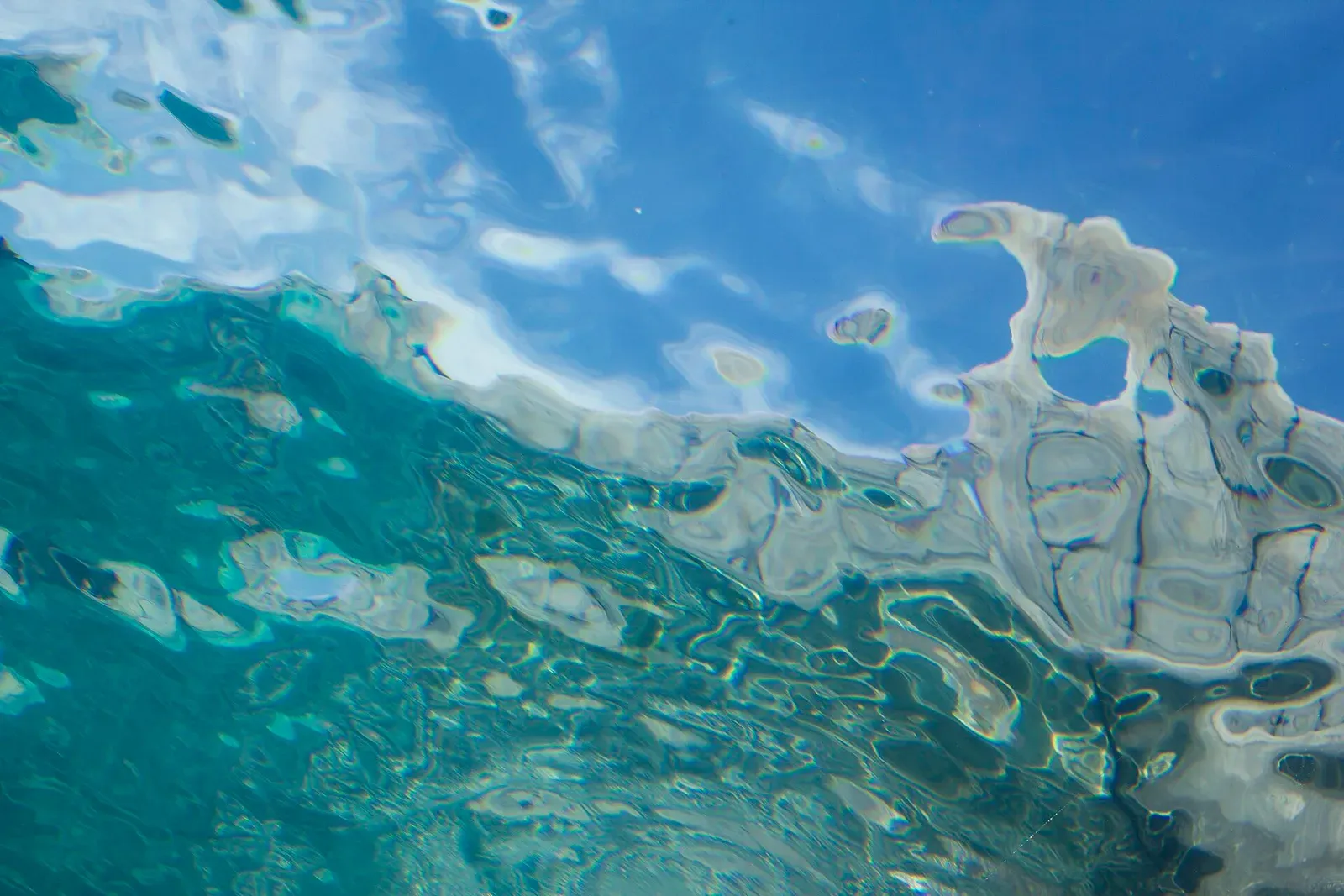
Light coming down from the sky bends toward the vertical as it enters the water, so the whole hemisphere above — horizon to horizon, 180° — arrives inside a cone. Its half-angle is the critical angle, arcsin(1/1.333) = 48.6°, so the window is 97.2° across. (You will see “about 96 degrees” and 97° quoted for it; the arithmetic with n = 1.333 gives 97.2.) The compression is anything but even. Sky 45° above the horizon lands 32.0° from the vertical, but sky 20° up is already at 44.8°, sky 10° up at 47.6°, and the horizon itself sits on the rim. The last twenty degrees of sky are packed into the last 3.8° of window and the last ten into the last 1°, which is why the horizon is crushed into a thin band at the rim. The rim is also dim: light arriving at a grazing angle is mostly reflected off the surface rather than let in, so the window fades towards its edge, and ripples break the edge into the wavy boundary in the photograph below.
Outside the cone the surface has nothing to show you from above, because no ray from the sky can arrive at those angles. Instead it reflects. A ray from the reef reaching the surface at more than 48.6° from the vertical cannot get out — Snell’s law would need a sine greater than one — and is turned back into the water whole, which is why the underside of a calm surface acts as a mirror for the reef beneath it. Outside the window you see either darkness or the bottom, never the sky. In seawater the rim pulls in a little, to 48.3°, and the window to 96.5° across.
Photographers use the disc deliberately, composing “such that their subjects fall inside Snell’s window, which backlights and focuses attention on the subjects.” Through a dome the window is its true 97°; through a mask, or a flat port, the 4/3 applies to the window as well, and the disc fills more of your view than it should.
Where the geometry shows
The 4/3 is there in a silted quarry, but you notice it where the water disappears. At Silfra Cathedral — glacial meltwater from the Langjökull ice cap, so the fresh-water index applies almost exactly — our record describes seeing the full 100 m corridor from its entrance, and every metre of it is 25 per cent nearer than it is. The cenotes of the Riviera Maya do the same under a limestone roof, from the course-work clarity of Cristalino to the stalactite rooms of Chac Mool, where every formation is a little further away than it looks. In the sea, the isolated reefs — Snapper Ledge at Layang-Layang, where our record gives around 50 m of visibility, and Big Brother in the Red Sea at 30 to 50 — are where haze does least to the far field and the near-field 4/3 shows plainly. And two sites carry the trade in their names: Photographer’s Reef, so marked on the charts, and Bonnie’s Arch, named for a Cayman photographer, both places where the dome-versus-flat-port choice gets argued on the boat.
Diving at Silfra, Iceland · gramsmose on YouTube
The colour side of the same water — why the far end of the corridor goes blue and the reds vanish — is in why the sea is blue; the shimmer where fresh and salt water meet, an index change made visible, is in the layered sea; the cave country itself is in cenotes and caverns, and the suit that lets you stay in Silfra long enough to enjoy the 100 m is in cold-water diving.
| Site | Depth | Level | Best months |
|---|---|---|---|
| Silfra Cathedral Silfra · Iceland | to 18 m | Intermediate | May–Sep |
| Silfra Big Crack Silfra · Iceland | 0.5–18 m | Intermediate | May–Sep |
| Silfra Hall Silfra · Iceland | to 10 m | Intermediate | May–Sep |
| Cenote Cristalino Riviera Maya Cenotes · Mexico | to 9 m | Beginner | Year-round |
| Gran Cenote Riviera Maya Cenotes · Mexico | to 10 m | Intermediate | Year-round |
| Cenote Chac Mool Riviera Maya Cenotes · Mexico | to 12 m | Intermediate | Year-round |
| Dan's Cave South Abaco Blue Holes · Bahamas | 23–46 m | Advanced | Jan–Apr |
| Snapper Ledge Layang-Layang · Malaysia | 25–40 m | Advanced | Closed |
| The Point Layang-Layang · Malaysia | 25–40 m | Advanced | Closed |
| Big Brother Island Brothers & Daedalus · Egypt | 10–35 m | Advanced | Jun–Aug |
| Daedalus Reef Brothers & Daedalus · Egypt | 10–40 m | Advanced | Jun–Aug |
| Molokini Crater Maui, Molokini & Lānaʻi · United States | 6–15 m | Beginner | Apr–Oct |
| MV Captain Keith Tibbetts Cayman Brac · Cayman Islands | to 27 m | Intermediate | Dec–May |
| Photographer's Reef Cape Peninsula Kelp Forests · South Africa | 3–14 m | Intermediate | Nov–Jun |
| Bonnie's Arch Grand Cayman · Cayman Islands | to 30 m | Advanced | Dec–Apr |
| Great Wall West Little Cayman · Cayman Islands | to 30.5 m | Intermediate | Dec–Apr |
| Frederiksted Pier St. Croix · U.S. Virgin Islands | to 7 m | Beginner | Dec–May |


