North America · United States
Lake Tahoe
North America's best-known high-altitude, clear-water lake diving
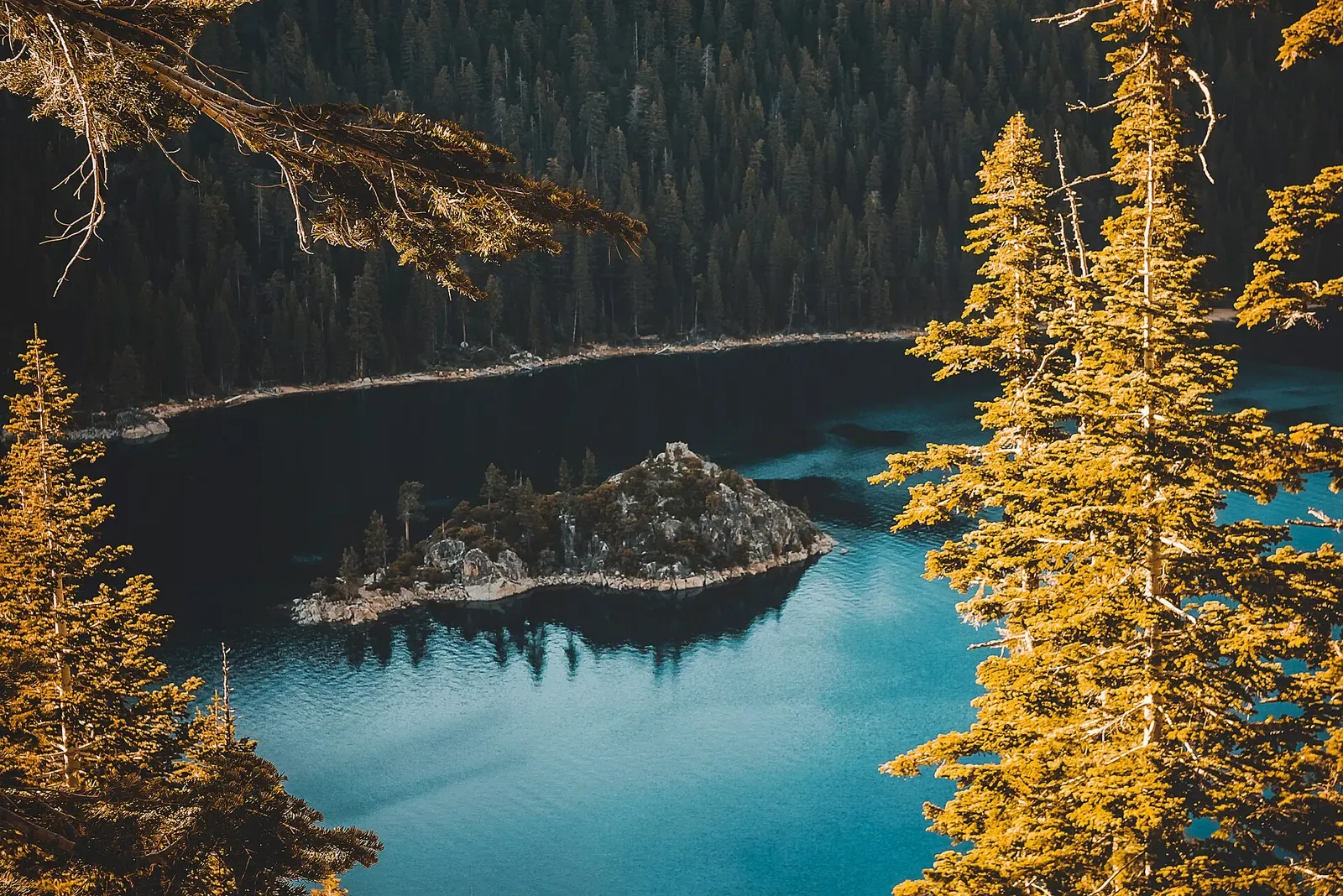
Photo: Jeff Hopper jeffhopper · CC0
Lake Tahoe sits at 1,897 m in the Sierra Nevada on the California–Nevada line, and its water is clear enough that California built one of its first underwater state parks here to protect a fleet of resort-era boats sunk in Emerald Bay rather than any reef. Rubicon Wall is a sheer granite face inside D.L. Bliss State Park, and Sand Harbor's boulder gardens sit on the Nevada shore. Every dive on the lake counts as an altitude dive, in fresh water that stays near 4°C at depth through midsummer.
About diving in Lake Tahoe
Lake Tahoe is a subalpine lake straddling the California–Nevada line at 1,897 m in the Sierra Nevada, the second-deepest lake in the United States at 501 m. Its water clarity has made it a landmark of freshwater diving in the country, and every dive here starts from an elevation few other dive destinations share: altitude-diving procedures apply across the whole lake, not only on its deeper sites, and a computer or table has to be run in altitude mode even for a shallow shore dive.
California State Parks brought the water of Emerald Bay into the park system in 1994, one of the state's first underwater parks, to protect small recreational boats and barges scuttled there once they were no longer wanted. A Historic Barge Dive Site opened to divers in 1998, and in October 2018 the state added three further sites and opened the Emerald Bay Maritime Heritage Trail, with underwater panels and waterproof dive cards describing vessels that range from Ponderosa pine cordwood barges to a 1915 passenger launch.
Away from the bay, Rubicon Wall at D.L. Bliss State Park is a granite cliff that drops far past recreational limits, reached by a long surface swim from Calawee Cove, and Sand Harbor on the Nevada shore is a shallower, calmer site of boulders and sand reached straight off the beach. Both call for a drysuit: even in August the water is near 4°C a few metres down, and there is no hyperbaric chamber at the lake itself, with the nearest in Reno, Sacramento and Chico.
When to dive Lake Tahoe
| Jan | Feb | Mar | Apr | May | Jun | Jul | Aug | Sep | Oct | Nov | Dec |
|---|---|---|---|---|---|---|---|---|---|---|---|
| Off-season | Off-season | Off-season | Off-season | Fair | Good | Prime | Prime | Prime | Fair | Off-season | Off-season |
Prime months run July to September; shore access such as D.L. Bliss State Park closes to vehicles once snow sets in, and deep water stays near 4°C even at the height of summer.
Dive types & marine life
Wildlife here is fish rather than reef life: rainbow, brown, Lahontan cutthroat and Mackinaw trout, dense schools of Lahontan redside shiners along the walls, and crayfish under rocks in the shallows. There is no coral or coloured invertebrate life to speak of; the draw at Tahoe is the clear water, the granite and the sunken boats rather than a species list.
- Freshwater
- Wall
- Freshwater fish
Notable dive sites in Lake Tahoe
Freshwater
Submerged trees, some 6,400 years old, at 4 to 6 m
Freshwater
Flat granite pitted with round craters, in 6 m of water
Freshwater
The lake's most popular summer night dive, free and shallow
Freshwater
An artificial reef under the red marker buoy at 9 m
Freshwater
A trail of resort-era barges and boats sunk in California's first underwater park
Freshwater
Sunken trees from 12 to 30 m, with no surface swim
Freshwater
Sand slope off the swim buoys to a rock ledge at 18 m
Wall
A granite cliff face that keeps dropping long past recreational depths
Freshwater
Easy boulder swim-throughs and a sand slope off a Nevada beach
Freshwater
Historic boathouse rails running into the lake, then a drop-off to 30 m
Freshwater
One of the few Tahoe sites with schools of Tahoe sucker
Freshwater
Flat sand, old bottles, and an easy entry for new divers
Getting there
Reno–Tahoe International Airport is the usual gateway, roughly an hour from either shore, and South Lake Tahoe on the California side is the main base for dive shops and services. State park day-use fees run $10–15 per vehicle, and shoreline parking at popular entry points such as Calawee Cove and Sand Harbor fills by mid-morning in summer.
Photos from Lake Tahoe
inkknife_2000 (7.5 million views +) · CC BY-SA 2.0
Jim Gateley · CC BY 3.0
Daran Grissom · CC BY-SA 3.0
Photo credits
- Rocky island in a deep blue alpine lake ringed by pine forest in autumn by Jeff Hopper jeffhopper, CC0, via Wikimedia Commons
- Granite boulders in shallow clear water at Sand Harbor with mountains beyond by inkknife_2000 (7.5 million views +), CC BY-SA 2.0, via Wikimedia Commons
- Pines and granite framing the blue expanse of Lake Tahoe by Jim Gateley, CC BY 3.0, via Wikimedia Commons
- Low storm cloud lying across the surface of Lake Tahoe by Daran Grissom, CC BY-SA 3.0, via Wikimedia Commons
In The Logbook
- Diving at altitude: why the rules changeBody & health · 7 min read
- Why the water steals your heatBody & health · 8 min read
- Buoyancy and weighting, worked outGear & kit · 8 min read
- Flying after diving, and the 18-hour ruleBody & health · 8 min read
- Freshwater diving: lakes, springs and quarriesFreshwater · 15 min read
Similar destinations

Nineteenth-century schooners preserved intact in cold fresh water

Nineteenth-century wrecks dived as drifts in a hard freshwater current

The only place in the US where you may legally swim with manatees

.jpg)
.jpg)

.jpeg)
A hundred wrecks in Shipwreck Alley, some shallow enough to snorkel