Three huge rocks offshore of the Perhentians, riddled with small caves and swimthroughs, known locally as the Three Brothers. It sits farther out than the island sites, and visibility runs to 30 m and more. Blacktip sharks patrol the deeper edges alongside barracuda, trevally and mackerel, with the usual reef fish packed around the rock.
Also known as Three Brothers.
Where it is and how deep
5.9147° N, 102.7770° EPublished position for this site.
The dive
The site is built from huge rocks with several small caves and swimthroughs between them, and the dive works the gaps rather than a single reef line. Visibility runs to 30 m and more, the clearest of the area's sites, so you can see one rock from the next and plan the crossings instead of groping along the bottom. Depths run from about 10 m on the tops down to 25 m.
The fish life is what carries the dive. Blacktip sharks work the outside of the rocks, and barracuda, trevally and mackerel pass through the open water between them, so it pays to look off the rock as often as at it. Closer in, the usual reef fishes and angelfish hold in the shelter of the boulders, and the swimthroughs concentrate them wherever the gaps narrow.
The caves are the part to plan for. This is treated as a cave diving spot, and the operators expect you to have the certifications before you go into anything overhead; a swimthrough with daylight at both ends is one thing, a small cave is another. Work them one diver at a time, keep the exit in sight, and save the shallow tops of the rocks for the end of the dive.
Marine life and season
- Reef sharks
- Barracuda
- Trevally & jacks
| Jan | Feb | Mar | Apr | May | Jun | Jul | Aug | Sep | Oct | Nov | Dec |
|---|---|---|---|---|---|---|---|---|---|---|---|
| Off-season | Off-season | Good | Prime | Prime | Prime | Prime | Good | Good | Fair | Off-season | Off-season |
Season follows Redang & Perhentian Islands: The marine park is officially closed November 1-February 28 for the northeast monsoon; conditions are calmest and clearest April-September.
Know before you go
- The small caves are a cave dive, not a swimthrough — the operators expect the matching certification, and the rest of the site is worth diving without going in.
- The rocks sit well offshore with open water between them, so a mid-water crossing away from the structure leaves you with nothing to hold on to if conditions pick up.
Photos from Terumbu Tiga
yeowatzup · CC BY 2.0
yeowatzup · CC BY 2.0
Questions divers ask
Why is Terumbu Tiga called the Three Brothers?+
The site is three huge rocks sitting together offshore, with small caves and swimthroughs between them, and the local name for the group is the Three Brothers.
Do I need a cave certification for Terumbu Tiga?+
For the overhead sections, yes — it is treated as a cave diving spot and operators expect the required certifications. The rocks, the swimthroughs with open exits and the fish life outside are divable without it.
Sources
- Terumbu Tiga dive site — Divezone
Photo credits
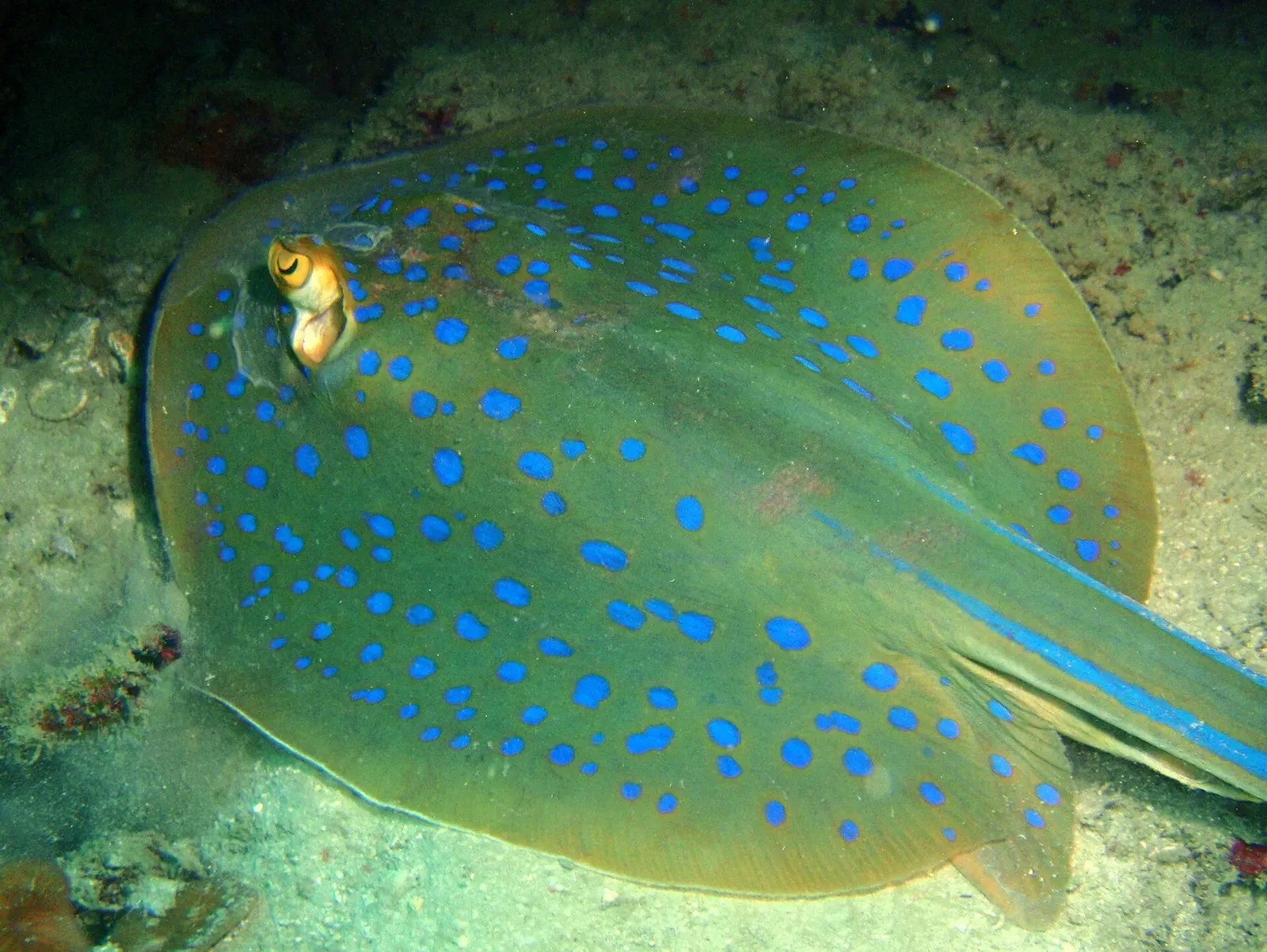
- Blue-spotted ribbontail ray resting on the sandy sea floor near Terumbu Tiga by yeowatzup, CC BY 2.0, via Wikimedia Commons
- Snub-nosed grouper facing the camera among the rocks off Pulau Perhentian by yeowatzup, CC BY 2.0, via Wikimedia Commons
- Banded boxer shrimp with long white antennae tucked in a coral crevice by yeowatzup, CC BY 2.0, via Wikimedia Commons
More dive sites in Redang & Perhentian Islands
Wreck
Maritime Wreck
A 32 m patrol vessel scuttled as a reef, top at 16 m
Wreck
Police Wreck
Three police boats sunk in 2012 between 14 and 19 m
Reef
Batu Layar
Staghorn and table coral to 18 m, with reliably clear water
Reef
Tanjung Basi
The northern tip's deep site: boulders and swim-throughs at 20 m
Wreck
Vietnamese Wreck
A troop transport at 24 m, with penetration for overhead divers
Wreck
Sugar Wreck
A 90 m sugar carrier the coral has not finished claiming
Wreck
Six Sisters
Six impounded fishing boats sunk together at 23 m
Pinnacle
Tokong Laut
Tunnels through a pinnacle in 20 m-plus visibility
Similar dives elsewhere

Volcanic boulders stacked into tunnels, with a cave at 21 m

Stonefish, lionfish and octopus tucked into the rock


Granite boulder maze of swim-throughs, caverns and morays
Violet and blue corals on the site's main bommie