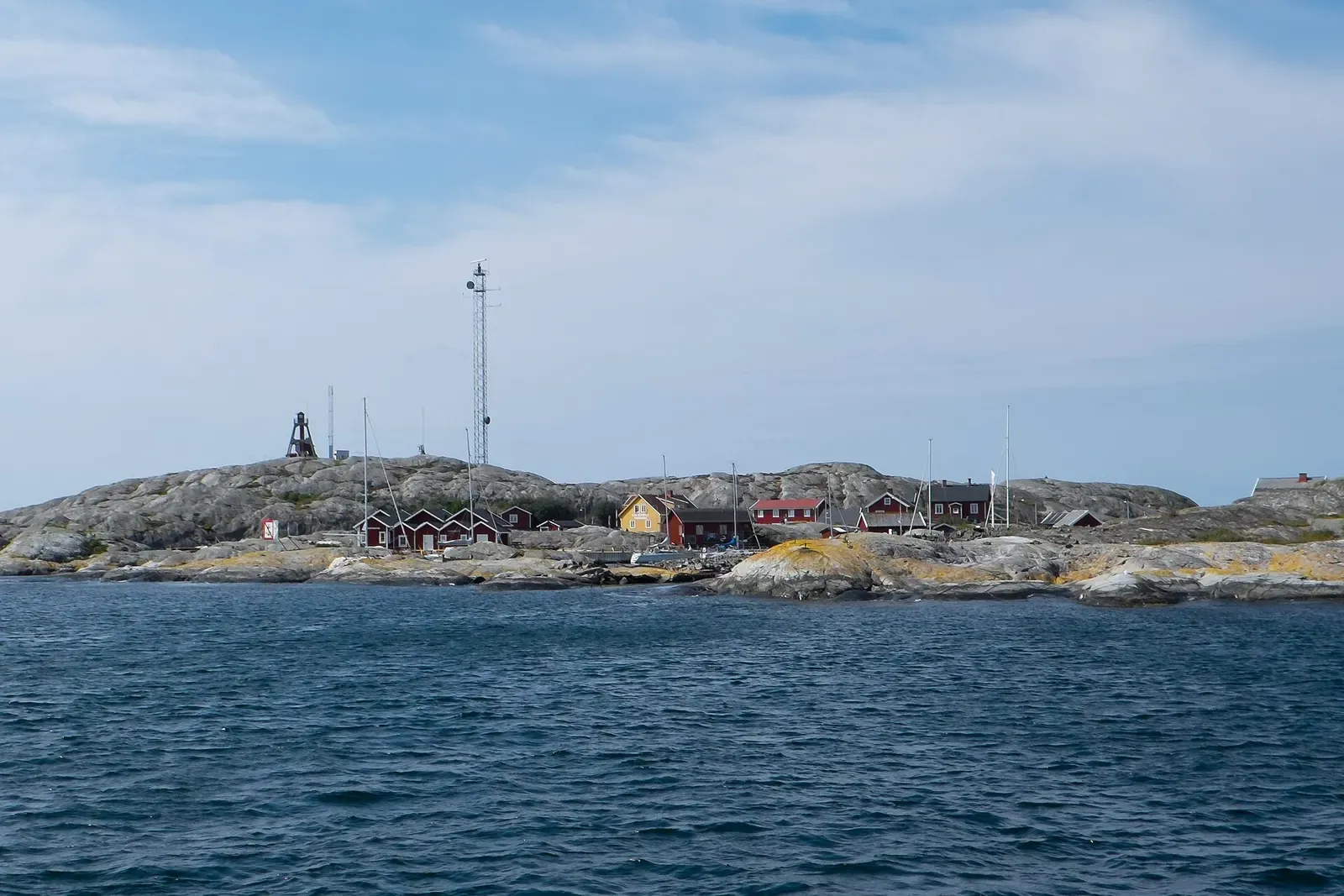
Väderöarna is a nature reserve of 365 islets and skerries west of Fjällbacka, as far west as the Swedish coast reaches in this region, and it ranks among the country's best places to dive. Full-day boat trips string dives together around stops on the islands: the current-swept walls of Trolleskär, the seal islets at Rågstuten, the scattered wreckage of the schooner Aurora at Valeskär. Dead man's fingers, sea anemones and lobsters crowd the boulders and walls.
About diving in Väderöarna
A diving day here is a full-day boat outing from Hamburgsund, where Dyk-Leif is the only centre that regularly runs trips to the islands. The day normally holds two boat dives, with sites picked by the guests' wishes and the weather. The surface interval is a long lunch stop ashore, when divers swim in summer, walk up to lighthouses or look for rock carvings from the 1400s and 1500s. Rågstuten often follows Trolleskär after a break on Väderöbod, the lighthouse island. Trolleskär and Valeskär need settled weather, and in strong wind the boats cannot always get out to the islands.
Underwater the skerries fall away as walls, ledges and boulder fields. Stora Sundskär steps down to about 40 m, while Torsöfläcken is a submerged hill rising to 5 m from sand at 22–25 m. Dead man's fingers and sea anemones grow thickly on the exposed rock, lobsters hide among the boulders, and spiny dogfish have been seen at Rågstuten. The reserve, protected since 2011 as a nature reserve and Natura 2000 site, even holds a living coral reef.
The islands suit cold-water divers at ease in some current, which runs at most sites and can be strong at Trolleskär and Rågstuten, where the currents carry nutrient-rich water to the filter feeders. A divemaster or guide in the water can be arranged but has to be booked ahead. Newcomers to diving can start with a try-dive in the sea or an entry-level course at the Hamburgsund centre.
Best time to dive Väderöarna
| Jan | Feb | Mar | Apr | May | Jun | Jul | Aug | Sep | Oct | Nov | Dec |
|---|---|---|---|---|---|---|---|---|---|---|---|
| Fair | Fair | Fair | Good | Good | Prime | Prime | Prime | Good | Good | Good | Fair |
Diving runs all year. Winter is drysuit season, and the water bottoms out in March at about 3°C. From 1 March to 31 August nobody may land on, or pass within 100 m of, the islands in the bird and seal sanctuaries. Summer is the warm stretch: the water reaches 20°C, a wetsuit becomes possible, and surface intervals turn into swims; August averages about 18°C. September to November stay in the diving calendar as the water cools back toward winter.
Dive types & marine life
Harbour and grey seals are the headline animals: large colonies use the islets at Rågstuten, seals are relatively common underwater at Lilla Knappen, and one is occasionally met at Guleskär. Rågstuten lies near deeper water, so animals that usually live a little deeper often turn up there.
- Wall
- Wreck
- Seals & sea lions
Best dive sites in Väderöarna
- 1
Trolleskär
The westernmost site in Sweden; strong currents feed thick dead man's fingers and sea anemones.
- 2
Rågstuten
Current-swept site whose islets hold large colonies of harbour and grey seals.
- 3
Valeskär
Boulders on the outer edge of Storön, strewn with the wreckage of the Finnish schooner Aurora.
- 4
Lilla Knappen
The northernmost site, where lobsters hide among huge boulders.
- 5
Stora Sundskär
A wall stepping down to around 40 m, its cracks sheltering marine life.
- 6
Guleskär
Next to Trolleskär, with ledges, boulders and smaller walls full of crevices.
Site guides
Wall
Seal colonies on the islets and spiny dogfish on the wall
Wall
Sweden's westernmost walls, furred with dead man's fingers
How to get to Väderöarna
Divers fly into Gothenburg Landvetter; the airport bus to Gothenburg and then the train is the usual onward route. Fjällbacka lies about 150 km (93 mi) from Gothenburg. Boats to the islands leave from Hamburgsund and Fjällbacka, and a Grebbestad dive centre also includes Väderöarna in its trips.
Photos from Väderöarna
CATXALOT · CC BY 2.0
Dive videos
Diving West of Sweden - Väderöarna dykning HD · Mikael Ryden on YouTube
Diving, Väderöarna, Swedish westcoast (original) · Nils Ekeroth on YouTube
Questions divers ask
Do the dive boats refill tanks between dives?+
No, there is no compressor on board. A second cylinder for the second dive, 8 litres at 300 bar or 12 litres at 200 bar, is lent at no extra cost.
Can divers go ashore on the islands between dives?+
Yes. Lunch is taken ashore between the two dives, often on Väderöbod with its lighthouse, but landing inside the bird and seal sanctuaries is banned from 1 March to 31 August.
What happens when wind keeps the boats from the outer sites?+
Trolleskär and Valeskär need settled weather. In a strong blow the boats dive sheltered inshore sites such as Vedholmarna and Kyrkogårdsön, overgrown rock and walls with good marine diversity, or the deep archipelago off Hamburgsund and Fjällbacka.
Sources
- Dykning – Dyk-Leif — Dyk-Leif
- Dykutfärder – Bröderna Klemmings Dykhjälp — Bröderna Klemming
- Väderöerne: Swedish Diving at Its Best! — X-Ray Mag
- Väderöarna naturreservat — Länsstyrelsen Västra Götaland
- Torsöfläcken (MySSI) — SSI
- Lysekil average sea temperatures — seatemperature.org
- Bohuslän — Wikivoyage
- Fjällbacka — Wikipedia
- Väderöarna — Wikipedia
Photo credits
- A low granite island with red and yellow wooden houses, a lattice mast and sailboat masts, seen across choppy blue water by Peterkz, CC BY 4.0, via Wikimedia Commons
- A gravel path and wooden bench on bare granite, looking out over calm grey sea dotted with low rocky skerries by CATXALOT, CC BY 2.0, via Openverse
Embed
Run a dive centre, club or blog? Embed this map of 11 dive sites near Väderöarna on your own page.
Similar destinations


Sweden's only cold-water coral reefs, inside its first marine national park
Cold Water
Anemone-hung skerry walls in and around Sweden's first marine park
Cold Water
Aran Islands
Ireland
Diving Poll na bPéist, the Wormhole of Inis Mór
Cold Water
The U-260 submarine and the Kowloon Bridge, both dived from Baltimore