Hachijojima is a volcanic island in the Izu chain, 290 km south of Tokyo, with dive points around its whole coast and nearly all of them facing the open ocean. Shore dives such as Sokodo and Yaene run from about 3 to 12 m over sand, rock, arches and boulders. The draw is Nazumado's Yuzen, a butterflyfish found only here and further south, alongside turtles and a rich cast of sea slugs, shrimp and crabs.
About diving in Hachijojima
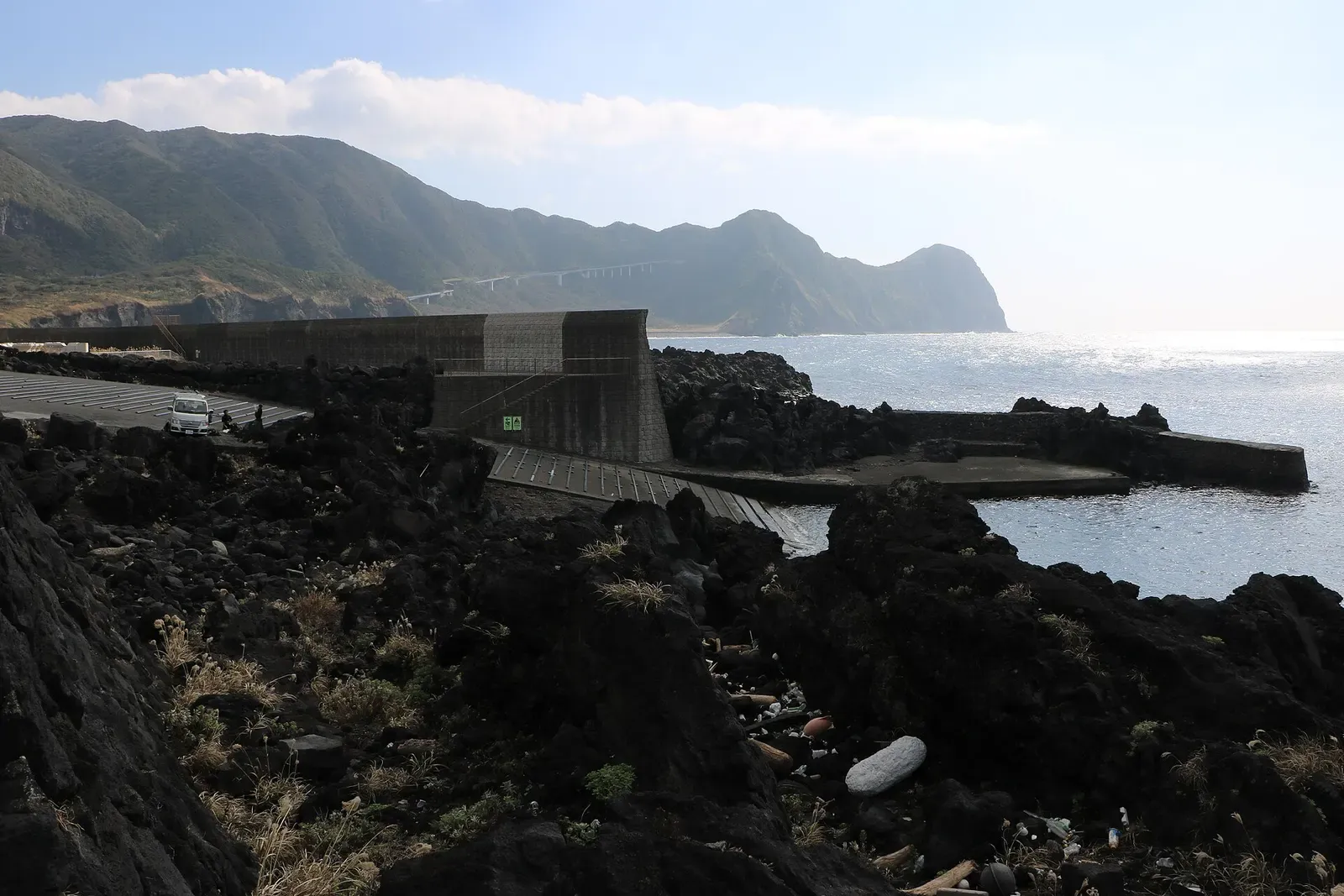
Points ring the whole island, and nearly all of them, shore and boat alike, face the open ocean. Shore entries run down slippery steps, as at Sokodo, or along a fixed rope, as at Nazumado. Boat dives leave the port and reach the closest points in about 5 minutes and the furthest in about 25, with Hachijo-kojima around 40 minutes out. The boat dives are drifts on the tide, and some points are prone to current, so the diving is kept cautious and within each group's limits.
Underwater this is volcanic rock: ledges, arches and crevices, with sandy bottoms and concrete boulders at the sheltered sites, where lobsters come out at night. Shrimp, crabs and sea slugs are plentiful alongside the fish, which include trumpetfish and moray eels, and green and loggerhead turtles move over the rocks and arches.
Nazumado asks more of a diver: its entry is hard work when the sea is choppy, and the current there sometimes runs hard, which is also why the fish are so thick. Sea slug hunters find species from subtropical, temperate and subarctic zones side by side, and the main sea slug sites are all shore dives. Divers set on a shark encounter will find the island a gamble, since hammerheads and threshers come mainly from May to July and are never assured.
Best time to dive Hachijojima
| Jan | Feb | Mar | Apr | May | Jun | Jul | Aug | Sep | Oct | Nov | Dec |
|---|---|---|---|---|---|---|---|---|---|---|---|
| Fair | Fair | Good | Prime | Prime | Good | Good | Fair | Good | Good | Good | Good |
January and February bring the coldest water of the year, around 18 °C (64 °F), and sit outside the island's good diving season. That season opens in March, and April and May are the best months of all. From May the sea warms to 23–25 °C (73–77 °F), and hammerheads and thresher sharks appear mainly between May and July. The good season pauses from mid-July to mid-September, then resumes through to the end of December. September and October are busy, with the sea still warm and long public holiday weekends in both months.
Dive types & marine life
The Yuzen, or wrought iron butterflyfish, lives at Nazumado and is the island's signature fish. Green and loggerhead turtles are regular over the rocks. Hammerheads and thresher sharks are known to appear mainly from May to July, a chance rather than a certainty. Sea slugs, shrimp and crabs fill the macro side of the diving.
- Wall
- Hammerheads
- Thresher sharks
- Sea turtles
- Nudibranchs
- Macro critters
Best dive sites in Hachijojima
- 1
Nazumado
Wall falling sharply down the slope, entered by a fixed rope; the classic spot for the Yuzen butterflyfish.
- 2
Sokodo
Shore site beside the port, starting in a sheltered 3 m bay; good for a refresher dive.
- 3
Yaene
Sheltered west-coast site: sand at 6–7 m giving way to rock gardens around 12 m.
- 4
Ochiyogahama
Shore site and one of the island's main dives for sea slug hunters.
Site guides
How to get to Hachijojima
Flights reach Hachijojima Airport in 45 minutes from Haneda, and dive staff meet guests there for the 10-minute drive to the shop. An overnight ferry leaves Takeshiba pier in Tokyo at 22.30 and arrives at 9.30. The dive shops handle shore and boat diving from the island.
Photos from Hachijojima
Nesnad · CC BY-SA 4.0
Dive videos
Dive in Tokyo Island "Hachijojima" 東京の南国、八丈島でダイビング · KIRIN SEKITO on YouTube
Discovery Divers Tokyo in Hachijojima & Izu Oshima · Tokyo Birdman on YouTube
Questions divers ask
When is the best time to dive Hachijojima?+
April and May are the best months. The good season runs from March to mid-July and again from mid-September to the end of December; September and October are busy because of holiday weekends.
When do hammerheads and thresher sharks appear at Hachijojima?+
Mainly between May and July. They are an occasional sighting rather than a reliable one, while turtles and the Yuzen butterflyfish are the steadier encounters.
How do divers get to Hachijojima?+
By a 45-minute flight from Haneda to Hachijojima Airport, where dive staff meet arrivals, or by the overnight ferry from Takeshiba pier in Tokyo, leaving at 22.30 and arriving at 9.30.
Is Hachijojima shore or boat diving?+
Both. The main sea slug sites are shore dives, while boat dives are tide drifts reached in 5 to 25 minutes from the port, or about 40 minutes to Hachijo-kojima.
How cold is the water at Hachijojima?+
About 18 °C (64 °F) in January and February, rising to 23–25 °C (73–77 °F) from May to October, when the best of the warm water coincides with the shark months.
Sources
- Crown Divers fun diving — Crown Divers
- Diving Club Concolor — Diving Club Concolor
- Scuba Diving in Hachijojima — Japan Airlines / Japan Travel
- Hachijo Island sea slug diving — umiushi.info
- Hachijō-jima — Wikipedia
- Hachijojima — Wikivoyage
- Concolor Hachijo sea — Diving Club Concolor
- Nazumado — ScubaGo
- Izu Islands diving — PADI blog
Photo credits
Embed
Run a dive centre, club or blog? Embed this map of 2 dive sites near Hachijojima on your own page.
Similar destinations
East Asia
Izu Ōshima
Japan
Hammerhead schools at sunrise, reached from a volcanic beach
East Asia
Amami Ōshima
Japan
Pufferfish sculpt two-metre geometric nests into the sand at 25 m

Shore-entry coral slopes at the warm southern tip of Taiwan


The world's northernmost table coral reef, growing at 33° north