North Carolina Wrecks · United States · Wreck
SS Papoose
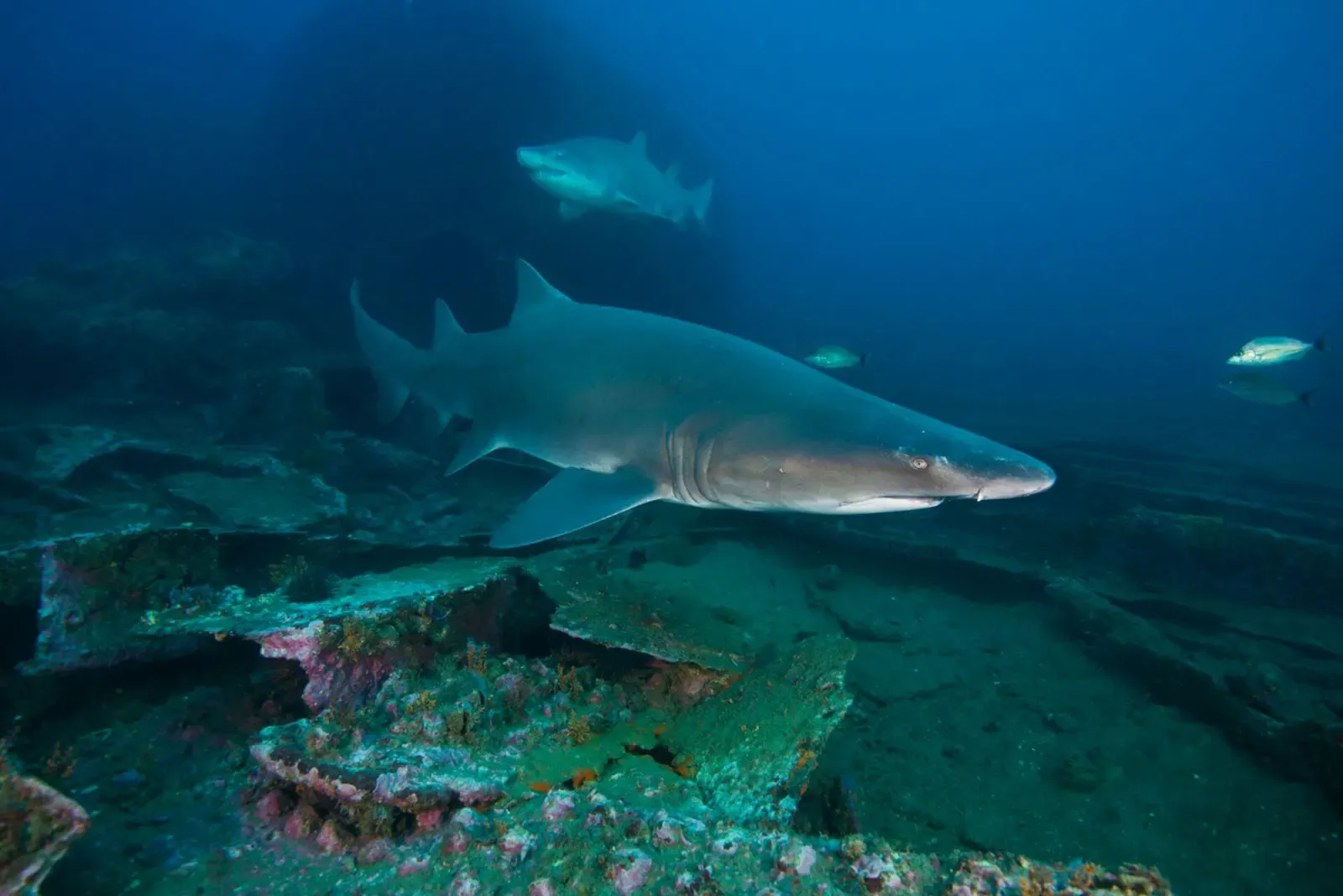
Sand tigers over an upside-down 1942 tanker hull
A wartime tanker off Cape Lookout, torpedoed by U-124 in March 1942 and still booked as the Papoose, although the Beaufort charter fleet now lists the hull as the W.E. Hutton. The wreck lies partially intact and upside down between about 27 and 37 metres, and it is one of the North Carolina hulls divers come to for sand tiger sharks.
Also known as W.E. Hutton, The Hutton.
Where it is and how deep
34.0800° N, 76.6700° WApproximate position — the dashed circle shows where the site lies; your operator's briefing has the mooring.
The dive
The boat runs offshore, hooks the wreck and ties in a line, and you go down it through open water onto a large hull lying upside down on the sand. Charters give the dive as 90 to 120 feet, about 27 to 37 metres, so the profile is set by the wreck rather than by you. Visibility here usually runs 15 to 24 metres, which on a good day puts a whole section of hull in view at once.
Two features orient most dives. A large anchor is still attached at the bow, and the propeller stands at the far end, so divers tend to work the length of the hull between them, keeping steel within reach instead of swimming out over open sand. She is only partially intact, and the gaps in an upside-down hull are an overhead environment rather than a swim-through.
Sand tiger sharks are why most divers book this wreck, and they hold in and around the wreckage rather than out in the blue. Turtles, jacks and stingrays use the same structure. Bottom time is short at this depth, so plan the turn early, come back along the hull to the tie-in and make the ascent on it, because that line is also the way back to the boat.
Gas planning, not cold, is the limit here. Bottom time between 27 and 37 metres is short, so know your own no-stop time before you leave the surface, particularly if the Papoose is the second dive of the day. The wreck itself is 138 metres of tanker and no single bottom time covers it, so pick the bow or the stern, dive that end properly, and leave the rest for another trip rather than trying to swim the whole hull.
The wreck
- Vessel
- W.E. Hutton (dived as SS Papoose)
- Type
- Tanker
- Length
- 138 m (453 ft)
- Built
- 1920
- Sunk
- 1942
- Cause
- Torpedoed by the German submarine U-124
- Lies
- Partially intact and upside down on sand, anchor at the bow and propeller aft
The tanker was built in 1920 by the Bethlehem Shipbuilding Corporation and first commissioned as the Portola Plumas. On 18 March 1942 she was torpedoed off Cape Lookout by U-124 under KL Mohr; 13 crew were killed and 23 survivors were picked up by the Port Halifax and landed at Savannah, Georgia. Divers worked the site for decades as the SS Papoose, and Discovery Diving's listing states the wreck was initially thought to be the Papoose and is still officially referred to by that name; the position given here is the published 1942 sinking position rather than a surveyed fix on the wreck.
Marine life and season
- Sand tiger sharks
- Sea turtles
- Trevally & jacks
- Stingrays
| Jan | Feb | Mar | Apr | May | Jun | Jul | Aug | Sep | Oct | Nov | Dec |
|---|---|---|---|---|---|---|---|---|---|---|---|
| Off-season | Off-season | Fair | Fair | Good | Good | Good | Good | Prime | Prime | Good | Off-season |
Season follows North Carolina Wrecks: Charter season runs roughly April-November; sand tiger shark aggregations peak in September-October, while December-February seas are too rough for most boats.
Know before you go
- The dive runs between about 27 and 37 metres, deep enough that no-stop time is short and a single distraction on the bottom eats the whole plan.
- The hull is upside down and only partially intact; its openings are true overhead environment and need wreck training and a line, not curiosity.
- The tie-in line is the only fixed reference on an offshore wreck. Stay in contact with structure and return to that line to ascend rather than coming up in open water.
Questions divers ask
How deep is the Papoose wreck?+
Charter operators give the dive as 90 to 120 feet, about 27 to 37 metres. That puts it well outside beginner limits: short no-stop times and an offshore descent line with no bottom in sight on the way down.
Are there sand tiger sharks on the Papoose?+
Yes. It is one of the North Carolina wrecks known for sand tigers, which hold in and around the wreckage rather than out in open water. Turtles, jacks and stingrays are on the site as well.
Is the Papoose really the W.E. Hutton?+
The wreck has been dived as the Papoose for decades, and the Beaufort charter listing now gives the hull as the tanker W.E. Hutton while noting the site is still officially called the Papoose. Book it as the Papoose; that is the name every boat uses.
Sources
- North Carolina Dive Sites — Discovery Diving
- List of shipwrecks of North Carolina — Wikipedia
- SS Papoose — Wikipedia
- Michael C. Barnette — Wikipedia
More dive sites in North Carolina Wrecks
Wreck
A cable ship broken into three pieces by Hurricane Fran
Sand tigers in numbers over a broken 1942 freighter at 26 m
Wreck
A protected war grave in three pieces, depth charges on the sand
Wreck
Bow pointing up at 8 m, two anchors still in place
Wreck
Brass wheel and a 5 m propeller (18 ft) on an upright 1918 stern
Wreck
Boilers and condenser on sand in 17 m, close to the shoals
Wreck
A dark 1942 tanker where sand tigers hang over the boilers
Wreck
Wire-dragged freighter debris field, the fleet's second dive
Similar dives elsewhere

The sanctuary's largest wreck, 162 m and inverted

A sunken tuna trawler that gathers bull sharks in season.

A WWII torpedo bomber intact on sand at 37 m off Anacapa

A 78 m steamer on her side, bow at 6 m and stern at 35 m