North Carolina Wrecks · United States · Wreck
SS Suloide
Wire-dragged freighter debris field, the fleet's second dive
A Brazilian freighter that sank in 1943 after striking the submerged hull of the wreck now dived as the Papoose, then was wire-dragged flat by the Coast Guard as a hazard to navigation. What is left is a broad debris field of plates, beams and boilers in about 20 metres, twelve miles out, and it is the boats' standard second dive.
Also known as Amassia, Maceio.
Where it is and how deep
34.0800° N, 76.6700° WApproximate position — the dashed circle shows where the site lies; your operator's briefing has the mooring.
The dive
This is an inshore wreck by North Carolina standards, twelve miles from Beaufort Inlet in about 20 metres, and the crews use it accordingly: a second dive after something deep, or the day's first dive when the sea state rules out the offshore run. The depth leaves plenty of no-stop time, which matters because the site takes some reading.
There is no standing hull to swim along. The Coast Guard wire-dragged the Suloide in 1944 to clear her as a navigation hazard, and what survives is a distinct outline of the ship laid out on the bottom, with plates and beams scattered around and the boilers standing as the obvious high points. Navigation across a debris field this broad is harder than on an intact wreck, so most divers use the boilers as the reference and work out and back from them rather than in one direction.
The flat ground and low, broken structure suit fish that like edges. Schools of sheepshead and spadefish are common over the debris, and flounder and sea bass are on the site as well. Because the whole site sits in about 20 metres, there is time to move slowly across the wreckage and look into it rather than covering ground, which is the better way to dive a field like this in any case.
The wreck
- Vessel
- SS Suloide (ex-Amassia, ex-Maceio)
- Type
- Brazilian freighter
- Length
- 103 m (338 ft)
- Sunk
- 1943
- Cause
- Struck the submerged hull of the wreck dived as the Papoose
- Lies
- Wire-dragged flat into a scattered field of plates, beams and standing boilers
The ship was built in Germany as the Maceio, later renamed the Amassia, and became the Suloide only after her sale to Lloyd Brasileiro. On 26 March 1943 she sank twelve miles off Beaufort Inlet after colliding with the hull of an already-sunken wreck, the tanker dived today as the Papoose. Deemed a hazard to navigation in her turn, she was wire-dragged by the US Coast Guard in 1944, which is why the site is a debris field rather than a ship.
Marine life and season
- Reef fish swarms
| Jan | Feb | Mar | Apr | May | Jun | Jul | Aug | Sep | Oct | Nov | Dec |
|---|---|---|---|---|---|---|---|---|---|---|---|
| Off-season | Off-season | Fair | Fair | Good | Good | Good | Good | Prime | Prime | Good | Off-season |
Season follows North Carolina Wrecks: Charter season runs roughly April-November; sand tiger shark aggregations peak in September-October, while December-February seas are too rough for most boats.
Know before you go
- Wire-dragging left a large, disorganised debris field rather than a hull, and it is easy to lose the way back. Fix a reference such as the boilers and swim out-and-back legs from it.
- Loose plating and twisted beams come with a wire-dragged wreck, along with the snag points that go with them. Keep a cutting tool accessible and stay off the debris rather than through it.
Questions divers ask
How deep is the Suloide wreck?+
The site sits in about 65 feet, roughly 20 metres, which is shallow enough to give a long bottom time. Operators rate it novice to intermediate; the difficulty is navigating the debris field, not the depth.
Sources
- North Carolina Dive Sites — Discovery Diving
- List of shipwrecks of North Carolina — Wikipedia
More dive sites in North Carolina Wrecks
Wreck
A cable ship broken into three pieces by Hurricane Fran
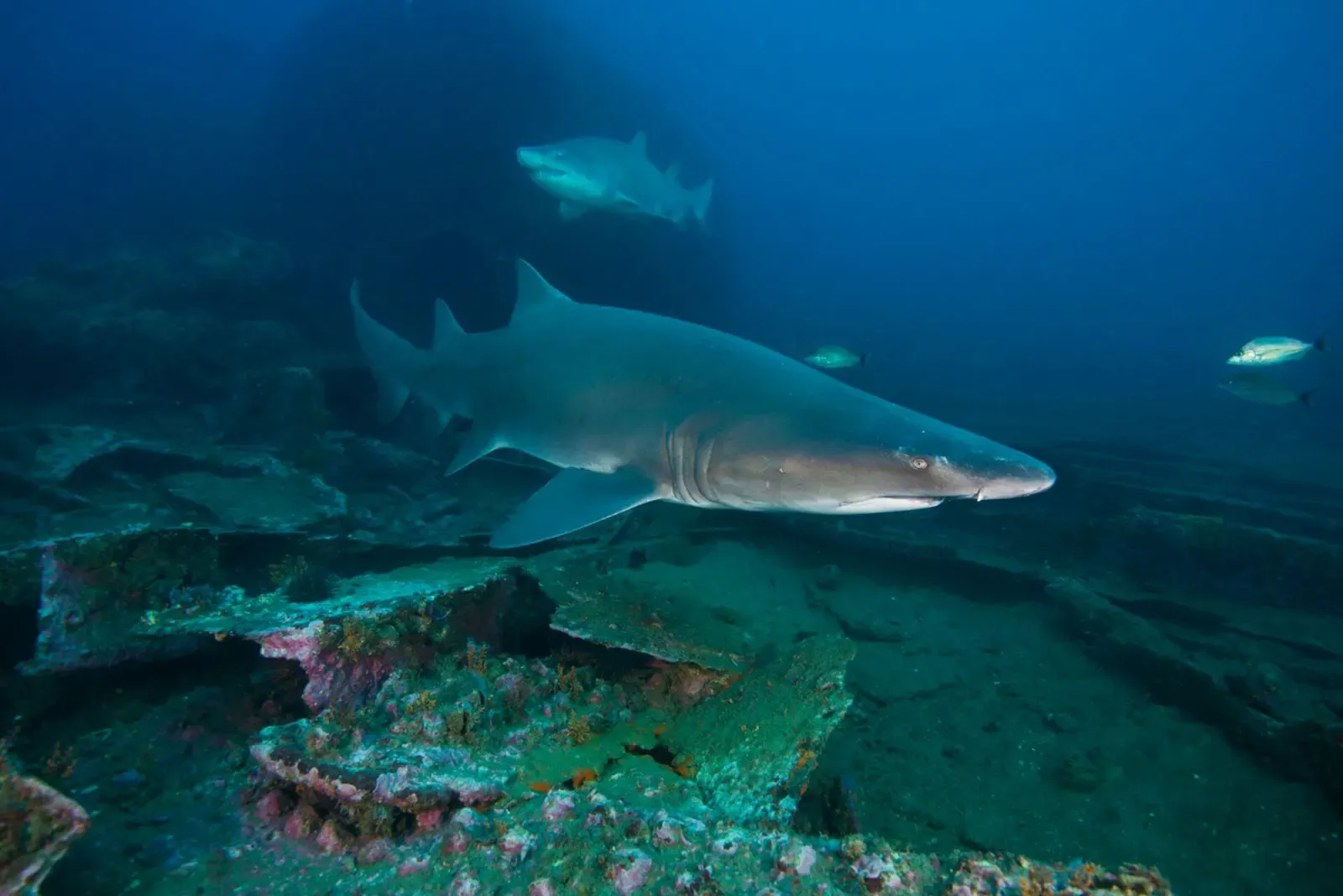
Sand tigers in numbers over a broken 1942 freighter at 26 m
Wreck
A protected war grave in three pieces, depth charges on the sand
Wreck
Bow pointing up at 8 m, two anchors still in place
Wreck
Brass wheel and a 5 m propeller (18 ft) on an upright 1918 stern
Wreck
Boilers and condenser on sand in 17 m, close to the shoals
Wreck
A dark 1942 tanker where sand tigers hang over the boilers
Wreck
Sand tigers over an upside-down 1942 tanker hull
Similar dives elsewhere

A scuttled navy hull in about 18 m of island water

A 1940 Lunenburg schooner scuttled for divers at 17 m
A scuttled smuggling ship with multi-level penetration at 21 m

Blown apart by lightning in 1930, at 24 m off Cockburn Island