North Carolina Wrecks · United States · Wreck
SS Ashkhabad
Boilers and condenser on sand in 17 m, close to the shoals
A Soviet tanker torpedoed off Cape Lookout in April 1942 and then shelled flat by an Allied destroyer to clear her as a hazard to navigation. She lies in about 17 metres on sand near the shoals, with the boilers and condenser standing as the high points, and the shallow depth buys a long dive in water that is rarely clear.
Where it is and how deep
34.3651° N, 76.3513° WPublished position for this site.
The dive
This is one of the shallow wrecks on the charter list, about 17 m (55 ft) to the sand, so the dive is limited by cold and comfort rather than by no-stop time. It also sits close to the shoals, and that position sets the conditions: visibility is generally 30 to 40 feet (12 m) rather than the 60-plus of the offshore sites, and moderate current across the wreck is normal.
The ship was shelled to the bottom rather than sunk cleanly, so there is no hull to follow. She lies on a sandy bottom with the boilers and the condenser as the high points, some of her ribs visible in the section forward of the boilers, and deck plates and twisted beams scattered across the site. Most divers take the boilers as the reference, run the forward section along the ribs, then circle the plating on the way back.
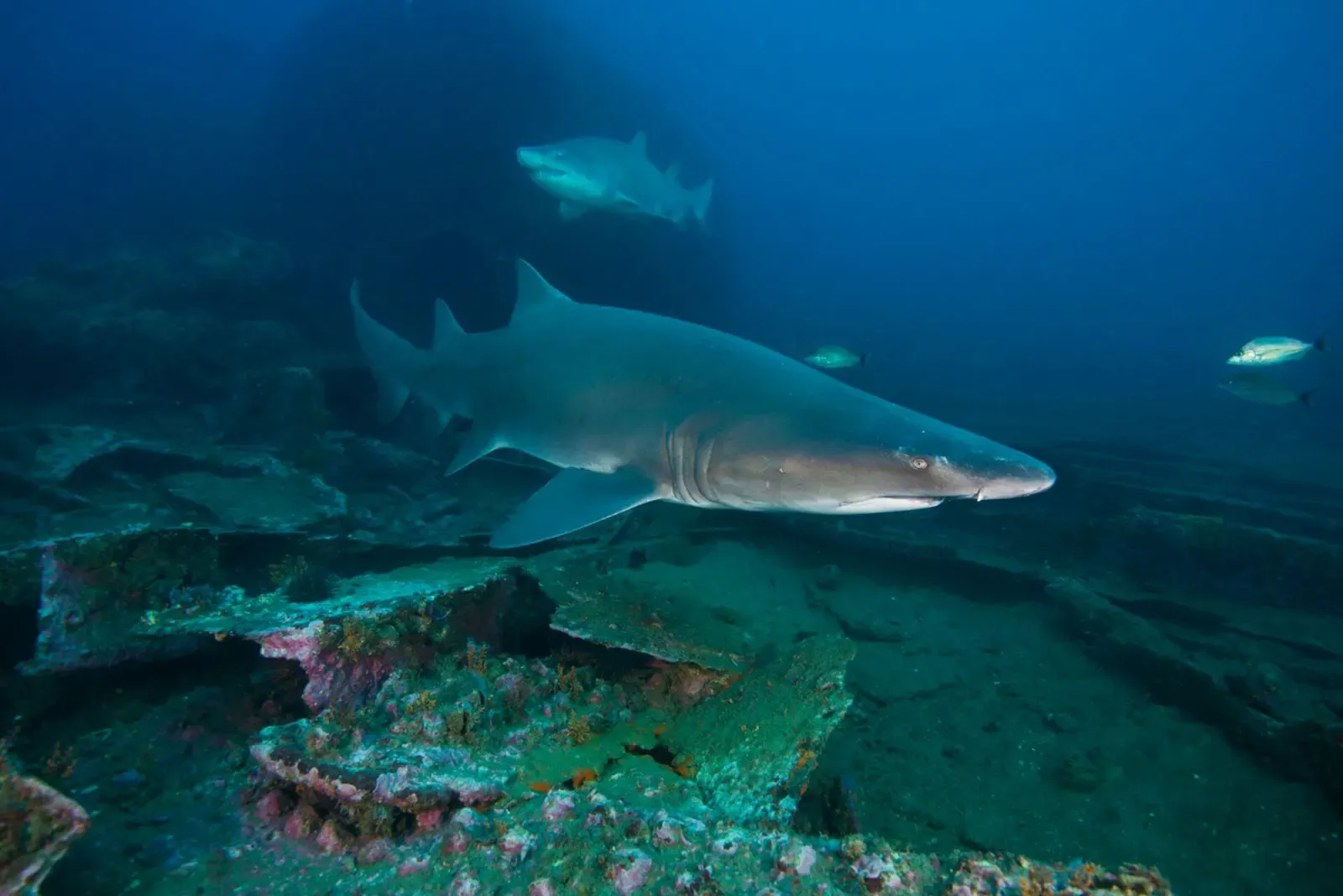
Low structure on flat sand concentrates fish. Sheepshead, triggerfish, sea bass and spadefish are all regulars on the wreck, and in the reduced visibility they come into view close, along the plating, rather than as a distant school. With the sand at only about 17 metres there is no reason to hurry any of it, and the shallow profile leaves room for the dive after one of the deep offshore wrecks.
The wreck
- Vessel
- SS Ashkhabad
- Type
- Tanker
- Length
- 126 m (413 ft)
- Built
- 1917
- Sunk
- 1942
- Cause
- Torpedoed by U-402, then shelled to the bottom as a menace to navigation
- Lies
- On sand, boilers and condenser highest, ribs forward and plating scattered
The Ashkhabad was a Russian tanker, built in Scotland in 1917 as a freighter. On 29 April 1942 she was torpedoed off Cape Lookout by U-402. She did not go down at once, and the destroyer USS Semmes (DD-189) and HMS St Zeono, under standing orders to sink wrecks that might be a menace to navigation, shelled the vessel until she sank completely. That gunfire is the reason the site is a field of boilers, ribs and scattered plating rather than a ship.
Marine life and season
- Reef fish swarms
| Jan | Feb | Mar | Apr | May | Jun | Jul | Aug | Sep | Oct | Nov | Dec |
|---|---|---|---|---|---|---|---|---|---|---|---|
| Off-season | Off-season | Fair | Fair | Good | Good | Good | Good | Prime | Prime | Good | Off-season |
Season follows North Carolina Wrecks: Charter season runs roughly April-November; sand tiger shark aggregations peak in September-October, while December-February seas are too rough for most boats.
Know before you go
- The wreck is close to the shoals, so visibility is lower than on the offshore sites and moderate current is common. Start into the current and keep the boilers in sight as your reference.
- The site is a low, scattered field of plates and twisted beams with sharp edges and snag points. Keep off the debris and carry a cutting tool.
Questions divers ask
How deep is the Ashkhabad wreck?+
The wreck lies in about 55 feet, roughly 17 metres to the sand, which makes it one of the shallower sites on the North Carolina charter list and gives a long bottom time.
What is the visibility like on the Ashkhabad?+
Generally 30 to 40 feet, about 9 to 12 metres. The wreck sits close to the shoals, which keeps the water more stirred than on the offshore wrecks and brings moderate current with it.
Sources
- North Carolina Dive Sites — Discovery Diving
- List of shipwrecks of North Carolina — Wikipedia
More dive sites in North Carolina Wrecks
Wreck
A cable ship broken into three pieces by Hurricane Fran
Sand tigers in numbers over a broken 1942 freighter at 26 m
Wreck
A protected war grave in three pieces, depth charges on the sand
Wreck
Bow pointing up at 8 m, two anchors still in place
Wreck
Brass wheel and a 5 m propeller (18 ft) on an upright 1918 stern
Wreck
A dark 1942 tanker where sand tigers hang over the boilers
Wreck
Sand tigers over an upside-down 1942 tanker hull
Wreck
Wire-dragged freighter debris field, the fleet's second dive
Similar dives elsewhere

A scuttled navy hull in about 18 m of island water

A 1940 Lunenburg schooner scuttled for divers at 17 m
A scuttled smuggling ship with multi-level penetration at 21 m

Blown apart by lightning in 1930, at 24 m off Cockburn Island