Cold Water · Russia
Sakhalin & Moneron Island
Steller sea lions and giant octopus in Russia's first marine park
Moneron, a small uninhabited island off Sakhalin's southwest coast, is Russia's first marine park, and the warm Tsushima current that washes it brings even subtropical species into a northern sea, giant Pacific octopus and abalone among them, with Steller sea lions in the water alongside. Boats cross from Nevelsk between mid-June and the end of September. On Sakhalin itself, sites such as Cape Mramorny and Kiryakov Gardens lie between 6 and 28 m.
About diving in Sakhalin & Moneron Island
Moneron diving starts in Nevelsk, where a chartered boat makes the crossing in two to three hours depending on the height of the waves, and the captain calls the trip off in stormy weather. Dives are made both from the boat and from shore. The island has no café, restaurant or shop, so joining an organised club group that brings a cook and food is the better way to go. Moneron lies inside Russia's Border Security Zone and, unlike Sakhalin, needs an entry permit.
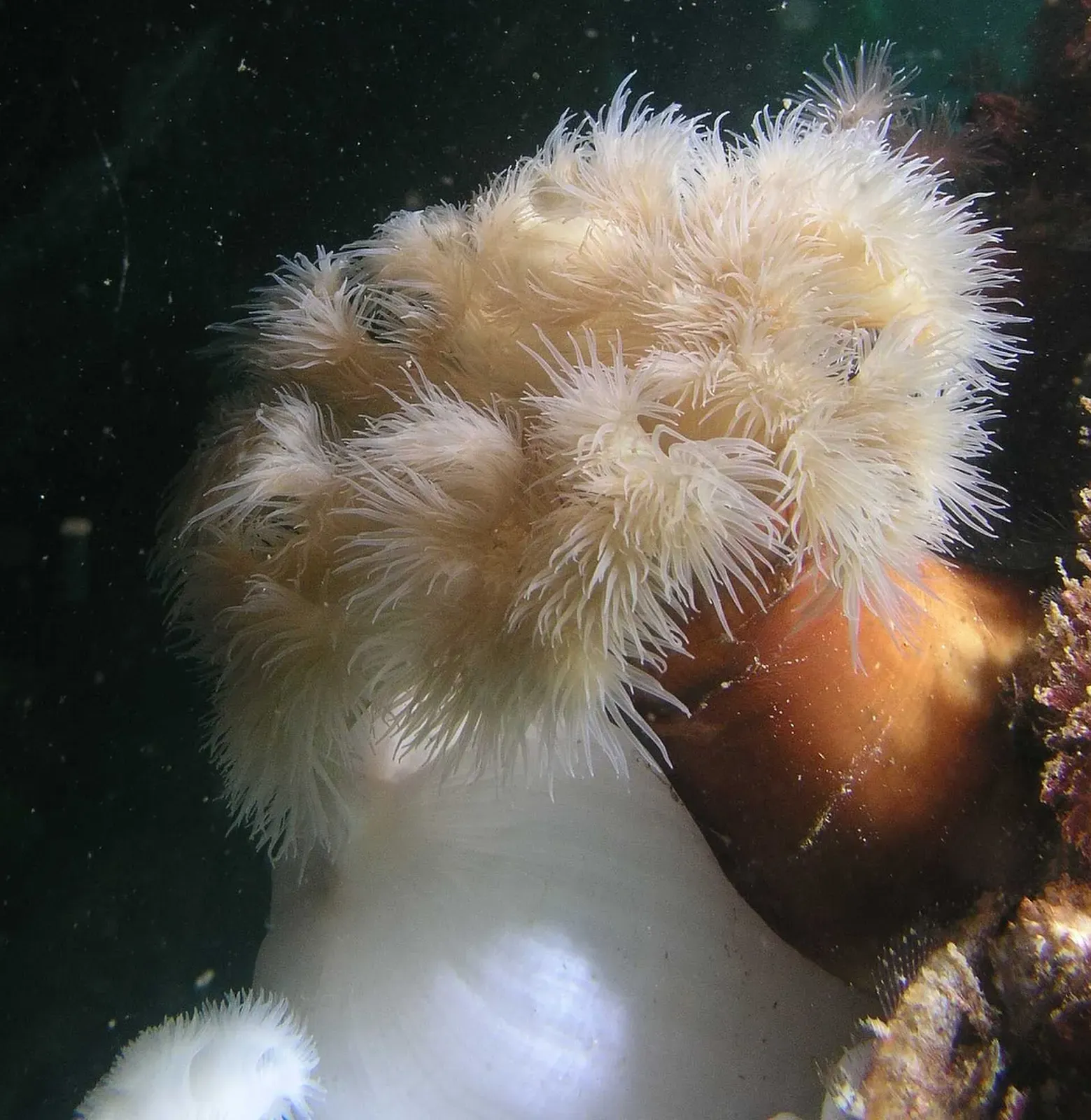
Underwater Moneron breaks into canyons, grottoes and drop-offs with stands of kelp. The warm Tsushima current brings an unusual mix: metridium anemones typical of the Okhotsk and Bering seas sit alongside giant Pacific octopus from the Sea of Japan, and the bottom holds trepang, abalone and many-armed sea stars. Steller sea lions and ringed seals share the water, and visibility is often 30–40 m. A small bay up to 5 m deep serves for night dives among sea stars and small critters. On Sakhalin the southern tip draws most divers, with molluscs, anemones and sponges in shallow water and salmon, flatfish, sculpins, perch and wolffish.
Moneron suits divers at ease in cold water who want marine mammals and a mix of northern and warm-water life in one place. Conditions are not the simplest, which is why unguided diving needs an advanced card, though the AOWD course can be taken on the island itself. Companions who do not dive can snorkel on the surface with ringed seals and sea lions, and a first try dive with scuba is run from shore in comfortable conditions.
Best time to dive Sakhalin & Moneron Island
| Jan | Feb | Mar | Apr | May | Jun | Jul | Aug | Sep | Oct | Nov | Dec |
|---|---|---|---|---|---|---|---|---|---|---|---|
| Fair | Fair | Fair | Fair | Good | Good | Prime | Prime | Good | Fair | Fair | Fair |
The sea off Nevelsk is at its coldest in February, around 2 °C. Steller sea lions haul out at the Nevelsk breakwater from early May to mid-July, and divers can meet them underwater there. Boats to Moneron run from mid-June to the end of September, and a storm can cancel the crossing. In summer the island's surface water warms to 17–18 °C, with 14–15 °C at depth, and in August the warm current lifts it to about 22 °C.
Dive types & marine life
Steller sea lions gather at the Nevelsk breakwater from early May to mid-July. On Moneron, Kologerasa Bay is the place to dive with them, and several dozen seals and sea lions can be in the water at once; nobody threatens them there, so they are curious and approach divers. Ringed seals also turn up.
- Kelp forest
- Night
- Seals & sea lions
- Octopus & cuttlefish
Best dive sites in Sakhalin & Moneron Island
- 1
Kologerasa Bay
Bay on Moneron's north shore and the best place on the island to dive with Steller sea lions.
- 2
Cape Mramorny
Kelp and colourful wolffish up to 2 m long at the mouth of Aniva Bay, 6–16 m.
- 3
Kiryakov Gardens
East-coast site near Lake Ptichye where plant beds look like a laid-out garden, at 28 m.
- 4
Cape Yunona
Shallow site near Prigorodnoye suited to newer divers, 9–14 m.
How to get to Sakhalin & Moneron Island
Yuzhno-Sakhalinsk airport (UUS) has flights from the major cities of the Russian Far East and several weekly links to Japan, South Korea and China. Moneron boats leave from Nevelsk, 50 km south of Kholmsk and a transfer from Yuzhno-Sakhalinsk; the crossing then takes two to three hours.
Dive videos
Подводный мир острова Монерон. Сахалинская обл. The underwater world of Moneron Island. Sakhalin · Tatiana Smal on YouTube
Moneron Island · Dmitry Baranov on YouTube
Questions divers ask
Is a permit needed to dive Moneron Island?+
Yes. Moneron is part of Russia's Border Security Zone, unlike Sakhalin itself. Russian citizens can get a permit on the day of application; for foreigners the procedure is very complicated, and an organised tour that handles the paperwork is the realistic route.
Can Moneron be done as a day trip?+
Yes. Between mid-June and the end of September a boat leaves Nevelsk at 8:00 and starts back from the park's pier at 15:00–15:30; the return can also be booked for a later day.
What certification is needed to dive Moneron?+
Advanced Open Water (PADI), 2* CMAS, Adventure SSI or higher to dive in a buddy pair or group without a guide. Divers without a card dive only as intro divers, one to one with an instructor.
Is a drysuit needed on Moneron?+
Most divers are more comfortable in one: summer water is 17–18 °C at the surface and 14–15 °C at depth. Cold-tolerant divers use a thick wetsuit or a semi-dry, and in August the warm current can lift the water to about 22 °C.
Sources
- Дайвинг центр Монерон — RuDIVE
- Дайвинг центр Монерон: вопрос-ответ — RuDIVE
- Дайвинг центр Монерон: правила — RuDIVE
- Пираты Охотского моря — Pirates of the Okhotsk Sea
- Дайвинг на Сахалине — Sakhalin regional tourism portal
- Дайвинг с сивучами на острове Монерон — Aquanaut dive club
- Sakhalin – Wikivoyage — Wikivoyage
- Moneron Island – Wikipedia — Wikipedia
- Nevel’sk average sea temperatures — seatemperature.org
Similar destinations

Sweden's only cold-water coral reefs, inside its first marine national park
Cold Water
Pembrokeshire & Skomer
United Kingdom
Shore and boat dives in Wales's only Marine Conservation Zone
Cold-water walls, wrecks and wolf eels in Puget Sound and Hood Canal

Jewel anemones and grey seals on a Berwickshire volcanic coast