
St. Eustatius · Caribbean Netherlands · Wreck · Artificial reef
Charlie Brown
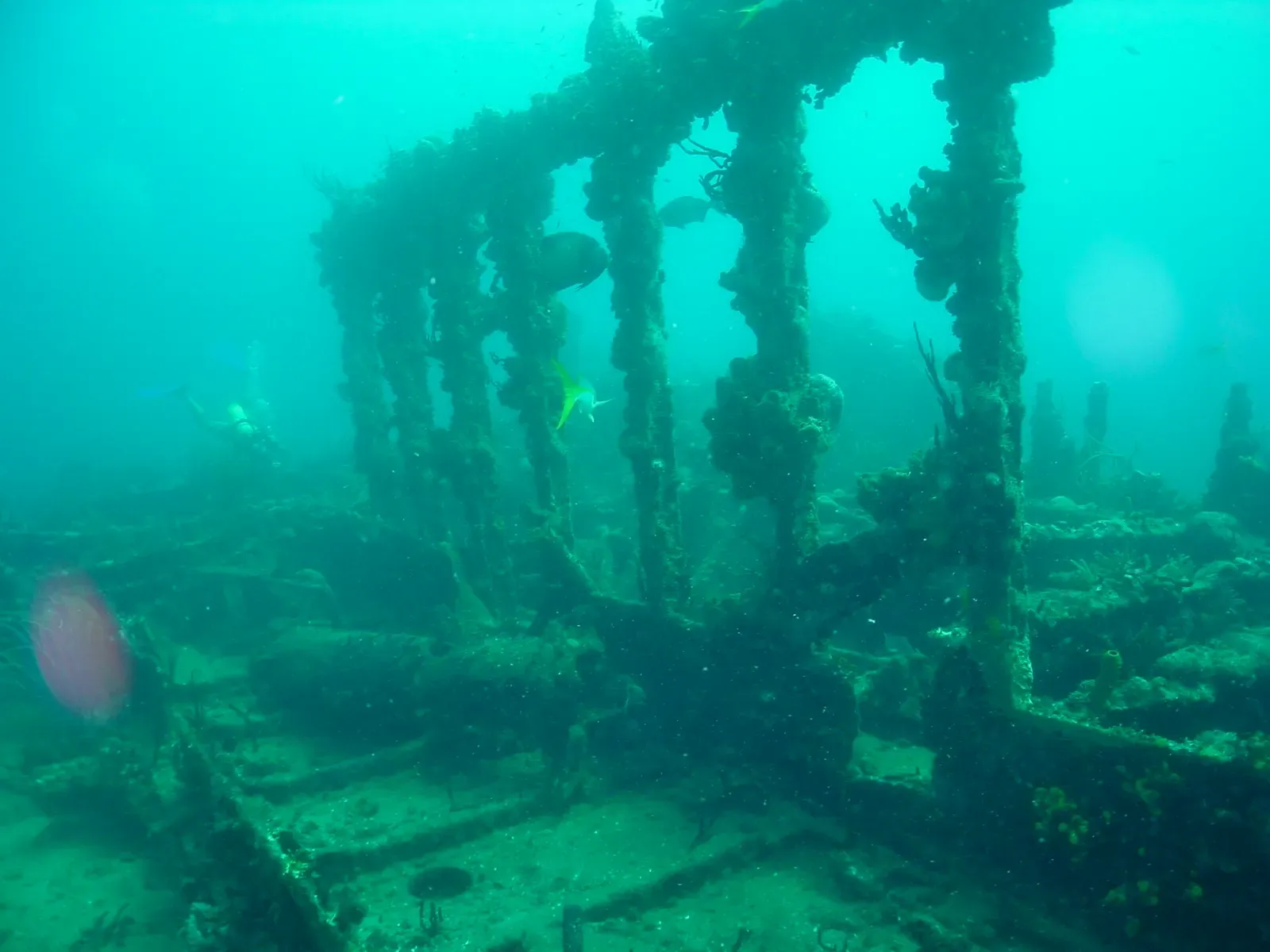
A cable-laying ship with a passage through its cable-handling hall
Area photo: SV Zanshin · CC BY-SA 3.0
Charlie Brown is a former cable-laying ship sunk as an artificial reef off Statia. Its upper structure offers a shallower view of the vessel, while deeper routes lead through the hallways and spaces once used to handle submarine cable.
Also known as Charles L. Brown, CS Salernum.
Where it is and how deep
17.4626° N, 62.9902° WApproximate position — the dashed circle shows where the site lies; your operator's briefing has the mooring.
The dive
The descent can use either the bow or stern mooring, depending on the current. At the deepest part of the route, the tapering bow and stern create large overhangs at 31 m. The upper wreck rises to around 18 m, allowing less experienced divers to stay above the deeper sections.
The Highway lies at 26 m: this wide, open hall once carried fibre-optic cable out from the cable tanks. A passage through the ship runs for about 40 m, followed by a crossing over the upper structure at around 17 m. Experienced divers can also explore the cable tanks, main galley and forward cable reel room.
Dense schools of horse-eye jacks gather above the hull, and barracuda live around the wreck, including a large resident nicknamed Charlie. Sailfin blennies live here too, with black jacks commonly found inside the vessel where portholes admit light. Algae on the white-painted surfaces attracted nudibranchs; sea turtles, lobsters and an octopus were among the early arrivals after sinking.
The wreck
- Vessel
- Charles L. Brown
- Type
- Cable-laying vessel
- Length
- 99.94 m (328 ft)
- Built
- 1954
- Sunk
- 2003
- Cause
- Deliberately sunk as an artificial reef and dive site
- Lies
- Bow and stern overhangs at 31 m; upper wreck rises to around 18 m.
Built in Naples, Italy, in 1954 as CS Salernum, the ship laid subsea fibre-optic telephone cables around the world. AT&T bought it through Transoceanic Cableship Co. in 1984. Statia acquired the vessel for a token $1, receiving it in August 2002. Island volunteers prepared it for an artificial reef; at 4 pm on July 25, 2003, the sea chests were opened to flood the ship. The vessel measures 99.94 m (327 ft).
Marine life and season
- Trevally & jacks
- Nudibranchs
- Sea turtles
- Octopus & cuttlefish
- Barracuda
| Jan | Feb | Mar | Apr | May | Jun | Jul | Aug | Sep | Oct | Nov | Dec |
|---|---|---|---|---|---|---|---|---|---|---|---|
| Prime | Prime | Prime | Prime | Good | Good | Good | Fair | Fair | Good | Good | Prime |
Season follows St. Eustatius: December to April is the drier stretch; August and September carry the hurricane peak, and diving may pause in September.
Know before you go
- Currents affect the choice between the bow and stern mooring lines.
- Routes into the cable tanks, galley and cable reel room involve wreck penetration.
Dive videos
C/S Charles L. Brown, Statia Golden Rock Divers · Golden Rock Dive Center on YouTube
C L Brown · lionfisheater on YouTube
Questions divers ask
What training suits the Charlie Brown wreck?+
Deep training suits the bottom at 31 m. Less experienced divers can stay on the upper wreck, which rises to around 18 m; the full route reaches deeper hallways and overhangs.
Can divers go inside Charlie Brown?+
Experienced divers can explore the cable tanks, main galley and forward cable reel room. The Highway is a wide, open hall at 26 m, with a passage of about 40 m through the ship.
How is Charlie Brown reached?+
The boat ride takes 10–12 minutes. The vessel has bow and stern mooring lines, with the choice depending on the current.
When and why was Charlie Brown sunk?+
The former cable-laying vessel was deliberately flooded on July 25, 2003, after island volunteers prepared it to become an artificial reef and dive site.
Sources
- Charles L. Brown - Dive Site — PADI
- Charlie Brown Artificial Reef — Golden Rock Dive Center (archived)
- Here are some more details on dive sites — Golden Rock Dive Center (archived)
- AT&T Corporation — Wikipedia
- Dive Sites — Scubaqua
- Dive sites — Golden Rock Dive Center
In The Logbook
- Ships sunk on purpose, and where to dive themWrecks · 14 min read
More dive sites in St. Eustatius
Artificial reef
STENAPA Reef
Garden-eel fields between a barge and a small tug
Wreck
Chien Tong
Green and hawksbill turtles settle on the wreck after sunset
Reef
Anchor Reef
A coral-covered French anchor of the 1750s, hooked into the reef
Reef
Barracuda Reef
Barracuda schools beside a volcanic mini-wall
Reef
Hangover
A lava maze with overhangs and sand-dwelling jawfish
Muck & macro
Blue Bead Hole
Seventeenth-century Dutch beads in the sand at 17 m
Reef
The Humps
Coral-covered lava bombs rising from white sand
Wall
The Cliffs
Creole wrasse above a cliff draped in wire coral
Similar dives elsewhere

A 1944 US Navy minesweeper, split in two at 26 metres

Two recompression chambers inside a submarine rescue ship
Four scuttled hulls on one mooring, from 20 to 27 m


A tug, a trawler and an oil barge share the bay