Berlengas & Peniche · Portugal · Wreck
Vapor do Trigo (Andreos)
A 1901 Greek steamer, still intact at 28–30 m
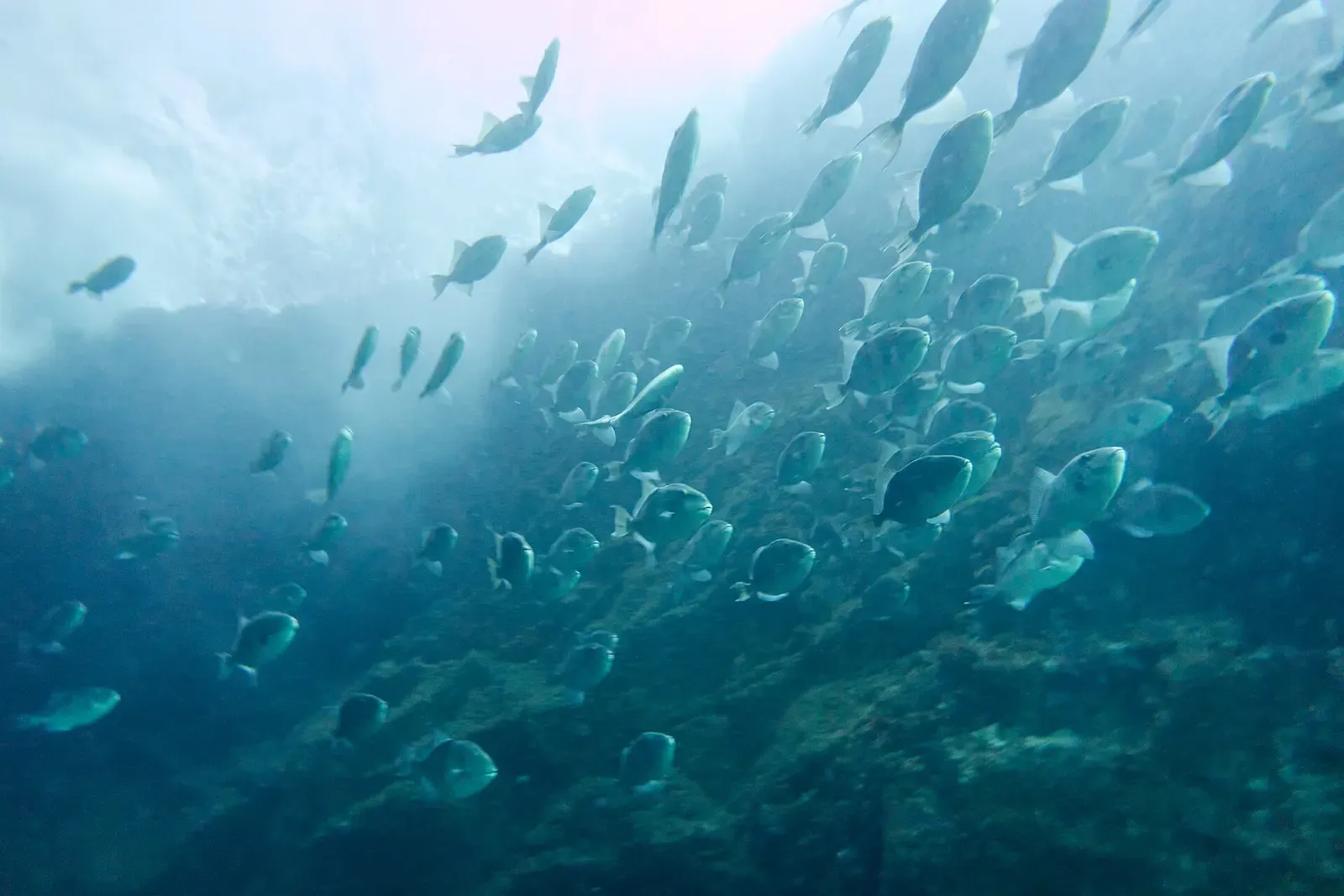
Area photo: Tiago Thedim · CC BY-SA 4.0
The wreck divers call Vapor do Trigo, the wheat steamer, was launched as the Andreos: a 4,438-ton Greek steam cargo ship built in 1901. She was lost in a storm on 20 November 1926, carrying wheat from Novorossiysk to Falmouth, and she is still very much intact at 28 to 30 metres. Her sheltered position means she can be dived in rough conditions that close the exposed sites.
Also known as Andreos.
Where it is and how deep
No published position for this site — the map shows Berlengas & Peniche and its other sites; operators know the mooring.
The dive
This is a deep dive by Berlengas standards. The wreck lies between 28 and 30 metres, so working time on the structure is short and the route is worth agreeing on the boat rather than at depth: down the line, one direction along the hull, back over the top, up. Because the ship held together, the descent lands you on recognisable structure rather than on a scatter of plates.
Large lobsters and conger eels hold in and around the boiler room, with solo snappers and schools of fish over the hull. The wreck's own reputation, though, is for moonfish drawn in by converging currents, and visitors can see up to ten of them. The damage is worth reading as you go: explosives were used to demolish the masts for navigation safety, and the wreck still carries what that did to it.
The wreck
- Vessel
- Andreos
- Type
- Greek steam cargo ship, 4,438 tons
- Built
- 1901
- Sunk
- 1926
- Cause
- Lost in a storm on 20 November 1926 while carrying wheat from Novorossiysk to Falmouth
- Lies
- Largely intact at 28–30 m, damaged where the masts were demolished with explosives
She was built in 1901 by N. Goulandris Bros. & Z. A. Vrondisis and named Andreos, a Greek steam cargo ship of 4,438 tons. On 20 November 1926 she was lost in a storm while carrying wheat from Novorossiysk to Falmouth, which is where the Portuguese name Vapor do Trigo, the wheat steamship, comes from. The wreck later suffered damage from explosives used to demolish her masts for navigation safety.
Marine life and season
- Mola mola
- Macro critters
- Reef fish swarms
| Jan | Feb | Mar | Apr | May | Jun | Jul | Aug | Sep | Oct | Nov | Dec |
|---|---|---|---|---|---|---|---|---|---|---|---|
| Off-season | Off-season | Fair | Fair | Good | Prime | Prime | Prime | Prime | Good | Fair | Off-season |
Season follows Berlengas & Peniche: June to October is the high season; from December to February the Atlantic swell allows diving only on occasional calm days.
Know before you go
- At 28–30 m in cold water the no-stop time is short, so set a turn time before the descent rather than working it out on the wreck.
Questions divers ask
How deep is Vapor do Trigo?+
The wreck lies between 28 and 30 metres, with 28 metres given as the average depth. That makes it an Advanced-level dive with a short working time on the structure.
Sources
- Vapor do Trigo dive site — Portugal Dive
- Diving in Berlenga — Centre of Portugal
More dive sites in Berlengas & Peniche
Reef
A platform at 25 m on the north side before the drop to 40 m
Cave & cavern
The archipelago's simplest dive, 6 m average in a sheltered bay
Reef
Sand, a small cavern and a broken wreck, all inside 15 m
Wreck
A 1947 coal steamer, largely intact from 15 m to 30
Canyons and underwater arches beside a dog-shaped rock
Wall
Gorgonian wall from 13 m to 35, conger in the cracks
Reef
A reef head that breaks at high tide, walls to 32 m
Reef
Abrupt granite canyons at 16 m on Berlenga's exposed side
Similar dives elsewhere
A steamer on its side under gorgonian growth, at 18–31 m
An 1856 steamship broken across the bottom from 22 m to 30 m

A First World War cargo ship with its propeller and rudder still in place
Wreck
Orseolo Pietro wreck
Glénan Archipelago · France
A propeller shaft hung with sea fans on a 142 m wartime cargo ship