Labuan & Brunei Wrecks · Labuan, Malaysia · Wreck
Cement Wreck
MV Tung Hwang: a 92 m freighter standing upright off Labuan from 8 m to 32 m
She sank in 1980 carrying cement for the Sultan of Brunei's new palace. The freighter struck Samarang Bank and settled on sand off Kuraman Island, in Malaysian waters, her masts within about 8 m of the surface and the seabed at 32 m. She is the shallowest and most forgiving of the four Labuan wrecks, used for wreck-diving training, and a gazetted heritage site since 2011. Labuan has little dive infrastructure of its own, so most trips are arranged from Brunei or Sabah.
Also known as Tung Hwang, MV Tung Hwang, Tung Hwuang.
Where it is and how deep
5.1870° N, 115.0887° EPublished position for this site.
The dive
She stands upright on hard sand with nothing else around her, so the descent lands on structure rather than a search for it. The wreck is dived in tiers: the masts reach to within about 8 m of the surface at low tide, the wheelhouse roof sits at 14 m, the main deck runs at 19 to 22 m, and the sand alongside the hull is at 30 to 32 m. That spread is what makes her work for a mixed group. She is 92 m long with a 15 m beam, more ship than one dive covers, so a circuit usually takes a section of deck and then drops down one side.
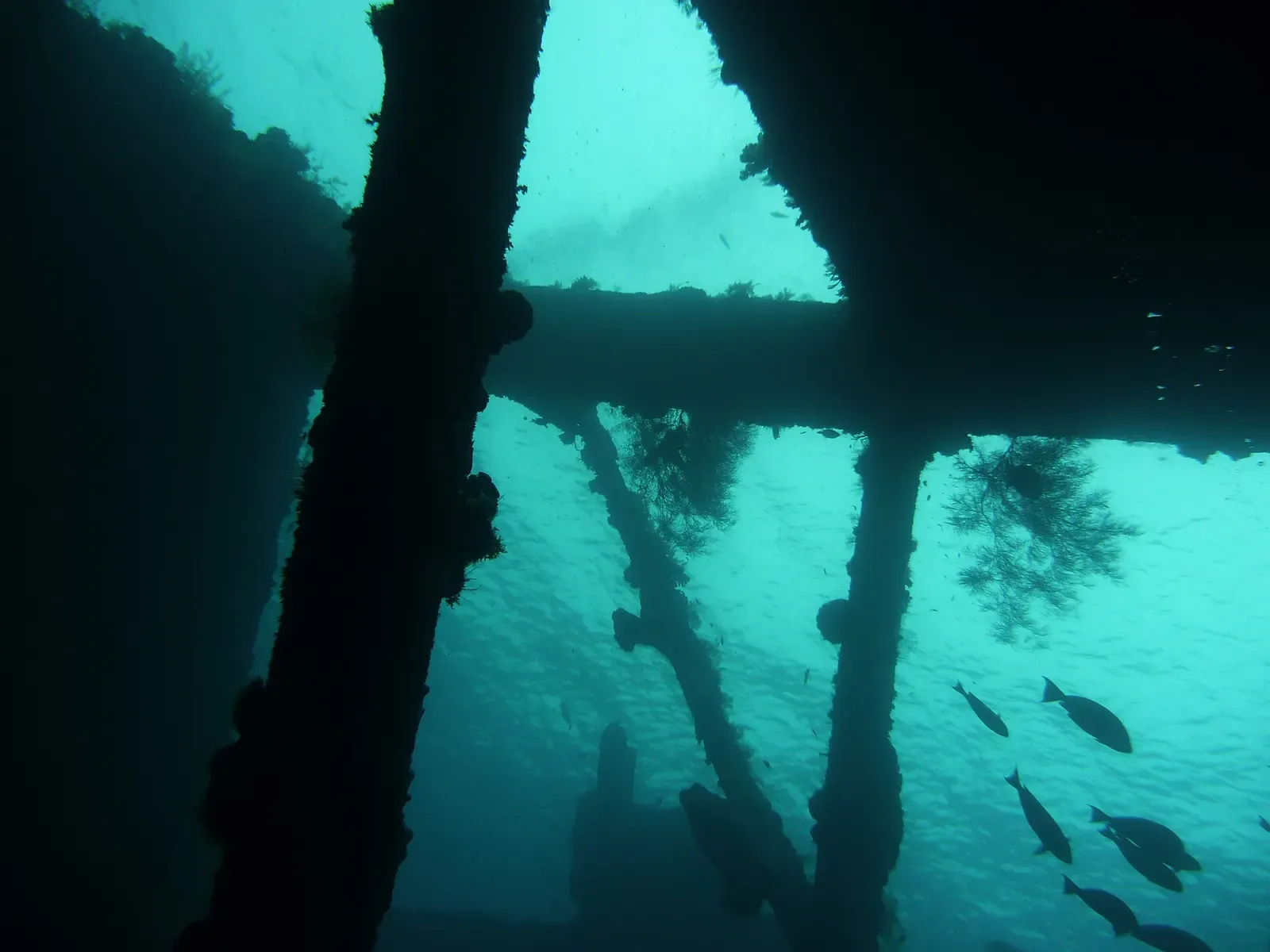
From the wheelhouse the cargo deck runs away into the haze, and the way she sits — upright, open, lit from above — makes her the easiest of the Labuan wrecks to pass through. Operators use her for wreck-diving training, and the Brunei centre that dives this group rates her and the Australian Wreck as the safest to enter. Holds, accommodation and the engine room beyond them are open to trained divers, but the funnel came down in the late 1990s and storms in 2002 tore out superstructure panelling, so she is less solid than she looks.
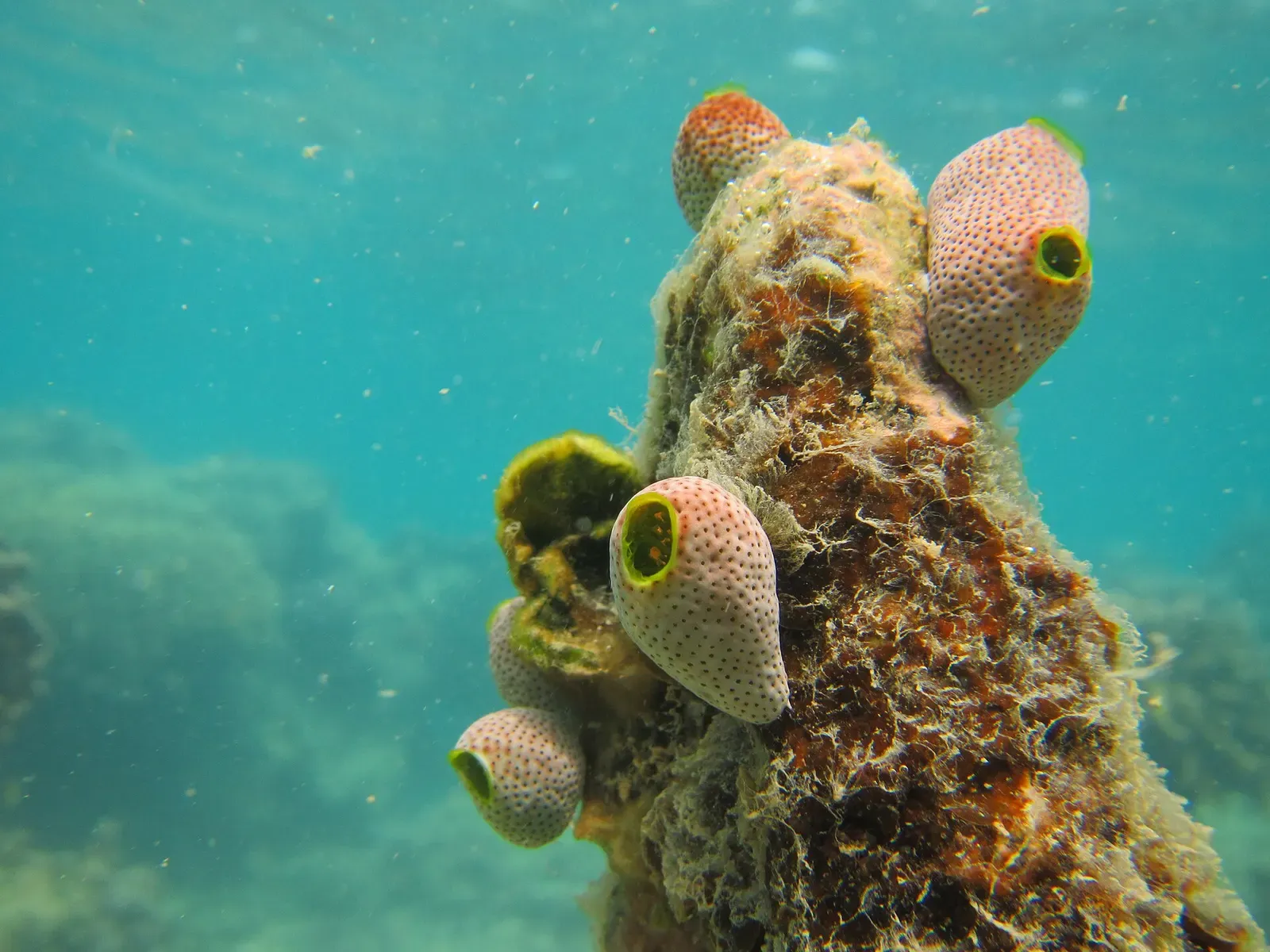
The upper half carries a garden of soft and hard corals, sponges, feather stars and anemones, which is why this is the wreck people here bring a camera to. Schools of small barracuda patrol the masts, batfish come to divers, and trevally, grouper, lionfish, pufferfish and octopus work the length of the hull. Nudibranchs and smaller critters live in the growth on the plating, turtles pass through, and whale sharks turn up over the wreck occasionally, though sightings are rare.
The logistics are the awkward part. Labuan has no dive centre, so the day is run from Brunei or from Sabah, roughly half an hour by boat out to the wreck off Kuraman Island, and visibility is usually 5 to 20 m with little current to speak of. The site is also legally protected: Labuan's wrecks were gazetted as a protected zone in 2011 under the National Heritage Act 2005, so everything on her, cargo included, stays where it is.
The wreck
- Vessel
- MV Tung Hwang (IMO 6618421)
- Type
- Japanese-built cargo freighter
- Length
- 92 m (302 ft)
- Sunk
- 1980
- Cause
- Struck Samarang Bank on 25 September 1980 while carrying cement to Brunei; no lives were lost
- Lies
- Upright on hard sand: masts to about 8 m, deck at 19 to 22 m, seabed at 30 to 32 m
She was carrying cement for the Sultan of Brunei's new palace when she ran onto Samarang Bank on 25 September 1980 and sank without loss of life. A 2025 survey of Labuan's wrecks by Universiti Malaysia Sabah historians, working from nautical records and admiralty court proceedings, puts the loss down to the captain's choice of route; the palace she was supplying, Istana Nurul Iman, was finished in 1984 regardless. The ship — 92 m long, 15 m in the beam, IMO 6618421 — settled upright near Kuraman Island, and on 23 September 2011 the Department of National Heritage gazetted Labuan's wreck sites, this one among them, as a protected zone.
Marine life and season
- Barracuda
- Trevally & jacks
- Groupers
- Reef fish swarms
- Nudibranchs
- Macro critters
- Octopus & cuttlefish
- Sea turtles
- Whale sharks
| Jan | Feb | Mar | Apr | May | Jun | Jul | Aug | Sep | Oct | Nov | Dec |
|---|---|---|---|---|---|---|---|---|---|---|---|
| Fair | Fair | Good | Prime | Prime | Prime | Prime | Good | Good | Good | Fair | Fair |
Season follows Labuan & Brunei Wrecks: Calm seas and better visibility run March to October, with April to July the best stretch; the wet season from November to February is rougher and murkier.
Know before you go
- The sand alongside the hull is at 30 to 32 m, far deeper than the masts suggest: fix a maximum depth before you descend rather than following the structure down.
- Old fishing net hangs from the masts and upper structure and more of it lies inside the holds. Carry a cutting tool and treat mesh as a reason to back out, not swim through.
- She is the easiest of these wrecks to enter, but the holds and engine room are an overhead environment at depth: torch, planned route and wreck training, or stay outside.
- The funnel collapsed in the late 1990s and storms in 2002 opened up the superstructure, so corroded plating and loose panels are something to look at rather than hold.
- The wreck is a gazetted protected zone: removing anything from her, cargo and fittings included, is an offence under Malaysia's National Heritage Act 2005.
Dive videos
Cement Wreck Labuan Scuba Diving in Malaysia (The Worlds Most Colourful and Photogenic Wreck) · Perling on YouTube
Cement wreck, The best of Labuan Wreck Diving · Dive Buddy (Malaysia) on YouTube
Diving in Cement Wreck in April 2022 · SirNoordin & Zazah Adventures on YouTube
Questions divers ask
How deep is the Cement Wreck?+
She stands from about 8 m to 32 m. The masts reach to within roughly 8 m of the surface at low tide, the wheelhouse roof is at 14 m, the main deck runs at 19 to 22 m and the sand alongside the hull is at 30 to 32 m, so you choose your depth by which part of the ship you visit.
Can beginners dive the Cement Wreck?+
Yes, on the upper structure. She is the easiest of the Labuan wrecks to move around and is used for wreck-diving training, and Open Water divers stay on the masts, wheelhouse and upper deck. The sand at 32 m calls for Advanced, and the holds and engine room for wreck training.
What ship is the Cement Wreck?+
The MV Tung Hwang, IMO 6618421, a Japanese-built cargo freighter 92 m long and 15 m in the beam. She was carrying cement to Brunei for the construction of Istana Nurul Iman when she struck Samarang Bank on 25 September 1980 and sank, with no lives lost.
Is the Cement Wreck in Brunei or Malaysia?+
In Malaysia. She lies off Kuraman Island in Labuan waters, a Malaysian federal territory, and is one of the four Labuan wrecks gazetted as a protected zone in 2011. Labuan has little dive infrastructure of its own, so she is usually dived on trips arranged from Brunei or Sabah, alongside the wrecks on the Brunei side of the border.
Sources
- Sekilas Sejarah Kapal Karam di Pulau Labuan, 1895-1983 — MINDEN Journal of History and Archaeology
- Labuan Shipwrecks Offer Divers A Journey Through History And Marine Wonders — Bernama
- Cement Wreck dive site — PADI
- Wreck diving in Labuan — PulauLabuan.com
- Cement Wreck — Asia Dive Site
- Dive Sites in Brunei — Poni Divers
- Labuan — Wikivoyage
- Diving in Brunei — Wikivoyage
In The Logbook
- Deep wreck diving: where recreational stopsWrecks · 8 min read
- Where to dive with whale sharks, month by monthBig animals · 16 min read
More dive sites in Labuan & Brunei Wrecks
Wreck
USS Salute: a 56 m minesweeper mined in 1945, broken in two at 22–32 m in Brunei Bay
Wreck
SS De Klerk: an 85 m Dutch steamer on her port side at 28–34 m in Brunei Bay
Wreck
Dolphin 88: a stone barge sunk off Pelong Rocks in 2013, top at 10 m, back half at 24 m
Similar dives elsewhere

A bulldozer and cement bags still in the cargo holds
Upright and intact, deck at 18-24 m, holds open
A fish-filled wreck at 30 m below a patchy coral slope
A 125 m cargo ship on a sand slope 30 m off the beach