A schedule, or a lottery
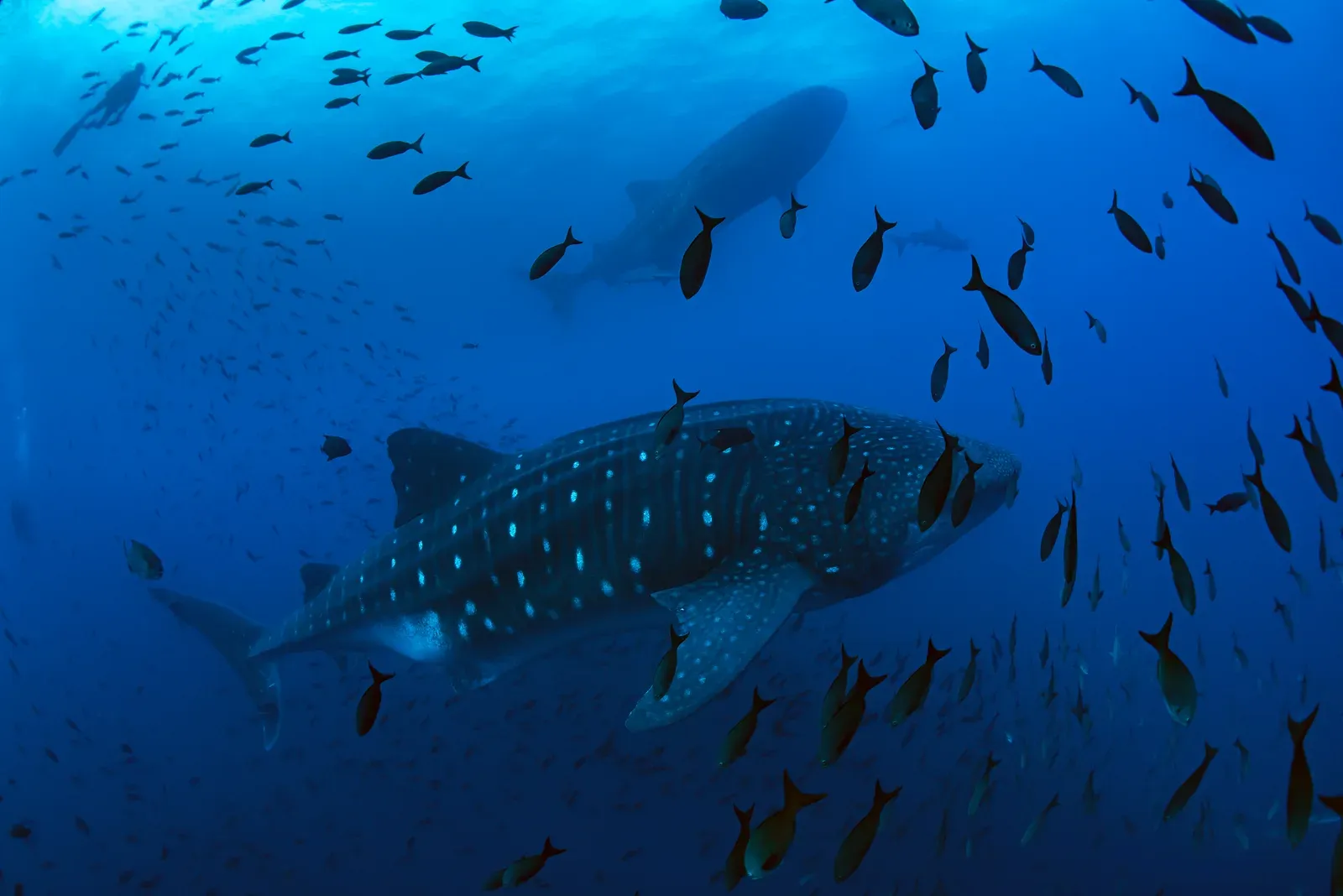
Thirty-nine of the sites we list carry whale sharks in their marine-life record, and they are not thirty-nine versions of the same dive. In a handful, the sharks come to eat something that is dependably there — baitfish spilling from a lift net, a slick of snapper spawn, a plankton bloom that arrives in the same weeks each year — and an operator can sell you a date against it. Everywhere else, a whale shark is a large animal that happened to pass a seamount while you were hooked into the rock. Both are worth diving. Only one is worth building a trip around, and telling them apart before you book is the whole job.
The animal explains the split. The whale shark is the largest fish alive: the biggest reliably measured individual was 18.8 m long, and a 2020 study put the average adult size at 8 to 9 m for males and around 14.5 m for females. It eats plankton, krill, fish eggs and small schooling fish two ways — swimming with its mouth open, which is ram filtration, and hanging almost still while it sucks water in. The first behaviour puts it anywhere a current is carrying food, which is most of an ocean. The second pins it to wherever the food is concentrated, and that is the only kind of place a calendar can be built on.
It is also Endangered, uplisted from Vulnerable on the IUCN Red List in 2016 on an inferred decline of more than half over three generations, and on Appendix I of the Convention on Migratory Species since 2017. Where your money goes matters more here than at most big-animal sites.
Where and when
Each row below is a site, each column a month, and the colour is the season rating from that site’s own page. Read it with one thing in mind: none of these sites carries a whale shark calendar of its own. The colour is the diving season — when the boats run, the sea is flat and the water is clear. At the aggregation sites the two coincide, because the operator’s season was built around the animal. At the pinnacles they do not, and the gap is where trips go wrong.
| Site | Jan | Feb | Mar | Apr | May | Jun | Jul | Aug | Sep | Oct | Nov | Dec |
|---|---|---|---|---|---|---|---|---|---|---|---|---|
| Kwatisore BagansCenderawasih Bay | Good | Good | Good | Good | Prime | Prime | Prime | Prime | Prime | Prime | Good | Good |
| South Ari Atoll Marine Protected AreaAri & Rasdhoo Atolls | Prime | Prime | Prime | Prime | Fair | Good | Good | Good | Good | Good | Fair | Prime |
| Arta Beach Whale Shark GroundsDjibouti | Prime | Prime | Good | Fair | Fair | Fair | Fair | Fair | Fair | Good | Prime | Prime |
| Ghoubbet al-KharabDjibouti | Prime | Prime | Good | Fair | Fair | Fair | Fair | Fair | Fair | Good | Prime | Prime |
| Shib HabilFarasan Banks & Al Lith | Good | Good | Prime | Prime | Prime | Fair | Fair | Fair | Fair | Good | Good | Good |
| Gladden SpitBelize Barrier Reef | Good | Good | Prime | Prime | Prime | Prime | Good | Fair | Off-season | Off-season | Fair | Good |
| Black HillsUtila | Good | Good | Prime | Prime | Prime | Prime | Prime | Prime | Fair | Fair | Good | Good |
| PintuyanSouthern Leyte | Prime | Prime | Prime | Prime | Good | Good | Fair | Fair | Fair | Good | Prime | Prime |
| Tuna AlleyDonsol & Ticao Pass | Good | Prime | Prime | Prime | Prime | Good | Fair | Fair | Fair | Fair | Good | Good |
| Darwin's ArchGalápagos | Good | Good | Good | Good | Good | Prime | Prime | Prime | Prime | Prime | Prime | Good |
| Roca PartidaRevillagigedo (Socorro) | Prime | Prime | Prime | Good | Fair | Off-season | Off-season | Off-season | Off-season | Off-season | Fair | Good |
| El Bajo SeamountSea of Cortez | Fair | Fair | Fair | Good | Good | Prime | Prime | Prime | Prime | Prime | Good | Fair |
| El FaroJardines de la Reina | Prime | Prime | Prime | Prime | Good | Fair | Fair | Fair | Off-season | Off-season | Good | Prime |
| The PinnacleRichelieu Rock | Good | Prime | Prime | Prime | Off-season | Off-season | Off-season | Off-season | Off-season | Off-season | Good | Good |
| Chumphon PinnacleKoh Tao | Good | Good | Prime | Prime | Prime | Good | Good | Good | Good | Fair | Fair | Good |
| Hin Daeng WallHin Daeng & Hin Muang | Prime | Prime | Prime | Prime | Fair | Off-season | Off-season | Off-season | Off-season | Fair | Good | Prime |
| Blue CornerPalau | Prime | Prime | Prime | Good | Good | Fair | Fair | Fair | Fair | Good | Good | Prime |
| FarikedeFuvahmulah | Prime | Prime | Prime | Prime | Good | Good | Good | Good | Good | Fair | Fair | Prime |
| Shark BankSeychelles | Good | Good | Prime | Prime | Good | Fair | Fair | Good | Prime | Prime | Good | Good |
| El BajónEl Hierro | Good | Good | Good | Good | Good | Prime | Prime | Prime | Prime | Prime | Good | Good |
Where the two calendars disagree, it is worth knowing before you pay:
- Jardines de la Reina dives best November to May, and El Faro’s whale sharks are a July-to-November possibility — a window that runs straight through September and October, the two months operators avoid at the hurricane peak.
- Socorro has the opposite problem: liveaboards run mid-November to May because June to October seas close the crossing, but whale sharks at Roca Partida and El Boiler are an occasional sighting in any of those months, never a reliable one.
- Galápagos is the rare case where the two agree. The cool, nutrient-rich water of June to November brings the biggest hammerhead schools and the whale sharks together, with the first animals at Darwin’s Arch in early July.
- Richelieu Rock sits inside a park that closes mid-May to mid-October; within the open season, February to April is when the plankton blooms peak and the sharks are most reliable.
- Koh Tao is dived year-round, but Chumphon Pinnacle’s whale sharks are recorded February to May and again in September.
- The Similan Islands close mid-May to mid-October, and the manta and whale shark peak is December to March.
- Seychelles whale sharks move through the inner-island channels from August into October, and are usually snorkelled from the boat rather than met on the pinnacle.
- Christmas Island is driest and calmest May to September, but the sharks pass November to April, around the red crab spawning.
The Atlantic and the Caribbean
Gladden Spit is the clearest schedule in the Atlantic and also the shortest. Thirty-six kilometres off Placencia, a shelf runs out from the reef and drops from about 40 m (130 ft) towards 2,000 m within 10 km, and mutton snapper and grouper hold a ten-day spawning aggregation along that edge between March and June. The whale sharks come for the eggs. Cubera snapper spawn on the same edge on lunar cycles from May to August and the sharks feed on those too. It is blue-water diving with nothing underneath, rated advanced for that rather than for depth, and it happens inside the reserve’s dedicated whale shark and reef-fish spawning aggregation conservation zone. The aggregation is ten days at a time, not a season: plan the dates or accept a reef dive.
Black Hills is the softer version. Utila sits on the edge of the Cayman Trench with nutrient-rich upwellings year-round, peaking in spring and late summer, and Black Hills is the island’s blue-water seamount — up to within 10 m of the surface, base past 40 m, strong current at the surface and on the down-current side. The sharks pass over and around it during the spring and autumn aggregations rather than settling on it, and the in-water encounters are snorkel-only under local rules, depending on the boat finding a surface feed.
El Faro in Cuba is a lottery ticket with a season printed on it: a seamount rising from over 30 m to within 6 m of the surface, dived early in the morning when the current is mild, with whale sharks possible from July through November. El Bajón, 300 m off La Restinga, is the southernmost dive in Spain — a submarine volcano inside the Mar de las Calmas reserve, two humps up to within 8 or 9 m and walls falling to about 50 m, or 80 m on the face that looks out to open sea. Current runs on almost every dive, which is what packs the mount with barracuda, amberjack and tuna; whale sharks and hammerheads turn up now and then. Boats tie to a mooring buoy rather than anchor, one boat per buoy, twelve divers maximum.
Then there is RFA Darkdale, which belongs here for a reason that is not the wreck. St Helena has its own whale shark aggregation from December to March, and it is snorkel-only. The Darkdale is the island’s deepest dive at 45 m — a Dale-class fleet tanker torpedoed at anchor in James Bay by U-68 on 22 October 1941, broken in two, nine of her fifty crew surviving — and the sharks turn up over the site, which makes the long ascent the part of that dive worth watching.
| Site | Depth | Current | Level | Best months |
|---|---|---|---|---|
| Gladden Spit Belize Barrier Reef · Belize | to 40 m | Moderate | Advanced | Mar–Jun |
| Black Hills Utila · Honduras | 10–40 m | Strong | Advanced | Mar–Aug |
| El Faro Jardines de la Reina · Cuba | 6–30 m | Mild | Intermediate | Dec–Apr |
| El Bajón El Hierro · Spain | 18–40 m | Strong | Advanced | Jun–Oct |
| RFA Darkdale St Helena · United Kingdom | to 45 m | Mild | Advanced | Dec–Mar |
The eastern Pacific
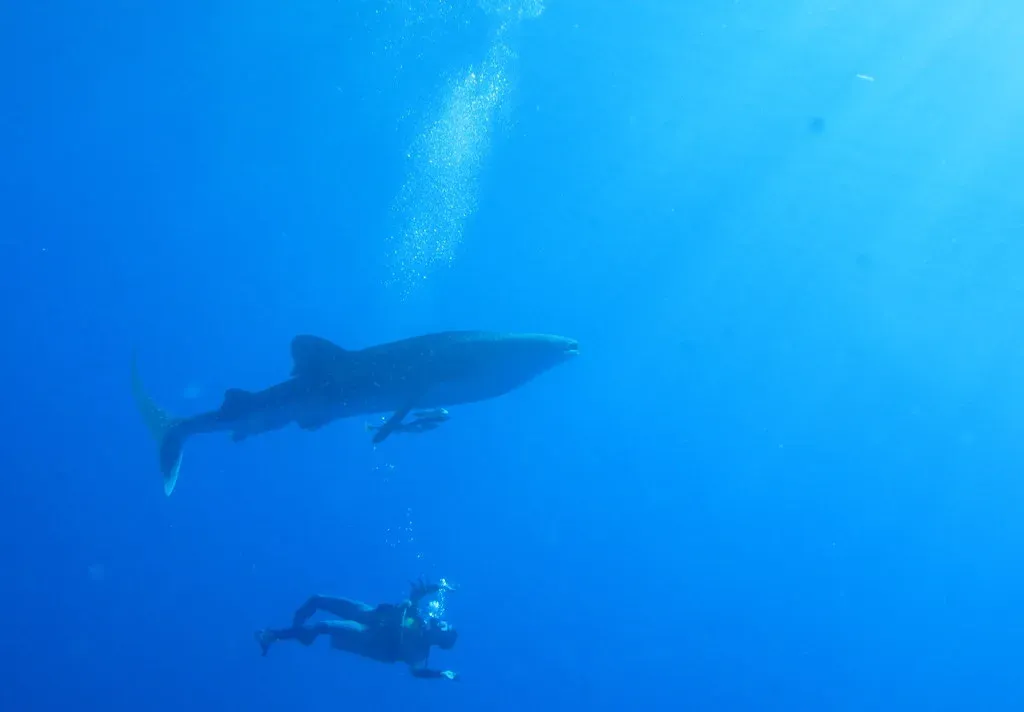
Darwin's Arch gives the best odds on this list that are not an aggregation. You drop onto a rocky slope a kilometre off Darwin Island — the arch itself collapsed in 2021 — settle between 18 and 24 m and stop swimming while the current runs past. The whale sharks here are large, recorded at up to 14 m, and unusual: a study across 2011 to 2013 found that 91.5% of the animals seen around Darwin Island were adult females. Access is liveaboard only.
Socorro’s two big-animal rocks list them as passers-by. Roca Partida is a bare rock standing alone in open ocean, small enough to circumnavigate on one dive, with vertical walls past 40 m to a base below 50 m and nothing to look at but the blue beside it; oceanic whitetips, hammerheads and whale sharks all cross it. El Boiler is the archipelago’s manta dive, a pinnacle from a base at around 50 m to within 6 or 7 m of the surface, and tiger sharks and whale sharks show up in the same water. Both are liveaboard-only, and Roca Partida also needs permits from the Mexican Armed Forces to enter the military zone around the island.
Up in the Sea of Cortez, El Bajo Seamount — charted as Marisla Seamount — is three peaks topping out at 16, 21 and 25 m with nothing showing at the surface, so the dive starts as a descent into open water. It is dived for scalloped hammerheads in schools of up to 100 animals, with whale sharks, giant mantas and amberjacks over the same structure. Cabo Pulmo logs them at two sites from opposite ends of the difficulty scale: El Bajo is an 11-to-18 m hard-coral reef comfortably inside Open Water limits, and Los Morros is rated advanced at 9 to 17 m — not for depth, but for swift current, water down to about 20 degrees and visibility that falls to around 5 m in winter.
The outlier is Molokini Back Wall. PADI gives the site a maximum of 30 feet (9 m) on a face that keeps going to 300 feet (91 m), so it is a drift run high on a wall with no bottom under the group at all; grey reef and Galápagos sharks patrol the blue and, with luck, a whale shark comes past.
| Site | Depth | Current | Level | Best months |
|---|---|---|---|---|
| Darwin's Arch Galápagos · Ecuador | 18–24 m | Strong | Advanced | Jun–Nov |
| Roca Partida Revillagigedo (Socorro) · Mexico | to 40 m | Moderate | Advanced | Jan–Mar |
| El Boiler Revillagigedo (Socorro) · Mexico | 6–30 m | Strong | Advanced | Jan–Mar |
| El Bajo Seamount Sea of Cortez · Mexico | 16–25 m | Moderate | Advanced | Jun–Oct |
| El Bajo Cabo Pulmo · Mexico | 11–18 m | Mild | Beginner | Jun–Oct |
| Los Morros Cabo Pulmo · Mexico | 9–17 m | Strong | Advanced | Jun–Oct |
| Molokini Back Wall Maui, Molokini & Lānaʻi · United States | to 9 m | Moderate | Advanced | Dec–Mar |
The Indian Ocean and the Red Sea
Three of the most schedulable encounters in diving are in this half of the world, and one of them is not a dive.
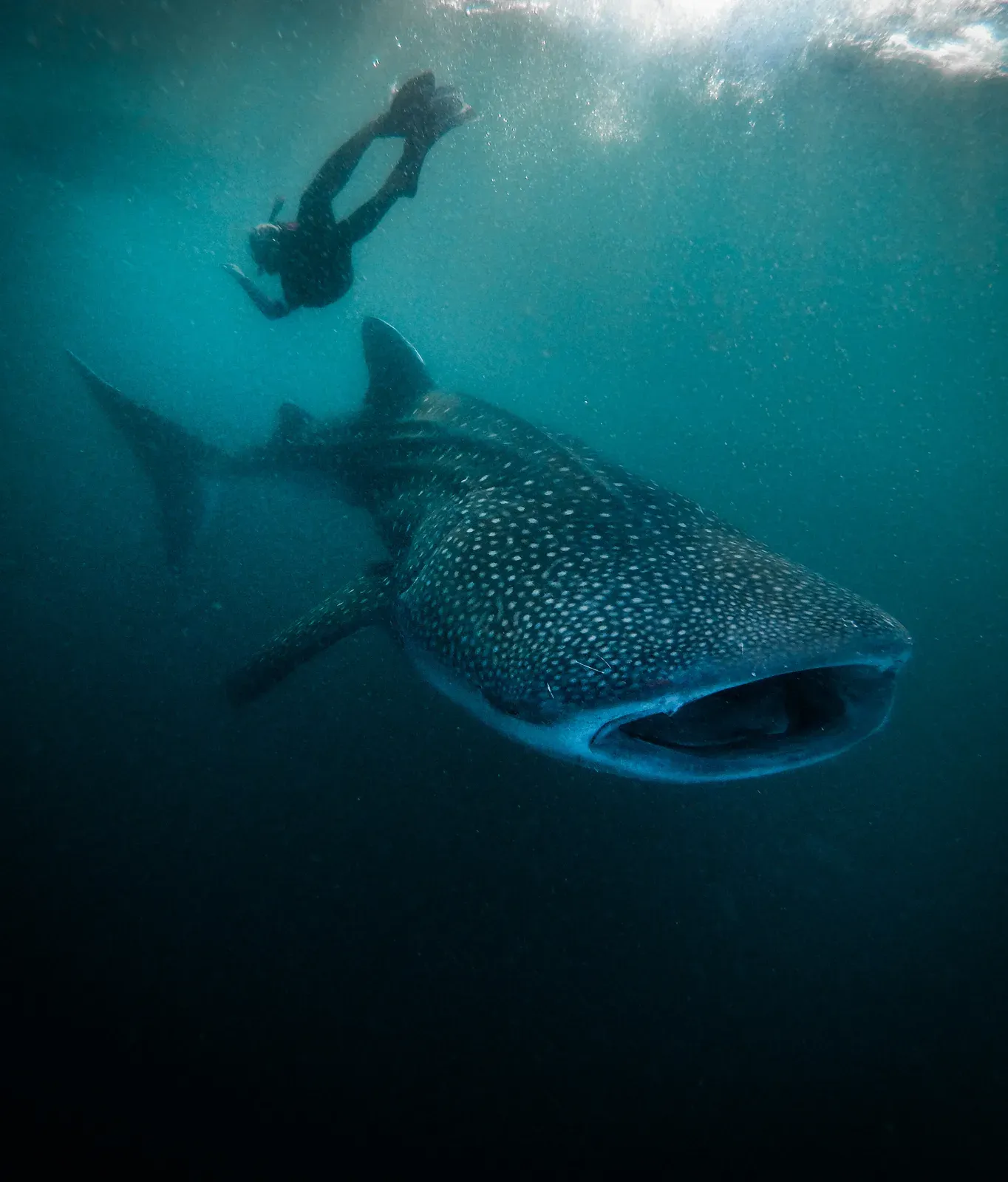
Arta Beach Whale Shark Grounds has no dive plan in the usual sense. The winter plankton bloom in the Gulf of Tadjoura draws juvenile whale sharks in along the Arta shoreline, the boat runs the coast watching for a fin, and the group slides in ahead of the animal and lets it come through. Encounters happen at the surface, on a breath-hold, and no certification is required; the season runs November to February and peaks in December and January, inside the 40.1 km² Arta marine protected area declared by presidential decree in 2014. Divers who want a tank on their back go west, to the head of the gulf and Ghoubbet al-Kharab, where whale sharks move into the near-landlocked cove from late October to February with November to January the prime window — but the diving there is the Crack, a coral-covered fissure as shallow as 8 m, and the channel outside it is worked at 35 to 45 m in current that can exceed 2 knots.
Shib Habil off Al Lith is the most precise window on this list. Between March and May, juvenile whale sharks gather over a reef platform crested at about 8 m to feed on plankton blooms — usually two to four animals, occasionally as many as ten, mostly 3 to 7 m long with an average around 4 m and roughly equal numbers of males and females. They are largely gone from July onward, and outside the window it is a plain coastal reef. It is liveaboard-only, departures are few and often sold as whole-boat charters, and the exposed face of the platform drops to about 80 m, so agree a floor before you go in.
South Ari Atoll Marine Protected Area is the year-round one. The protected area is a strip a kilometre wide and 42 km² in extent, running from the western reef edge at Rangali to the northern reef at Dhigurah, and it is one of the only places in the world where whale sharks are resident in every month. The scuba is a long drift down a gentle reef slope to a sandy floor at 30 m, going in with the tide; the sharks are usually found by boats working the length of the strip watching the surface, and a sighting typically turns into a group snorkelling alongside for as long as the animal stays up.
The rest of the region is structure. Farikede is a short, hard drift over a plateau, worked to a maximum of 30 m, where hammerheads, threshers, silvertips, oceanic mantas, mola mola and whale sharks all come up out of the blue. Shark Bank off Mahé concentrates its fish between 18 and 30 m, and whale sharks are around from late August into October. Lima Rock has a cleaning station on its exposed eastern end that has produced whale sharks, rays and sunfish, on limestone cliffs that carry on underwater as drops of more than 60 m. And West White Beach is one of the easiest dives in this guide and the hardest to reach: shore to 15 m and graded beginner, but four-wheel drive to get near it and then a hard walk through dense rainforest with kit.
| Site | Depth | Current | Level | Best months |
|---|---|---|---|---|
| Arta Beach Whale Shark Grounds Djibouti · Djibouti | to 5 m | Mild | Beginner | Nov–Feb |
| Ghoubbet al-Kharab Djibouti · Djibouti | 8–35 m | Strong | Advanced | Nov–Feb |
| Shib Habil Farasan Banks & Al Lith · Saudi Arabia | 8–25 m | Moderate | Intermediate | Mar–May |
| South Ari Atoll Marine Protected Area Ari & Rasdhoo Atolls · Maldives | to 30 m | Moderate | Intermediate | Dec–Apr |
| Farikede Fuvahmulah · Maldives | to 30 m | Strong | Advanced | Dec–Apr |
| Shark Bank Seychelles · Seychelles | 18–30 m | Moderate | Advanced | Mar–Apr |
| Lima Rock Musandam · Oman | to 30 m | Strong | Advanced | Mar–Apr |
| West White Beach Christmas Island · Australia | to 15 m | Mild | Beginner | May–Sep |
The Andaman Sea and the Gulf of Thailand
Everything here is a lottery, but the tickets are cheap: this is Thailand and its neighbours, on day boats and short liveaboards off a coast you were probably visiting anyway.
The Pinnacle is the famous one. The summit of the seamount breaks to within 2 or 3 m of the surface at low tide and is close to invisible at high water, and the flanks fall away on every side towards a base past 35 m, with the site maximum around 33 m. Boats work an anchor line and the standing advice is to hold it on the way down and the way back up. Most of what the rock is known for is small and well hidden — frogfish, harlequin shrimp, ghost pipefish — but February to April is the window for the large pelagics, whale sharks and mantas included, and the shallow summit is the best place to watch for them.
Hin Daeng Wall, 50 km south of Ko Lanta, is only reliably diveable November to April and is dived in the 25-to-40 m band on red soft-coral walls. Giant mantas are what it is famous for; whale sharks turn up on the same walls far less predictably. Dixon's Pinnacle off Havelock is a cleaning station on three soft-coral pinnacles, and the animals it cleans are mostly mantas, mobulas, turtles and napoleon wrasse, with the occasional whale shark; the 35 m maximum puts Deep Diver on PADI’s list alongside Advanced Open Water. Boulder City is a field of granite blocks on sand off Ko Payan, usually worked 10 to 25 m with a 40 m maximum, and its own record is honest about the odds: mantas and whale sharks are both possible, but neither is anything to plan a dive around.
The Gulf side is a set of submerged granite towers. Chumphon Pinnacle tops out at about 14 m with nothing showing at the surface and drops to 26 m; the schooling barracuda and jacks are the reason to go, and whale sharks are recorded there February to May and again in September. Southwest Pinnacle is seven pinnacles 13 km south-west of the island, crown at 5 m and base at 30 m, and the shallow crown makes the safety stop easy in a way Chumphon’s does not. Sail Rock — Hin Bai — stands 15 m above the water roughly between Koh Tao and Ko Samui and is dived from both shores, so it appears in the directory once from each side, as Sail Rock and as Sail Rock Pinnacle; the two entries grade it differently, which is a fair reflection of a rock that runs to 40 m or more in moderate-to-strong current. Its feature is the Chimney, a vertical shaft inside the rock entered at about 18 m and exited between 12 and 6 m.
Two outliers close the region. Western Rocky in Myanmar is liveaboard-only, and its best-known feature is an overhead: a tunnel runs right through the centre of the island from 17 m to a maximum of 24 m, narrowing to single file near its northern exits, with a nurse shark around three metres long that can make it impossible to get through. Whale sharks are an occasional visit on top of all that. Koh Prins is five to six hours off the Cambodian mainland at the far end of the overnight run, and its whale sharks are reported in December and again in May.
| Site | Depth | Current | Level | Best months |
|---|---|---|---|---|
| The Pinnacle Richelieu Rock · Thailand | 2–33 m | Moderate | Advanced | Feb–Apr |
| Hin Daeng Wall Hin Daeng & Hin Muang · Thailand | 25–40 m | Strong | Advanced | Dec–Apr |
| Dixon's Pinnacle Andaman Islands · India | to 35 m | Moderate | Advanced | Dec–Mar |
| Boulder City Similan Islands · Thailand | 10–25 m | Mild | Advanced | Dec–Mar |
| Western Rocky Mergui Archipelago · Myanmar | 12–25 m | Moderate | Advanced | Dec–Mar |
| Chumphon Pinnacle Koh Tao · Thailand | 14–26 m | Moderate | Advanced | Mar–May |
| Southwest Pinnacle Koh Tao · Thailand | 5–30 m | Mild | Advanced | Mar–May |
| Sail Rock Koh Tao · Thailand | to 40 m | Moderate | Advanced | Mar–May |
| Sail Rock Pinnacle Sail Rock · Thailand | to 40 m | Moderate | Intermediate | Mar–May |
| Koh Prins Koh Rong & Koh Tang · Cambodia | 6–18 m | Mild | Intermediate | Nov–Apr |
The Coral Triangle and the western Pacific
And here is the one that breaks the pattern. Kwatisore Bagans is the only place in this guide where the sharks hold to a man-made structure and do it all year. Whale sharks in Cenderawasih Bay have learned to hang under bagan lift-net platforms and take the small baitfish the nets raise. The dive is a station rather than a swim: boats tie alongside early, you get in beside the platform and hang a few metres down in open water with the hulls and net frames above you and nothing below to hold on to, and you stay there while several animals circle. They are mostly juveniles, they feed vertically with the tail down and stay put, and sessions run long enough that divers usually come out cold rather than low on gas. It is graded beginner, the maximum is 5 m, and the behaviour holds in every month — May to October is simply the calmer half for reaching it. Access is almost entirely by liveaboard out of Manokwari, Nabire or Biak.
The Philippines has the other two schedules. Donsol built the template for community-run whale shark tourism — strictly regulated, snorkel-only by law, spotters putting small boats onto animals feeding in plankton-rich water — and the sharks are in the bay from roughly November to June, with the best odds February to May. The dive that goes with it is Tuna Alley, out in Ticao Pass on the western edge of Manta Bowl, where the ledges start at 18 m and step down to 25 and skipjack tuna come through in fast schools. Whale sharks follow those schools, so the tuna are the signal to stop and watch the blue rather than carry on along the ledge. Across in Sogod Bay, Pintuyan has whale sharks from October to April, approached under a community-managed, snorkel-only scheme that keeps boat numbers low; the diving there is Sonok Point, an exposed current-fed point from 8 to 40 m and firmly in the experienced column. Its coastal waters became part of the Panaon Island Protected Seascape in 2025.
Everything else in the region is a passing sighting on a dive worth doing anyway. Limasawa Island, at the mouth of the same bay, is two walls running from 20 m to 50, and Adrian’s Wall is where a whale shark occasionally drifts past in the blue off the edge. Pescador Island keeps them on PADI’s sightings list for a wall carrying 450 species of hard coral and a resident sardine school. USAT Liberty Wreck logs sunfish, whale sharks and blacktips over 125 m of cargo ship you walk to from the beach, though the reliable interest there is the reef growing on the ship itself. Cement Wreck — the 92 m MV Tung Hwuang, aground on a sandbank in 1980 with a cargo of cement — has them turn up occasionally, but sightings are rare. And Palau’s two great hook-in dives, Blue Corner and Peleliu Wall, list whale sharks among a cast of hammerheads, bull sharks and tiger sharks that show up — as Blue Corner’s own record puts it — never on a schedule.
| Site | Depth | Current | Level | Best months |
|---|---|---|---|---|
| Kwatisore Bagans Cenderawasih Bay · Indonesia | to 5 m | Mild | Beginner | May–Oct |
| Tuna Alley Donsol & Ticao Pass · Philippines | 18–25 m | Strong | Advanced | Feb–May |
| Pintuyan Southern Leyte · Philippines | 8–40 m | Moderate | Advanced | Nov–Apr |
| Limasawa Island Southern Leyte · Philippines | 20–50 m | Moderate | Advanced | Nov–Apr |
| Pescador Island Moalboal · Philippines | 5–40 m | Moderate | Intermediate | Apr–Jun |
| USAT Liberty Wreck Tulamben · Indonesia | 5–30 m | Mild | Intermediate | May–Oct |
| Cement Wreck Brunei Wrecks · Malaysia | 8–32 m | Mild | Intermediate | Apr–Aug |
| Blue Corner Palau · Palau | 8–30 m | Strong | Advanced | Dec–Mar |
| Peleliu Wall Palau · Palau | 10–30 m | Strong | Advanced | Dec–Mar |
How to be in the water with one
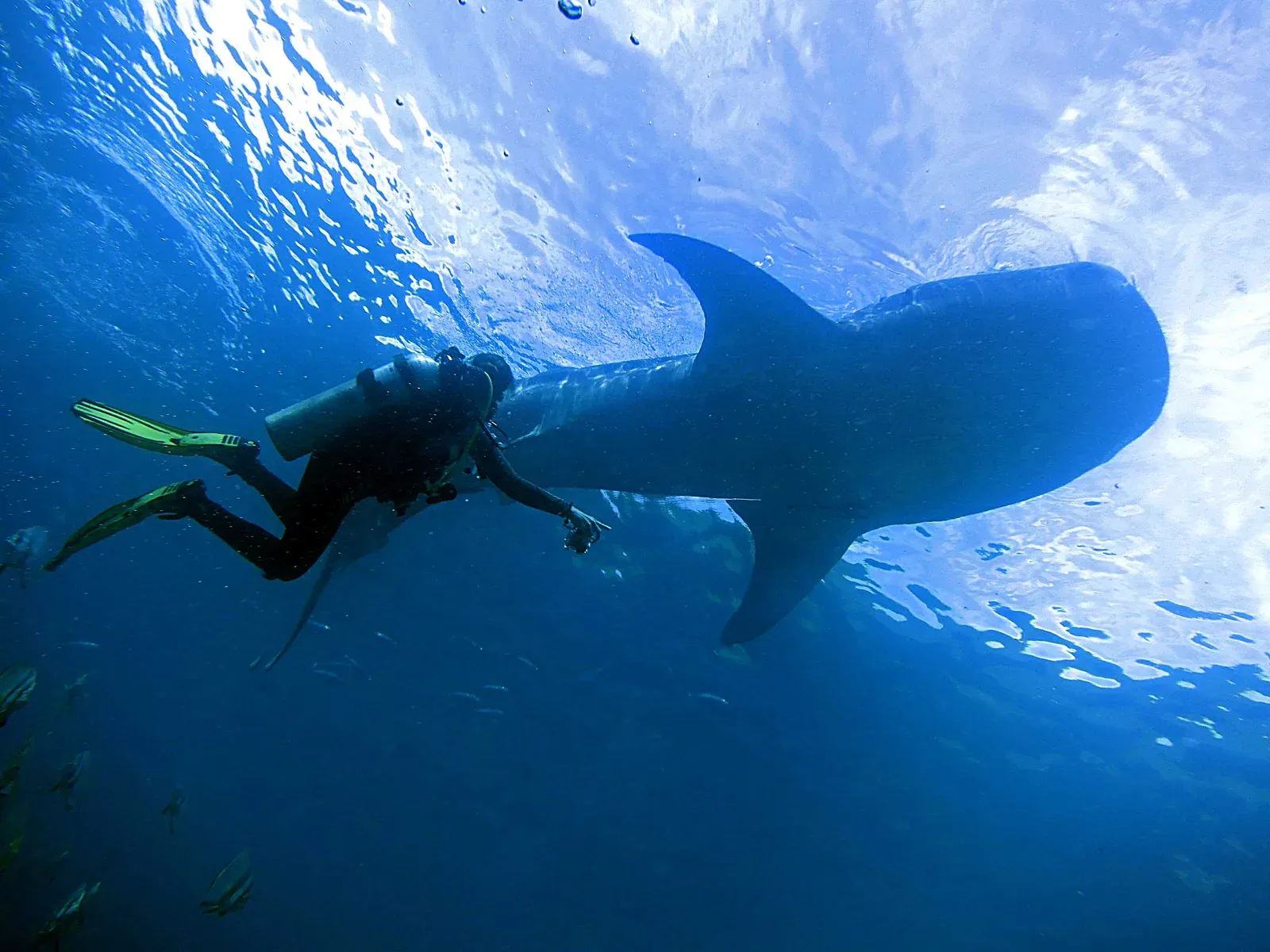
Let it set the pace. A feeding whale shark moves slowly because it is working, and the encounters that last are the ones where the diver stops trying to shorten the distance. Get ahead of its line, stop, and let it come through. Swimming at one ends the encounter for everybody on the boat.
Nobody touches, and nobody rides. Give a wide berth to the flanks and the tail — a tail beat from an animal this size is not aimed at you and will still hurt. At the bagans, where several sharks circle a fixed point, staying out of the way is most of the job.
Watch your depth the moment you stop watching the reef. Site after site in this guide carries a hazard note about exactly this: Gladden Spit over a shelf falling towards 2,000 m, Shib Habil’s exposed face at about 80 m, Molokini’s 91 m back wall, Tuna Alley at 25 m in channel water where a school can hold your attention for a long time. Agree a floor and a turn pressure before you splash, because you will forget both while a shark works past.
Think about who you are paying. Feeding whale sharks to keep them in one place works, which is the problem. At Oslob in the Philippines — a site we do not list — sharks are hand-fed 250 to 400 kg of sergestid shrimp daily, year-round, and more than 500,000 tourists came in 2018. Researchers photo-identified 171 animals there and found newly arrived sharks learned to turn up earlier and earlier after their first visit, with experienced ones appearing about five minutes after the feeder boat; sharks with more previous visits were less likely to move away from swimmers. Compliance ran the other way, with surveys recording somebody inside the 2 m rule rising from 78.6% in 2012 to 96.6% in 2014. No site in this guide is recorded as a feeding station. Cenderawasih’s bagans come closest, and the difference is that the nets are there for the fishermen.


