Cabo de Gata-Níjar · Spain · Wreck
El Motor
A WWII bomber engine standing alone in the sand at 27 m
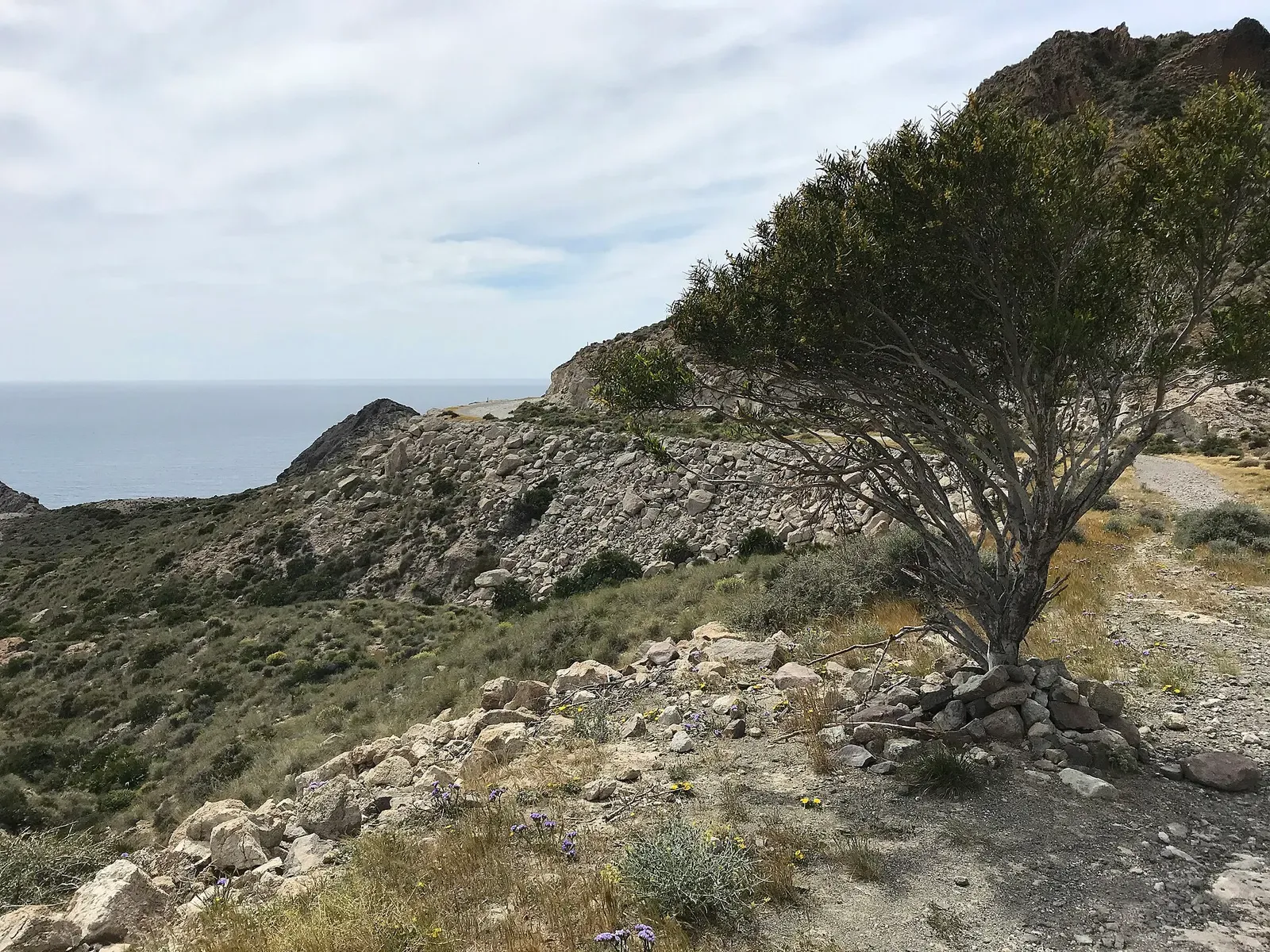
Area photo: Konrad Hädener from Thun, Switzerland · CC BY 2.0
El Motor is the odd wreck of the San Andrés dives: the Bristol Pegasus engine of a WWII bomber, resting in the sand at 27 m at one end of a wall that drops to 31 m on the crater's south slope. Heavily colonised by invertebrates, the engine now serves as a den for large moray and conger eels.
Where it is and how deep
36.9913° N, 1.8853° WApproximate position — the dashed circle shows where the site lies; your operator's briefing has the mooring.
The dive
Boats from Carboneras drop divers on the outermost part of the Cráter de San Andrés, where a wall on the south slope descends to 31 m. At one end of this wall, at 27 m, the Bristol Pegasus engine sits alone in the sand — a compact, singular target rather than a sprawling wreck.
The engine is heavily colonised by invertebrates and has become a den: large moray eels and conger eels frequent it, so the close-up life is as much the point as the aviation history. Depth, not distance, sets the limits here — at 27 m against a 31 m wall, watch your no-decompression time and keep a margin in hand for the ascent.
The wreck
- Vessel
- Vickers Wellesley (Bristol Pegasus engine)
- Type
- Single-engine RAF bomber — engine only
- Cause
- Contact lost off Carboneras in 1940-41 returning from an Africa Campaign mission to Malta, per the Carboneras operator's account
- Lies
- The Bristol Pegasus engine rests in the sand at 27 m, at one end of the south wall of the Cráter de San Andrés
According to the Carboneras dive operator, the engine belonged to a British Vickers Wellesley bomber — a type of which only 177 were ever built — that was returning from an Africa Campaign mission to its base on Malta when contact was lost off Carboneras in 1940-41, during the Battle of the Mediterranean. Decades later, in the 1990s, a fishing trawler brought the engine up in its nets and it was placed at Isla de San Andrés, where it has been dived since. The identification rests on the operator's account and has not been confirmed against an aviation-archaeology register.
Marine life and season
- Macro critters
| Jan | Feb | Mar | Apr | May | Jun | Jul | Aug | Sep | Oct | Nov | Dec |
|---|---|---|---|---|---|---|---|---|---|---|---|
| Fair | Fair | Fair | Good | Good | Prime | Prime | Prime | Prime | Good | Fair | Fair |
Season follows Cabo de Gata-Níjar: Visitor season peaks spring through summer; surface water swings from 10-15 °C in winter to 21-30 °C in summer, with 22 °C still logged in October.
Questions divers ask
What kind of wreck is El Motor?+
It is not a full wreck but a single Bristol Pegasus aircraft engine, attributed by the local operator to a WWII Vickers Wellesley bomber, resting in the sand at 27 m.
Sources
- 2 El Motor dive site — Scubago
- Buceo Carboneras — inmersiones (site list) — Buceo Carboneras
More dive sites in Cabo de Gata-Níjar
Reef
Try-dive shallows at 3-5 m, groupers on the way to 16 m
Cave & cavern
Gliding through light-filled rock canyons inside 12 m
Eagle rays and hunting barracuda on the island's outer wall
Seamount
Dropping through a volcano-shaped crater to an arch full of eels
Reef
Small octopus on the anchorage rock at 5 m
Cave & cavern
A natural rock tunnel to swim through at 15-20 m
Cave & cavern
Volcanic cave diving without an advanced card
Wall
Sardine schools hunted by small tuna at the end of summer
Similar dives elsewhere

A wartime Flying Fortress upright on clean sand at 25–28 m
A coal carrier on a slope from a 13 m plateau to about 27 m
A Luftwaffe He 111 bomber at 30 m, with a resident conger named Sam

.jpg)
The park's most intact wreck: a 1908 minesweeper in 27 m