Mediterranean · Spain
Cabo de Gata-Níjar
Giant groupers in volcanic caves along Andalusia's largest coastal protected area
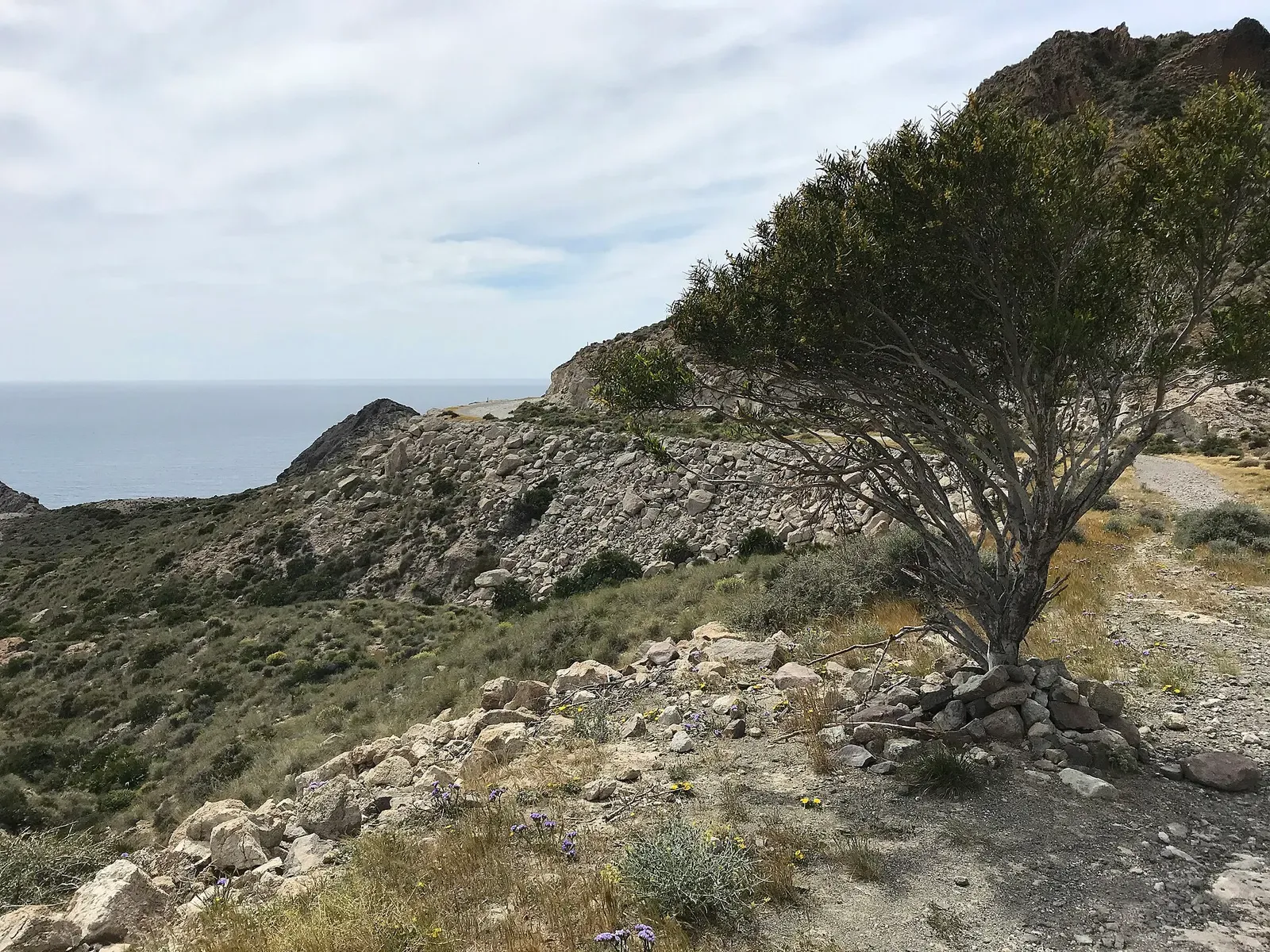
The Cabo de Gata-Níjar Natural Park protects a volcanic stretch of the Almería coast, Andalusia's largest coastal protected area, whose marine reserve runs more than 45 km from Almería to Carboneras. Diving works from two separate bases: the western villages of San José, Las Negras and La Isleta del Moro, where shore and boat sites such as La Cueva del Francés and El Túnel Naranja sit at 7-20 m, and Carboneras in the east, whose operator dives the sites around Isla de San Andrés down to 22 m. Low rainfall and a sparse population keep the water exceptionally clear.
About diving in Cabo de Gata-Níjar
A day here starts from one of two bases about 25 km apart on the same protected coast. In the west, centres in San José, Las Negras, La Isleta del Moro and Agua Amarga run daily guided shore and boat dives when conditions allow, working the coves and points around their own villages. In the east, the Carboneras centre sits beside its embarkation point, so groups board and cross the 400 m to Isla de San Andrés without further travel. Diving in the reserve happens under authorisation from the Andalusian environmental authority, and the integral-reserve zones at the park's headlands are closed to divers outright.
The terrain is volcanic. Western sites run corridors of white sand between rock walls carpeted in sponges and corals, past caves inhabited by giant groupers and small underwater mounts where barracuda and tuna gather to hunt. Off Carboneras, the Cráter de San Andrés is a submarine mountain with a large crater-like cavity; its western slope drops through a valley of gorgonians between 22 and 29 m, and an old engine wreck on the outer crater shelters large moray and conger eels. Ordinary depths stay modest on both sides, roughly 7-22 m, with El Vapor — the wreck of the steamer Arna off the lighthouse — the celebrated exception.
The park suits new and mid-level divers: most western sites are rated for all divers or Open Water, and on the San Andrés side Cañones and El Arrecife are used for first dives and refreshers, with try-dives run from the shallow anchorage of Acuario 2. Divers after depth, big pelagics or protected seamounts will do better at Cabo de Palos further up the Spanish coast. Wind matters — the Las Negras boats go out only when conditions permit — and spearfishing with tanks is banned throughout the park.
When to dive Cabo de Gata-Níjar
| Jan | Feb | Mar | Apr | May | Jun | Jul | Aug | Sep | Oct | Nov | Dec |
|---|---|---|---|---|---|---|---|---|---|---|---|
| Fair | Fair | Fair | Good | Good | Prime | Prime | Prime | Prime | Good | Fair | Fair |
Visitor season peaks spring through summer; surface water swings from 10-15 °C in winter to 21-30 °C in summer, with 22 °C still logged in October.
Dive types & marine life
Giant groupers are resident in the western caves, and barracuda and tuna gather to hunt over the small underwater mounts. Around San Andrés, moray and conger eels frequent the engine wreck on the outer crater and small octopus hold on the anchorage rock at El Acuario. No shark, dolphin or ray sighting is documented for either side.
- Reef
- Wall
- Wreck
- Cave & cavern
- Seamount
- Groupers
- Barracuda
- Tuna
- Octopus & cuttlefish
Notable dive sites in Cabo de Gata-Níjar
Reef
Try-dive shallows at 3-5 m, groupers on the way to 16 m
Cave & cavern
Gliding through light-filled rock canyons inside 12 m
Eagle rays and hunting barracuda on the island's outer wall
Seamount
Dropping through a volcano-shaped crater to an arch full of eels
Reef
Small octopus on the anchorage rock at 5 m
Wreck
A WWII bomber engine standing alone in the sand at 27 m
Cave & cavern
A natural rock tunnel to swim through at 15-20 m
Cave & cavern
Volcanic cave diving without an advanced card
Wall
Sardine schools hunted by small tuna at the end of summer
A crack rising from 15 m to 5 m at the turnaround point
Gorgonian fans lining a wall from 22 to 29 m
Isleta del Moro
Easy shore dive entered from the beach in front of the fishing village, run in a south-west direction.
El Vapor
Wreck of the Arna, a roughly 100 m Czechoslovak steamer, one nautical mile south-east of the Cabo de Gata lighthouse.
Getting there
Almería Airport is about 30 km from San José, reached via the A-7; a hire car is recommended over the park's bus lines. Western centres are in San José, Las Negras, La Isleta del Moro and Agua Amarga; the San Andrés operator is in Carboneras, beside its embarkation point.
Photos from Cabo de Gata-Níjar
Nachosan · CC BY-SA 3.0
Nachosan · CC BY-SA 3.0
Konrad Hädener from Thun, Switzerland · CC BY 2.0
Nikater · CC BY-SA 3.0
Photo credits
- Rocky volcanic headland of Loma Pelada meeting the sea under a clear sky by Konrad Hädener from Thun, Switzerland, CC BY 2.0, via Wikimedia Commons
- Shallow rocky reef with seaweed and a small school of fish in sunlit blue water by Nachosan, CC BY-SA 3.0, via Wikimedia Commons
- Rocky seabed with a striped fish swimming close to boulders and sand by Nachosan, CC BY-SA 3.0, via Wikimedia Commons
- A lone tree on a dirt path overlooking the rocky coastline of Loma Pelada by Konrad Hädener from Thun, Switzerland, CC BY 2.0, via Wikimedia Commons
- A traditional windmill and palm tree in the village of El Pozo de los Frailes by Nikater, CC BY-SA 3.0, via Wikimedia Commons
Similar destinations
A zoned 2016 marine reserve, a sunk minesweeper and a 3 km hypogenic cave
Long limestone caves and the 110 m Malakoff wreck off one Balearic island
A WWII landing ship in two sections at 19 and 30 m off a cave-cut volcanic island

.jpg)


.jpg)

Dusky groupers the size of car doors patrol two submerged mountains