Chausey Islands & Granville · France · Wreck
Anvers wreck
A century-old cargo wreck open to French Level 1 divers
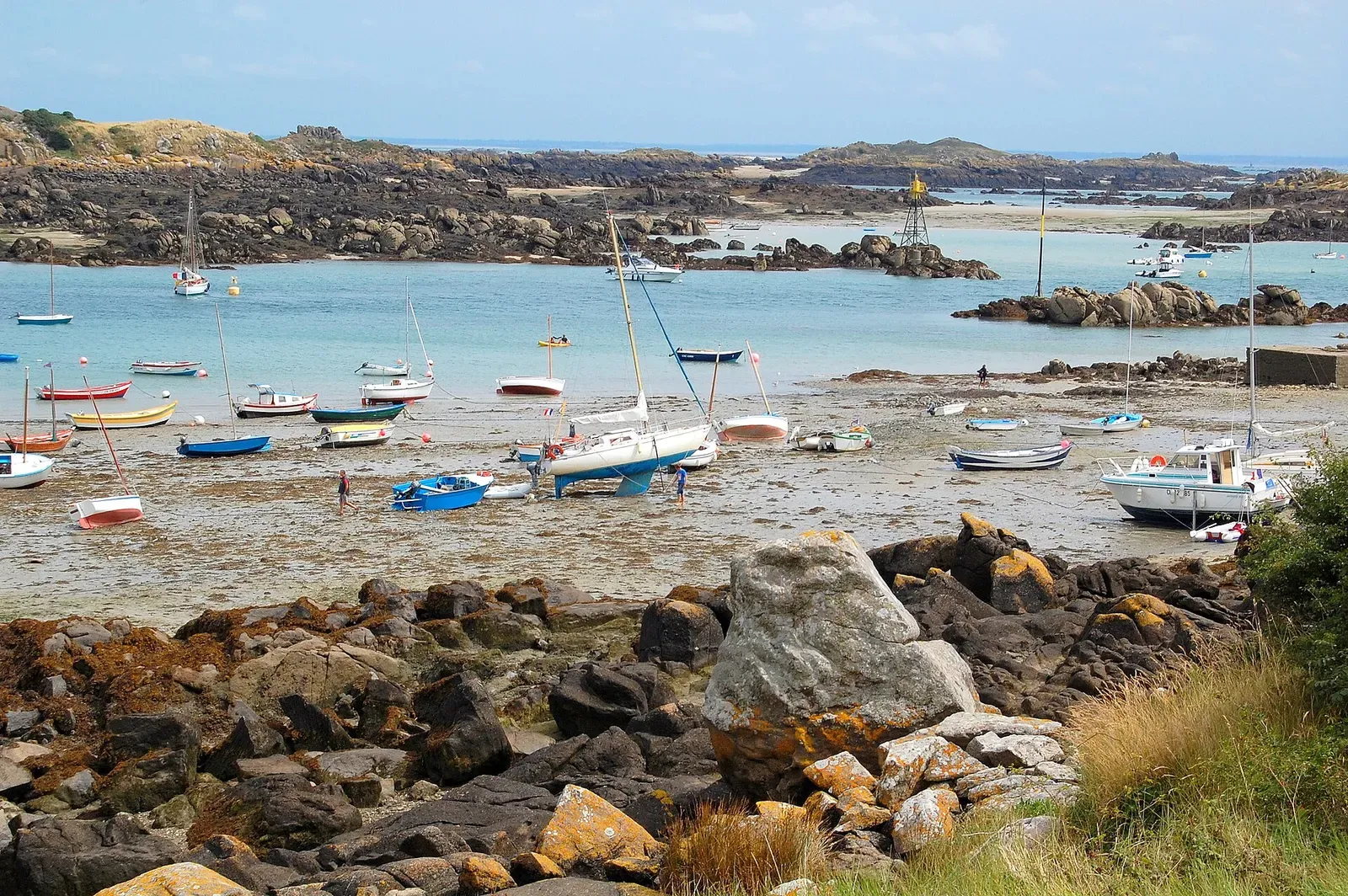
Area photo: Pline · CC BY-SA 3.0
The Anvers is a small cargo ship of 35 to 40 m that sank in a collision early in the last century and now lies to the east of the Chausey islands. Depending on the tide, the bottom around it sits between 12 and 22 m. It is the Chausey wreck open to French Level 1 divers, reached by boat from Granville.
Also known as Anvers, L'Anvers.
Where it is and how deep
48.8982° N, 1.6829° WApproximate position — the dashed circle shows where the site lies; your operator's briefing has the mooring.
The dive
The boat runs out from Granville to the eastern side of the Chausey archipelago, where the Anvers lies. The tide sets the depth more than anything else here: the same seabed around the wreck reads 12 m at low water and 22 m at high water, so the depth of the dive depends on when the boat arrives. Divers descend to a small cargo ship of 35 to 40 m, sunk in a collision at the start of the last century.
The currents over the Anvers are capricious and never really stop, which is why the dive is best planned for a neap tide, when the flow is at its weakest. Being open to French Level 1 divers, it is the Chausey wreck for divers early in their training. The archipelago's tidal range reaches 14 m on the equinox springs, so timing the dive to the tide table matters as much as the dive plan itself.
The wreck
- Vessel
- Anvers
- Type
- Small cargo ship
- Cause
- Sank after a collision early in the 20th century
- Lies
- East of Chausey on a bottom of 12 to 22 m, depending on the tide
Marine life and season
The sources we used don't single out particular species here.
| Jan | Feb | Mar | Apr | May | Jun | Jul | Aug | Sep | Oct | Nov | Dec |
|---|---|---|---|---|---|---|---|---|---|---|---|
| Fair | Fair | Fair | Fair | Fair | Good | Good | Prime | Prime | Good | Good | Fair |
Season follows Chausey Islands & Granville: The ratings follow the sea temperature, warmest in August and September (about 18 °C) and coldest in February (about 9 °C); no month is singled out for diving.
Know before you go
- The current over the wreck never fully stops, so the dive is best planned for a neap tide.
- Depth changes with the tide, from 12 to 22 m, so plan gas and no-stop time for the high-water figure.
Questions divers ask
How deep is the Anvers wreck at Chausey?+
The bottom around the Anvers lies between 12 and 22 m, depending on the state of the tide.
What level is needed to dive the Anvers?+
The Anvers is open to divers from French Level 1. The current never fully stops, so it is best dived on a neap tide.
Sources
- CR épave l'Anvers à Chausey (forum) — Plongeur.com
- Plongée sous-marine tous niveaux — Plongée Chausey Loisirs
More dive sites in Chausey Islands & Granville
Artificial reef
A quiet wreck between 20 and 30 m out near the Minquiers
Wreck
A wartime patrol boat torpedoed on 3 July 1944
Artificial reef
A wreck on sand at 38 m beside a Chausey drop-off
Artificial reef
A boat-dived wreck between 25 and 35 m
Similar dives elsewhere
Boilers in 7 m on the rocks that took a 1907 steamer
Wreck
Anna Katrina Fritzen
Klaipėda & Curonian Spit · Lithuania
A torpedoed steam freighter, pieced together from scattered wreckage
Wreck
Anna Maria
Stockholm Archipelago & Dalarö · Sweden
An Amsterdam-built fluit that caught fire and sank at the Dalarö quay

An old work boat with small sport boats around it