
Easter Island's isolation, thousands of kilometers from the nearest continent, leaves its waters low in nutrients and famously clear, often exceeding 40 meters of visibility around volcanic arches, caves, and drop-offs near Hanga Roa. The underwater landscape of lava tunnels and basalt columns is the main draw rather than abundant marine life, though green sea turtles, reef sharks, and dolphins are seen. Endemic reef fish found nowhere else make up much of what divers do encounter on the reef.
About diving in Rapa Nui (Easter Island)
Diving is a small operation run from the harbour at Hanga Roa, the island's only town. The boats are open and short-ranged, the runs are measured in minutes, and the usual pattern is two dives in the morning before the wind builds, leaving the afternoon for the archaeology most visitors came for. Site choice is dictated by swell rather than by tide or plan: with no barrier reef and no lagoon to shelter behind, crews read the exposed coast each morning and work whichever side is lying down that day.
What you dive is bare volcanic rock. The bottom is dark, low and scoured in places, cut into ledges, fissures and swim-throughs elsewhere, and hard coral appears as low crusts and scattered heads rather than thickets — a short list of species rather than a reef community. Sites vary mainly by exposure: the further from the shelter of the bays, the more oceanic the water feels, the more relief there is to swim through, and the more the day's plan depends on the swell.
The sensation people remember is scale. With very little suspended in the water, walls and boats resolve at distances that feel wrong, and divers commonly misjudge how far off something is and how deep they have gone. The other stop visitors ask about is a moai on the seabed near town: it is a replica, reportedly sunk for a film or documentary shoot rather than an archaeological find, and operators say so up front. Expect a short list of sites — the diving adds to a trip built around the island rather than filling one.
Best time to dive Rapa Nui (Easter Island)
| Jan | Feb | Mar | Apr | May | Jun | Jul | Aug | Sep | Oct | Nov | Dec | |
|---|---|---|---|---|---|---|---|---|---|---|---|---|
| Season | Prime | Prime | Prime | Good | Good | Fair | Fair | Fair | Good | Good | Good | Prime |
| Sea surface | 24°C75°F | 26°C79°F | 25°C77°F | 25°C77°F | 23°C73°F | 22°C72°F | 21°C70°F | 21°C70°F | 20°C68°F | 21°C70°F | 22°C72°F | 23°C73°F |
| Daytime high | 25°C77°F | 26°C79°F | 26°C79°F | 25°C77°F | 24°C75°F | 22°C72°F | 21°C70°F | 21°C70°F | 21°C70°F | 21°C70°F | 22°C72°F | 23°C73°F |
| Rain | 40 mm1.6 in | 28 mm1.1 in | 47 mm1.9 in | 58 mm2.3 in | 73 mm2.9 in | 53 mm2.1 in | 45 mm1.8 in | 38 mm1.5 in | 36 mm1.4 in | 34 mm1.3 in | 30 mm1.2 in | 25 mm1.0 in |
| Jan | Feb | Mar | Apr | May | Jun |
|---|---|---|---|---|---|
| Prime | Prime | Prime | Good | Good | Fair |
| Sea surface | |||||
| 24°C75°F | 26°C79°F | 25°C77°F | 25°C77°F | 23°C73°F | 22°C72°F |
| Daytime high | |||||
| 25°C77°F | 26°C79°F | 26°C79°F | 25°C77°F | 24°C75°F | 22°C72°F |
| Rain | |||||
| 40 mm1.6 in | 28 mm1.1 in | 47 mm1.9 in | 58 mm2.3 in | 73 mm2.9 in | 53 mm2.1 in |
| Jul | Aug | Sep | Oct | Nov | Dec |
|---|---|---|---|---|---|
| Fair | Fair | Good | Good | Good | Prime |
| Sea surface | |||||
| 21°C70°F | 21°C70°F | 20°C68°F | 21°C70°F | 22°C72°F | 23°C73°F |
| Daytime high | |||||
| 21°C70°F | 21°C70°F | 21°C70°F | 21°C70°F | 22°C72°F | 23°C73°F |
| Rain | |||||
| 45 mm1.8 in | 38 mm1.5 in | 36 mm1.4 in | 34 mm1.3 in | 30 mm1.2 in | 25 mm1.0 in |
2011–2025 averages. Sea surface: NOAA Coral Reef Watch, measured at the surface, so deeper water can run colder. Daytime high and rain: NASA POWER.
Austral summer (Dec-Mar) brings the calmest seas and warmest water; austral winter (Jun-Aug) can bring swell that limits boat access to exposed sites.
Best months: January, February, March, December
Easter Island water temperature and weather by month
The sea surface runs from 20 °C (68 °F) in September to 26 °C (79 °F) in February. It is 24 °C (75 °F) or warmer from January to April. Most rain falls from March to July, peaking at about 70 mm (2.8 in) in May; December is the driest. Daytime highs reach 26 °C (79 °F) in February and drop to 21 °C (70 °F) in September. The coldest water here is about 20 °C (68 °F), so pack a 5 mm suit.
Dive types & marine life
Green turtles are the reliable sighting, grazing in the bays by town most days of the year. Out on the exposed sites, sharks and dolphins are chance encounters rather than anything to plan around, and the reef fish are mostly small and site-attached rather than schooling. Little changes month to month, so the calm Dec-Mar window buys access and comfort rather than more animals.
- Cave & cavern
- Wall
- Reef
- Sea turtles
- Reef sharks
- Dolphins
Best dive sites in Rapa Nui (Easter Island)
Reef
A coral-covered rock with arches of many sizes
Cave & cavern
A lava tube threading rock arches like a cathedral's buttresses
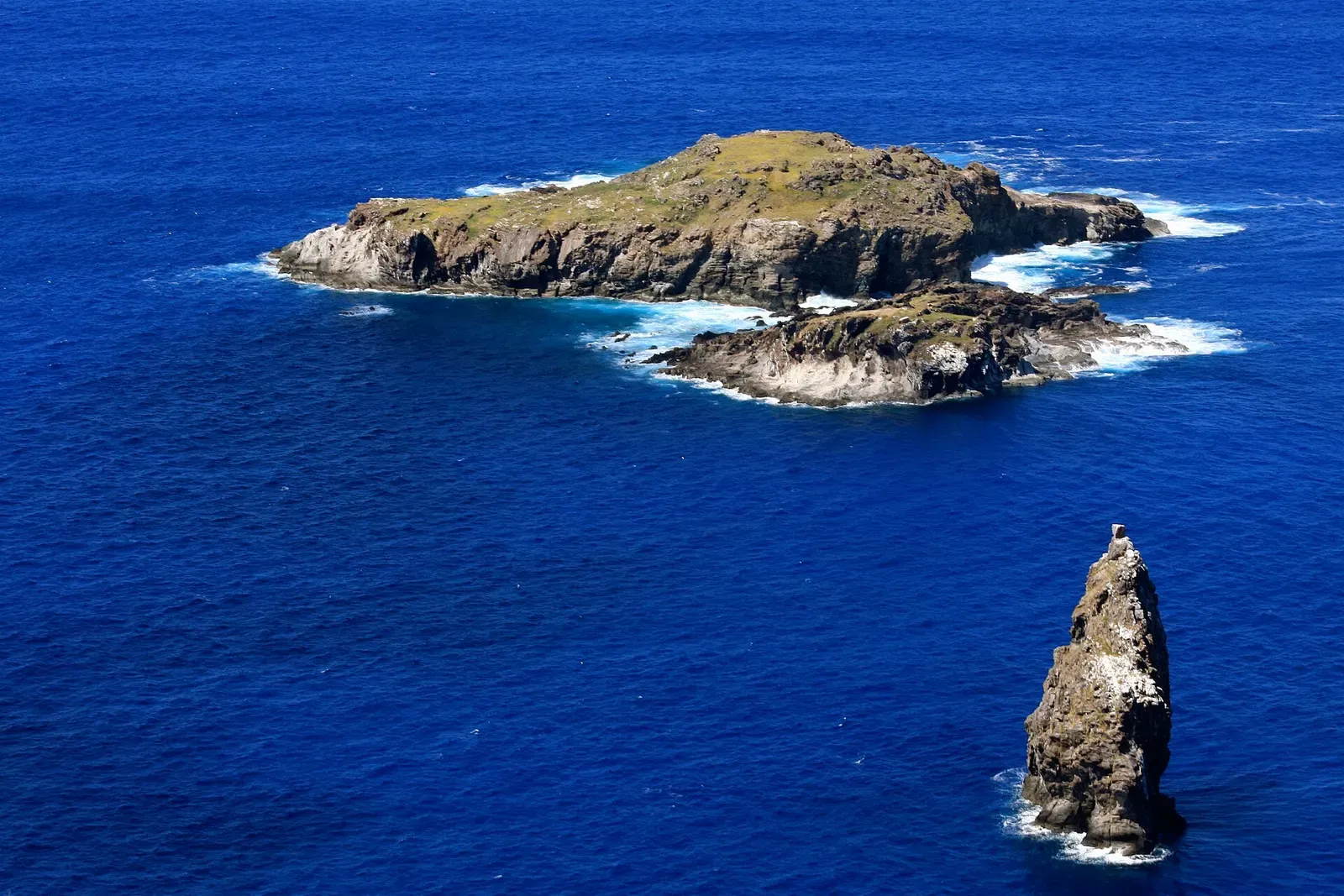
Sharp islet cliffs where the birdman egg hunt took place
Reef
Crevice-split shoals holding lobsters and black jack
Cave & cavern
Arches and small caverns ending at Motu Tautara
Manavai
Sheltered volcanic bay used as a checkout and training site.
Ana Kai Tangata
Coastal cave dive beside a historic painted sea cave.
How to get to Rapa Nui (Easter Island)
Flights land at Mataveri, and essentially all of them come from Santiago; a Papeete connection has come and gone from the schedules, so confirm before planning around it. Everyone stays in Hanga Roa, where the dive centres sit by the harbour within walking distance of most guesthouses. Diving is small-boat day trips plus a few shore entries.
Photos from Rapa Nui (Easter Island)
Gabriele Giuseppini · CC BY 3.0
Dive videos
Diving Easter Island · bdbenj on YouTube
RAPA NUI. Motu Nui and Motu Iti diving. A brief story of the island. · Blue Sea Corner on YouTube
Photo credits
- Waves break over the volcanic rocky shoreline near Hanga Roa on Rapa Nui, Easter Island by Meik.ch, CC BY 3.0, via Wikimedia Commons
- A quiet bay along the coast of Rapa Nui with clear blue water and a rocky headland by Gabriele Giuseppini, CC BY 3.0, via Wikimedia Commons
Embed
Run a dive centre, club or blog? Embed this map of 1 dive sites near Easter Island on your own page.
Similar destinations

Manta rays glide through diver spotlights on Kona's nightly manta dive.

Molokini's crater wall and Lānaʻi's skylit lava caverns

Banded sea kraits are seen resting in caves on nearly every dive.


_-_panoramio_-_Gabriele_Giuseppini.jpg)
Forty-metre visibility over lava caves and canyons, straight off the reef