
Julian Rocks · Australia · Cave & cavern
Cod Hole
A small cave at 15 to 21 m on the island's northern tip
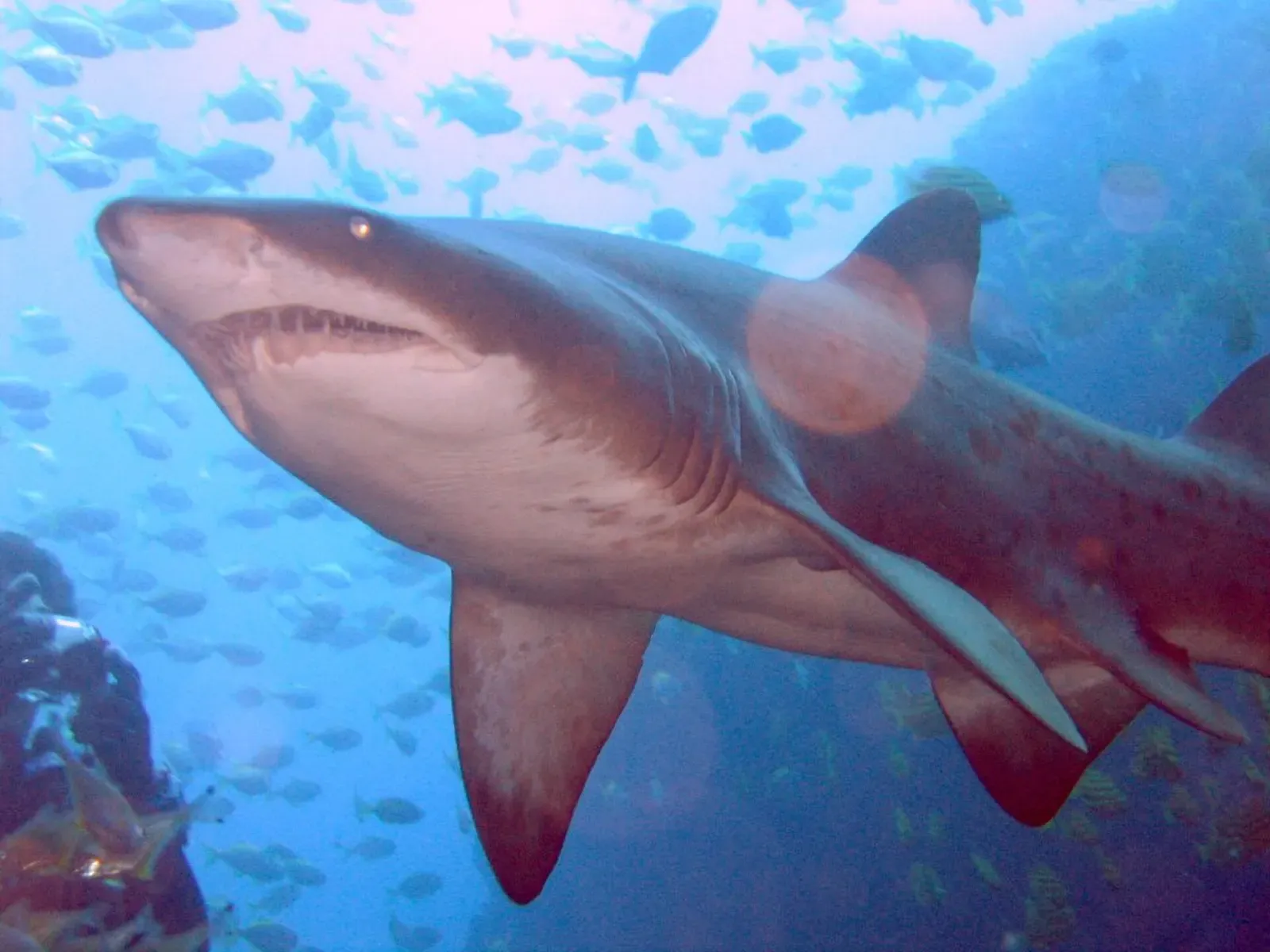
Photo: JulianGWilson · CC BY-SA 4.0
The Cod Hole is a small underwater cave on the northern tip of Julian Rocks. The mouth opens at around 15 m and the floor slopes down to 21 m at the back, and through winter grey nurse sharks use it as shelter — the rock is one of about a dozen critical habitats for the species in New South Wales. Large moray eels, wobbegongs and schooling pelagic fish use the same cave.
Also known as The Cod Hole.
Where it is and how deep
28.6097° S, 153.6293° EApproximate position — the dashed circle shows where the site lies; your operator's briefing has the mooring.
The dive
The Cod Hole is on the northern tip of Julian Rocks, and the dive is short rather than deep. You descend to the mouth at about 15 m, where the opening breaks the rock, and the floor slopes away from there to 21 m at the back. It is genuinely overhead, which is why the local dive centre puts it to experienced divers rather than to anyone who happens to be on the boat.
Through winter, grey nurse sharks use the cave as shelter, and that is what most divers come for. Julian Rocks is one of about a dozen critical habitats for the grey nurse shark in New South Wales, and the reserve sits inside a Cape Byron Marine Park sanctuary zone declared in 2006, so the animals are protected: hold position, keep off the floor and let them settle rather than swimming in at them.
The cave is not only a winter site. Large moray eels sit back in the cracks, wobbegongs lie flat on the ledges where they are easy to miss until you are close, and schools of large pelagic fish work the water over the entrance. With the back of the cave at 21 m, this is the deeper end of the diving on Julian Rocks without being a deep dive in its own right.
Marine life and season
- Sand tiger sharks
- Wobbegongs
| Jan | Feb | Mar | Apr | May | Jun | Jul | Aug | Sep | Oct | Nov | Dec |
|---|---|---|---|---|---|---|---|---|---|---|---|
| Prime | Prime | Prime | Good | Good | Prime | Prime | Prime | Prime | Good | Good | Prime |
Season follows Julian Rocks: Leopard sharks arrive Dec–Apr and grey nurse Jun–Nov, so the site has a marquee species almost year-round.
Know before you go
- The Cod Hole is a genuine overhead: the mouth is at about 15 m and the floor drops to 21 m at the back, so keep a clear line back to the opening and go through one at a time.
- Grey nurse sharks shelter in the cave through winter — never block the entrance or cut off their way out; wait for a gap rather than pushing past.
Dive videos
Kingfish and Mulloway at the Cod Hole, Julian Rocks, Byron Bay Australia · Dave Bryant - Travel and Underwater Videos. on YouTube
Questions divers ask
How deep is the Cod Hole at Julian Rocks?+
The mouth opens at about 15 m and the floor slopes to 21 m at the back, which makes it the deeper end of the diving on the island and a dive the local centre puts to experienced divers.
When can you see grey nurse sharks at the Cod Hole?+
In winter, when the cave gives them shelter. Julian Rocks is one of about a dozen critical habitats for the grey nurse shark in New South Wales.
Sources
- Byron Bay Dive Centre — Julian Rocks dive sites — Byron Bay Dive Centre
- Julian Rocks dive site — PADI
- Nguthungulli Julian Rocks Nature Reserve — Wikipedia
Photo credits
- A dense school of trevally rising through blue water toward the surface at Julian Rocks. by JulianGWilson, CC BY-SA 4.0, via Wikimedia Commons
More dive sites in Julian Rocks
Cave & cavern
Grey nurse sharks around a cave at the island's deep end
Wall
Spanish dancers and pineapple fish on vertical rock at 18 m
Pinnacle
Bombies at 5 to 15 m where mantas come in to feed
Reef
Resident green, hawksbill and loggerhead turtles shelter here
Similar dives elsewhere
One of the largest ocean caverns in the Southern Hemisphere

A massive entrance running back into tunnels and cross passages

A twin-entrance overhang at 24 m below a 16 m cleaning station

.jpg)
A 60 m slot in the cliff, entered at 16-18 m and naturally lit