
Julian Rocks · Australia · Wall
Hugo's Trench
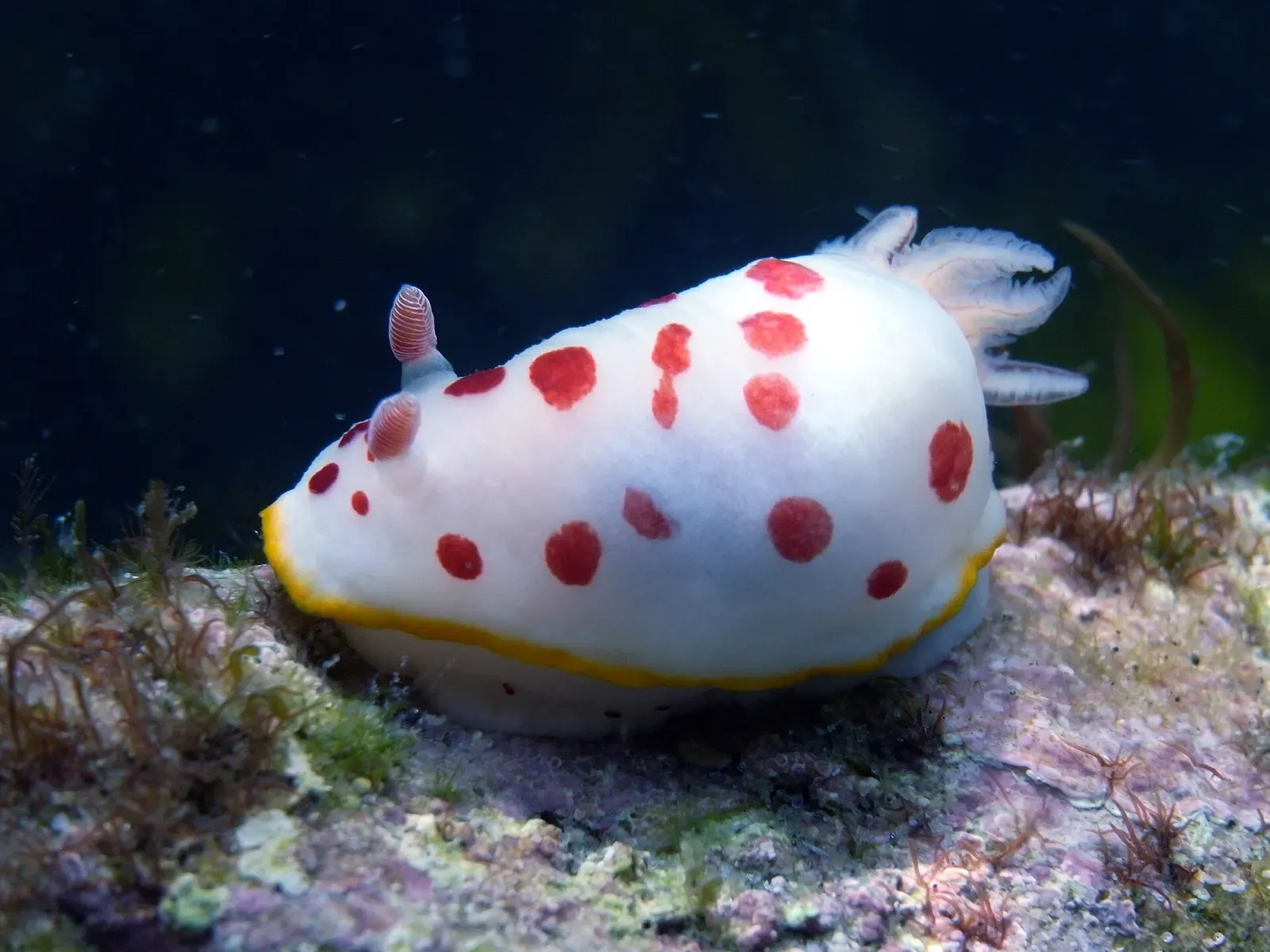
Spanish dancers and pineapple fish on vertical rock at 18 m
Area photo: JulianGWilson · CC BY-SA 4.0
Hugo's Trench is a gutter cut into the sheltered side of Julian Rocks, with sheer walls on both sides and a working depth of 15 to 18 m. It is the macro dive on the island: nudibranchs and Spanish dancers, crayfish, mantis shrimp, moray eels, ghostfish, pineapple fish and bubble snails work the rock faces, while bull rays and wobbegongs wedge into the same crevices.
Where it is and how deep
28.6111° S, 153.6285° EApproximate position — the dashed circle shows where the site lies; your operator's briefing has the mooring.
The dive
You drop into the trench and settle between two sheer walls, with a working range of 15 to 18 m from the top of the rock to the bottom of the cut. There are in fact two parallel gutters here, Hugo's Trench and False Trench, both on the sheltered side of the island and both out of the strong northerlies that run from September to Christmas. The dive is linear — you follow the gutter rather than picking a route — which makes it an easy site to rush.
Pace is the whole thing here, because most of what lives on these faces only shows itself once you have stopped moving and let your eyes settle on one patch of rock. Nudibranchs are the constant, Spanish dancers among them; crayfish and mantis shrimp sit back in the holes, moray eels use the same cracks, and ghostfish, pineapple fish and bubble snails turn up on the faces once you are looking at the right scale. None of it is large, and none of it is obvious at swimming speed.
The trench is not only macro. Bull rays and wobbegongs use the crevices here as well, and both are large enough to be easy to miss when you are focused on something thumb-sized — wobbegongs in particular lie flat and patterned against the rock, so watch where you put hands and fins. With a maximum of 18 m, depth is not what makes this dive; the rock close on both sides is.
Marine life and season
- Nudibranchs
- Macro critters
- Stingrays
- Wobbegongs
| Jan | Feb | Mar | Apr | May | Jun | Jul | Aug | Sep | Oct | Nov | Dec |
|---|---|---|---|---|---|---|---|---|---|---|---|
| Prime | Prime | Prime | Good | Good | Prime | Prime | Prime | Prime | Good | Good | Prime |
Season follows Julian Rocks: Leopard sharks arrive Dec–Apr and grey nurse Jun–Nov, so the site has a marquee species almost year-round.
Know before you go
- Wobbegongs lie flat and camouflaged in the crevices of the trench; keep hands and fins clear of any ledge you are about to hold or kick past.
- The walls are close on both sides and everything worth seeing is on them, so sloppy buoyancy means contact — damage to the wall or a scrape for you.
Dive videos
Hugo's Trench Dive · tompinnell88 on YouTube
byronoct1 · craig bolland on YouTube
Questions divers ask
How deep is Hugo's Trench?+
Between 15 and 18 m, from the top of the rock to the bottom of the cut. Depth is not the demanding part — the sheer walls close on both sides mean the whole dive is spent near rock, so buoyancy control matters.
What can you see at Hugo's Trench?+
It is the macro dive on the rock: nudibranchs and Spanish dancers, crayfish, mantis shrimp, moray eels, ghostfish, pineapple fish and bubble snails, plus bull rays and wobbegongs tucked into the crevices.
Sources
- Byron Bay Dive Centre — Julian Rocks dive sites — Byron Bay Dive Centre
- The Dive Site — Julian Rocks — Sundive Byron Bay
- Julian Rocks dive site — PADI
- Nguthungulli Julian Rocks Nature Reserve — Wikipedia
In The Logbook
- Nudibranchs: species, habits and where to diveMacro & muck · 13 min read
More dive sites in Julian Rocks
A small cave at 15 to 21 m on the island's northern tip
Cave & cavern
Grey nurse sharks around a cave at the island's deep end
Pinnacle
Bombies at 5 to 15 m where mantas come in to feed
Reef
Resident green, hawksbill and loggerhead turtles shelter here
Similar dives elsewhere
Sponge-covered ledges to 26 m, walked in from shore
A 50 m wall with an overhang you shoot from underneath

Small caves and big overhangs on top of the Lonsdale Wall
.jpg)
Beginner wall dive to 14 m with sleeping blue gropers on night dives