
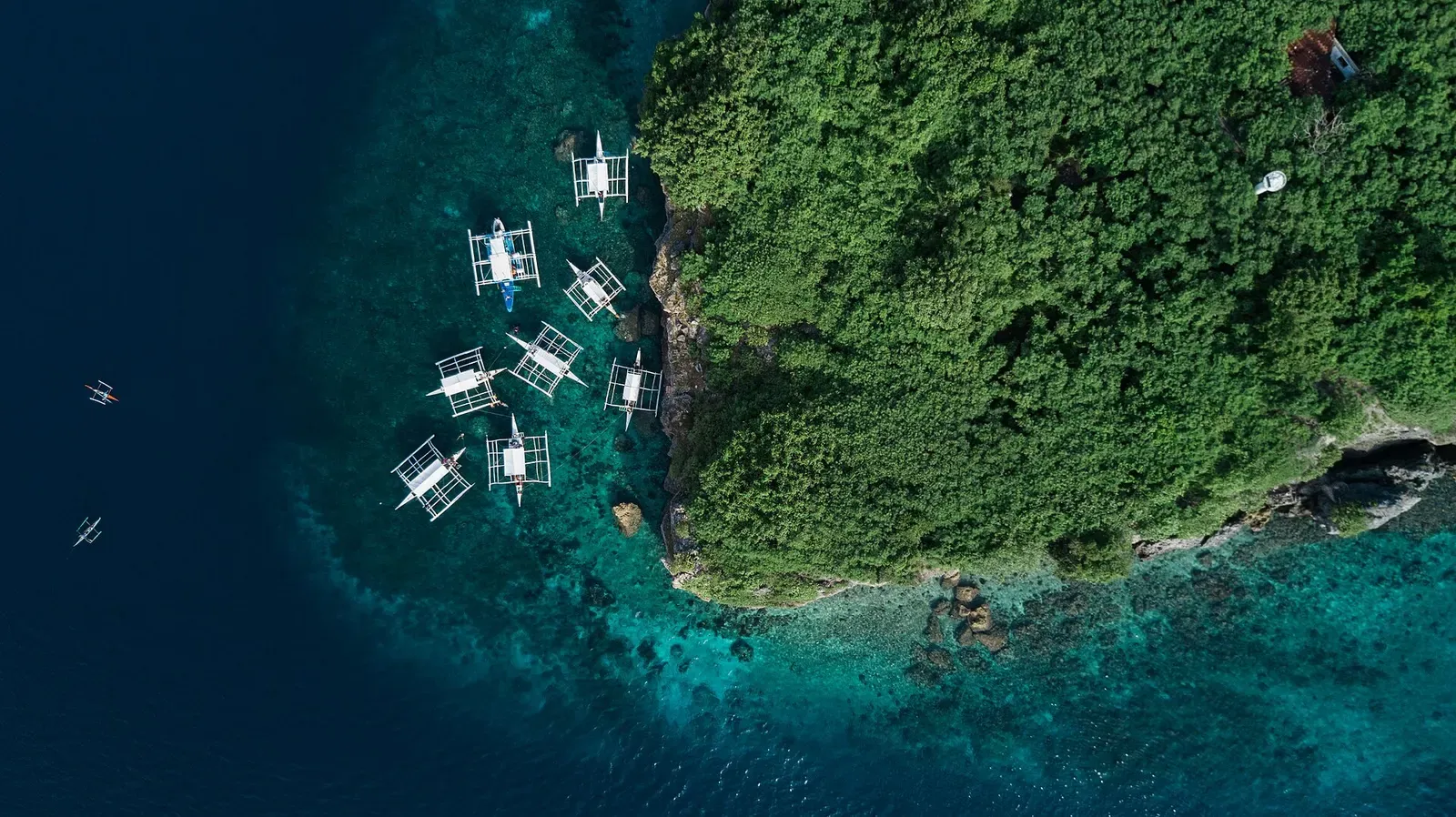
A wall dive on the western side of Panglao, normally run as a drift from banca boats. Coral gardens lead to a wall that runs between 25 and 40 metres, and the coral is the point of the site: table corals on top and healthy growth down the wall face. Current varies from slight to quite strong depending on the tide.
Where it is and how deep
9.5481° N, 123.7020° EPublished position for this site.
The dive
Boats drop you over the coral gardens that sit above the wall, and the first part of the dive is across that shallower coral, where the table corals are. The catalogue entry singles out the abundance of healthy coral as the site's main feature, and this is where you see most of it. The tide sets the pace from the moment you are in the water, so the group stays together and moves with whatever the current is doing rather than working against it.
The gardens end at the wall, which runs between 25 and 40 metres. This is the deep half of the dive and it is done as a drift, tracking along the face with the coral growth on your shoulder rather than descending and holding one spot. Because the wall itself starts at 25 metres, bottom time goes quickly and the sensible shape is a single pass along the face before working back up onto the coral on top.
How the dive feels depends entirely on the tide. On a slack day it is an unhurried swim along a well covered wall; on a running tide it is a fast drift, and the current can be quite strong. Either way the dive finishes in the shallower coral gardens, where the group can spread out and the boat picks you up wherever you surface.
Marine life and season
- Pristine corals
| Jan | Feb | Mar | Apr | May | Jun | Jul | Aug | Sep | Oct | Nov | Dec |
|---|---|---|---|---|---|---|---|---|---|---|---|
| Prime | Prime | Prime | Prime | Prime | Good | Fair | Fair | Fair | Good | Prime | Prime |
Season follows Panglao: Nov–Jun is the main season; the south-west monsoon and typhoons disrupt Jul–Oct, though the sheltered south coast keeps working through much of it.
Know before you go
- Current varies from slight to quite strong with the tide, so the dive can turn into a fast drift — stay with the group and let the boat follow rather than holding position on the wall.
- The wall starts at 25 metres and runs to 40, which is deep enough to eat no-decompression time quickly; plan the deep pass first and finish shallow on the coral gardens.
Questions divers ask
How deep is the wall at Gak-Ang?+
The wall runs between 25 and 40 metres, with coral gardens on top of it. That makes it one of the deeper dives on the Panglao coast and a site for divers comfortable with a deep drift profile.
Is Gak-Ang a drift dive?+
Normally, yes. It is usually done as a drift from banca boats, and currents vary from slight to quite strong depending on the tide, so the dive can be anything from a gentle swim to a fast pass along the wall.
Sources
- Gak-Ang - Scubago — Scubago
More dive sites in Panglao
Wall
A chimney through the wall, 18 m in and 8 m out
Reef
Ghost pipefish and pygmy seahorses on a calm coral slope
A turtle point about 10 m under a shallow reef cliff
Wall
A drifted wall from 5 m to 25 m, minutes from Alona
Wall
A vertical wall of huge gorgonians on Panglao's quietest corner
Wreck
A dive boat on the sand at 37 m, a kilometre off Alona Beach
Reef
Panglao's critter slope, five minutes off Alona Beach
Reef
An easy north-coast reef on the Napaling and Doljo road trip
Similar dives elsewhere

A sharp wall to 40 m under a broad shelf of coral
An open-top cave in the northwest wall of a limestone island

A sheer Pantar Strait face dropping to 90 metres


Drift along a sloping wall with sharks and fish schools