
St. Eustatius · Caribbean Netherlands · Reef
Triple Wreck
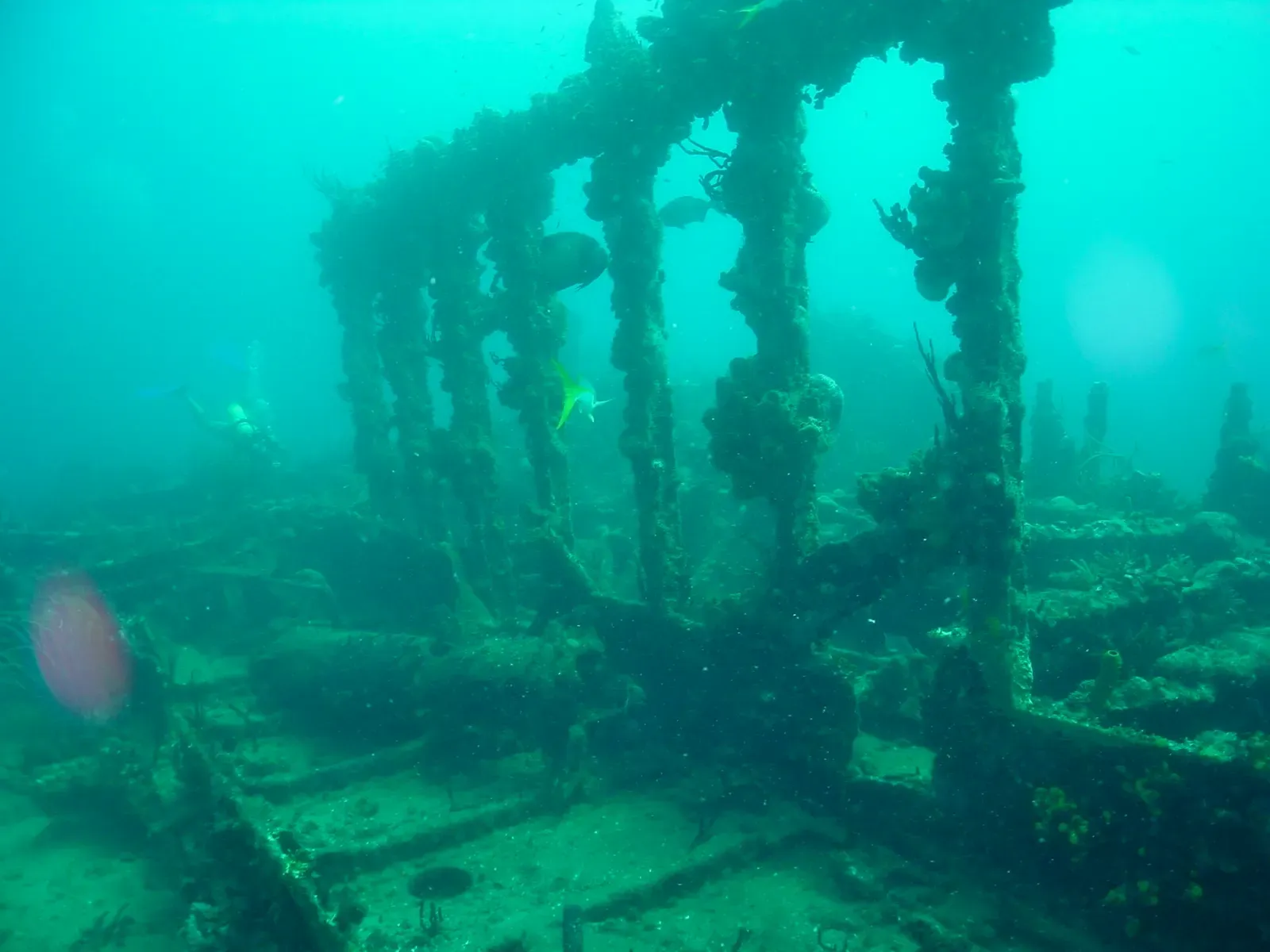
Ballast, cannon, anchors and yellow Dutch bricks at 19 m
Area photo: SV Zanshin · CC BY-SA 3.0
An archaeological site at 19 m that Scubaqua describes as an underwater museum: ballast stones, barrel hoops, wine bottles, pottery, anchors, a cannon and yellow Dutch bricks scattered across the old anchorage, with coral and sponge grown over the ballast. PADI records the dive type as archaeological rather than wreck, and there is no hull left to swim.
Where it is and how deep
17.4783° N, 62.9945° WApproximate position — the dashed circle shows where the site lies; your operator's briefing has the mooring.
The dive
Nineteen metres of open ground with material scattered across it. There is no hull to swim around: what is here is the residue of ships that worked the anchorage, ballast stones, barrel hoops, wine bottles and pottery lying where they settled, anchors and a cannon among them, and yellow Dutch bricks that stand out against everything else.
The dive is a slow traverse rather than a route. The interest is in recognising what you are looking at, since a barrel hoop or a bottle neck takes a moment to resolve out of the sand and the ballast piles read as reef until you are close to them, coral and sponge having grown over the stones. At 19 m the tank rather than the depth sets the length of the dive, which is the right way round for a site that is looked at more than it is swum.
Background
St. Eustatius was an open roadstead rather than a harbour, and ships rode at anchor off the town for as long as the trade lasted. What is left on this ground is what that traffic dropped or lost: ballast stone from vessels that broke up here, barrel hoops, wine bottles and pottery from their cargo and stores, anchors, a cannon, and yellow Dutch bricks. Coral and sponge have since grown over the ballast, so the site reads as reef until you look closely at what the growth is sitting on.
Marine life and season
The sources we used don't single out particular species here.
| Jan | Feb | Mar | Apr | May | Jun | Jul | Aug | Sep | Oct | Nov | Dec |
|---|---|---|---|---|---|---|---|---|---|---|---|
| Prime | Prime | Prime | Prime | Good | Good | Good | Fair | Fair | Good | Good | Prime |
Season follows St. Eustatius: December to April is the drier stretch; August and September carry the hurricane peak, and diving may pause in September.
Questions divers ask
How deep is the Triple Wreck?+
Scubaqua lists it at 19 m and rates it Open Water, shallow enough for the long bottom times a scattered artefact field needs.
Is there a shipwreck to see at Triple Wreck?+
No hull survives. PADI lists the dive type as archaeological, and what lies on the bottom is ballast stone, barrel hoops, wine bottles, pottery, anchors, a cannon and yellow Dutch bricks, much of it overgrown.
Sources
- St. Eustatius Dive Sites — Scubaqua
- Triple Wreck - Dive Site — PADI
More dive sites in St. Eustatius
Reef
A coral-covered French anchor of the 1750s, hooked into the reef
Reef
Barracuda over a volcanic mini-wall, in groups of five to twenty
Reef
A small coral island with a vertical wall, to 19 m
Muck & macro
Seventeenth-century Dutch beads in the sand at 17 m
Wreck
A 100 m cable layer with a 40 m cable corridor through her hull
Wreck
A 52 m Taiwanese trawler, top at 15 m and seabed at 27 m
Reef
Ballast fused into the shape of a ship, and two anchors at 18 m
Wall
An almost vertical drop at the island's southern tip
Similar dives elsewhere

Coral heads standing 8 m off the sand, full of swim-throughs
Coral ridges in north-south lines with sand lanes between

Up to ten reef sharks over a 15 m patch reef

Short boat ride to a varied reef no deeper than 18 m (60 ft)