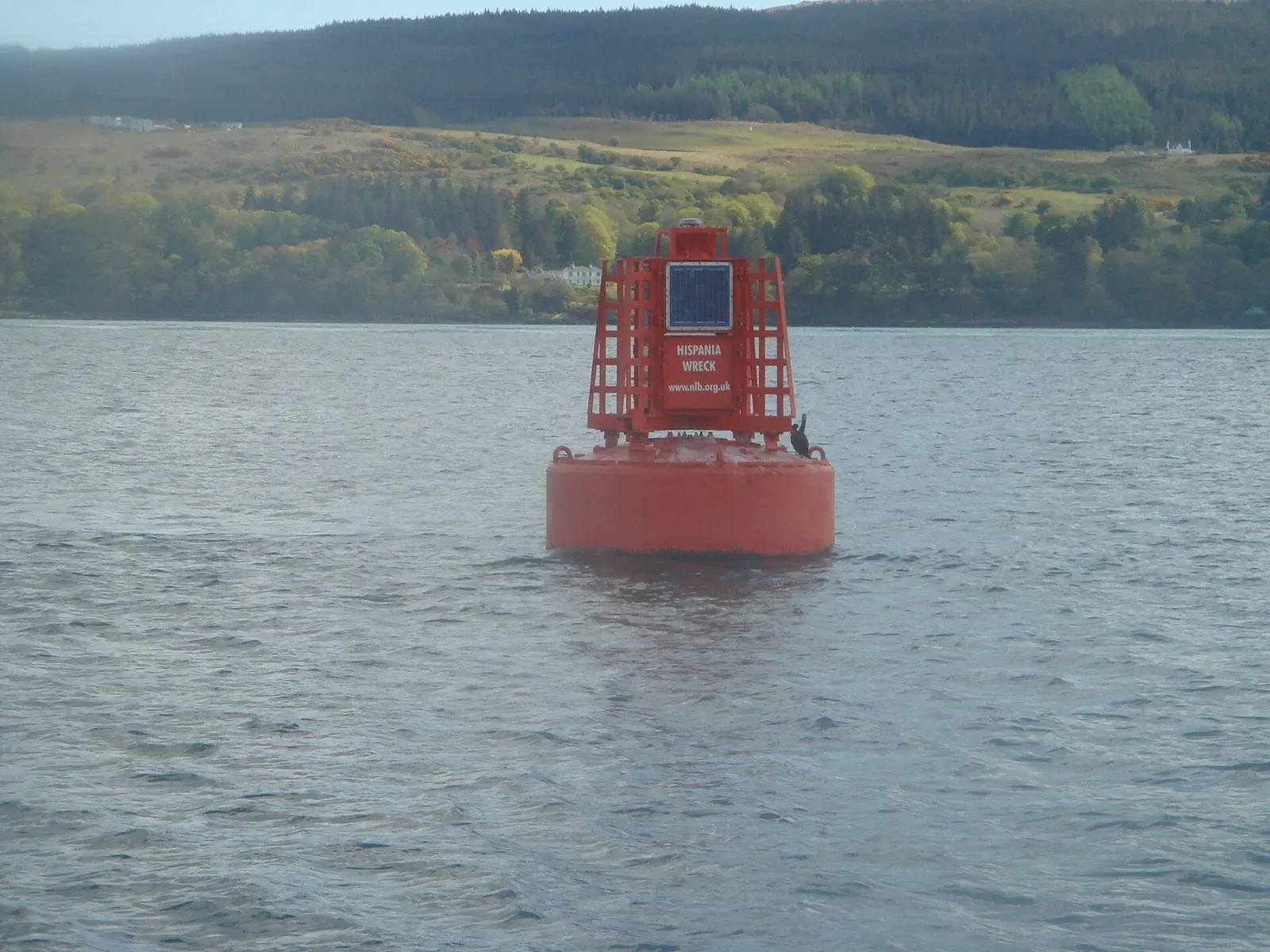
Sound of Mull · United Kingdom · Wreck
Hispania
Seventy-two metres of plating under a coat of anemones
Photo: Nick Birse · CC BY-SA 4.0
A Swedish steamer that struck the Sgeir More in a December 1954 storm and now sits upright with a slight list to starboard, largely intact. Her plating carries so much anemone growth that the hull reads as texture before it reads as steel. The dive runs between 25 and 30 m and only works at slack water.
Also known as SS Hispania.
Where it is and how deep
56.5653° N, 5.9869° WPublished position for this site.
The dive
Boats work the wreck between one and two hours before high or low water, the only window when the Sound's tidal stream lets go of her. You go down the shot line onto the hull, and the first thing that resolves is not steel but growth: the plating is covered in anemones, so the ship arrives as a textured mass with the shape of a vessel somewhere behind it.
She is 72 m long and sits upright with a slight list to starboard, still intact enough that the layout reads as a ship rather than a debris field. Working her length keeps you between 25 and 30 m, and most dives on her do not exceed 25 m, so what limits the dive is the cold and the slack-water window rather than the ceiling.
Scarborough Sub-Aqua Club salvaged the wreck through the 1950s, so what you swim is a stripped ship and the interest is in the structure and the anemone cover rather than in cargo. In summer, watch the water above you on the way back: migrating stinging jellyfish pass over the wreck and their tentacles catch on shot lines, so hoods and gloves stay on and the ascent is worth watching all the way up.
The wreck
- Vessel
- SS Hispania
- Type
- Swedish triple-expansion steamer, 1,323 GRT
- Length
- 72.2 m (237 ft)
- Built
- 1912
- Sunk
- 1954
- Cause
- Struck the Sgeir More rock in a storm while seeking shelter
- Lies
- Upright with a slight list to starboard, largely intact, in 25 to 30 m of water
The Hispania was carrying steel, asbestos and rubber sheeting from Liverpool to Varberg in Sweden when she hit the Sgeir More in severe weather on 18 December 1954, in near-zero visibility, and began to list. Her captain, Ivan Dahn, refused to leave the ship despite his crew's pleas during a lull in the storm and was the one life lost. Scarborough Sub-Aqua Club salvaged the wreck through the 1950s, and Puffin Dive Centre in Oban bought her in November 2002.
Marine life and season
The sources we used don't single out particular species here.
| Jan | Feb | Mar | Apr | May | Jun | Jul | Aug | Sep | Oct | Nov | Dec |
|---|---|---|---|---|---|---|---|---|---|---|---|
| Off-season | Off-season | Fair | Good | Good | Prime | Prime | Prime | Prime | Good | Fair | Off-season |
Season follows Sound of Mull: Apr–Oct is the season; visibility is often best in early spring before the plankton bloom, and winter gales stop the charters.
Know before you go
- The site can only be dived at slack water, between one and two hours before high or low water; outside that window the tidal stream runs hard through the Sound.
- Migrating stinging jellyfish pass over the wreck in summer and their tentacles catch on shot lines, so hoods and gloves stay on and the ascent is worth watching.
Dive videos
SS Hispania (Sound of Mull) - wreck diving with GoPro Hero4 · Scuba Scotland on YouTube
Questions divers ask
How deep is the Hispania?+
She sits between 25 and 30 m, with the shallower side of the hull at about 25 m and the seabed at 30 m. Most dives on her do not exceed 25 m.
When can the Hispania be dived?+
Only at slack water, which falls between one and two hours before high or low water. Outside that window the tidal stream through the Sound makes the site undivable.
Sources
- SS Hispania (1912) — Wikipedia
- Wreck record 541 — Hispania — Wrecksite.eu
- Diving in the United Kingdom — Wikivoyage
Photo credits
- Red and white Northern Lighthouse Board buoy marking the Hispania wreck, with the Sound of Mull shoreline behind by Nick Birse, CC BY-SA 4.0, via Wikimedia Commons
In The Logbook
- Cold-water diving: is it worth the drysuit?Cold water · 8 min read
More dive sites in Sound of Mull
Similar dives elsewhere
A 1939 mine casualty broken across a 30 m seabed
A cannon still on its wooden carriage aboard a frigate lost in 1678
Wreck
Chadwick
Isle of Skye · United Kingdom
An upturned 1892 coal ship beneath the cliffs just north of Neist Point

A 1997 cargo ship split in two, bow and stern dived separately