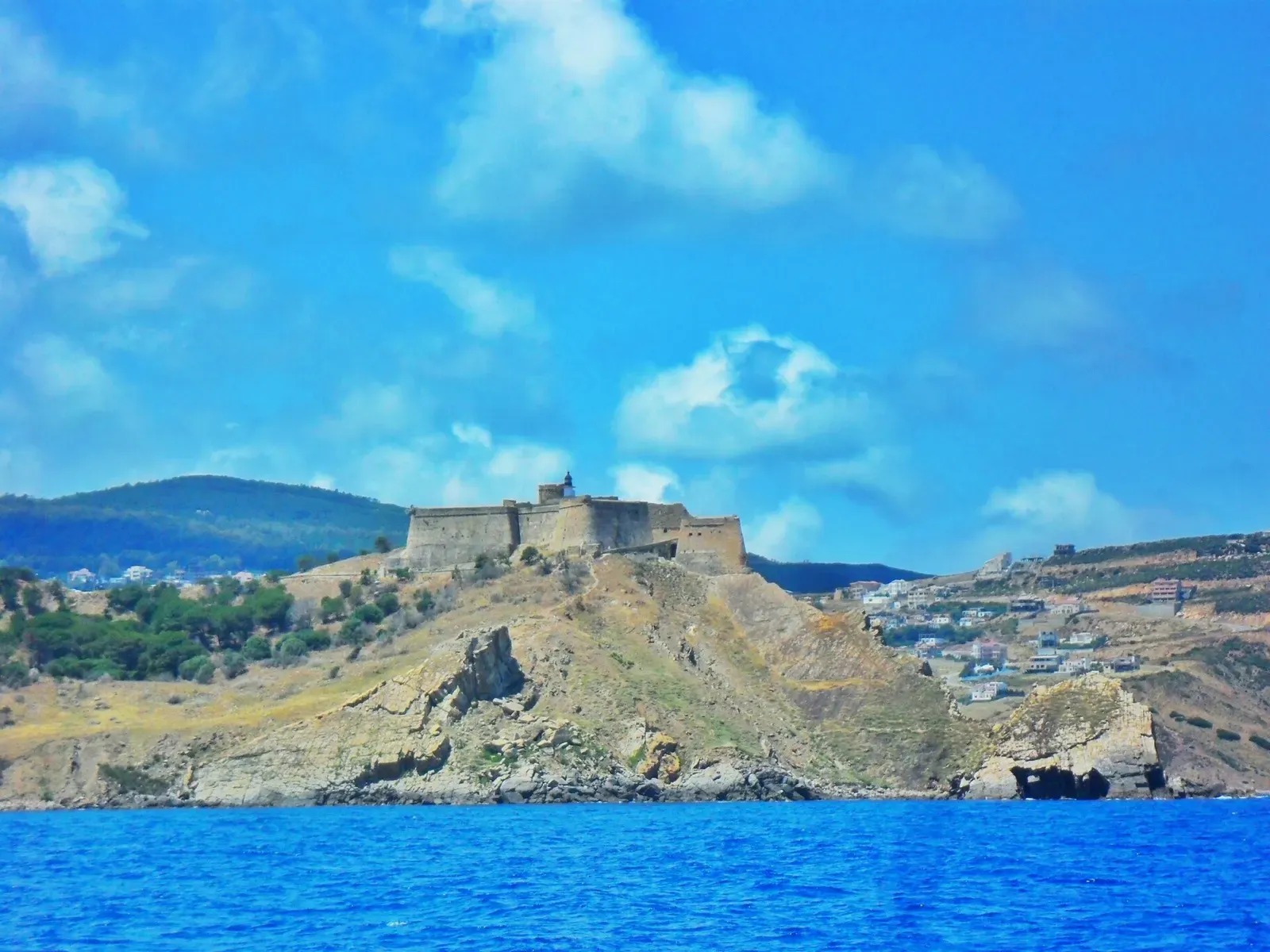
Tabarka · Tunisia · Reef
Cap Tabarka
Headland rock to about 19 m, with groupers and dentex
Photo: Foued Bejaoui · CC BY-SA 3.0
Cap Tabarka is the shallower of the two dive sites listed for the town, worked to about 19 m off the headland it is named after. Groupers and dentex are the fish divers report on Tabarka's dives. It runs as a boat dive with the Club nautique on the marina, the one dive club left in town, which sends boats out at 9h and 14h.
Where it is and how deep
36.9696° N, 8.7409° EApproximate position — the dashed circle shows where the site lies; your operator's briefing has the mooring.
The dive
The site takes its name from the cape just west of the town, and the point plotted here is that headland landmark rather than a published underwater position. What is on the record is the depth: about 19 m at the deepest, which sits just past the limit of entry-level certifications but still leaves useful no-decompression time once you are down.
Groupers and dentex are the species reported on Tabarka's dives, and they are what you are down here looking for. No entry description, no route and no feature-by-feature profile is published for this site, so the shape of the dive comes out of the briefing on the boat rather than from anything you can read beforehand. Treat the depth and the fish as the reliable part.
Conditions run the diary on this coast. The water is not especially clear and the sea is sometimes rough, and June and September are the two months named as the best for diving here. Departures at 9h and 14h mean a blown-out morning does not automatically cost you the day, but it is worth arriving with a flexible plan rather than a fixed one.
Marine life and season
- Groupers
| Jan | Feb | Mar | Apr | May | Jun | Jul | Aug | Sep | Oct | Nov | Dec |
|---|---|---|---|---|---|---|---|---|---|---|---|
| Off-season | Off-season | Fair | Fair | Good | Prime | Prime | Prime | Good | Good | Fair | Off-season |
Season follows Tabarka: Winter swell hammers this exposed coast; May-October brings calm seas and the best visibility, with La Galite crossings only in settled summer weather.
Know before you go
- The water is not especially clear and the sea is sometimes rough here, so agree a lost-buddy procedure and an ascent plan instead of counting on keeping your buddy or the boat in sight.
- No profile is published for the site, so the maximum depth is whatever you agree on the boat; confirm the intended depth and turn pressure in the briefing before you get in.
Photos from Cap Tabarka
Foued Bejaoui · CC BY-SA 3.0
Selma Jmii · CC BY-SA 3.0
Selma Jmii · CC BY-SA 3.0
Dive videos
Cap Tabarka 2015 · Slim Medimegh on YouTube
Questions divers ask
How deep is Cap Tabarka?+
About 19 metres at its maximum, which makes it the shallower of the two dive sites listed for Tabarka and a straightforward recreational profile rather than a deep one.
When is the best time to dive Cap Tabarka?+
June and September are named as the best months for diving at Tabarka. The water is not especially clear and the sea is sometimes rough, so conditions rather than the calendar decide whether a given dive runs.
How do you get to Cap Tabarka?+
By boat from the Club nautique on Tabarka's marina, the one dive club still operating in the town, with departures at 9h and 14h. No mooring position is published, so the skipper's local knowledge finds the site.
Sources
- Tabarka — Wikivoyage (French)
- Cap Tabarka (OpenStreetMap node) — OpenStreetMap
Photo credits
- The Genoese fort atop Tabarka's headland seen from the sea under a bright sky. by Foued Bejaoui, CC BY-SA 3.0, via Wikimedia Commons
- A small boat passing below Tabarka's headland fort, blue sea in the foreground. by Foued Bejaoui, CC BY-SA 3.0, via Wikimedia Commons
- Weathered wreck timbers on foreshore rocks with the headland fort visible across the bay. by Selma Jmii, CC BY-SA 3.0, via Wikimedia Commons
- Waves breaking over Tabarka's harbour breakwater with the headland fort behind. by Selma Jmii, CC BY-SA 3.0, via Wikimedia Commons
More dive sites in Tabarka
Reef
Named for the grouper, and the deeper of Tabarka's two sites
Similar dives elsewhere
Try-dive shallows at 3-5 m, groupers on the way to 16 m

Blocks, caves and furrows in the south face that took ships' anchors
Reef
Camel Stone Reef
Kalkan · Turkey
A short tunnel squeeze through the reef


.JPG)
A plateau below the lighthouse with barracuda, groupers and cuttlefish