
Coral Triangle · Philippines
Apo Reef
The world's second-largest contiguous coral reef, closed to fishing
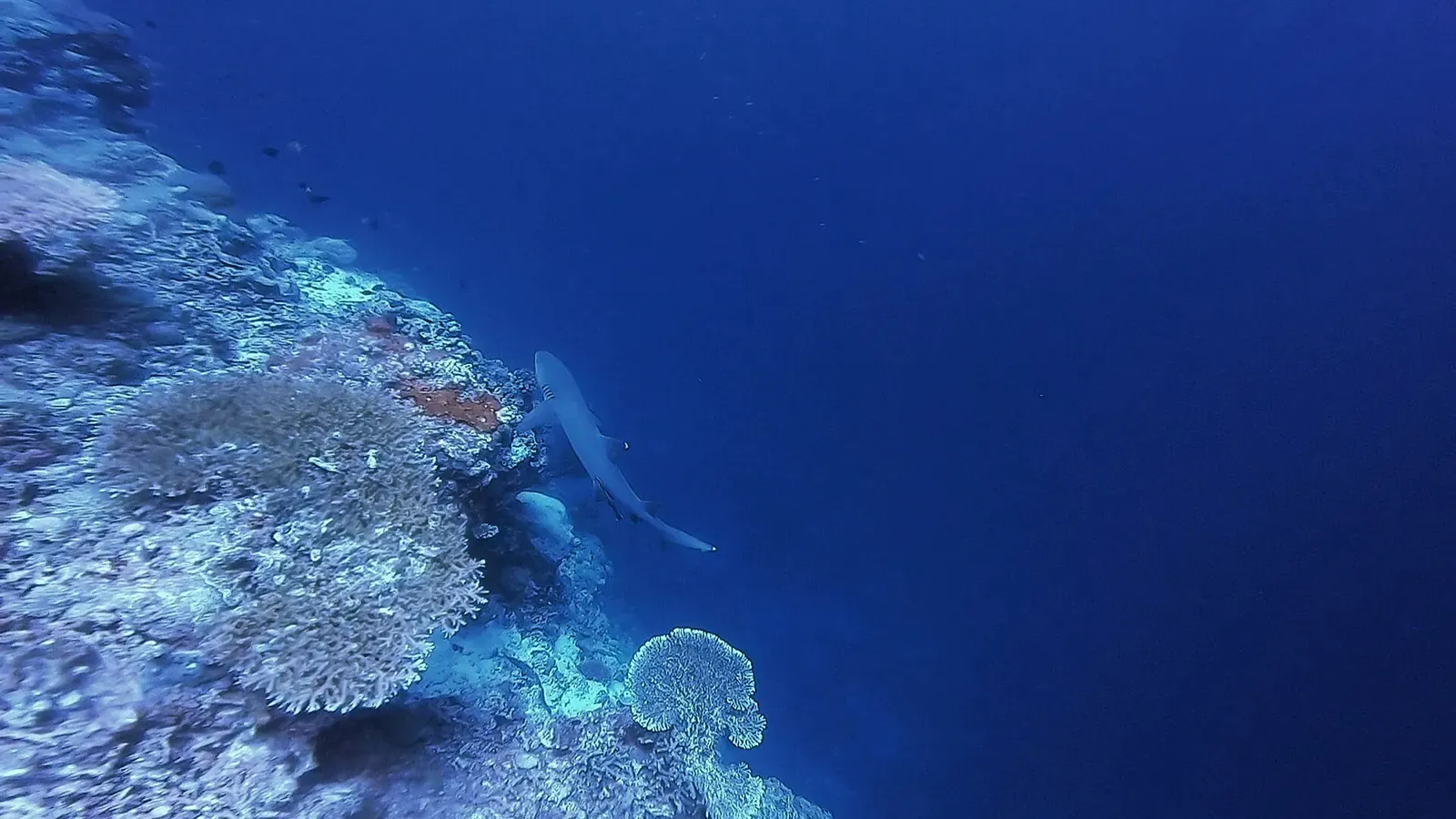
Photo: Wiki.mjmasangkay · CC BY-SA 4.0
Apo Reef, off the west coast of Mindoro, is the second-largest contiguous coral reef system in the world after the Great Barrier Reef — a 34-square-kilometre atoll-like platform in open sea, declared a natural park and closed to fishing. It is not the same place as Apo Island near Dumaguete, and confusing the two is common. Walls drop from the reef edge into deep water where grey reef and whitetip sharks patrol, and hammerheads pass in the season.
About diving in Apo Reef
Nothing about a dive day here is casual. Boats leave Sablayan on the Mindoro coast early and spend a couple of hours crossing open sea, so a single-day trip is a long, weather-dependent affair built around two or three dives and a break ashore. Most divers take two or three nights instead, camping on the islet by the ranger station or joining a liveaboard on the Puerto Galera-to-Coron run, which puts the boat on the reef at first light, takes the crossing out of every day and picks up the isolated pinnacles that sit along the route.
The reef is two shallow platforms split by a deeper channel, each rimmed by a coral shelf that runs well out before it breaks. Inside are lagoons with mangrove along the shores of the main islet; outside, the shelf edge drops away and the character of a dive comes down to which side the wind lets you use. The eastern rim is the steepest, falling close to vertical from shallow water, while the northern and western edges run more as sloping coral shoulders and ridges, with current tracking along the lip rather than pushing over it.
The standard move is to drop onto the shallow reef, fin to the lip and stop there, facing out into blue with the shelf behind you as a reference. Fishing has been shut out of the park for roughly two decades and the fish read accordingly: grouper tend to hold position rather than bolt, and jack schools give up less ground than on reefs that are still worked. Coral cover on the shelf tops is good across long stretches, though the reef still carries damage from the years before the ban. Surface intervals happen on the boat or on the sand, and there is nothing else to do but dive.
This suits divers who are comfortable descending into blue with no bottom in sight, who read a forecast before booking and who accept that a trip can be called off at the mooring. Nothing runs from July to September, when the south-west monsoon and the typhoon season shut the crossing down, and March to May is the settled stretch worth aiming for. Macro hunters and anyone wanting a resort strip, easy shore entries or a choice of operators should look elsewhere in the Philippines; Apo Reef pairs better with the Coron wrecks or a Puerto Galera week than it stands alone.
Best time to dive Apo Reef
| Jan | Feb | Mar | Apr | May | Jun | Jul | Aug | Sep | Oct | Nov | Dec | |
|---|---|---|---|---|---|---|---|---|---|---|---|---|
| Season | Prime | Prime | Prime | Prime | Prime | Good | Off-season | Off-season | Off-season | Fair | Good | Prime |
| Sea surface | 28°C82°F | 28°C82°F | 29°C84°F | 30°C86°F | 30°C86°F | 30°C86°F | 30°C86°F | 29°C84°F | 29°C84°F | 30°C86°F | 30°C86°F | 29°C84°F |
| Daytime high | 30°C86°F | 30°C86°F | 31°C88°F | 32°C90°F | 32°C90°F | 31°C88°F | 30°C86°F | 30°C86°F | 30°C86°F | 30°C86°F | 30°C86°F | 30°C86°F |
| Rain | 56 mm2.2 in | 37 mm1.5 in | 36 mm1.4 in | 49 mm1.9 in | 168 mm6.6 in | 388 mm15.3 in | 532 mm20.9 in | 410 mm16.1 in | 438 mm17.2 in | 367 mm14.4 in | 162 mm6.4 in | 163 mm6.4 in |
| Jan | Feb | Mar | Apr | May | Jun |
|---|---|---|---|---|---|
| Prime | Prime | Prime | Prime | Prime | Good |
| Sea surface | |||||
| 28°C82°F | 28°C82°F | 29°C84°F | 30°C86°F | 30°C86°F | 30°C86°F |
| Daytime high | |||||
| 30°C86°F | 30°C86°F | 31°C88°F | 32°C90°F | 32°C90°F | 31°C88°F |
| Rain | |||||
| 56 mm2.2 in | 37 mm1.5 in | 36 mm1.4 in | 49 mm1.9 in | 168 mm6.6 in | 388 mm15.3 in |
| Jul | Aug | Sep | Oct | Nov | Dec |
|---|---|---|---|---|---|
| Off-season | Off-season | Off-season | Fair | Good | Prime |
| Sea surface | |||||
| 30°C86°F | 29°C84°F | 29°C84°F | 30°C86°F | 30°C86°F | 29°C84°F |
| Daytime high | |||||
| 30°C86°F | 30°C86°F | 30°C86°F | 30°C86°F | 30°C86°F | 30°C86°F |
| Rain | |||||
| 532 mm20.9 in | 410 mm16.1 in | 438 mm17.2 in | 367 mm14.4 in | 162 mm6.4 in | 163 mm6.4 in |
2011–2025 averages. Sea surface: NOAA Coral Reef Watch, measured at the surface, so deeper water can run colder. Daytime high and rain: NASA POWER.
Nov–Jun is the season with Mar–May best; the south-west monsoon and typhoons close the reef entirely from July to September.
Best months: January, February, March, April, May, December
Apo Reef water temperature and weather by month
The sea surface stays between 28 and 30 °C (82–86 °F) all year. Most rain falls from June to October, peaking at about 530 mm (21 in) in July; it stays largely dry from January to April. Daytime highs sit around 30 °C (86 °F) all year. The coldest water here is about 27 °C (81 °F), so pack a 3 mm, or even a 2 mm, suit.
Dive types & marine life
Whitetips tend to sit on the shelf tops while greys hold along the deeper edge, and turtles, napoleon wrasse and barracuda work the shallows, with jacks stacking where current bends around a corner. Hammerheads, mantas and eagle rays turn up on the deeper rims often enough to watch for during the Nov-to-Jun season, but none of them is a reason to book.
- Wall
- Reef
- Drift
- Pelagic & blue water
- Coral garden
- Reef sharks
- Hammerheads
- Sea turtles
- Trevally & jacks
- Napoleon wrasse
- Barracuda
- Manta rays
- Pristine corals
- Eagle rays
Best dive sites in Apo Reef
Wall
North-east wall dived from a 10 m coral plateau to 40 m
Coral garden
Coral gardens across the island's southern tip, 15 m to 40 m
Wall
Sheer drop-off at the island's northern tip, 15 m to 40 m
Wall
The afternoon wall, and the island's bumphead parrotfish schools
The island's most reliable edge for grey reef and whitetip sharks
Binangaan Drop-off
Sheer wall falling from 8 m into deep water on the eastern rim.
Apo Island
The reef's own islet with a lighthouse and shallow coral gardens.
Hunter's Rock
Submerged seamount en route, with sea snakes and schooling fish.
Merope Rock
Isolated pinnacle in open sea, dived only in flat conditions.
How to get to Apo Reef
Trips stage through Sablayan in Occidental Mindoro, reached by road from the San Jose airstrip to the south or from Puerto Galera to the north, with park permits and ranger fees arranged in town before the outrigger crossing. The alternative is a liveaboard on the Puerto Galera to Coron route, which carries the reef as a scheduled stop and removes the daily run out.
Photos from Apo Reef
Ervin Malicdem · CC BY-SA 4.0
Wiki.mjmasangkay · CC BY-SA 4.0
Efdr13 · CC BY-SA 4.0
q.phia · CC BY 2.0
Dive videos
Diving APO REEF & PANDAN ISLAND 2025 · Diver‘s View on YouTube
Scuba Diving Apo Reef (Mini Tubbataha) on a Budget · ScubaDad on YouTube
Photo credits
- A whitetip reef shark cruises along a coral wall drop-off at Apo Reef. by Wiki.mjmasangkay, CC BY-SA 4.0, via Wikimedia Commons
- A giant Napoleon wrasse swims over the reef at Shark Point, Apo Reef. by Ervin Malicdem, CC BY-SA 4.0, via Wikimedia Commons
- A diver explores a coral-encrusted shipwreck resting on Apo Reef's sand. by Wiki.mjmasangkay, CC BY-SA 4.0, via Wikimedia Commons
- Aerial view of Apo Island's lighthouse islet ringed by reef and lagoon. by Efdr13, CC BY-SA 4.0, via Wikimedia Commons
- A hawksbill sea turtle rests on the coral at Apo Reef's Coconut Point. by q.phia, CC BY 2.0, via Openverse
Embed
Run a dive centre, club or blog? Embed this map of 5 dive sites near Apo Reef on your own page.
In The Logbook
- Where to see reef sharks on your first divesBig animals · 14 min read
Similar destinations

Step off a jetty into the world's largest lagoon, or cross to open ocean

The world's third-largest atoll, and a wall running the length of Selayar

Drift dives through some of the richest marine life on Earth


Hot gas vents stream through the reef from an active submarine volcano