
Baa Atoll & Hanifaru Bay · Maldives · Lagoon
Hanifaru Bay
The largest known manta feeding aggregation — snorkel only
Area photo: Abllo · CC BY-SA 4.0
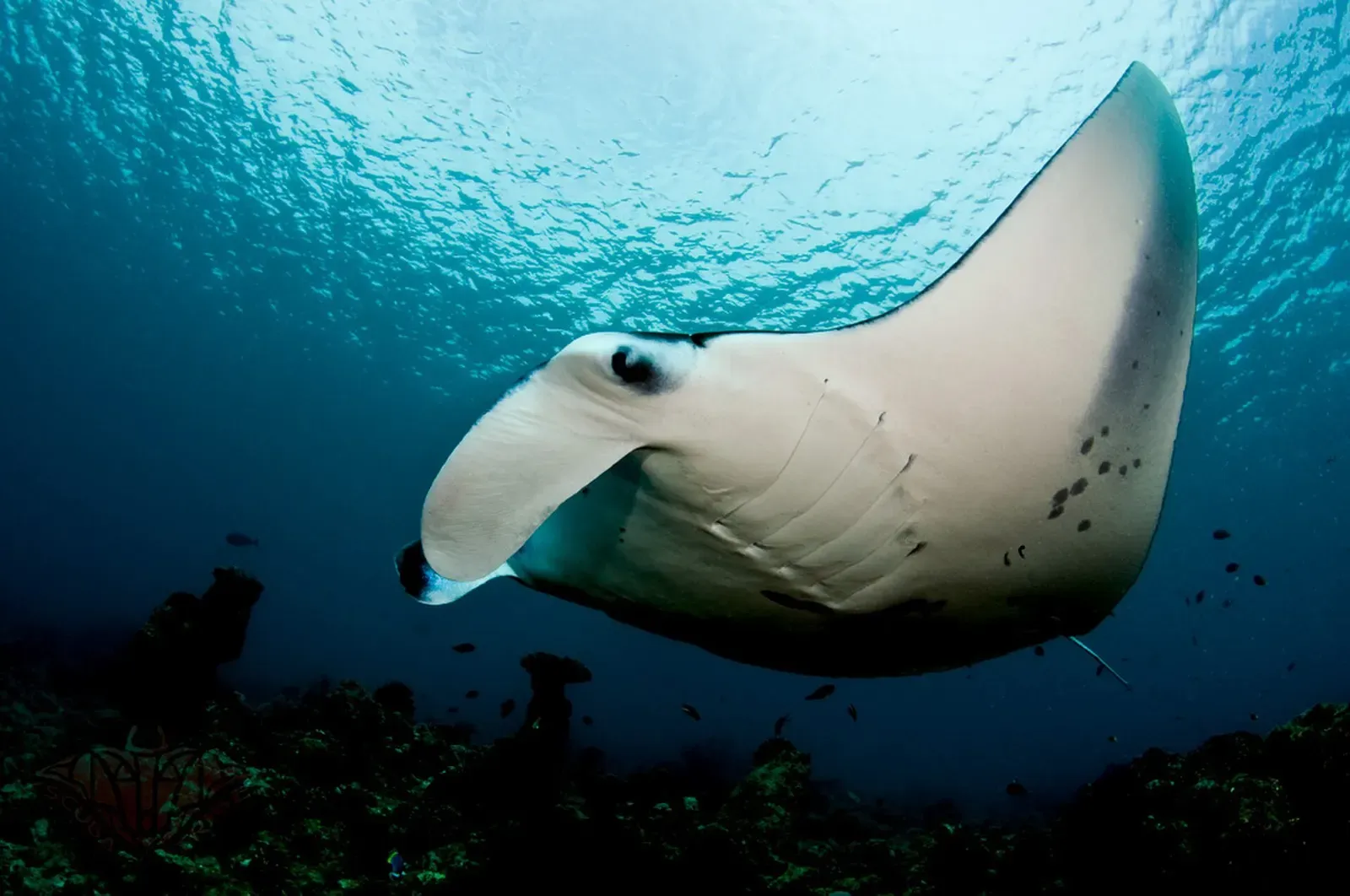
Hanifaru Bay is the manta feeding and breeding ground Baa Atoll is known for, and the largest of its kind known anywhere. It is shallow: the plankton and the animals concentrate between 2 and 10 m, and the bay bottoms out at around 20 m. Scuba has been banned since it became a Marine Protected Area, so visits are on snorkel, capped and time-limited.
Where it is and how deep
5.1732° N, 73.1443° EPublished position for this site.
The dive
There is no dive here in the scuba sense. The bay is a Marine Protected Area, scuba diving and fishing are both banned inside it, and you go in with mask and fins. In practice that is not the limitation it sounds like: the animals feed near the surface and the plankton is densest between 2 and 10 m, which is where they stay. The bay's maximum depth is only around 20 m anyway.
Entry is from a boat and the visit is short and controlled — the number of people in the water at once is capped and time inside the bay is restricted, so slots rotate between boats and nobody stays long. Mantas are the constant from May to November, with the best of it between late July and early October, and whale sharks and dolphins come through from time to time.
Because the water is shallow and the feeding happens at the surface, novice snorkellers manage the bay without difficulty. The skill it asks for is not depth but discipline: staying where the guides put you, keeping off the animals, and making the most of a slot measured in minutes rather than hours.
Background
Hanifaru was declared a Marine Protected Area on World Oceans Day, 8 June 2009. The regulations that came with the designation limit the number of visitors, restrict how long people can spend inside the bay, and ban scuba diving and fishing outright. Snorkelling remains permitted, which is why the largest known manta feeding aggregation in the world is visited on breath-hold rather than on tanks, and why the atoll's actual diving happens on the thilas around it.
Marine life and season
- Manta rays
- Whale sharks
- Dolphins
| Jan | Feb | Mar | Apr | May | Jun | Jul | Aug | Sep | Oct | Nov | Dec |
|---|---|---|---|---|---|---|---|---|---|---|---|
| Fair | Fair | Fair | Good | Prime | Prime | Prime | Prime | Prime | Prime | Good | Fair |
Season follows Baa Atoll & Hanifaru Bay: The Hanifaru aggregation runs May–Nov on the south-west monsoon and peaks Aug–Oct; Dec–Apr is calmer and clearer but the mantas disperse.
Questions divers ask
Can you scuba dive in Hanifaru Bay?+
No. Scuba diving and fishing have both been banned inside the bay since it was declared a Marine Protected Area in 2009. Snorkelling is permitted, and since the mantas feed between 2 and 10 m, snorkelling covers the whole show.
When is the best time to see mantas at Hanifaru Bay?+
The manta season runs from May to November, and the best window inside it is between late July and early October.
How deep is Hanifaru Bay?+
Around 20 m at its deepest, but the plankton is densest between 2 and 10 m and the mantas and whale sharks spend most of their time feeding near the surface.
Sources
- Hanifaru Bay — Scubago
- Snorkeling with Mantas at Hanifaru Bay, Baa Atoll | A Complete Guide — Snorkeling Report
In The Logbook
- Where to dive, month by monthTrip planning · 13 min read
- Why you pee when you dive, and tire afterBody & health · 12 min read
More dive sites in Baa Atoll & Hanifaru Bay
Reef
Coral slopes and a vertical wall between 5 m and 30 m
Blue hole
A vertical chimney through the reef with a cave exit
Reef
Canyons and overhangs from 12 to 30 m, with a shark nursery
Pinnacle
Four coral pinnacles 30–50 m apart, from 10 m down to 30 m
Turtles and whitetips resting under a quiet 10 m pinnacle
Pinnacle
Endemic sponge snail on a protected thila topping out at 7 m
Pinnacle
A 400 m ridge from an 8 m top down to about 35 m
A narrow swim-through and mantas on a current-split point
Similar dives elsewhere

White rubble floors at 8-12 m ringed by sheer coral walls.
A check-out dive circling one big bommie in 12 m of sheltered water.
A sheltered 6 m cove dive around a swimming jetty


Sand and coral heads at 3–6 m, sheltered from the trade winds