
Indian Ocean · Maldives
Baa Atoll & Hanifaru Bay
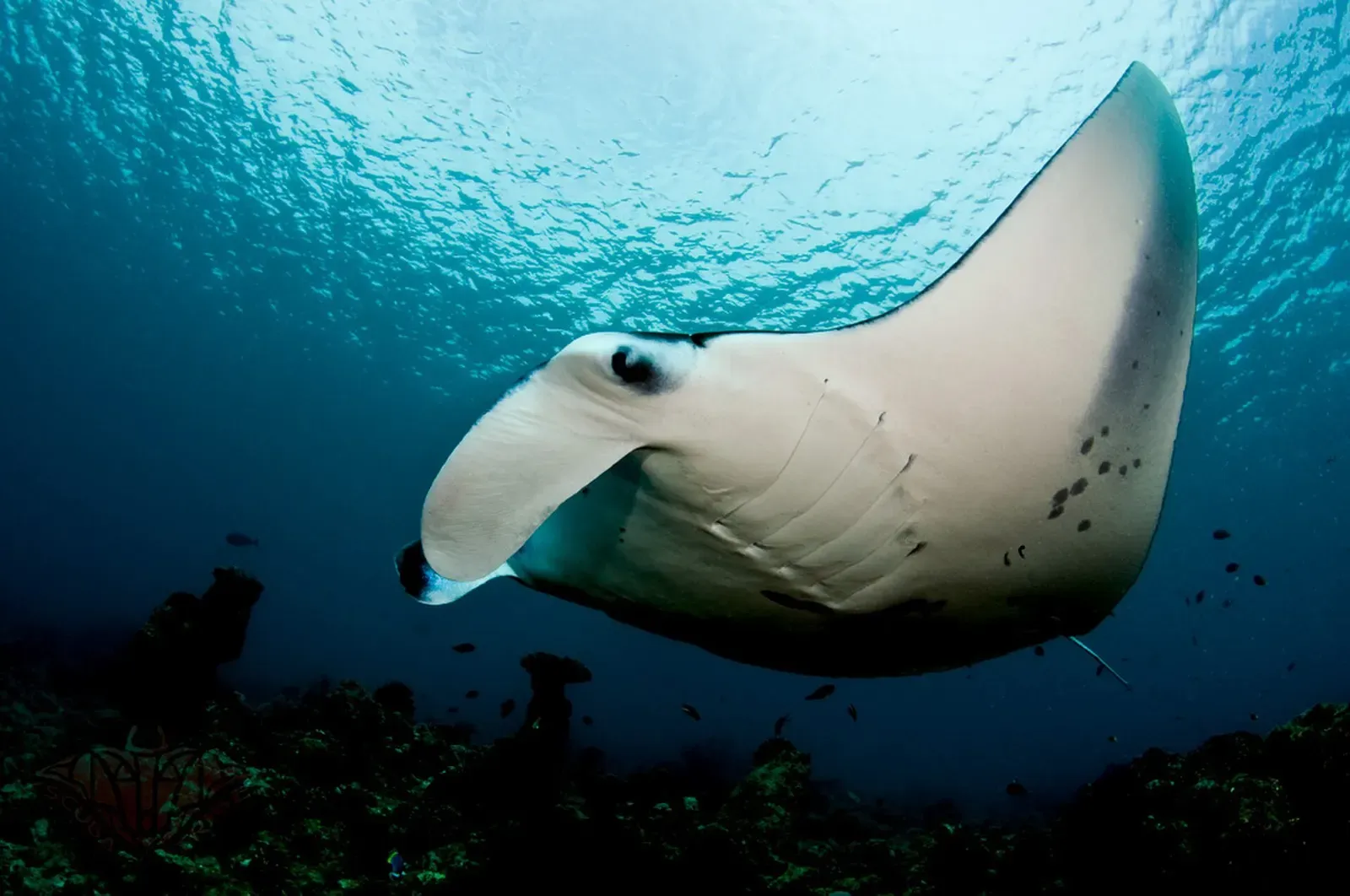
Up to two hundred reef mantas barrel-roll inside a 200 m bay
Photo: Abllo · CC BY-SA 4.0
Baa Atoll is a UNESCO Biosphere Reserve, and for a few months a year the south-west monsoon drives a current that traps plankton inside Hanifaru Bay, a cul-de-sac barely 200 m across. Reef mantas arrive to feed in numbers that have reached two hundred animals at once, barrel-rolling in chains through the soup, sometimes joined by whale sharks. Scuba has been banned there since 2012, so the bay is snorkel-only and permit-limited, while the atoll's thilas carry the actual diving.
About diving in Baa Atoll & Hanifaru Bay
A day in Baa runs on a dhoni and a radio. Boats plan two or three dives on the atoll's thilas, and when rangers or another skipper report animals moving into the bay the plan is dropped and the boat repositions: tanks stay racked, everyone goes in with mask and fins, and the visit is short, because numbers in the water are capped and slots are rotated between boats. Afterwards the day picks up where it left off, from a resort, an island guesthouse, or a liveaboard working the atoll over several days.
The diving itself happens on thilas, coral pinnacles that rise off the atoll floor and stop short of the surface, so you descend onto a reef top and work down and around it rather than along a wall. Position decides the dive. Thilas tucked inside the atoll are dived slowly and close in, with the interest under the ledges and in the fish stacked in their shade. Those sitting in a channel take the tidal flow head-on and become a drift, with the reef itself the only shelter to stop and watch from.
Even in the strongest months the bay is not a scheduled event. Plankton has to build before the animals commit, so plan several days in the atoll with the willingness to wait, rather than one booked morning. That is also why the thilas matter: mantas visiting the reefs outside the bay are met on scuba, at a fixed spot, for as long as your gas lasts, and with far fewer people in the water than the bay itself allows.
Who it suits depends on when you come. From May to November divers take greener, plankton-heavy water and some surge as the price of the manta season. From December to April the aggregation disperses, the water settles and clears, and Baa becomes a quieter reef-and-drift destination that rewards photographers working coral, macro and resident reef fish more than anyone counting big animals. Either way it repays a week; a two-night stop is a coin toss.
Best time to dive Baa Atoll & Hanifaru Bay
| Jan | Feb | Mar | Apr | May | Jun | Jul | Aug | Sep | Oct | Nov | Dec | |
|---|---|---|---|---|---|---|---|---|---|---|---|---|
| Season | Fair | Fair | Fair | Good | Prime | Prime | Prime | Prime | Prime | Prime | Good | Fair |
| Sea surface | 28°C82°F | 29°C84°F | 29°C84°F | 30°C86°F | 30°C86°F | 29°C84°F | 29°C84°F | 29°C84°F | 29°C84°F | 29°C84°F | 29°C84°F | 29°C84°F |
| Daytime high | 28°C82°F | 29°C84°F | 29°C84°F | 30°C86°F | 30°C86°F | 30°C86°F | 29°C84°F | 29°C84°F | 29°C84°F | 29°C84°F | 29°C84°F | 29°C84°F |
| Rain | 62 mm2.4 in | 30 mm1.2 in | 54 mm2.1 in | 80 mm3.1 in | 216 mm8.5 in | 138 mm5.4 in | 172 mm6.8 in | 173 mm6.8 in | 169 mm6.7 in | 195 mm7.7 in | 193 mm7.6 in | 146 mm5.7 in |
| Jan | Feb | Mar | Apr | May | Jun |
|---|---|---|---|---|---|
| Fair | Fair | Fair | Good | Prime | Prime |
| Sea surface | |||||
| 28°C82°F | 29°C84°F | 29°C84°F | 30°C86°F | 30°C86°F | 29°C84°F |
| Daytime high | |||||
| 28°C82°F | 29°C84°F | 29°C84°F | 30°C86°F | 30°C86°F | 30°C86°F |
| Rain | |||||
| 62 mm2.4 in | 30 mm1.2 in | 54 mm2.1 in | 80 mm3.1 in | 216 mm8.5 in | 138 mm5.4 in |
| Jul | Aug | Sep | Oct | Nov | Dec |
|---|---|---|---|---|---|
| Prime | Prime | Prime | Prime | Good | Fair |
| Sea surface | |||||
| 29°C84°F | 29°C84°F | 29°C84°F | 29°C84°F | 29°C84°F | 29°C84°F |
| Daytime high | |||||
| 29°C84°F | 29°C84°F | 29°C84°F | 29°C84°F | 29°C84°F | 29°C84°F |
| Rain | |||||
| 172 mm6.8 in | 173 mm6.8 in | 169 mm6.7 in | 195 mm7.7 in | 193 mm7.6 in | 146 mm5.7 in |
2011–2025 averages. Sea surface: NOAA Coral Reef Watch, measured at the surface, so deeper water can run colder. Daytime high and rain: NASA POWER.
The Hanifaru aggregation runs May–Nov on the south-west monsoon and peaks Aug–Oct; Dec–Apr is calmer and clearer but the mantas disperse.
Best months: May, June, July, August, September, October
Baa Atoll & Hanifaru water temperature and weather by month
The sea surface stays between 28 and 30 °C (82–86 °F) all year. Most rain falls from May to December, peaking at about 220 mm (8.7 in) in May; it stays largely dry from January to April. Daytime highs sit around 29 °C (84 °F) all year. The coldest water here is about 27 °C (81 °F), so pack a 3 mm, or even a 2 mm, suit.
Dive types & marine life
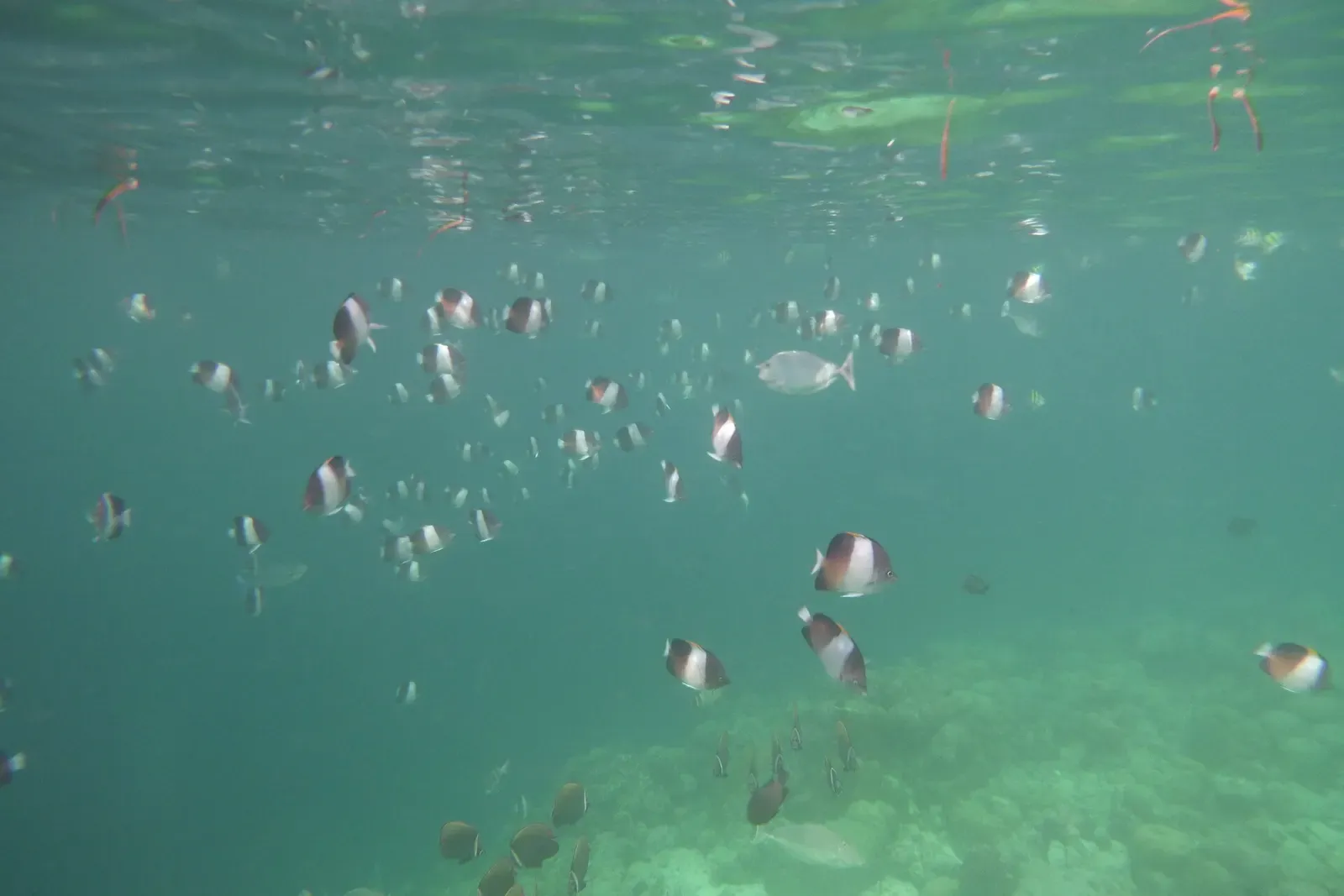
Reef mantas are the constant from May to November and peak between August and October, when whale sharks sometimes join the feeding. Both thin out over the calmer December-to-April window, when the thilas still hold reef sharks, napoleon wrasse, eagle rays, turtles and jack schools, and the clearer water suits nudibranch hunting along the coral.
- Reef
- Drift
- Pelagic & blue water
- Coral garden
- Wall
- Manta rays
- Whale sharks
- Reef sharks
- Sea turtles
- Napoleon wrasse
- Eagle rays
- Trevally & jacks
- Nudibranchs
Best dive sites in Baa Atoll & Hanifaru Bay
Reef
Coral slopes and a vertical wall between 5 m and 30 m
Blue hole
A vertical chimney through the reef with a cave exit
Reef
Canyons and overhangs from 12 to 30 m, with a shark nursery
Pinnacle
Four coral pinnacles 30–50 m apart, from 10 m down to 30 m
Turtles and whitetips resting under a quiet 10 m pinnacle
Pinnacle
Endemic sponge snail on a protected thila topping out at 7 m
Pinnacle
A 400 m ridge from an 8 m top down to about 35 m
A narrow swim-through and mantas on a current-split point
A shore-entry slope from 3 m down, with 20–25 m visibility
Pinnacle
Canyons and overhangs cut between 12 and 30 m
Lagoon
The largest known manta feeding aggregation — snorkel only
Reef
180 m of reef with a pinnacle at each end, 10 m to 30 m
Reef
Reef from 5 m down to a 35 m wall with overhangs
Pinnacle
An offshore rock that begins at 19 m and drops to 35 m
Drift
A drift from a 4 m bay onto a steep wall, mantas Jan–Apr
Nelivaru Haa
Reef top at 12 m falling to 30 m, thick with soft coral and sweepers.
How to get to Baa Atoll & Hanifaru Bay
Most divers fly into Male and connect on the short domestic flight to Dharavandhoo, then transfer by speedboat to a resort or a guesthouse on one of the local islands; seaplanes serve some resorts directly. Liveaboards swing into Baa during the season. Hanifaru is reached only by boat, and the entry fee and ranger permit are normally arranged by the operator.
Photos from Baa Atoll & Hanifaru Bay
MDC Seamarc Maldives · CC BY-SA 4.0
7777777kz · CC BY 3.0
Storm Martin · CC BY 4.0
Samee Shafeeg · CC BY 3.0
Dive videos
4K MALDIVES | Mantas, Sharks and Rays | Hanifaru Bay and the Central Atolls · 3Elements on YouTube
Scuba Diving (4k 60fps) at Baa Atoll, Maldives 2022 w/GoPro9 · Kostya Nakazny on YouTube
Photo credits
- Aerial view of Mudhdhoo Island's reef ring in Baa Atoll, near Hanifaru Bay by Abllo, CC BY-SA 4.0, via Wikimedia Commons
- A giant clam nestled among staghorn coral on a reef at Angafaru in Baa Atoll by MDC Seamarc Maldives, CC BY-SA 4.0, via Wikimedia Commons
- A young blacktip reef shark cruising over sand in shallow water off Baa Atoll by 7777777kz, CC BY 3.0, via Wikimedia Commons
- A flowery rockcod grouper resting on the coral reef in the Maldives by Storm Martin, CC BY 4.0, via Wikimedia Commons
- Aerial view of a chain of reef islands enclosing a shallow turquoise lagoon by Samee Shafeeg, CC BY 3.0, via Wikimedia Commons
Embed
Run a dive centre, club or blog? Embed this map of 12 dive sites near Baa Atoll & Hanifaru on your own page.
In The Logbook
- Where to see reef sharks on your first divesBig animals · 14 min read
- Where to dive with sea turtlesBig animals · 15 min read
- Where to dive in every month of the yearTrip planning · 14 min read
- Why do you pee when diving, and tire after?Body & health · 12 min read
- Where to dive with manta rays, month by monthBig animals · 8 min read
Similar destinations

An atoll wall dropping into open ocean, 400 km from the nearest island

Whale sharks live year-round on the South Ari reef shelf

Drift out on the falling tide as an entire atoll empties past you


.jpg)


A manta cleaning station dived all year and a wartime tanker on her side at 33 m