Why you need to pee within minutes of getting wet
Every diver asks it eventually, usually on a boat, usually of nobody in particular: why do I have to pee when diving, every single time, when I went before I kitted up? The answer is a piece of plumbing called immersion diuresis, and it starts the moment your chest goes under. Water is heavy. Standing or hanging in it, the hydrostatic pressure on your legs is higher than on your chest, and it squeezes blood that normally pools in the veins of the legs up into the thorax. DAN’s physiology is specific: immersion produces “a rapid distribution of blood from the legs to the thorax, which can increase blood volume in the thorax by up to 700 ml” — and that extra blood raises the pressure in the right atrium by 16 to 18 mmHg and cardiac output by 30 per cent. Your heart, in other words, is suddenly handling the load of a body that has been given most of a litre of transfusion it did not ask for.
The heart cannot tell the difference between too much blood and blood that has merely been rearranged. Its atria stretch, and, per the diving-physiology summary on Wikipedia, “the increased atrial volume results in a compensatory diuresis.” Mechanically, the body “detects an increase in the blood pressure and inhibits the release of vasopressin (also known as antidiuretic hormone (ADH)), causing an increase in the production of urine.” ADH is the hormone that tells the kidneys to hold water back; switch it off and they stop holding. DAN’s Neal Pollock describes the same chain — the stretched heart “responds immediately by contracting harder and then, over a short period, by suppressing certain hormones to promote increased fluid elimination through the kidneys” — and lands the practical line: “this is why people have to urinate even after fairly short periods of immersion.” It is a healthy response to a false alarm. The body is fixing a fluid surplus that only exists because you are lying in the sea.
Two things about it are worth knowing before the next section. First, it needs the torso under: Wikipedia’s Diuresis entry is blunt that “partial immersion of only the limbs does not cause increased urination” — the hand-in-warm-water prank has no physiology behind it. Second, it needs you to be hydrated: the diving-reflex literature notes that “diuresis is reduced in dehydrated subjects, and in trained athletes in comparison with sedentary subjects.” Peeing a lot on a dive is, in a slightly backwards way, a sign you arrived in reasonable shape.
Cold does not multiply it, it adds a second bill
The folk version says cold water makes you pee more, and the folk version is right about the outcome and wrong about the mechanism. The classic immersion effect is a pressure effect, and the way we know is that it happens in water that is not cold at all: a 1990 note in Undersea Biomedical Research carried the finding in its title, that immersion diuresis “occurs independently of water temperatures” anywhere between 25 and 35 °C. A wetsuit diver in 29 °C water off Raja Ampat gets the full hydrostatic squeeze, the same atrial stretch, the same ADH suppression, and the same urge as a drysuit diver in a quarry. Pressure alone is sufficient.
That range stops at 25 °C, and below it cold adds a separate line on the invoice. Cold-induced diuresis is “thought to be caused by the redirection of blood from the extremities to the core due to peripheral vasoconstriction, which increases the fluid volume in the core” — the skin’s blood vessels clamp down to save heat, and the blood they no longer hold goes to the same central circulation the water is already crowding. The kidneys sense the pressure and excrete again. So a cold dive is not the immersion mechanism turned up; it is two mechanisms stacked, both shoving fluid into your chest and both being answered by the kidneys. The colder the water, the harder the skin clamps down, and it is no mystery that the 12 °C dive ends with a more urgent walk than the 28 °C one. The heat guide has the arithmetic of why the vasoconstriction happens in the first place.
The dehydration you surface with
The fluid the kidneys threw away was not surplus. It was your plasma, and once the water lets go of your legs at the ladder, the blood that was crowded into your chest drains back down and the body discovers it is short. DAN’s line is precise on the timing and the reason: after the dive “the diver will experience a decline in the central blood volume and blood pressure. The effect exceeds the simple loss of hydrostatic pressure because the body has been actively reducing the fluid volume during the diving (or wetsuit-wearing) period.” Note the parenthesis. A tight wetsuit compresses the legs enough to shift some blood centrally on its own, so the diver who spends an hour kitted up on deck before the drop has started the process dry.
Dehydration matters for one reason beyond feeling flat, and it should be stated at exactly the strength the evidence supports. DAN’s summary of decompression-stress factors puts it in one sentence: “Dehydration can increase the risk of DCS, and hyperhydration can promote immersion pulmonary edema.” Then it immediately hedges, and so should we: “it is probably fair to say that the diving community has sometimes focused too much on dehydration as a risk factor in decompression stress”, partly because DCS itself causes fluid shifts, which muddles cause and effect, and partly out of “the human desire to find something simple to blame.” So: a real factor, not the master key. The mechanics of how tissues shed nitrogen and why perfusion matters are the safety-stop guide’s subject, and the day-long version, where dive two inherits dive one, is surface intervals. This article only insists that the diver who climbs out of the water is a diver whose plasma volume has been quietly cut by their own kidneys, and who is about to do it again after lunch.
P-valves, wetsuits, and the honest answer
Nobody has repealed the physiology, so the gear question is only ever about where the result goes. In a wetsuit the answer is the wetsuit, and every diver who claims otherwise is either dry-suited or lying; the warm sensation on a cold dive is a small comfort followed by a larger flush at the next kick, and the only real cost is the rinse bucket. The rule on liveaboards — go in the sea, not the suit, before the surface interval — is hygiene, not prudery.
A drysuit changes the terms. There is no discreet option: it is either a bladder held for an hour, an adult nappy, or a P-valve, an overboard fitting on the thigh connected to an external catheter for men or an adhesive external device for women. Cave and technical divers treat the valve as standard kit because their dives are too long for the alternative, and the physiology does not pause for a run time. DAN’s drysuit-care advice is the least glamorous sentence in this article and the most useful for anyone fitting one: “Flush P-valves to disinfect them and prevent urea crystallization and bacterial growth that can compromise valve function or cause infection.” A P-valve is plumbing. Plumbing you do not flush becomes a medical appointment.
Why you are so tired after diving
Post-dive fatigue has a long list of suspects, and Adelaide anaesthetist Richard Harris, asked by DAN’s Alert Diver, reads out the whole roster — “thermal stress, decompression stress, energy expenditure, high and prolonged oxygen exposure, anxiety and seasickness”, plus the “potentially unrelated causes such as lack of sleep on holidays, alcohol, jet lag, etc.” But the first suspect is the one this article has already arrested. The blood shift and the diuresis that answers it leave you with less circulating volume and lower blood pressure the moment you stand up on the ladder, and Pollock’s verdict is that “this set of events likely explains a substantial portion of the normal postdive tiredness. Most important, fatigue is due to immersion, independent of depth and decompression stress.” You would be tired after an hour floating in a pool in a wetsuit. The reef is incidental.
The second suspect is your chest. The lungs move the same litres per minute at every depth, but each litre weighs more the deeper you go, and the mass your respiratory muscles push through a regulator, a mouthpiece and your own airways scales with it. Wikipedia’s physiology summary names the outcome plainly: hydrostatic pressure differences, “increased breathing gas density due to ambient pressure, and increased flow resistance due to higher breathing rates may all cause increased work of breathing and fatigue of the respiratory muscles.” We can put a number on the load, because gas density is a computable thing: at 18 litres a minute, a 50-minute dive at the surface passes 1.1 kg of air through your lungs, a dive at 20 m passes 3.3, at 30 m (100 ft) 4.4 kg, and at 40 m 5.5 kg — nearly five times the mass, moved by the same muscles, on the same breath count.
Two things the chart says quietly. EAN32 sits fractionally above air, about 80 grams more over the 40 m dive, because oxygen is heavier than the nitrogen it replaces — nitrox does not lighten the chest’s load — and only the helium in a trimix does. And the breath has a heat cost on top of its mass cost, which the heat guide’s model puts in watts: warming and wetting that gas costs about 45 watts at 30 m in 28 °C tropical water, 71 watts in 10 °C water, and over 110 for a working diver at 4 °C. In the tropics the heat bill is modest and the mass bill is the whole story; in a quarry both are running.
The third suspect is decompression stress, and here the honest word is subclinical. “Unexplained fatigue” is a listed constitutional symptom of decompression sickness, and in the US Navy’s frequency table extreme fatigue appears in 1.3 per cent of DCS presentations against 89 per cent for joint pain — a symptom, but a rare presenting one. The more interesting suggestion comes from the fatigue research itself: the 2010 Belgian field study reasoned that if nitrox reduced post-dive fatigue it “would suggest a pathological origin, possibly the presence of asymptomatic nitrogen bubbles in the body after a dive.” Silent venous bubbles after ordinary no-stop dives are well documented; their contribution to how you feel at dinner is plausible and unproven, and we will not pretend otherwise. What is not in doubt is the boat: sun, wind, a two-hour RIB ride, a bout of seasickness and a 6 a.m. wake-up call are fatigue with no physiology required.
Does nitrox make you less tired?
Divers say so, constantly, and the trials disagree with each other, which is the fact worth carrying rather than either slogan. The 2003 Adelaide study, led by Harris himself at the Royal Adelaide Hospital, was the clean design: double-blinded, randomised, 11 divers breathing air or EAN36 in a dry chamber at 18 m for 40 minutes, with exercise, tested afterwards on a fatigue inventory, attention and concentration tasks. Result: “no measurable difference in fatigue, attention levels, ability to concentrate or DHS scores, following dives using either breathing gas.” Then the 2010 field study, much bigger and much wetter: 219 divers in tropical open water, 121 on air and 98 on EAN32, averaging 21 m for 43 minutes, and “the change in perceived fatigue level after a single dive was significantly lower when EANx was breathed”, with an objective alertness measure that fell 6 per cent on air and rose 4 per cent on nitrox. A small 2017 chamber trial split the difference: eight blinded divers could not tell which gas they were breathing, but performed measurably better on cognitive tests on nitrox, and its authors conclude that “differences in postdive fatigue between air and EANx diving deserve further investigation.”
DAN’s editorial position is the right one to borrow. Harris, asked whether reliable data support the claim, answers “No” — his own trial included — adding that he is “not convinced that the size and power of any of them have addressed the problem comprehensively”; Pollock calls the data “not compelling” and then, generously, points out that placebo effects are physiologically real, “so let the diver enjoy the sense.” Our reading: nitrox has an excellent reason to exist — a lower nitrogen load for the same dive, which the gas guide explains — and a fatigue benefit that may be real, is not settled, and is not why to buy the fill. And it is not lighter to breathe; the chart above is unambiguous about that.
What actually helps
The physiology is not optional, so the plan works on what it leaves behind. Hydration first, and balanced: the same DAN sentence that warns about dehydration warns about the opposite, because over-hydration is a recognised trigger for immersion pulmonary oedema — “excess hydration coupled with rapid onset of heavy swimming exercise on the surface” is the classic combination, and “military divers are instructed to avoid overhydration before high-energy swimming.” IPE “presents as a rapid onset of shortness of breath, cough and sometimes blood-tinged, frothy sputum”, and it is a surface-and-oxygen emergency, not a symptom to swim through. Drink steadily across the day and skip the litre chugged on the swim step.
Warmth second, and specifically warmth late in the dive. The cleanest number in the decompression literature is a US Navy series DAN summarises: divers kept warm on the bottom and cold on the ascent and stop had a DCS rate of 22 per cent; divers kept cold on the bottom and warm on the ascent were given more than twice the bottom time and still came in at 1.3 per cent. A chilled diver is also a vasoconstricted diver running the cold-diuresis pathway on top of the pressure one, so the suit that fits is a hydration measure as well as a comfort one.
Where the long days are
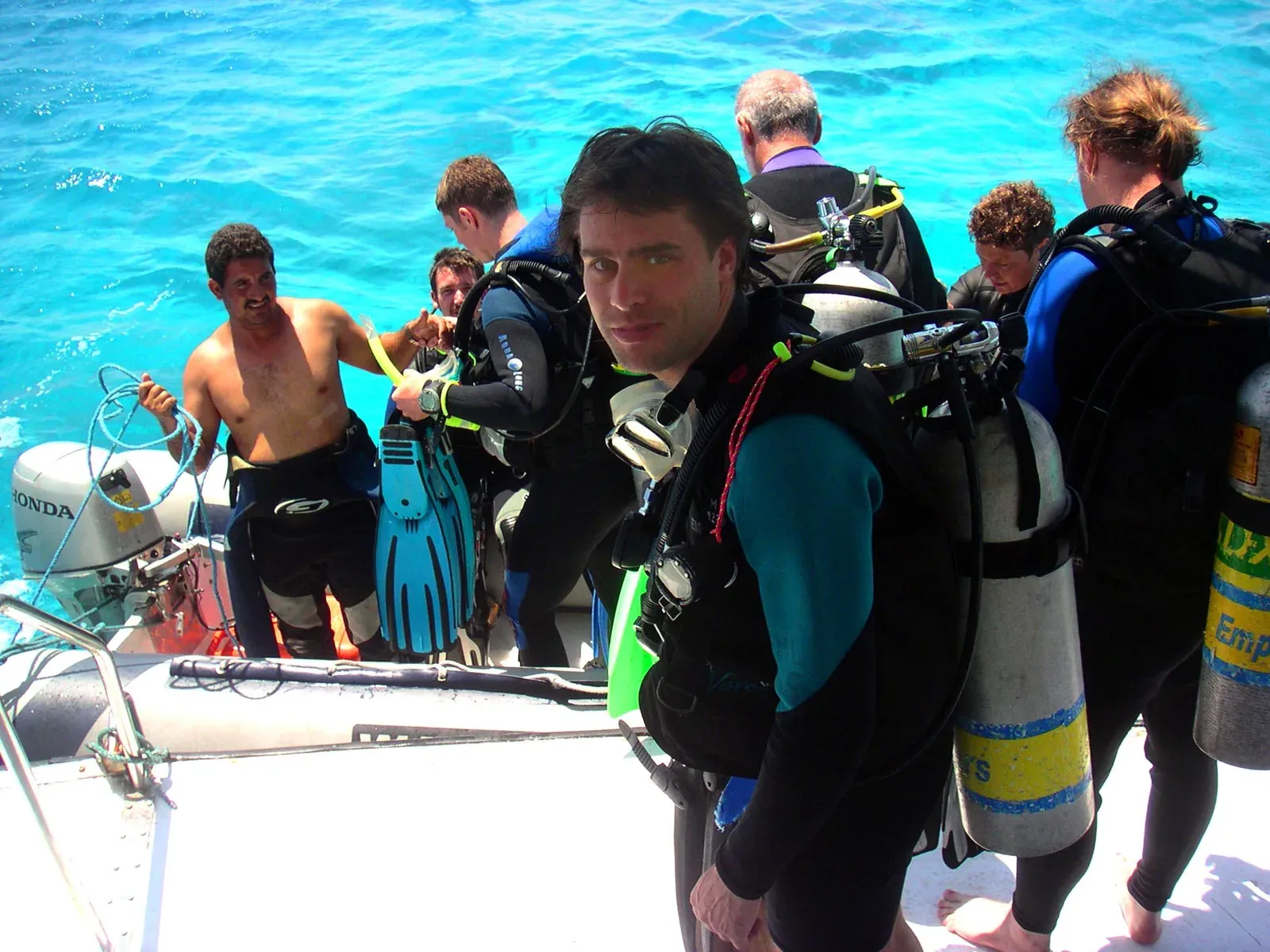
The places that run this physiology hardest are the ones where four dives a day is the timetable, and they are the best diving on the planet, which is the whole difficulty. Komodo’s current-swept pinnacles at Castle Rock and Batu Bolong add real finning to the bill; the Red Sea’s offshore circuit — Big Brother, Habili Ali, Sudan’s Shaab Rumi — stacks deep walls, strong current and a week of early RIB drops; Tubbataha and Chuuk are days from anywhere with a clinic. Every one of them is dived, happily, by people who drink between dives and sleep on the crossings — the choice between that life and a resort’s two-tank mornings is its own guide.
| Site | Depth | Level | Best months |
|---|---|---|---|
| Castle Rock Komodo · Indonesia | 10–25 m | Advanced | Jun–Oct |
| Batu Bolong Komodo · Indonesia | 10–25 m | Advanced | Jun–Oct |
| Elephant Head Rock Similan Islands · Thailand | 25–40 m | Advanced | Dec–Mar |
| Hanifaru Bay Baa Atoll & Hanifaru Bay · Maldives | 2–10 m | Beginner | May–Oct |
| Fish Head Ari & Rasdhoo Atolls · Maldives | 10–35 m | Advanced | Dec–Apr |
| Cape Kri Raja Ampat · Indonesia | to 40 m | Advanced | Nov–Mar |
| Blue Magic Raja Ampat · Indonesia | 7–30 m | Advanced | Nov–Mar |
| Habili Ali St John's Reefs · Egypt | 10–40 m | Advanced | Apr–Jun |
| Big Brother Island Brothers & Daedalus · Egypt | 10–35 m | Advanced | May–Jun |
| Shaab Rumi Sudanese Red Sea · Sudan | 5–30 m | Advanced | Apr–May |
| Sankisan Maru Chuuk Lagoon · Micronesia | 5–30 m | Intermediate | Nov–May |
| Jessie Beazley Reef Tubbataha Reefs · Philippines | 7–50 m | Advanced | Apr–May |
"Jacques' shack" - diving Shaab Rumi, Sudan 2008 · Martin Johnston on YouTube
The heat side of the ledger is computed in why the water steals your heat; the density curve behind the breathing chart is in gas density and narcosis; and what the night on deck does to tomorrow’s nitrogen is in surface intervals.