Mediterranean · Spain
Cabrera Archipelago
A permit-only national park off Mallorca, capped at 40 divers a day
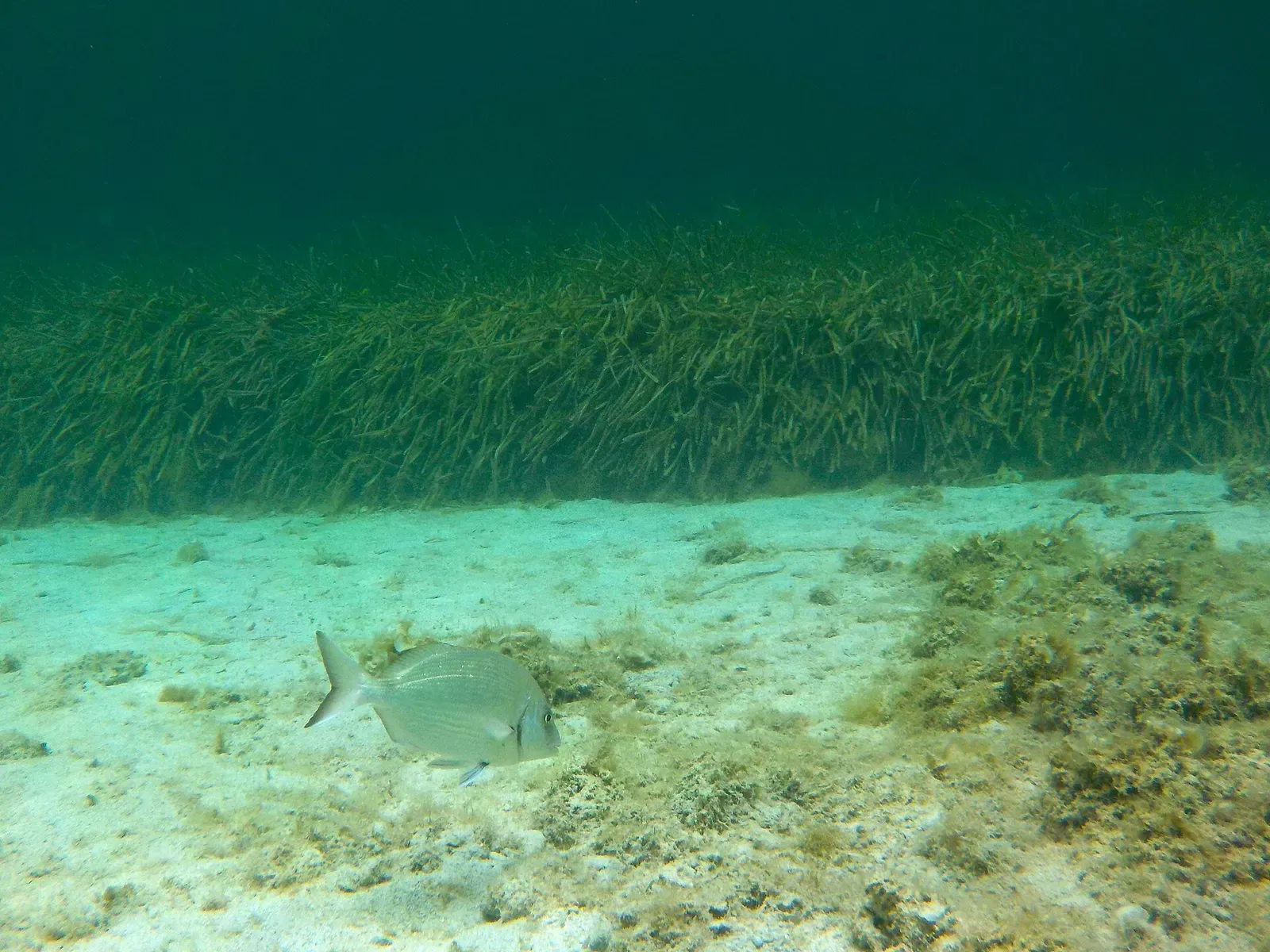
Photo: Victords2012 · CC BY-SA 4.0
Cabrera is a national park of small uninhabited islands south of Mallorca, protected since 1991 and extended in 2019 to more than 90,000 hectares, almost all of it sea. Scuba diving is allowed only in four permit zones: Cala Galiota beneath Cap de Llebeig, the islet of Ses Bledes, the south-west side of Illa des Conills and the wreck of the fishing boat Ana Rosa, with no more than 40 divers a day across the park. Walls, caves and deep posidonia meadows hold groupers and barracuda in water where sport fishing is banned.
About diving in Cabrera Archipelago
Every dive here runs on a park permit. The archipelago can only be reached by sea, visiting boats need prior authorisation to enter and moor, and a scuba permit covers only the designated zones, where boats tie to the park’s temporary buoys instead of anchoring. In practice divers join a centre’s boat from Colònia de Sant Jordi on Mallorca’s south coast for two dives, sometimes with a visit to the harbour and castle between them. The park caps the day at 40 divers across all zones and keeps 70 per cent of those places for dive centres.
Underwater the islands are steep. Cliffs continue below the surface as walls, and around the southern islets the drop-off reaches 90 m; caves and tunnels are common, some crossing whole islets from side to side. Low rainfall means little silt reaches the sea, which keeps the water unusually clear. Posidonia meadows grow down to about 45 m, the deepest known, with beds of maerl below them, and more than 950 species of marine fauna have been recorded, including spiny and slipper lobsters and over 240 fish.
The zones are few and fixed, so the choice is between them rather than among dozens of sites. Cap de Llebeig and Cala Galiota, on the north-west side, offer large rock formations crowded with groupers and barracuda, and a sheltered bay with barracuda schools at the point. Ses Bledes adds a rock platform at about 12 m and an outer side dropping to 40 m, circled in a single dive. The Ana Rosa, a 40 m fishing boat sunk in 1994, lies flat on sand between 22 and 32 m.
The park suits divers who value quiet, protected water and relaxed fish, and who are happy to plan a trip around a permit. The three ordinary zones reach 35 to 40 m and call for deep training; the Ana Rosa is limited to Advanced or an equivalent. Anyone who wants to choose sites freely or dive from shore is better served on Mallorca’s south-west coast around Palma, where boats reach reserve islets in ten minutes and some sites are dived from shore.
Best time to dive Cabrera Archipelago
| Jan | Feb | Mar | Apr | May | Jun | Jul | Aug | Sep | Oct | Nov | Dec | |
|---|---|---|---|---|---|---|---|---|---|---|---|---|
| Season | Off-season | Off-season | Fair | Good | Good | Prime | Prime | Prime | Prime | Good | Fair | Off-season |
| Sea surface | 15°C59°F | 15°C59°F | 15°C59°F | 16°C61°F | 19°C66°F | 23°C73°F | 26°C79°F | 27°C81°F | 26°C79°F | 24°C75°F | 20°C68°F | 17°C63°F |
| Daytime high | 17°C63°F | 16°C61°F | 17°C63°F | 19°C66°F | 22°C72°F | 26°C79°F | 28°C82°F | 29°C84°F | 28°C82°F | 25°C77°F | 22°C72°F | 18°C64°F |
| Rain | 42 mm1.7 in | 36 mm1.4 in | 44 mm1.7 in | 38 mm1.5 in | 27 mm1.1 in | 14 mm0.6 in | 10 mm0.4 in | 22 mm0.9 in | 65 mm2.6 in | 61 mm2.4 in | 79 mm3.1 in | 50 mm2.0 in |
| Jan | Feb | Mar | Apr | May | Jun |
|---|---|---|---|---|---|
| Off-season | Off-season | Fair | Good | Good | Prime |
| Sea surface | |||||
| 15°C59°F | 15°C59°F | 15°C59°F | 16°C61°F | 19°C66°F | 23°C73°F |
| Daytime high | |||||
| 17°C63°F | 16°C61°F | 17°C63°F | 19°C66°F | 22°C72°F | 26°C79°F |
| Rain | |||||
| 42 mm1.7 in | 36 mm1.4 in | 44 mm1.7 in | 38 mm1.5 in | 27 mm1.1 in | 14 mm0.6 in |
| Jul | Aug | Sep | Oct | Nov | Dec |
|---|---|---|---|---|---|
| Prime | Prime | Prime | Good | Fair | Off-season |
| Sea surface | |||||
| 26°C79°F | 27°C81°F | 26°C79°F | 24°C75°F | 20°C68°F | 17°C63°F |
| Daytime high | |||||
| 28°C82°F | 29°C84°F | 28°C82°F | 25°C77°F | 22°C72°F | 18°C64°F |
| Rain | |||||
| 10 mm0.4 in | 22 mm0.9 in | 65 mm2.6 in | 61 mm2.4 in | 79 mm3.1 in | 50 mm2.0 in |
2011–2025 averages. Sea surface: NOAA Coral Reef Watch, measured at the surface, so deeper water can run colder. Daytime high and rain: NASA POWER.
June to September is the main season: dive trips to the park are scheduled through the summer, the sea off Palma averages 22 °C in June and 26 °C in August, and the day’s 40 permit places are in most demand, so book early. April, May and October are good shoulder months, with the sea from about 16 °C in April to 23 °C in October and fewer boats competing for the zones. March and November are marginal, at around 14 °C and 20 °C. December to February is rated off: the sea averages 14 to 16 °C, and the dive trips offered to the park run in the warmer months.
Best months: June, July, August, September
Cabrera Archipelago water temperature and weather by month
The sea surface runs from 15 °C (59 °F) in February to 27 °C (81 °F) in August. It is 24 °C (75 °F) or warmer from July to October. Most rain falls from September to January, peaking at about 80 mm (3.1 in) in November; June to August are the driest. Daytime highs reach 29 °C (84 °F) in August and drop to 16 °C (61 °F) in February. The coldest water here is about 14 °C (57 °F), so pack a 7 mm suit with a hood, or a semi-dry.
Dive types & marine life
Groupers are the constant, with barracuda schools at Cala Galiota. Moray eels, octopus and lobsters live in the rock, and rays cross the sand. Loggerhead turtles and dolphins are regular in the park’s waters, and sperm, pilot and fin whales visit the surrounding waters.
- Reef
- Wall
- Cave & cavern
- Coral garden
- Wreck
- Groupers
- Barracuda
- Octopus & cuttlefish
- Nudibranchs
- Reef fish swarms
- Stingrays
- Sea turtles
Best dive sites in Cabrera Archipelago
- 1
Cap de Llebeig
Boat dive from a sheltered cove among large rock formations, 7 to 35 m, with groupers and barracuda.
- 2
Cala Galiota
Sheltered bay anchorage at about 6 m with the bottom falling to 40 m, and barracuda schools at the point.
- 3
Ses Bledes
Islet circled in a single dive, with a rock platform at about 12 m and the outer side dropping to 40 m.
- 4
Ana Rosa
Fishing boat sunk in 1994, flat on sand at 22 to 32 m; one boat and ten divers a day, Advanced only.
- 5
Illa des Conills (south-west)
Permit zone on the south-west side of Conillera, from the Es Corrals reef to Es Penyalar.
Site guides
Wreck
A 40 m fishing boat wreck in a restricted park zone
Reef
A school of barracuda that can number in the hundreds
Reef
Large rock formations crowded with groupers and barracuda
Reef
A full lap of a rocky islet in very clear water
How to get to Cabrera Archipelago
Fly to Palma, then head to Colònia de Sant Jordi on Mallorca’s south coast, home to the park’s visitor centre and the port for dive and passenger boats; the crossing takes about an hour. Es Port is the only landing point, there is no shore diving or dive centre on the islands, and no camping.
Photos from Cabrera Archipelago
Николай Максимович · CC BY 3.0
Antoni Pons Oliver · CC BY-SA 3.0
Dive videos
Cabrera Sea Bottom . Balearic Islands - Full Documentary · Planet Doc Full Documentaries on YouTube
Questions divers ask
Do I need a permit to dive in Cabrera National Park?+
Yes. Scuba diving needs an authorisation from the park administration, requested in advance with each diver’s certification, and it is valid only in the designated zones. Most divers go with a centre from Mallorca, which arranges the permit; 70 per cent of each day’s places are reserved for centres.
Where can divers dive in the Cabrera Archipelago?+
Only in four zones: Cala Galiota beneath Cap de Llebeig, the islet of Ses Bledes, the south-west side of Illa des Conills, and the Ana Rosa wreck. The park caps the total at 40 divers a day, and the Ana Rosa at one boat and ten divers.
What certification do I need to dive Cabrera?+
Open Water is enough for the three ordinary zones on a guided dive. The Ana Rosa wreck, between 22 and 32 m, is open only to divers with Advanced or an equivalent certification. The walls drop steeply, so good buoyancy matters as much as the card.
How do I get to Cabrera from Mallorca?+
By boat from Colònia de Sant Jordi, on Mallorca’s south coast, a crossing of about an hour. The islands can only be reached by sea, only registered vessels may enter the park, and Es Port, on the sheltered north side, is the only landing point.
Can I dive in the Cova Blava?+
Not with scuba: the Cova Blava lies outside the four permitted dive zones. It is a low sea cave lit blue by light filtering through the water, and in calm weather boat trips let visitors swim in, since only a dinghy or small RIB fits inside.
Sources
- Buceo: Parque Nacional Archipiélago de Cabrera — Organismo Autónomo Parques Nacionales
- Cabrera Archipelago Maritime-Terrestrial National Park: technical details — Govern de les Illes Balears
- Archipiélago de Cabrera: usos compatibles — Ministerio para la Transición Ecológica
- Cabrera Archipelago Maritime-Terrestrial National Park — Wikipedia
- Cabrera travel guide — Wikivoyage
- Cabrera dive sites — Aventura IB
- Buceo Isla Bledas — ZOEA Mallorca
- Marine reserves of Mallorca: Cabrera — ZOEA Mallorca
- Palma de Mallorca: climate — Wikipedia
Photo credits
- A white seabream swims over sand beside a dense Posidonia seagrass meadow in Cabrera National Park by Victords2012, CC BY-SA 4.0, via Wikimedia Commons
- Limestone ridge dropping into clear blue water with sailboats anchored beyond by Николай Максимович, CC BY 3.0, via Wikimedia Commons
- Yachts moored in the sheltered natural harbour bay of Cabrera island by Antoni Pons Oliver, CC BY-SA 3.0, via Wikimedia Commons
Embed
Run a dive centre, club or blog? Embed this map of 4 dive sites near Cabrera Archipelago on your own page.
Similar destinations
A B-17 bomber upright on the sand at 25 m below the citadel
Gorgonian reefs from 24 m down to 90 m, and an all-levels wreck at 4 to 18 m

A hot spring vents into the sea off Karaada's caves


.jpg)

Granite seamounts rising to the surface off Sardinia's south-east corner