Capo Carbonara · Italy · Wall · Reef
Isola dei Cavoli
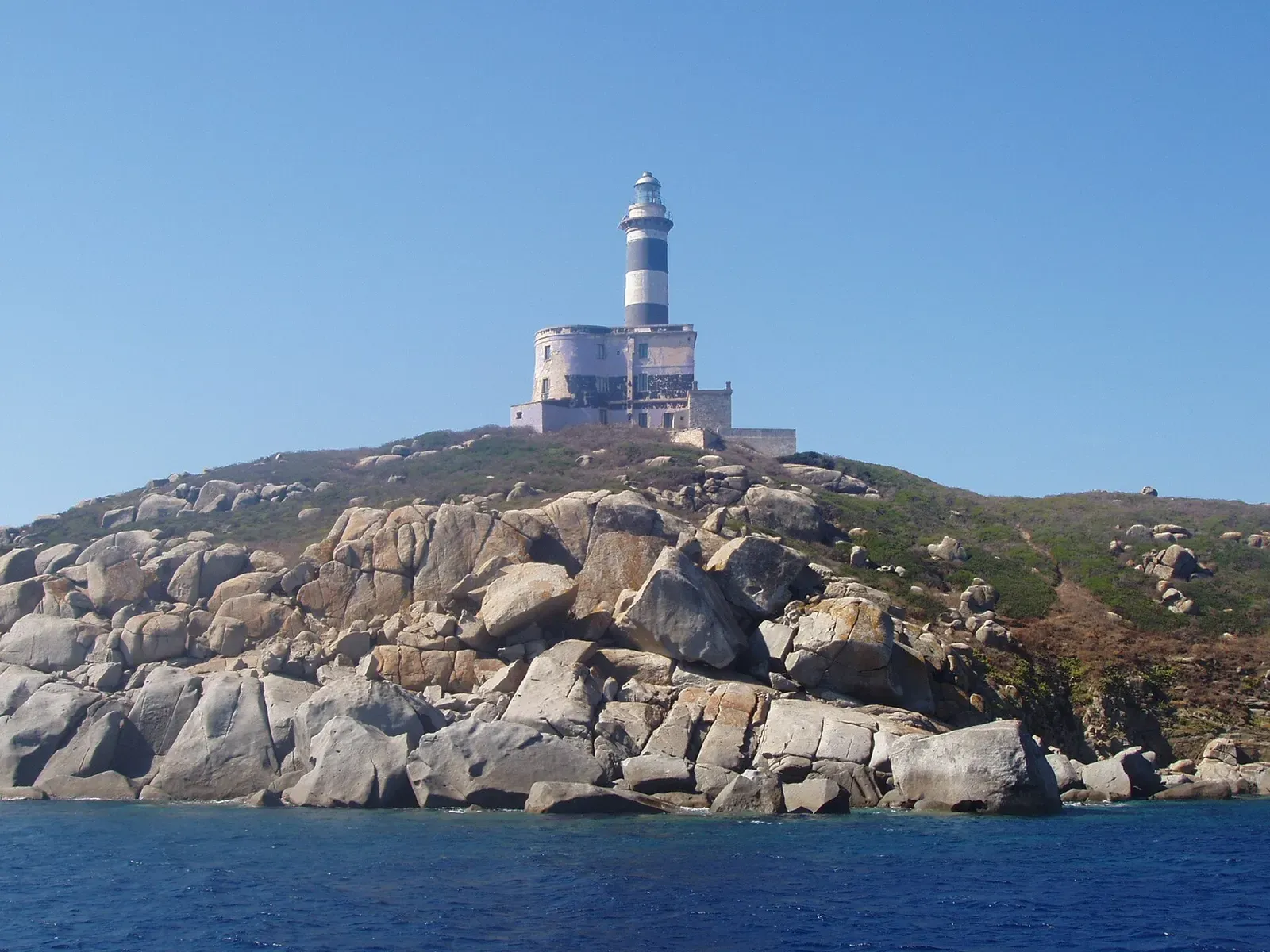
A lighthouse islet with granite ground on every side
Photo: Fflavio74 · CC BY-SA 3.0
A lighthouse islet 690 m off Cape Carbonara, inside the marine protected area that also takes in Serpentara. Underwater it is a coastal wall with a wide fall of big granite blocks, running from 5 m down to 40 m and worked as several separate dives rather than one profile. The 1858 light above is still active and now shares the island with a University of Cagliari research centre.
Where it is and how deep
39.0886° N, 9.5334° EApproximate position — the dashed circle shows where the site lies; your operator's briefing has the mooring.
The dive
This is island ground rather than one fixed dive. A Villasimius operator describes the underwater side of the island as a coastal wall with a wide fall of large granite blocks, running from 5 m to 40 m and dived as multiple different routes. Which one you get depends on the boat and the wind. The marine park's own list of itineraries covers the points that ring the islet — Variglioni dei Cavoli on the granite running south-east, Nave dei Cavoli, Madonna del Naufrago — but carries no entry for the island shore under its own name.
Topside the marker is unmistakable. The lighthouse on the islet dates from 1858 and is still active, automated and solar-powered; with no resident keepers left, the buildings now house the botanical and zoological research centre of the University of Cagliari. The island sits 690 m from Cape Carbonara and, together with Serpentara, falls inside the Capo Carbonara marine protected area.
Background
The islet has been lit since 1858. Automation removed the need for resident keepers, and the lighthouse now runs on solar power while the buildings around it have been given over to the botanical and zoological research centre of the University of Cagliari. The island lies 690 m off Cape Carbonara and, with Serpentara to the north, is part of the Capo Carbonara marine protected area.
Marine life and season
The sources we used don't single out particular species here.
| Jan | Feb | Mar | Apr | May | Jun | Jul | Aug | Sep | Oct | Nov | Dec |
|---|---|---|---|---|---|---|---|---|---|---|---|
| Fair | Fair | Fair | Good | Good | Prime | Prime | Prime | Prime | Good | Fair | Fair |
Season follows Capo Carbonara: May–Oct is the settled season with the warmest water; the mistral and easterlies close the exposed seccas in winter.
Photos from Isola dei Cavoli
Yanashpitsberg · CC BY-SA 4.0
Dive videos
Prima Immersione, 18 metri, Isola dei Cavoli, Villasimius - Xiaomi Yi 4K · ricky.tz.83 on YouTube
Questions divers ask
How deep is the diving at Isola dei Cavoli?+
The granite around the island is dived between 5 m and 40 m, as several separate routes rather than one fixed profile, so the depth depends on which route the boat runs and what your certification covers.
Sources
- Immersioni – Explorers Team — Explorers Team Dive Center
- Isola dei Cavoli Lighthouse — Wikipedia
- Cape Carbonara — Wikipedia
- Immersioni in AMP – itinerari consigliati — Area Marina Protetta Capo Carbonara
Photo credits
- The lighthouse of Isola dei Cavoli standing on granite boulders above the sea by Fflavio74, CC BY-SA 3.0, via Wikimedia Commons
- Granite rocks in the foreground with Isola dei Cavoli and its lighthouse across open water by Yanashpitsberg, CC BY-SA 4.0, via Wikimedia Commons
More dive sites in Capo Carbonara
Reef
Granite weathered into a ship's bow above a Posidonia meadow
Sea fans on the boulder at the foot of the wall
Reef
A named point off Isola dei Cavoli, granite rather than steel
Wreck
A 1943 torpedo casualty lying in trim at about 35 m
Entry-level rock west of Isola dei Cavoli
Reef
One circuit around an emergent boulder in 15 m
Pinnacle
A circuit of the boulders around an offshore beacon
Reef
Gorgonian fans thick enough to block the channels
Similar dives elsewhere
Wall
Big Canyon
Kemer & Tekirova · Turkey
Amphorae up to 2000 years old along a drop-off to 38 m
The park's best-known walls, and a cave with an air pocket
Two dives in one: an easier south side to 35 m, a deep north side past 40 m


An old four-pronged grapple anchor lying deep on the reef