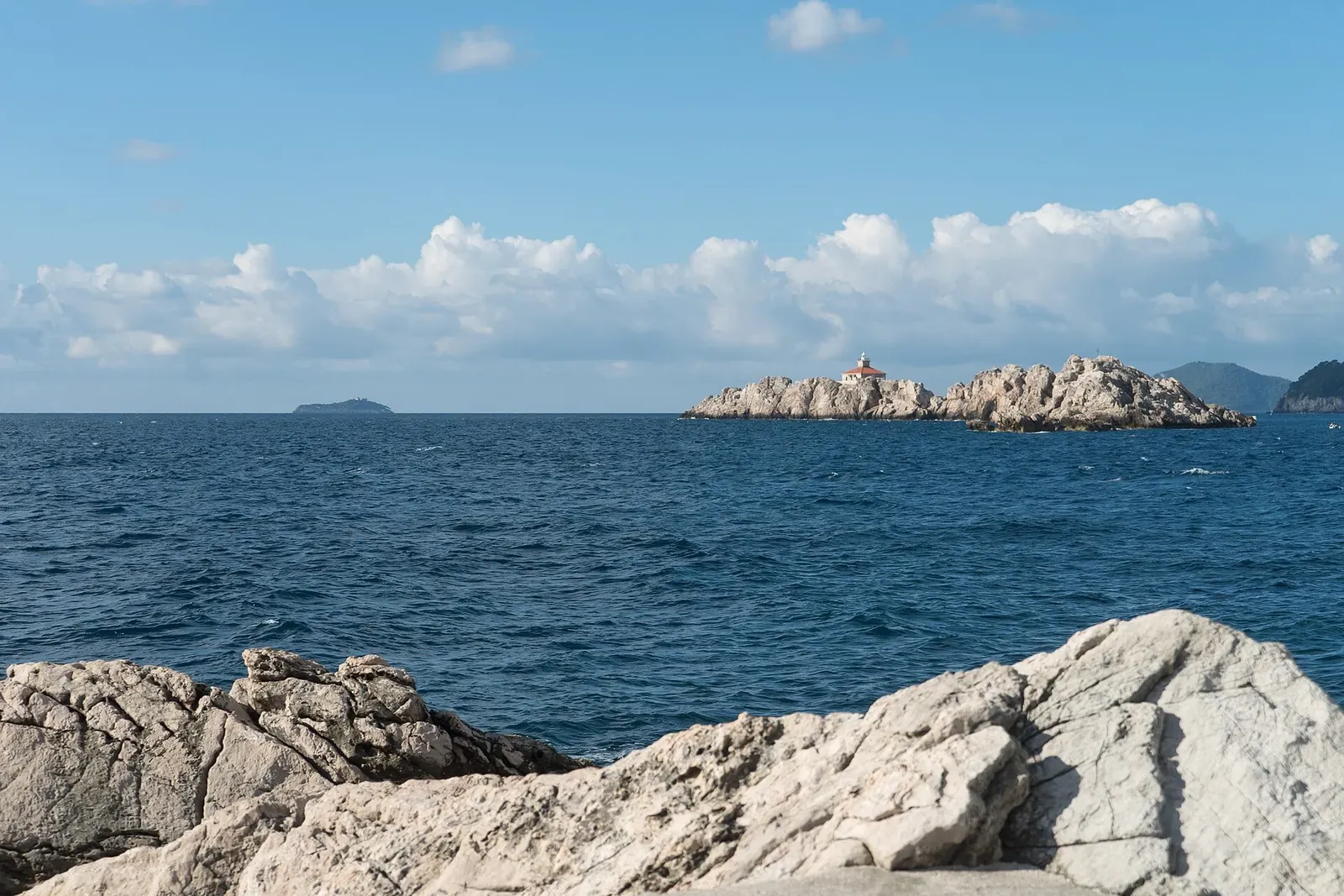
Mediterranean · Croatia
Dubrovnik & the Elafiti Islands
Wrecks and island caves a few minutes by boat from Dubrovnik
Photo: Alexey Komarov · CC BY-SA 4.0
The southern Adriatic coast off Dubrovnik, with the nature reserve of Lokrum just offshore and the Elafiti Islands of Koločep and Lopud to the north-west. Diving is by short boat ride from the city, on a mix of wrecks, walls and caves. The MV Taranto, a Second World War wreck, and the Tomislav off Lokrum both lie around 40 m, while the sailing ship Aurora off Koločep rests at about 16 m. Diving runs all year.
About diving in Dubrovnik & the Elafiti Islands
Diving here is a day-boat operation. Centres are based at hotels in the city, one of them on a beach on the Lapad peninsula, and most sites are a few minutes away by boat: the island of Lokrum just off the old town, and Koločep and Lopud in the Elafiti chain to the north-west. Lokrum is a nature reserve, and its wreck and tunnel are dived from boats out of the city. Weather permitting, divers can choose the site, and some of the wrecks lie further out. The boats run in every season.
The underwater terrain is rock formations, caves and walls. Koločep is cut with caves, coves and underwater reefs; at Bezdan a cave opens over an abyss that falls almost to 40 m. Off Lopud, the Šunj Beach Wall drops as vertical cliffs. On Lokrum, a cave and tunnel run from the Dead Sea, which is devoid of underwater life, though crabs and bream gather along the tunnel. The wrecks range from the Aurora at about 16 m to the Taranto and Tomislav near 40 m.
The area suits divers who want wrecks and caves within easy reach of a city base, with a shallow and a deep hull in the same trip. Much of the reef and cave diving is open to all levels, the first day usually starts with an easier dive before a more challenging one, and the Aurora gives less experienced divers a wreck of their own. Large marine life is scarce, so divers after big animals will find the draw here is caves and history rather than fish.
Best time to dive Dubrovnik & the Elafiti Islands
| Jan | Feb | Mar | Apr | May | Jun | Jul | Aug | Sep | Oct | Nov | Dec |
|---|---|---|---|---|---|---|---|---|---|---|---|
| Good | Good | Good | Good | Good | Prime | Prime | Prime | Good | Good | Good | Good |
Diving runs year-round; summer is the most popular season, for its warmer water and calm sea.
Dive types & marine life
Octopuses, moray eels and lobsters live at Bezdan on Koločep alongside sea sponges and snails, while crabs and bream gather in the cave and tunnel beyond Lokrum's Dead Sea.
- Wreck
- Wall
- Cave & cavern
- Octopus & cuttlefish
Best dive sites in Dubrovnik & the Elafiti Islands
- 1
MV Taranto
Second World War shipwreck resting at 40 m, teeming with marine life.
- 2
Blue Cave at Bezdan
Cave on Koločep over an abyss dropping almost 40 m, with intricate chambers and a play of light.
- 3
Tomislav wreck
Ship wreck lying around 40 m just off the shore of Lokrum.
- 4
Aurora wreck
Remains of a sailing ship off Koločep at only about 16 m, the shallower wreck option.
- 5
Šunj Beach Wall
Vertical cliffs by the bay of Šunj on Lopud, with a lively wall ecosystem.
- 6
Dead Sea tunnel
Cave and tunnel on Lokrum, dived from the boat anchored at the tunnel entrance.
Site guides
Wreck
A sailing ship's remains at only about 16 m off Koločep
Cave & cavern
The Blue Cave above an abyss on Koločep's southern shore
Wreck
A Rotterdam-built cargo ship lost in 1943 off the Grebeni islets
Wreck
A mostly intact 80 m hull just off the shore of Lokrum
How to get to Dubrovnik & the Elafiti Islands
Dubrovnik has its own international airport near Čilipi, about 20 km (12 mi) south-east of the city centre. The dive centres are in the city, and boats leave from there to Lokrum and the Elafiti Islands, which are also linked to Dubrovnik by daily ferries.
Photos from Dubrovnik & the Elafiti Islands
paularps · CC BY 2.0
Alexey Komarov · CC BY-SA 4.0
Questions divers ask
When is the best time to dive Dubrovnik?+
Diving runs all year, but summer is the most popular season for its warmer water and calm sea. The water reaches about 28 °C in July and August and falls to about 13 °C in January.
Is diving in Dubrovnik shore or boat?+
Boat. Centres take divers a few minutes out to Lokrum, the wrecks off the city and the Elafiti Islands of Koločep and Lopud.
What certification is needed for the Taranto wreck?+
The Taranto and the Tomislav off Lokrum are rated for advanced divers, and both lie around 40 m. The Aurora wreck off Koločep, at about 16 m, is the shallower alternative.
How do divers get to Dubrovnik?+
Dubrovnik airport, near Čilipi, is about 20 km (12 mi) south-east of the city. Daily ferries from Dubrovnik serve the Elafiti Islands, though dive boats reach the island sites directly.
Sources
- Diving in Dubrovnik — Blue Planet Diving
- Diving around Lokrum Island — Blue Planet Diving
- Koločep Island — Blue Planet Diving
- Abyss Diving Center - Dubrovnik — Abyss Dubrovnik
- Dubrovnik — Wikipedia
- Elaphiti Islands — Wikipedia
- Dubrovnik average sea temperature — seatemperature.org
- Locations — Blue Planet Diving
- Group dives — Blue Planet Diving
- Lopud — Wikipedia
Photo credits
- Two low, pale limestone islets on a dark blue sea under scattered white clouds, seen from a rocky white shore by Alexey Komarov, CC BY-SA 4.0, via Wikimedia Commons
- Wooded islands and narrow channels spread across a deep blue sea, with hazy mountains behind by paularps, CC BY 2.0, via Openverse
- Steep pine-covered limestone cliffs dropping into deep blue water, with a coastline and islands in the distance by Alexey Komarov, CC BY-SA 4.0, via Wikimedia Commons
Embed
Run a dive centre, club or blog? Embed this map of 10 dive sites near Dubrovnik & the Elafiti Islands on your own page.
Similar destinations
Mediterranean
Cavtat & Konavle
Croatia
Ancient amphora cargoes and giant Greek storage jars on the seabed
Mediterranean
Herceg Novi & the Luštica Blue Cave
Montenegro
Military wrecks, Yugoslav submarine tunnels and the Luštica Blue Cave

Four thousand Classical amphorae still stacked on the seabed at 25 m


A 40 m wall under the monastery filmed in The Big Blue