
New Caledonia · France · Wall · Drift · Channel & pass
Mur aux Loches
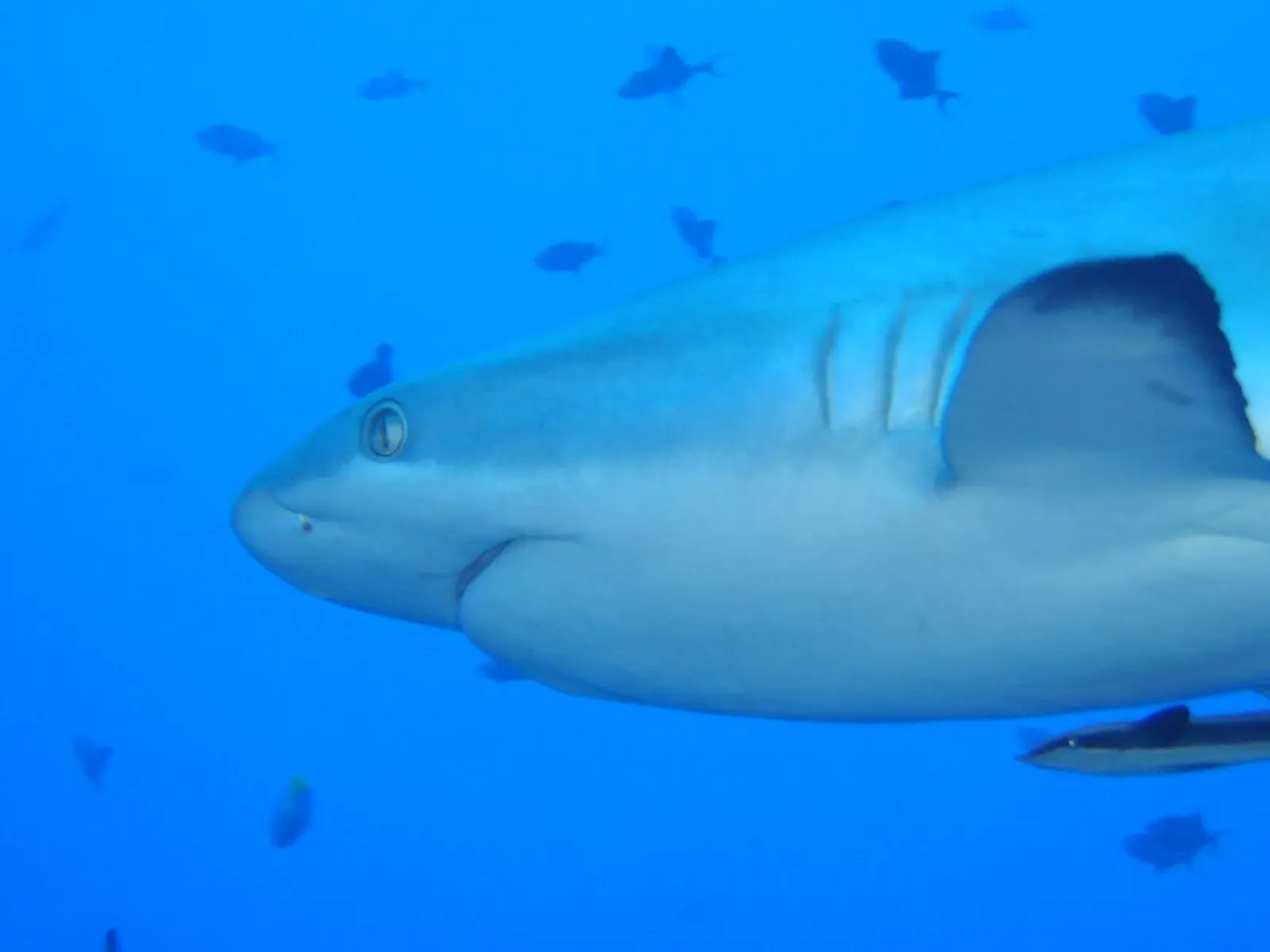
A school of about 70 grey reef sharks on a drifting wall
Area photo: Jean Rerêve · CC BY-SA 4.0
The inner wall of the Dumbéa pass, on the barrier reef west of Nouméa, running as a straight face from 5 m down to 25 m. Tide pushes hard through the pass and the site is dived as a drift, with grey reef sharks — the site listing counts a school of around 70 — holding in the moving water. Napoleon wrasse work the wall and mantas are seen on the way back out.
Also known as Mur Aux lôches.
Where it is and how deep
22.3627° S, 166.2573° EPublished position for this site.
The dive
Dives here run with the tide rather than against it. The wall is the pass's inner face, a straight drop that begins at about 5 m and bottoms out at 25 m, so the whole dive sits inside recreational limits and there is no deep section to manage. The current is the point rather than an obstacle: the site listing describes it as heavy enough to pull pelagics in, and the dive is run as a drift along the face rather than as a fixed tour.
The sharks are what the site is known for. Scubago's entry describes a school of around 70 grey reef sharks in the flow, alongside napoleon wrasse on the wall itself, and lists occasional hammerheads, bull sharks, great whites and dogtooth tuna among the larger visitors. Mantas are reported on the way out of the pass, so the last part of the drift is worth spending in the blue rather than tight against the reef.
Marine life and season
- Reef sharks
- Napoleon wrasse
- Manta rays
| Jan | Feb | Mar | Apr | May | Jun | Jul | Aug | Sep | Oct | Nov | Dec |
|---|---|---|---|---|---|---|---|---|---|---|---|
| Fair | Fair | Good | Good | Good | Good | Good | Good | Prime | Prime | Prime | Good |
Season follows New Caledonia: Sep–Dec is warmest and clearest before the wet season; Jan–Mar is cyclone season, and winter water drops to about 21°C.
Know before you go
- The pass runs hard on the tide: this is a drift, so stay with the group, carry a surface marker and expect the boat to pick you up down-current rather than at a mooring.
Dive videos
Mur aux Loches Nouméa 16/02 · kingJulian77000 on YouTube
Questions divers ask
How deep is Mur aux Loches?+
The wall runs from about 5 m at the top down to 25 m at its base, so the dive stays within recreational limits. The current, not the depth, is what sets the level here.
What sharks are seen at Mur aux Loches?+
Grey reef sharks are the resident draw — the site listing describes a school of around 70 holding in the current. Hammerheads, bull sharks, great whites and dogtooth tuna are listed as occasional visitors, and mantas are seen on the way out of the pass.
Sources
- Mur Aux lôches — Scubago
In The Logbook
- Where to see reef sharks on your first divesBig animals · 14 min read
More dive sites in New Caledonia
A manta cleaning station on a 13 m plateau in the Boulari pass
Wreck
A broken-up 50 m wreck on a 12 m bottom
Wreck
A well-preserved fishing boat leaning to starboard at 20 m
Wall
Passages and arches at 10 m above a wall that falls to 70 m
Lagoon
Sand and coral heads at 3–6 m, sheltered from the trade winds
Drift
A gentle drift slope from 6 m to 50 m with a diver's memorial
Wreck
A wooden minesweeper reduced to her metal ribs
Reef
Reported as the densest fish concentration near Nouméa
Similar dives elsewhere
Hook into the plateau lip and let the sharks stack up off the edge

Two reef-hook stops, 10 to 30 m, in often the strongest current in Palau

Blue-water swim-throughs at the lip of a 30 m drop

The outer rim's face drops 91 m into open ocean