Indian Ocean · Madagascar
Nosy Be
Whale sharks feed in the channel toward Nosy Iranja each October through December
Photo: Diego Delso · CC BY-SA 4.0
Nosy Be and its surrounding islets off northwest Madagascar offer sheltered reef diving around Nosy Tanikely marine park and pelagic-focused trips to the Mitsio Archipelago, where big schools of barracuda and jacks patrol volcanic pinnacles. Whale sharks aggregate in the channel between Nosy Be and Nosy Iranja from October to December, feeding on seasonal plankton blooms, and humpback whales pass offshore during the austral winter. Cyclone season closes most operations from January through March.
About diving in Nosy Be
Boats leave straight off the sand. The dive centres cluster along the south-west beaches around Ambatoloaka, tenders go out through the shallows at whatever the tide allows, and the day is shaped by how far you intend to go. The reefs off Nosy Tanikely and Nosy Sakatia are a short run and get dived as an unhurried two-tank morning. The Mitsio Archipelago sits far enough north that reaching it means a full day at sea, or a leg on a small safari boat with bunks aboard.
The geology is volcanic and it shows. Inshore, the islets are ringed by shallow coral slopes on sand, and the water often carries a green cast from plankton and mainland runoff rather than the blue of an atoll — good for life, harder for wide-angle photography. Further out, the Mitsio islands stand as bare basalt above the waterline and continue below as pinnacles and columns dropping into open water. They are exposed, so those trips are weather-dependent, and the pay-off is depth and blue rather than coral.
The whale shark season is a surface activity rather than a dive: boats look for animals feeding near the top of the water and people get in with mask and fins, so it sits alongside the scuba day rather than inside it. Humpbacks are watched from the boat. The place suits divers relaxed about organisation who want the country as well as the water — little here is polished, most operators close through January and February, and March is a rebuilding month rather than a full season.
Best time to dive Nosy Be
| Jan | Feb | Mar | Apr | May | Jun | Jul | Aug | Sep | Oct | Nov | Dec | |
|---|---|---|---|---|---|---|---|---|---|---|---|---|
| Season | Off-season | Off-season | Fair | Good | Good | Good | Good | Good | Good | Prime | Prime | Good |
| Sea surface | 29°C84°F | 29°C84°F | 30°C86°F | 30°C86°F | 29°C84°F | 28°C82°F | 27°C81°F | 27°C81°F | 27°C81°F | 28°C82°F | 29°C84°F | 29°C84°F |
| Daytime high | 30°C86°F | 30°C86°F | 30°C86°F | 31°C88°F | 30°C86°F | 29°C84°F | 28°C82°F | 29°C84°F | 30°C86°F | 31°C88°F | 31°C88°F | 31°C88°F |
| Rain | 391 mm15.4 in | 260 mm10.2 in | 285 mm11.2 in | 136 mm5.4 in | 43 mm1.7 in | 21 mm0.8 in | 17 mm0.7 in | 13 mm0.5 in | 20 mm0.8 in | 35 mm1.4 in | 134 mm5.3 in | 256 mm10.1 in |
| Jan | Feb | Mar | Apr | May | Jun |
|---|---|---|---|---|---|
| Off-season | Off-season | Fair | Good | Good | Good |
| Sea surface | |||||
| 29°C84°F | 29°C84°F | 30°C86°F | 30°C86°F | 29°C84°F | 28°C82°F |
| Daytime high | |||||
| 30°C86°F | 30°C86°F | 30°C86°F | 31°C88°F | 30°C86°F | 29°C84°F |
| Rain | |||||
| 391 mm15.4 in | 260 mm10.2 in | 285 mm11.2 in | 136 mm5.4 in | 43 mm1.7 in | 21 mm0.8 in |
| Jul | Aug | Sep | Oct | Nov | Dec |
|---|---|---|---|---|---|
| Good | Good | Good | Prime | Prime | Good |
| Sea surface | |||||
| 27°C81°F | 27°C81°F | 27°C81°F | 28°C82°F | 29°C84°F | 29°C84°F |
| Daytime high | |||||
| 28°C82°F | 29°C84°F | 30°C86°F | 31°C88°F | 31°C88°F | 31°C88°F |
| Rain | |||||
| 17 mm0.7 in | 13 mm0.5 in | 20 mm0.8 in | 35 mm1.4 in | 134 mm5.3 in | 256 mm10.1 in |
2011–2025 averages. Sea surface: NOAA Coral Reef Watch, measured at the surface, so deeper water can run colder. Daytime high and rain: NASA POWER.
Cyclone season (Jan-Mar) shuts down most diving; whale sharks aggregate Oct-Dec and humpback whales pass offshore during the austral winter.
Best months: October, November
Nosy Be water temperature and weather by month
The sea surface runs from 27 °C (81 °F) in August to 30 °C (86 °F) in April. Most rain falls from December to April, peaking at about 390 mm (15 in) in January; it stays largely dry from May to October. Daytime highs sit around 30 °C (86 °F) all year. Below the surface the water can drop to about 24 °C (75 °F), so pack a 3 mm full suit.
Dive types & marine life
Whale sharks are the October-to-December draw and are met on snorkel; humpbacks pass offshore in the austral winter, broadly July to September. From April onwards the Mitsio pinnacles hold barracuda, jack schools and reef sharks in the current, while turtles, eagle rays and nudibranchs are steady on the sheltered islet reefs. January and February are effectively closed.
- Reef
- Wall
- Drift
- Pelagic & blue water
- Whale sharks
- Sea turtles
- Reef sharks
- Dolphins
- Whales
- Eagle rays
- Barracuda
- Trevally & jacks
- Nudibranchs
- Reef fish swarms
Best dive sites in Nosy Be
Reef
Coral plateau with fusilier shoals, turtles and passing grey sharks
Seamount
A 500 m dome where grey reef and leopard sharks patrol the slopes
Wall
Sheer walls where barracuda, mobulas and whitetips pass
Wall
A deep drop-off off Nosy Iranja with a fair chance of big fish
Wall
A tunnel and arches cut through a gorgonian wall below 30 m
Reef
A long soft-coral reef thick with reef fish, kept for the third dive
Pinnacle
Two rock peaks breaking the surface, cut through with arches and caves
Artificial reef
A scuttled trawler at 28.5 m off Nosy Sakatia
Reef
Leopard, grey and whitetip sharks on a hand-shaped reef
Reef
Gorgonians, tube sponges and brain corals in a protected islet reef
Nosy Tanikely
Marine park islet with turtles and reef fish over shallow coral
Mitsio Archipelago
Pelagic-rich pinnacles with barracuda and jack schools
Nosy Iranja
Channel where whale sharks aggregate October through December
Pain de Sucre
Sugarloaf-shaped pinnacle known for large schooling fish
How to get to Nosy Be
Flights land at Fascene on Nosy Be, either on the domestic hop from Antananarivo or on seasonal direct services from Europe; the overland alternative is the road to Ankify on the mainland and a speedboat across. Centres sit on the south-west beaches around Ambatoloaka, and sites are reached by day boat or on a multi-day safari boat.
Photos from Nosy Be
Diego Delso · CC BY-SA 4.0
Diego Delso · CC BY-SA 4.0
Diego Delso · CC BY-SA 4.0
Dive videos
Nosy Be - Madagascar diving | Dune Subocea | Scuba diving | Plongée à Nosy Be 4K · TSOYE Officiel on YouTube
DIVING MADAGASCAR - NOSY BE (SAKATIA) · Forever Fishing ZA on YouTube
Photo credits
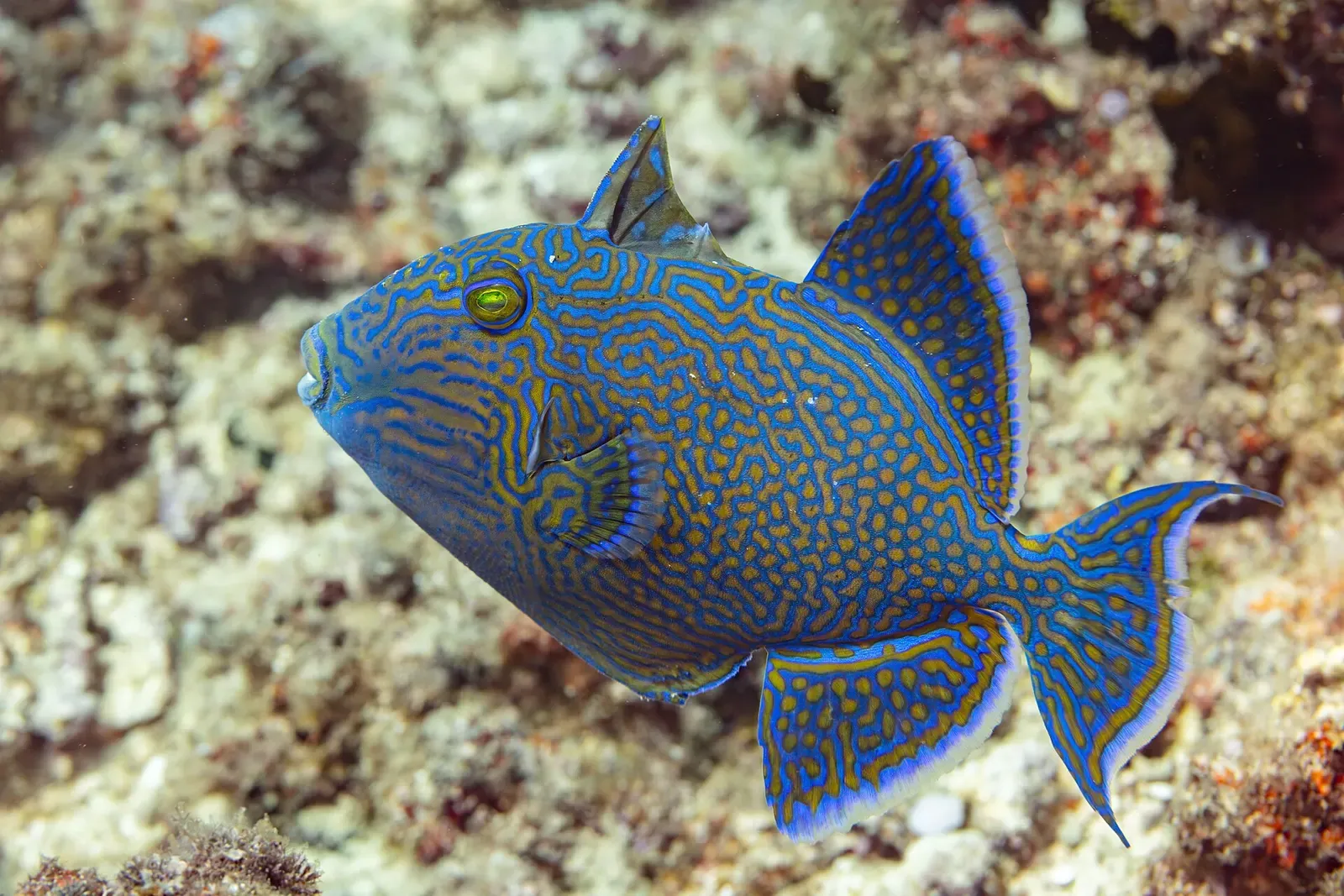
- Blue triggerfish with maze-like yellow markings hovering over pale coral rubble by Diego Delso, CC BY-SA 4.0, via Wikimedia Commons
- Iridescent bigfin reef squid hanging in black water with its arms curled below its eye by Diego Delso, CC BY-SA 4.0, via Wikimedia Commons
- Goldtail angelfish with pale vertical bars and a yellow tail swimming over coral rubble by Diego Delso, CC BY-SA 4.0, via Wikimedia Commons
- Small white juvenile parrotfish with an orange head and a black-spotted yellow dorsal fin against soft coral by Diego Delso, CC BY-SA 4.0, via Wikimedia Commons
Embed
Run a dive centre, club or blog? Embed this map of 7 dive sites near Nosy Be on your own page.
Similar destinations

Resident manta rays clean daily at Passe en S inside the barrier reef lagoon

Barracuda schools circle Barren Island, home to India's only active volcano

Whale sharks live year-round on the South Ari reef shelf

,_Nosy_Antanimora,_Madagascar,_2025-09-15,_DD_73.jpg)
,_Nosy_Iranja,_Madagascar,_2025-09-17,_DD_134.jpg)
,_Ambalihabe,_Madagascar,_2025-09-16,_DD_125.jpg)
,_Nosy_Antanimora,_Madagascar,_2025-09-15,_DD_105.jpg)
Up to two hundred reef mantas barrel-roll inside a 200 m bay