
Pamilacan · Philippines · Reef · Coral garden · Drift
Cervera Shoal
Banded sea kraits crawling openly over a sunken plateau
Area photo: Pierre Pericard · CC BY 4.0
Cervera Shoal is a sunken coral plateau in open water west of Pamilacan, its top at about 10 to 18 m and its edges falling to 30, and it is dived for one thing: black-and-white banded sea kraits, out on the reef in numbers rather than hidden away. Turtles, moray eels, nudibranchs and barrel sponges fill in around them. There is no island above it — you drop onto a reef in the middle of the sea.
Also known as Snake Island, Snake Shoal.
Where it is and how deep
9.4900° N, 123.8448° EApproximate position — the dashed circle shows where the site lies; your operator's briefing has the mooring.
The dive
Nothing marks the site from the surface: the boat stops over open water and you drop, and the plateau comes up to meet you at somewhere around 10 to 18 m. It is a flat-topped coral bank with edges that fall away to about 30 m, which makes the dive simple to run — work the top, look over the rim, and come back up onto the plateau to finish. Currents can run across it, so the guide picks the side.
The sea kraits are why the boat comes out here, and they are not a lucky sighting. Black-and-white banded kraits are out crawling over the coral in the open, several at a time, hunting through the cracks with their heads down and paying divers no attention at all. They are venomous but famously disinclined to bite; the rule is the ordinary one — do not touch, do not corner one, and let a moving snake carry on past you.
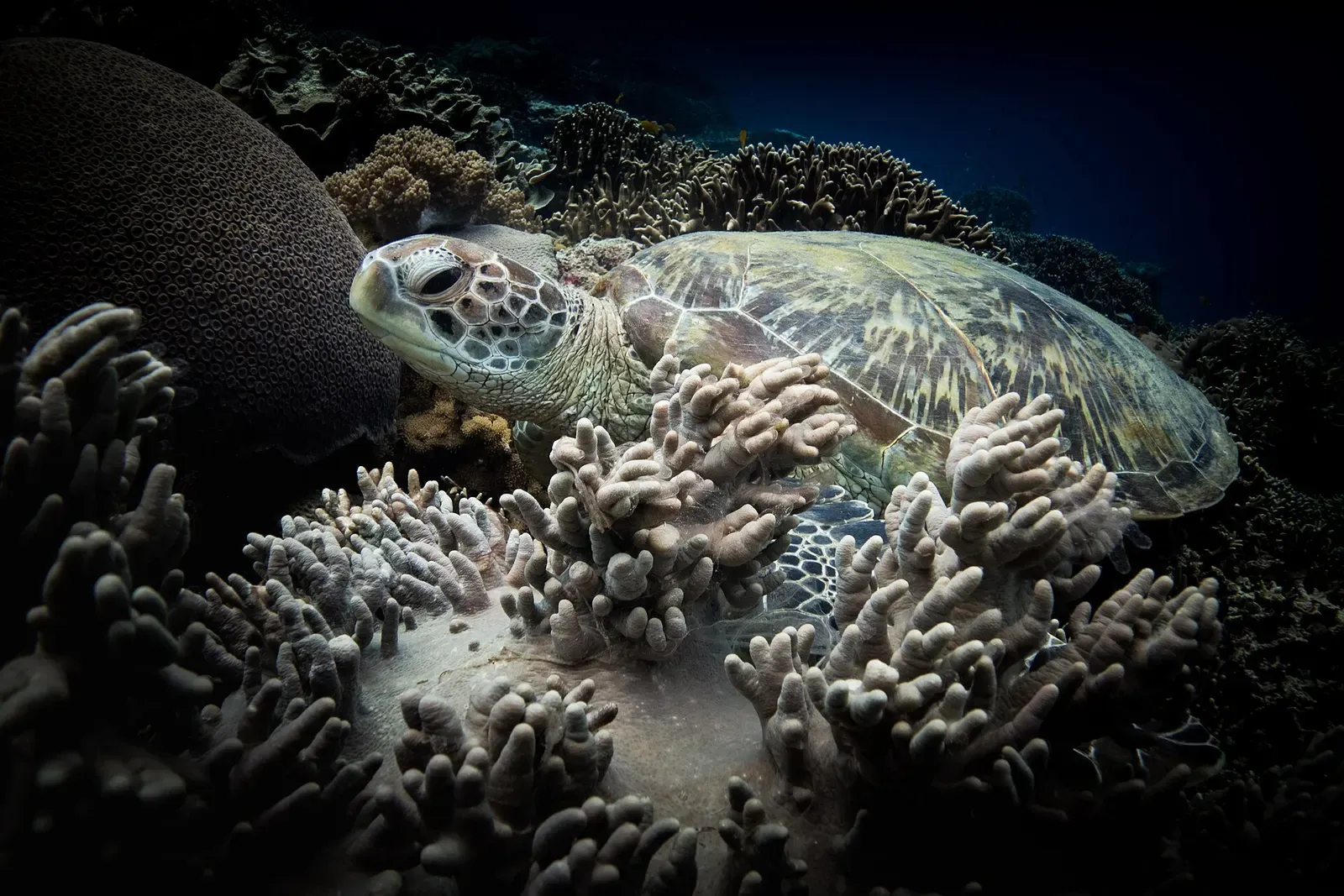
Beyond the snakes the plateau carries good coral for a bank this exposed, with barrel sponges standing up off it, turtles resting on the top, moray eels in the structure and enough nudibranchs to keep a macro diver busy. It is usually paired with a site on Pamilacan itself, since both sit on the same run out of Alona Beach and the shoal alone would not justify the crossing.
Marine life and season
- Sea snakes
- Sea turtles
- Nudibranchs
- Reef fish swarms
- Pristine corals
- Macro critters
| Jan | Feb | Mar | Apr | May | Jun | Jul | Aug | Sep | Oct | Nov | Dec |
|---|---|---|---|---|---|---|---|---|---|---|---|
| Prime | Prime | Prime | Prime | Prime | Good | Fair | Fair | Fair | Good | Prime | Prime |
Season follows Pamilacan: Nov–Jun is the workable season; the crossing is exposed and trips are called off on the wind, so Jul–Oct is unreliable.
Know before you go
- Banded sea kraits are highly venomous even though they are placid and rarely bite: keep hands off them, do not block one that is moving, and never handle one for a photograph.
- It is an offshore shoal with nothing above water and no shelter, so a current can take you off the plateau quickly — carry a surface marker and stay with the group.
Dive videos
Snake Island | Cervera Shoal | Dakit-Dakit | Pamilacan Island · Jan Mario Ubas on YouTube
Questions divers ask
How deep is Cervera Shoal?+
The plateau top is published at about 10 m by one operator and 18 m by Wikipedia, with the edges dropping to around 30 m. The dive is spent on top of the bank, so it works comfortably inside recreational limits.
Why is Cervera Shoal called Snake Island?+
For the black-and-white banded sea kraits that live on it. They are out on the coral in the open, several on a dive, hunting through the cracks — unusually visible for a sea snake, and the reason most divers make the crossing.
Sources
- Pamilacan — Wikipedia
- Dive sites of Panglao, Alona beach, Balicasag, Pamilacan, Cabilao — Tropical Divers Alona
- Your Guide to Diving in Bohol — Dive The World
- Cervera Shoal, Bohol — OpenStreetMap
More dive sites in Pamilacan
Drift
A drifted slope of soft and black coral off Pamilacan's tip
Wall
Black coral and sea fans on a wall past 40 m
Drift
A hard drift off the point, with tuna and barracuda in the flow
Drift
A drifted wall under a 200-year-old Spanish watchtower
Coral garden
A calm coral garden at 5–20 m, the island's easiest dive
Similar dives elsewhere
Frogfish and cuttlefish in the island's densest hard coral

An easy north-coast reef on the Napaling and Doljo road trip
A no-take reef since 1982, with turtles on nearly every dive


The protected shallows where Balicasag's turtles are thickest