
Thunder Bay · United States · Wreck
Portsmouth
An 1853 steamer in 2.4 m, shallow enough to snorkel
Area photo: NOAA's National Ocean Service · CC BY 2.0
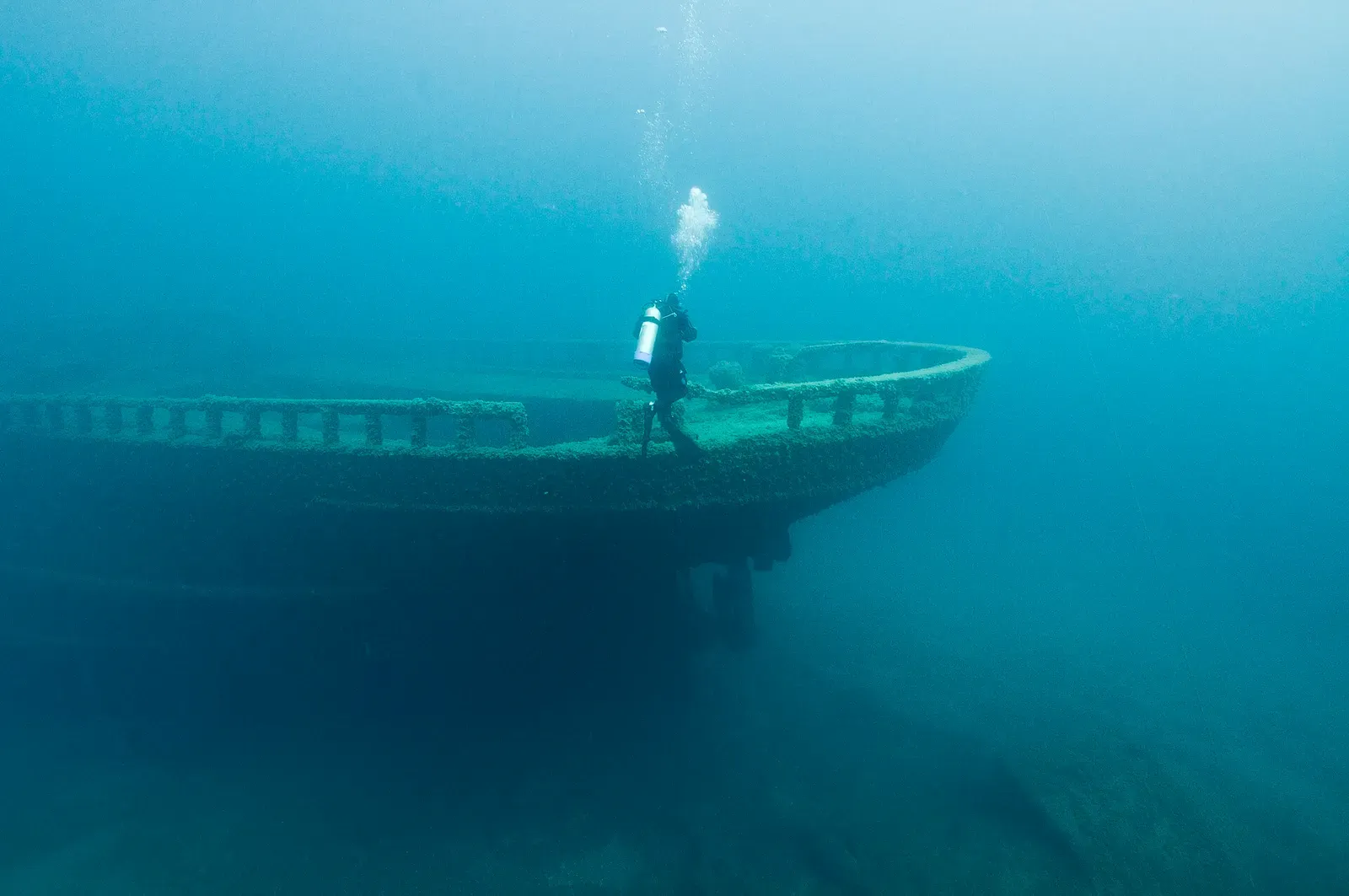
A 55-metre propeller steamer built in 1853 that ran aground on Middle Island during a November 1867 storm with 418 tons of pig iron aboard. What survives — the stern, a section of the keelson, the engine mounts and inner and outer hull planking — lies in 2.4 metres of clear water, shallow enough to snorkel or paddle over as easily as dive.
Where it is and how deep
45.1978° N, 83.3338° WPublished position for this site.
The dive
There is barely a descent. The wreck sits in 2.4 metres off the Middle Island Life-Saving Station, and the water is clear enough that most of the structure is visible before you put your face in — which is why paddlers and snorkellers use the site as much as divers do. Weighting matters more than usual: this shallow, in fresh water, it is easy to end up either bobbing on the surface or scraping the timbers.
What is left is the back of the ship. The stern is the most coherent piece, and from it a long section of the keelson — the ship's backbone — runs out across the bottom with the engine mounts still sitting on it and inner and outer hull planking spread to either side. Read it from the stern forward and the construction of a mid-nineteenth-century propeller steamer is laid out flat, which is a rare thing for a hull built in 1853.
Most of the machinery is missing because it was taken. Salvage had to wait out the winter, and the owners recovered the bulk of the cargo and machinery the following June, so what remains is structure rather than fittings. Everything inside Thunder Bay National Marine Sanctuary is protected, and with the whole site inside snorkelling depth it is wind and surge, not air or time, that decide whether the dive happens.
The wreck
- Vessel
- Portsmouth
- Type
- Propeller steamer
- Length
- 55 m (180 ft)
- Built
- 1853
- Sunk
- 1867
- Cause
- Ran aground on Middle Island in a November storm carrying 418 tons of pig iron
- Lies
- In 2.4 m off Middle Island: the stern, a section of keelson, the engine mounts, and inner and outer hull planking
Portsmouth was built in 1853 by Bidwell and Banta at Buffalo, New York, and was carrying 418 tons of pig iron when a storm drove it aground on Middle Island in November 1867. Salvage had to wait, because the wreck was encased in ice through the winter; it was the following June before the owners recovered most of the cargo and machinery. The stern and the keelson stayed where they were, and that is what divers and snorkellers see today.
Marine life and season
The sources we used don't single out particular species here.
| Jan | Feb | Mar | Apr | May | Jun | Jul | Aug | Sep | Oct | Nov | Dec |
|---|---|---|---|---|---|---|---|---|---|---|---|
| Off-season | Off-season | Off-season | Off-season | Fair | Good | Prime | Prime | Prime | Fair | Off-season | Off-season |
Season follows Thunder Bay: The season runs late May to early October, with July and August warmest; the lake is unworkably cold and rough otherwise.
Know before you go
- At 2.4 metres the wreck is well inside the reach of wind waves, and surge can push a diver into broken timber; pick a flat day and stay off the structure.
- This is open water off an island with small boats and paddlers over it, so fly a flag and stay aware of traffic even though you are only a couple of metres down.
Questions divers ask
How deep is the Portsmouth wreck?+
About 2.4 metres. The whole site sits in clear, shallow water off Middle Island, so it can be snorkelled or paddled over as easily as dived; depth is not the limiting factor here, wind and surge are.
What is left of the Portsmouth?+
The stern, a section of the keelson, the engine mounts, and inner and outer hull planking. Most of the cargo and machinery was salvaged the June after the 1867 wreck, so what remains is the ship's structure rather than its fittings.
Sources
- Portsmouth Shipwreck — NOAA Thunder Bay National Marine Sanctuary
More dive sites in Thunder Bay
Wreck
Ghost schooner upright at 56 m, masts still standing
Wreck
Steering wheel and chained windlass on a broken schooner
Wreck
The sanctuary's largest wreck, 162 m and inverted
Wreck
An intact 1848 schooner on an even keel at 56 m
Wreck
Three masts still on deck at 63 m
Upright steel freighter with engine and boilers still in place
Wreck
A Great Lakes freighter lying inverted at 53 m
An 1862 schooner in 18 m on a mooring buoy
Similar dives elsewhere
Wreck
Urca de Lima
Treasure Coast · United States
Florida's first Underwater Archaeological Preserve, in 3-4.5 m
Drum seiner lost in 2005, now home to marine life at 34 m
Wreck
Aeolus
North Carolina Wrecks · United States
A cable ship broken into three pieces by Hurricane Fran
.jpg)
Remains of the largest wooden steamer on the Great Lakes, in 5 m