
Thunder Bay · United States · Wreck · Freshwater
Isaac M. Scott
A Great Lakes freighter lying inverted at 53 m
Area photo: NOAA's National Ocean Service · CC BY 2.0
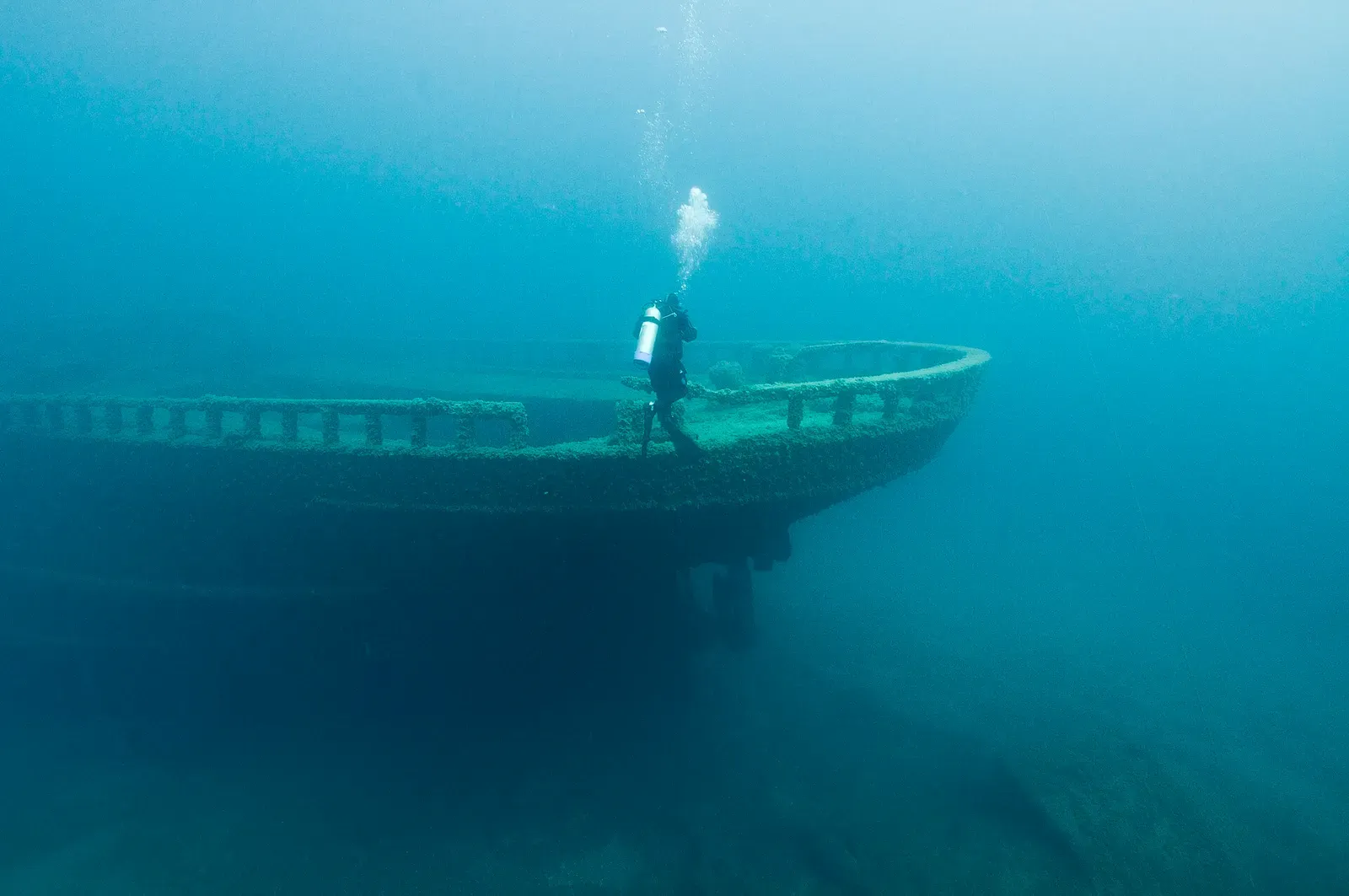
A steel bulk freighter of 1909 lying upside down on the bottom of Lake Huron at 53 m, inside Thunder Bay National Marine Sanctuary. She rolled over and sank in the November 1913 storm the lakes remember as the white hurricane, taking all 28 hands with her. The depth makes this a technical dive, worked in sections rather than swum end to end.
Where it is and how deep
45.0653° N, 83.0392° WPublished position for this site.
The dive
You descend into cold, dark fresh water with no mooring line to follow, because the sanctuary's seasonal buoys are set on other wrecks. The hull is inverted, so the first thing under you is the flat underside of a Great Lakes freighter rather than a deck, and orientation comes from finding an edge and following it. At 53 m in water this cold there is no exploring your way into the dive: the route, the gas and the turn point are settled on the surface.
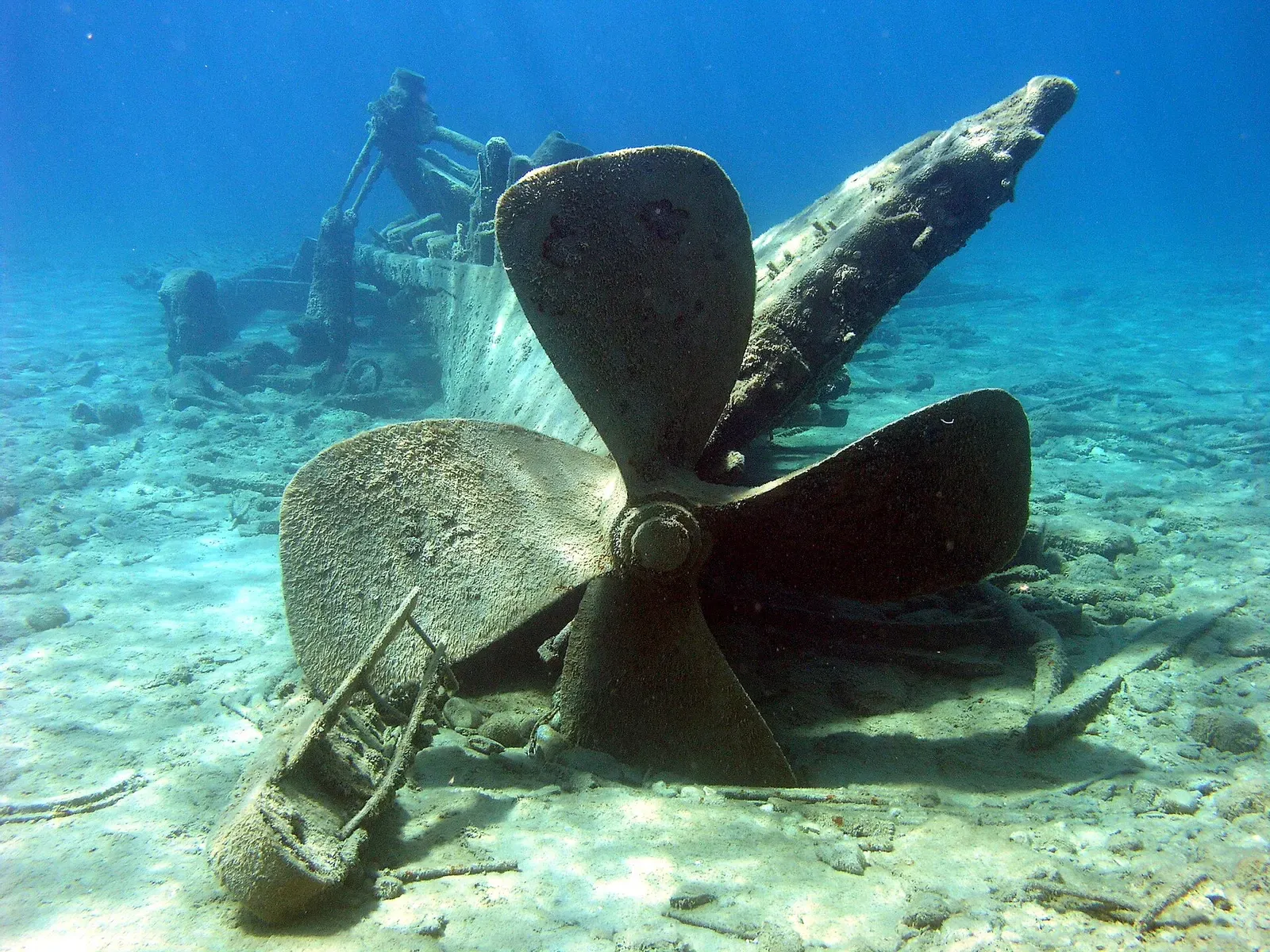
Divers work the wreck in pieces — the stern and its propeller, the long overturned flank, the bow. NOAA's own site photographs show technical divers hovering at the stern beside the propeller and swimming off the bow, which is about as much as one plan covers. Because the ship rolled as she sank there is no open deck to swim and the dive stays an exterior one, carried by the scale of the hull in the dark. Everything on the bottom is protected sanctuary property, so artefacts are looked at and left.
The wreck
- Vessel
- Isaac M. Scott
- Type
- Steel motor bulk freighter
- Length
- 160 m (525 ft)
- Built
- 1909
- Sunk
- 1913
- Cause
- Rolled over in the November 1913 white hurricane while carrying coal to Milwaukee
- Lies
- Upside down on the lake bottom, hull visible in side-scan sonar
The Scott was built in 1909 by American Ship Building Co. at Lorain, Ohio, and was four years old when she left Port Huron on 9 November 1913 with a cargo of coal for Milwaukee. Two storm systems had converged over the lakes into what became known as the white hurricane, producing 11-metre waves (35 feet) and 145 km/h gusts (90 mph). The ship rolled over and sank just east of Thunder Bay and all 28 of her crew were lost. Twelve vessels went down in that storm and 248 sailors died with them.
Marine life and season
The sources we used don't single out particular species here.
| Jan | Feb | Mar | Apr | May | Jun | Jul | Aug | Sep | Oct | Nov | Dec |
|---|---|---|---|---|---|---|---|---|---|---|---|
| Off-season | Off-season | Off-season | Off-season | Fair | Good | Prime | Prime | Prime | Fair | Off-season | Off-season |
Season follows Thunder Bay: The season runs late May to early October, with July and August warmest; the lake is unworkably cold and rough otherwise.
Know before you go
- At 53 m in cold fresh water, narcosis and cold both bite early: run the dive on planned gas and time rather than on how you feel.
Questions divers ask
How deep is the Isaac M. Scott?+
NOAA gives 175 feet — 53 m — for the wreck and 180 feet for the lake bottom at the site, which puts the dive beyond recreational depth limits and into technical territory.
What certification do I need to dive the Isaac M. Scott?+
Technical certification with decompression training, plus cold-water and drysuit experience. NOAA notes the wreck attracts technical divers, who work the stern, propeller and bow.
Sources
- Isaac M. Scott — NOAA Thunder Bay National Marine Sanctuary
- Mooring Buoys — NOAA Thunder Bay National Marine Sanctuary
In The Logbook
- The layered sea: thermoclines and haloclinesOcean science · 8 min read
More dive sites in Thunder Bay
Wreck
Ghost schooner upright at 56 m, masts still standing
Wreck
Steering wheel and chained windlass on a broken schooner
Wreck
The sanctuary's largest wreck, 162 m and inverted
Wreck
An intact 1848 schooner on an even keel at 56 m
Wreck
Three masts still on deck at 63 m
Upright steel freighter with engine and boilers still in place
An 1862 schooner in 18 m on a mooring buoy
A burned steamer in 5.5 m, readable from the surface
Similar dives elsewhere

A steamer down a slope from 18 m to an intact stern at 46 m
Bowsprit still extending from an 1852 hull at 32 m
A 1940 Lunenburg schooner scuttled for divers at 17 m

.jpg)
Twin propellers at the shot line, then the length of an upturned keel