
North America · United States
Thunder Bay — Alpena
A hundred wrecks in Shipwreck Alley, some shallow enough to snorkel
Photo: NOAA's National Ocean Service · CC BY 2.0
Thunder Bay National Marine Sanctuary protects a stretch of Lake Huron that nineteenth-century mariners called Shipwreck Alley, and roughly a hundred wrecks lie inside it. Fresh water near freezing for much of the year has preserved them to a degree salt water never allows: schooners with masts standing, deck cargo in place, paint still on the hulls. Several sit in under 10 m and can be snorkelled, while others lie past 30 m in the dark and cold.
About diving in Thunder Bay — Alpena
A day here is run out of Alpena's harbour on a small charter, and the lake decides how far it goes: the outer wrecks need a flat morning, while the inshore hulls stay workable when it is blowing. The sanctuary sets seasonal mooring buoys on a number of the wrecks, so boats tie in rather than hook a hull, and crews plan two dives with a long surface interval to keep the cold in check. Nothing about the rhythm is tropical. You dress before you leave the dock and peel off again between dives.
There is no reef and no wall; the lake floor is sand, clay and limestone, and the ships are the only structure on it. That splits the diving by depth more than by site. Above the reach of storm waves and winter ice the hulls are broken open and spread across the bottom, which makes them easy to swim and easy to read. Below that line the weather never got at them, so they sit closer to the way they went down, and the deeper dives feel less like wreckage than like a ship parked in the dark.
The sanctuary was designated in 2000 and enlarged in 2014, and everything inside it is protected, so artefacts stay where they lie and the interest is in looking rather than handling. Most visitors start at the Great Lakes Maritime Heritage Center in Alpena, the sanctuary's visitor centre, which explains what they are about to swim over. Fresh water is worth a thought as well: anyone who weights themselves for the sea will turn up carrying more lead than the job needs.
This suits people who come for history rather than animals, and who accept diving colder than a warm-water background prepares them for. A drysuit is the sensible default even in August, and cold-water skills matter more here than depth experience. Non-divers are not an afterthought either, since glass-bottom tour boats run over the shallow hulls out of Alpena and some of the same ships can be paddled over. Anyone after warm water, big fish or three tanks before lunch should look somewhere else entirely.
Best time to dive Thunder Bay — Alpena
| Jan | Feb | Mar | Apr | May | Jun | Jul | Aug | Sep | Oct | Nov | Dec | |
|---|---|---|---|---|---|---|---|---|---|---|---|---|
| Season | Off-season | Off-season | Off-season | Off-season | Fair | Good | Prime | Prime | Prime | Fair | Off-season | Off-season |
| Daytime high | 4°C39°F | 5°C41°F | 8°C46°F | 13°C55°F | 18°C64°F | 22°C72°F | 26°C79°F | 26°C79°F | 25°C77°F | 20°C68°F | 13°C55°F | 8°C46°F |
| Rain | 42 mm1.7 in | 39 mm1.5 in | 56 mm2.2 in | 92 mm3.6 in | 71 mm2.8 in | 75 mm3.0 in | 78 mm3.1 in | 75 mm3.0 in | 58 mm2.3 in | 87 mm3.4 in | 51 mm2.0 in | 54 mm2.1 in |
| Jan | Feb | Mar | Apr | May | Jun |
|---|---|---|---|---|---|
| Off-season | Off-season | Off-season | Off-season | Fair | Good |
| Daytime high | |||||
| 4°C39°F | 5°C41°F | 8°C46°F | 13°C55°F | 18°C64°F | 22°C72°F |
| Rain | |||||
| 42 mm1.7 in | 39 mm1.5 in | 56 mm2.2 in | 92 mm3.6 in | 71 mm2.8 in | 75 mm3.0 in |
| Jul | Aug | Sep | Oct | Nov | Dec |
|---|---|---|---|---|---|
| Prime | Prime | Prime | Fair | Off-season | Off-season |
| Daytime high | |||||
| 26°C79°F | 26°C79°F | 25°C77°F | 20°C68°F | 13°C55°F | 8°C46°F |
| Rain | |||||
| 78 mm3.1 in | 75 mm3.0 in | 58 mm2.3 in | 87 mm3.4 in | 51 mm2.0 in | 54 mm2.1 in |
2011–2025 averages. Daytime high and rain: NASA POWER.
The season runs late May to early October, with July and August warmest; the lake is unworkably cold and rough otherwise.
Best months: July, August, September
Thunder Bay water temperature and weather by month
Rain falls through the year, about 60 mm (2.4 in) a month on average, with April the wettest. Daytime highs reach 26 °C (79 °F) in July and drop to 4 °C (39 °F) in January. The coldest water here is about 2 °C (36 °F), so pack a drysuit.
Dive types & marine life
This is a history site rather than a wildlife one. Expect burbot and sculpin tucked into the wreckage, smallmouth bass and perch over the shallow hulls through the warm July-to-September stretch, crayfish on the sand and invasive round gobies almost everywhere. Nothing large, and nothing that gives you a reason to time a trip.
- Wreck
- Freshwater
- Freshwater fish
Best dive sites in Thunder Bay — Alpena
Wreck
Ghost schooner upright at 56 m, masts still standing
Wreck
Steering wheel and chained windlass on a broken schooner
Wreck
The sanctuary's largest wreck, 162 m and inverted
Wreck
An intact 1848 schooner on an even keel at 56 m
Wreck
Three masts still on deck at 63 m
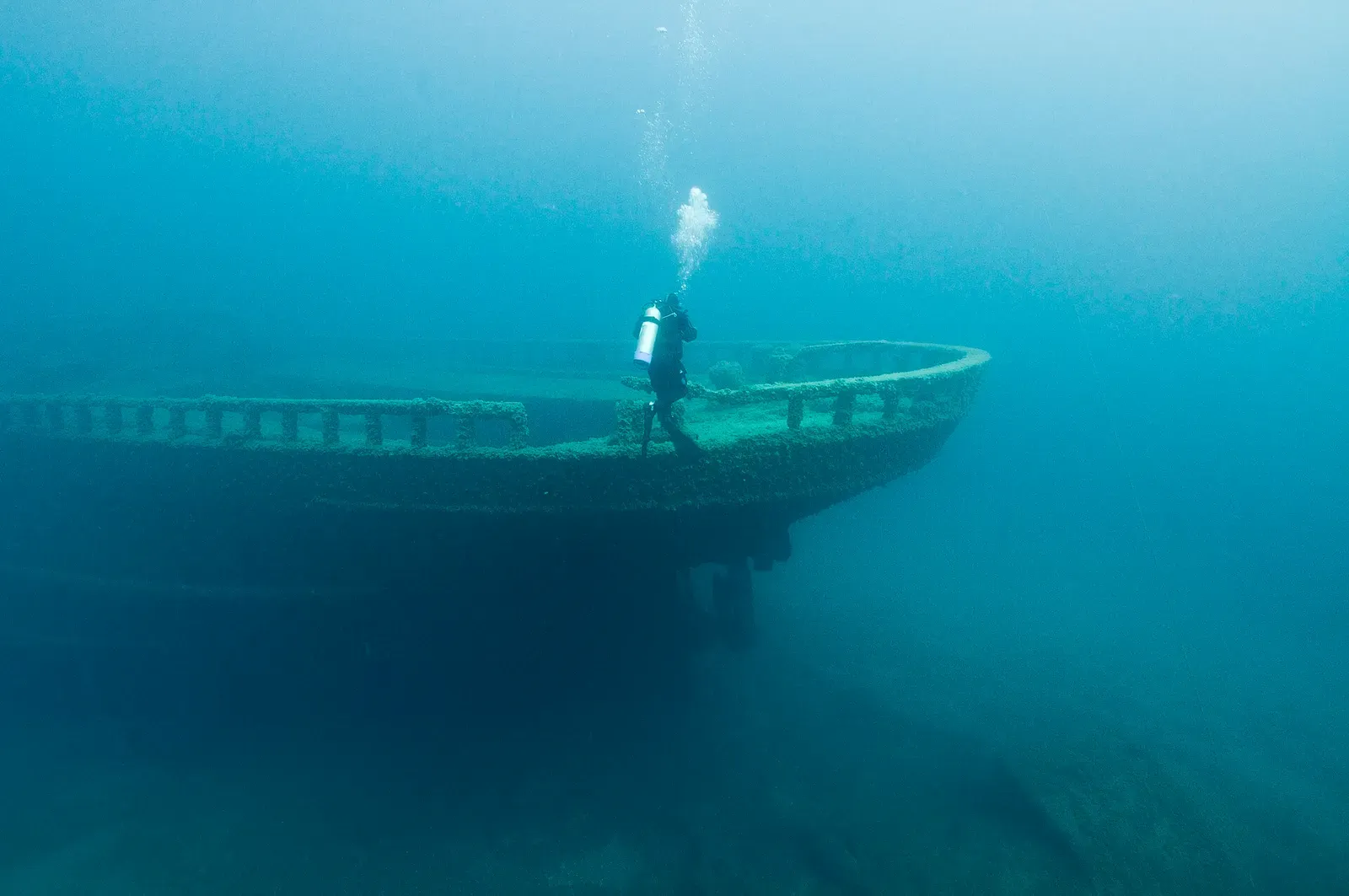
Upright steel freighter with engine and boilers still in place
Wreck
A Great Lakes freighter lying inverted at 53 m
An 1862 schooner in 18 m on a mooring buoy
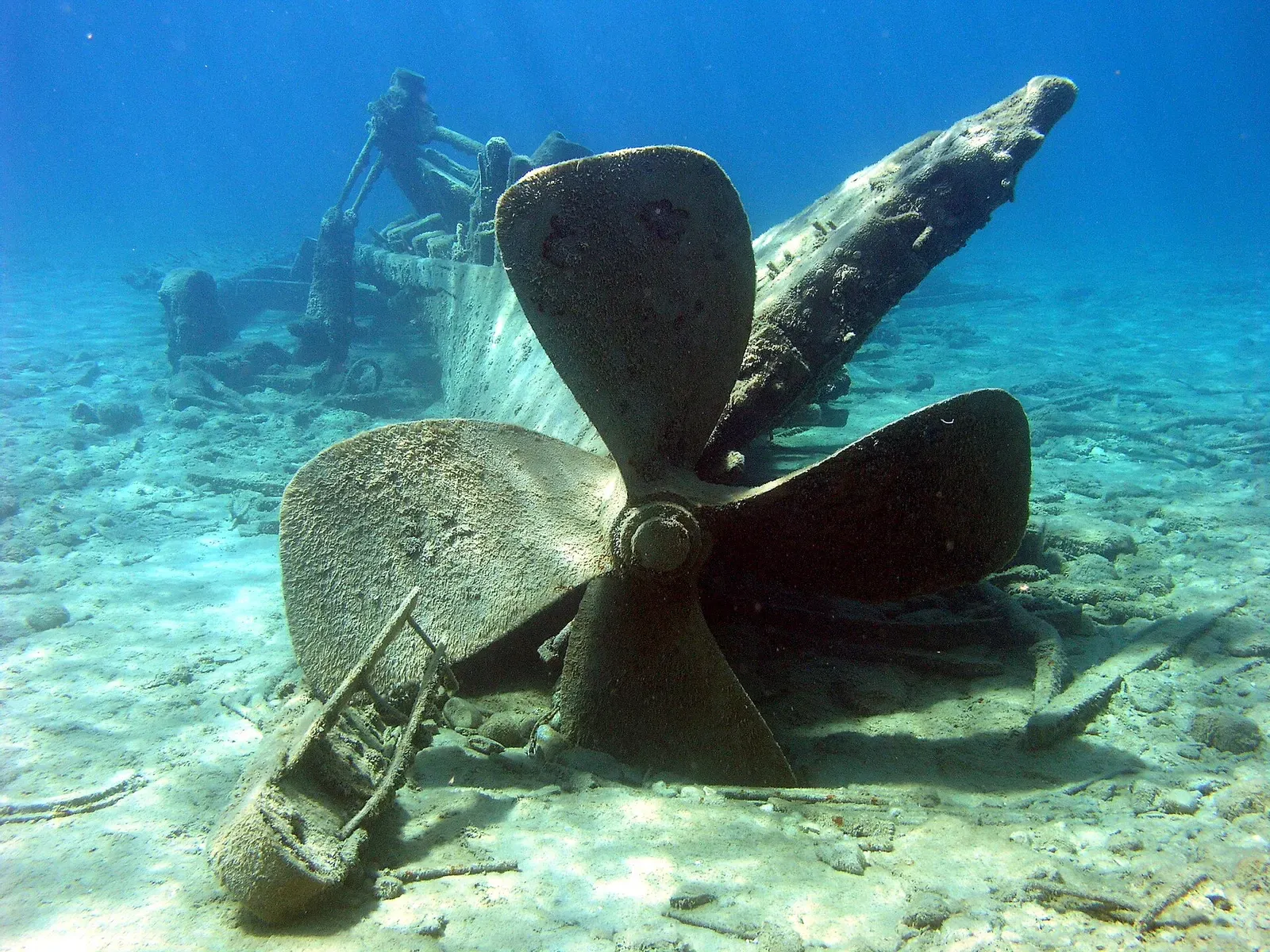
A burned steamer in 5.5 m, readable from the surface
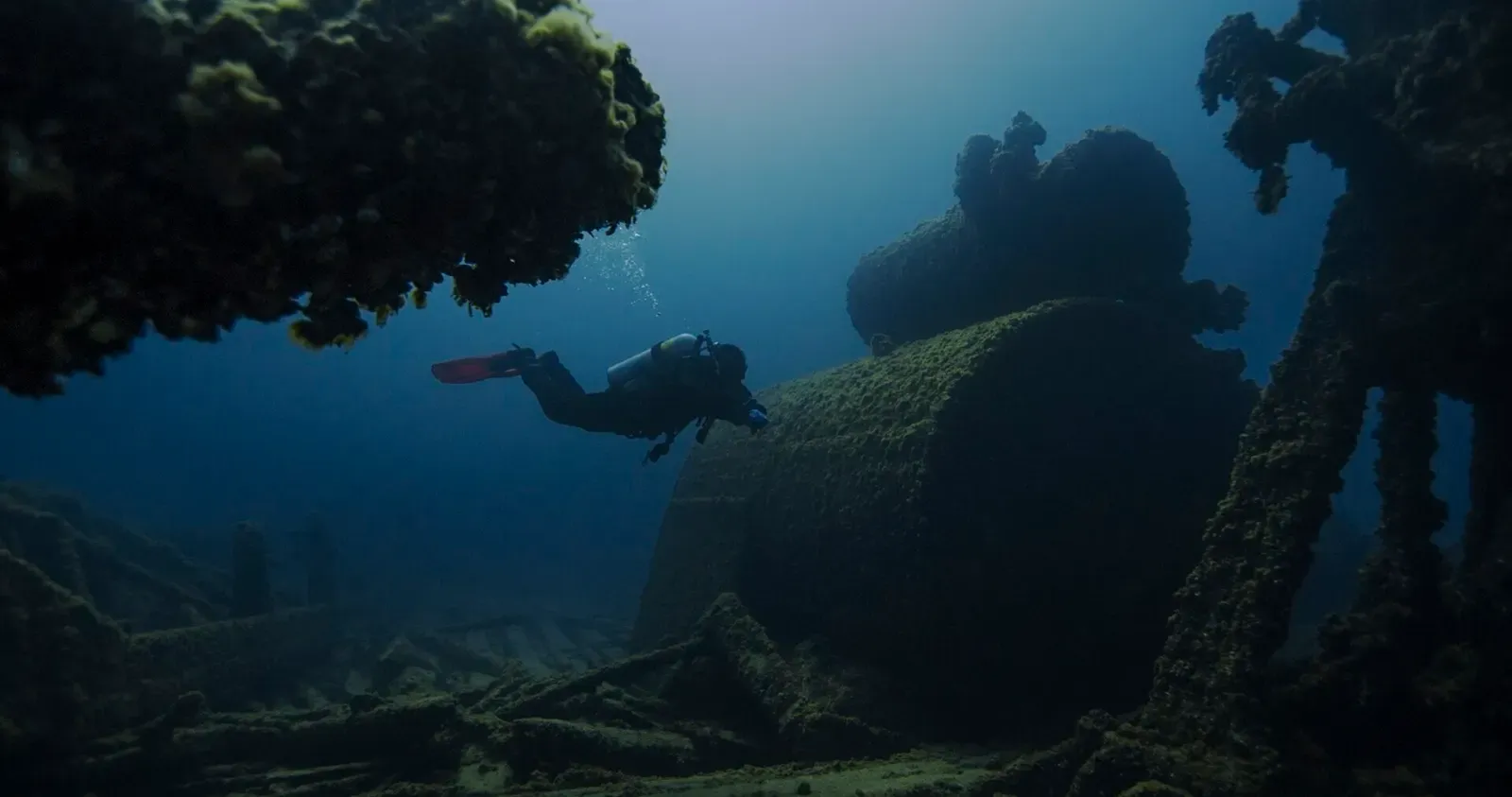
A three-storey steam engine standing intact at 20 m
Wreck
An 1885 freighter at 44 m, modelled in 3D by NOAA
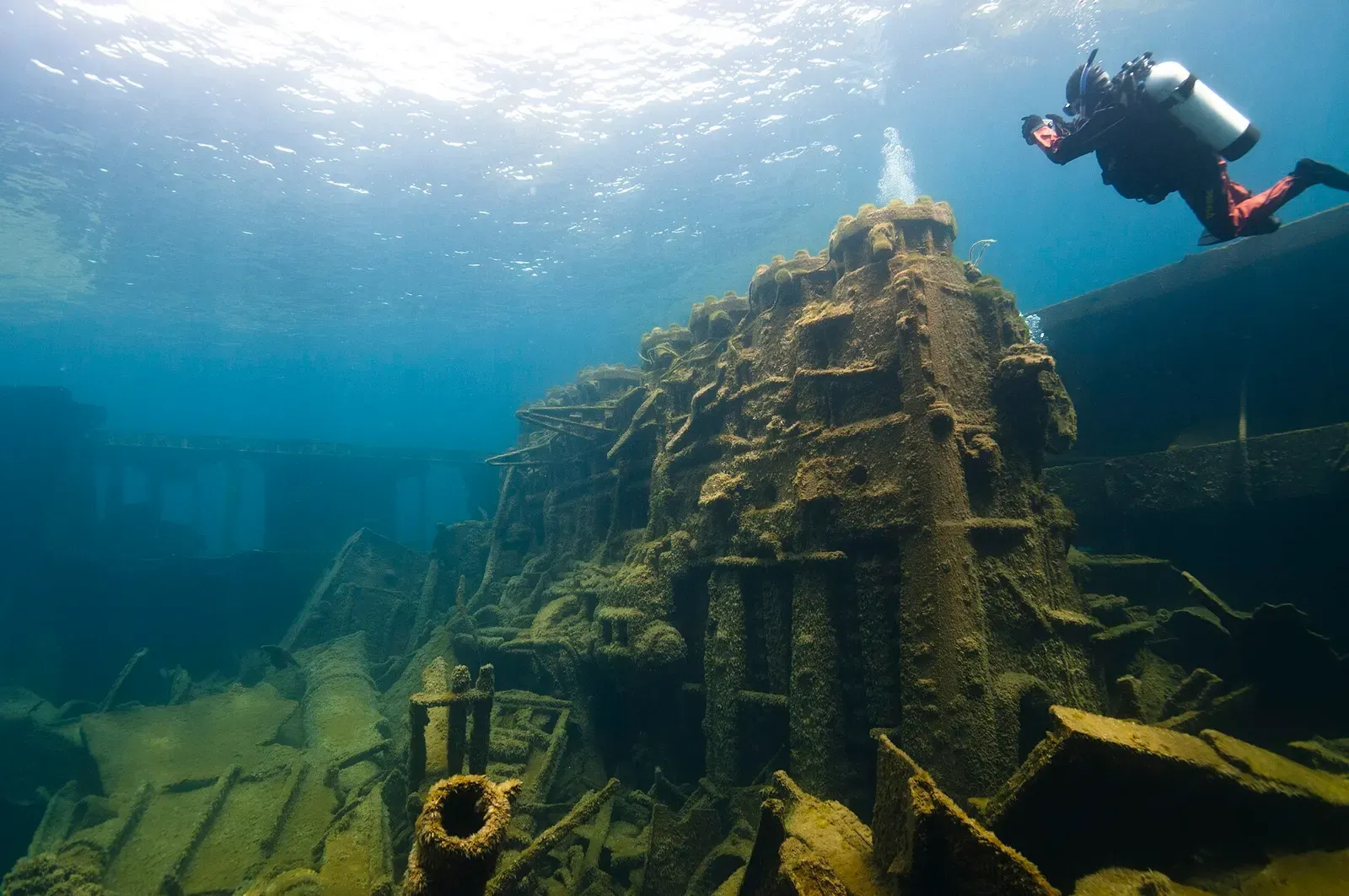
A 144-metre ocean freighter (471 feet) broken across a shoal in 12 m
Wreck
Pilothouse and engine room intact at 61 m
Wreck
The 1863 steamer lost in Thunder Bay's worst wreck
Wreck
An 1853 steamer in 2.4 m, shallow enough to snorkel
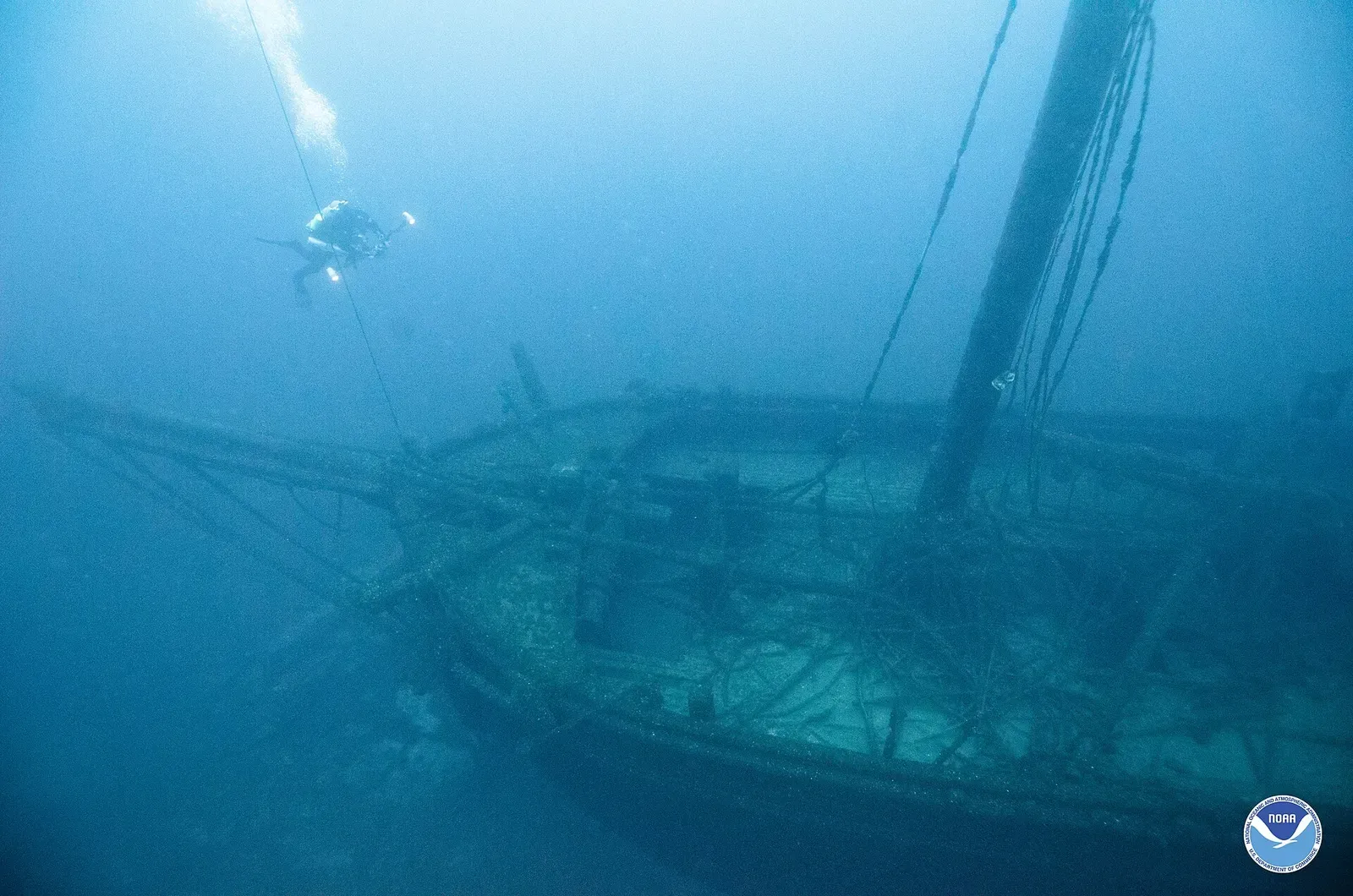
Foremast standing and the bell still on the windlass
Wreck
A Norwegian ocean freighter upright at 57 m
How to get to Thunder Bay — Alpena
Alpena is the base. Most divers fly into Detroit and connect to Alpena's regional airport, or drive up the US-23 shore road; from elsewhere in Michigan and the Midwest, driving is the norm. Charters leave the town harbour, and only a handful of the shallowest wrecks are worth attempting from shore.
Photos from Thunder Bay — Alpena
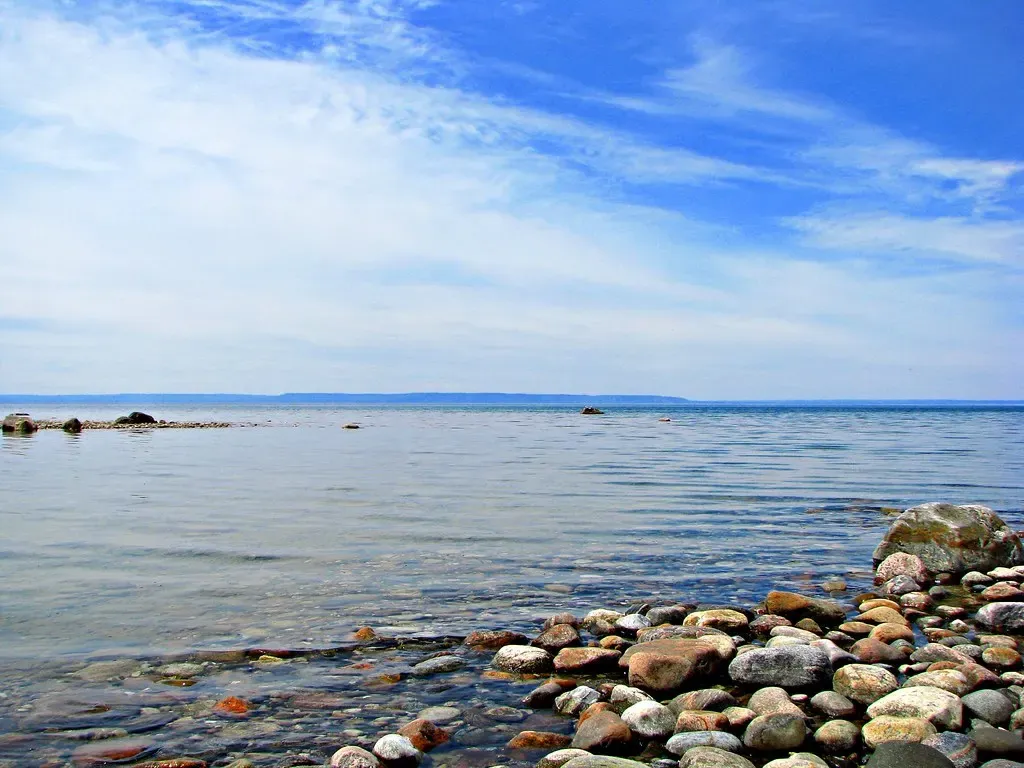
U.S. Fish and Wildlife Service - Midwest Region · Public domain
Dive videos
Nordmeer Wreck Scuba Dive, Lake Huron - Thunder Bay Michigan · WimbletonProductions on YouTube
SHIPWRECKS OF THUNDER BAY NATIONAL MARINE SANCTUARY · Michael C. Barnette on YouTube
Photo credits
- Diver exploring the wooden hull timbers of the James Davidson shipwreck in Thunder Bay National Marine Sanctuary. by NOAA's National Ocean Service, CC BY 2.0, via Wikimedia Commons
- A small research boat on the calm, clear waters of Lake Huron's Thunder Bay near Alpena, Michigan. by U.S. Fish and Wildlife Service - Midwest Region, Public domain, via Wikimedia Commons
Embed
Run a dive centre, club or blog? Embed this map of 12 dive sites near Thunder Bay on your own page.
In The Logbook
- How a rebreather works, and what it buys youGear & kit · 8 min read
- What are thermoclines and haloclines?Ocean science · 8 min read
- Cold-water diving: is it worth the drysuit?Cold water · 8 min read
- Deep wreck diving: where recreational stopsWrecks · 8 min read
- Freshwater diving: lakes, springs and quarriesFreshwater · 15 min read
- Air, nitrox or trimix: which gas, and when?Gear & kit · 15 min read
- Your first wreck dive: what to expect and whereFirst dives · 6 min read
Similar destinations
North America
Alger Underwater Preserve & Munising
United States
Great Lakes shipwrecks within recreational limits off Pictured Rocks

Nineteenth-century wrecks dived as drifts in a hard freshwater current

Cave and cavern diving in constant-temperature springs
.jpg)
.jpg)
Three shallow wrecks off Christian and Hope Islands, most in 3–12 m of fresh water