Weymouth & Portland · United Kingdom · Wreck
Countess of Erne
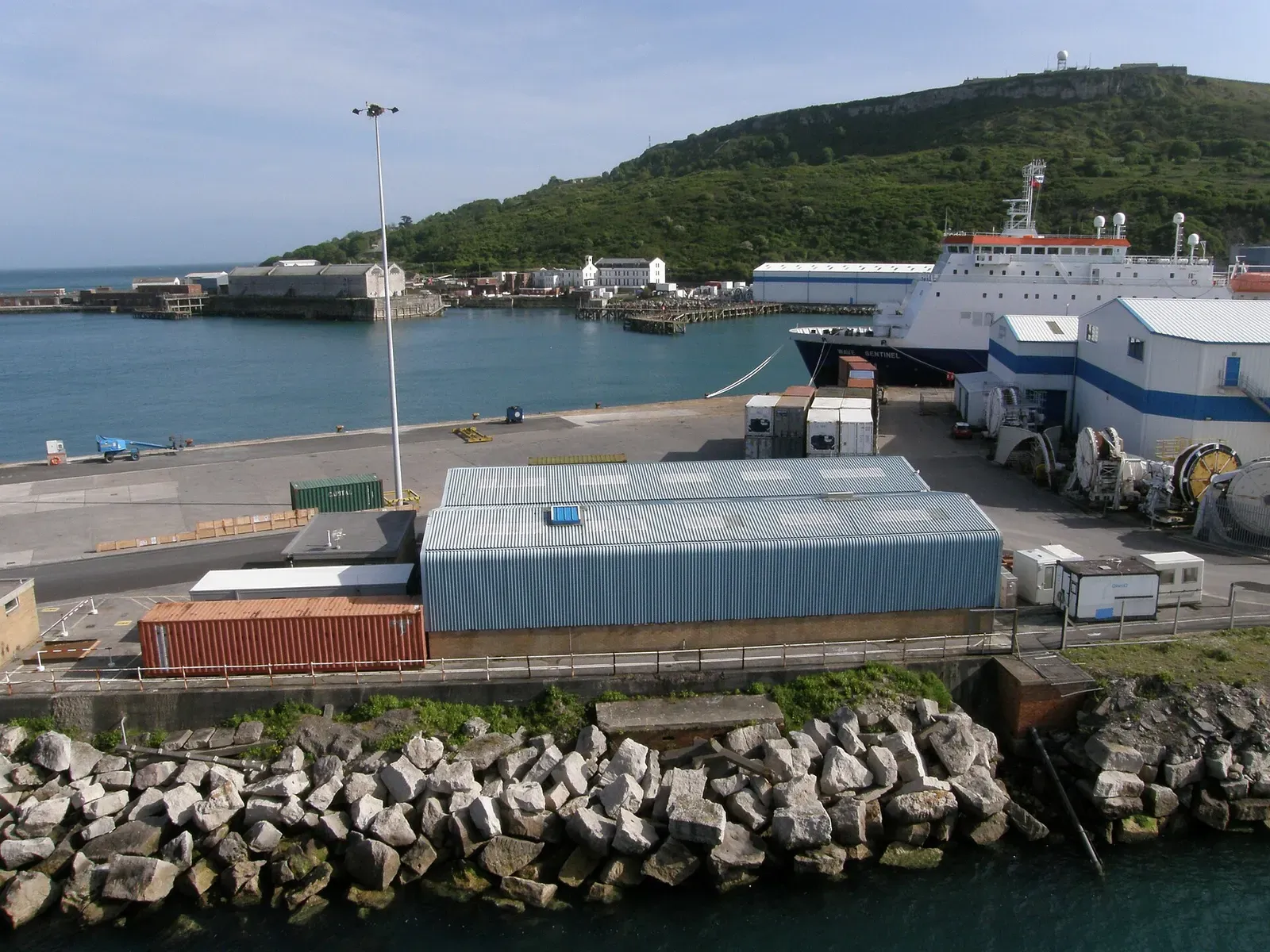
An 1868 paddle steamer upright beside the Portland breakwater
Area photo: Jacko · CC BY-SA 2.0
The Countess of Erne is an iron paddle steamer of 1868 that ended her working life as a coal hulk and, in September 1935, broke free of her moorings in Portland Harbour and sank against the breakwater, where she remains. She lies upright and parallel to the wall on sand and silt, her deck 8 to 10 m down and the seabed at 16 m, with holds open enough to swim in and out of. She is used as a training site as much as a wreck.
Also known as PS Countess of Erne.
Where it is and how deep
50.5863° N, 2.4198° WApproximate position — the dashed circle shows where the site lies; your operator's briefing has the mooring.
The dive
Most dives start at the bow, where the shotline is tied and the capstan is the prominent feature; the bow is intact and still holds its shape. She sits upright on sand and silt, parallel to the breakwater, with the deck 8 to 10 m down and 16 m at the seabed. Working aft you pass overhead deck cross-members, some of them collapsed, and can either stay on the deck or drop into the cargo holds.
Inside, the cabin walls have corroded or collapsed into open space wide enough for two divers side by side, with deck-support pillars and ladders to negotiate, few snagging wires and exits that stay in sight. The hull is full of large holes, which is why the site is used for buoyancy practice. Keep off the bottom: it is sand and silt and a careless fin can take the visibility to nothing in seconds. There is little on the seabed apart from the rudder, so stay close to the hull and come back to the shot.
The wreck
- Vessel
- PS Countess of Erne
- Type
- Iron paddle steamer, later a coal hulk
- Length
- 74 m (243 ft)
- Built
- 1868
- Sunk
- 1935
- Cause
- Broke free of her moorings in a gale and sank against the Portland breakwater
- Lies
- Upright on sand and silt parallel to the breakwater, deck 8-10 m, seabed 16 m
The Countess of Erne was an iron-hulled paddle steamer of 830 tons, 74 m long, built in Dublin in 1868 for the London & North Western Railway. She carried passengers between Holyhead and Dublin from 1869 to 1873 and between Holyhead and Greenore from 1873 to 1889, then was sold, stripped of her fittings and spent some 30 years as a coal hulk. On the night of 16 September 1935 she broke free of her moorings in Portland Harbour, drifted onto the breakwater and sank, and she has lain there since.
Marine life and season
- Macro critters
- Nudibranchs
- Octopus & cuttlefish
| Jan | Feb | Mar | Apr | May | Jun | Jul | Aug | Sep | Oct | Nov | Dec |
|---|---|---|---|---|---|---|---|---|---|---|---|
| Fair | Fair | Fair | Good | Good | Prime | Prime | Prime | Prime | Good | Fair | Fair |
Season follows Weymouth & Portland: Sea temperature runs from about 7 °C in February to 17 °C in August; winter gales off the Atlantic rather than the cold are what stop the boats.
Know before you go
- Sand and silt around the wreck goes up with one careless fin stroke and can cut the visibility to zero in seconds.
- Losing the wreck in poor visibility can put you drifting towards the harbour entrance, where shipping passes; carry a DSMB.
Questions divers ask
Is the Countess of Erne a good training wreck?+
Yes. She sits upright in 16 m of harbour water with her deck at 8 to 10 m, the holds are open and the exits stay in sight, and there can be a current but it is not usually strong enough to hinder diving. The silt is the thing to manage: it clouds in seconds.
Sources
- Countess of Erne - Scubago — Scubago
- PS Countess of Erne — Wikipedia
- Above 18m: The Countess of Erne — Divernet
More dive sites in Weymouth & Portland
A 1939 mine casualty broken across a 30 m seabed
Wreck
A flat bow-section wreck at 17 to 20 m with reef alongside
Shore entry over shingle into boulders and kelp to 15 m
Wreck
Boilers at 24 m on the edge of the Shambles Bank
Wreck
A 1918 torpedo loss at 36 to 38 m on clean sand
Wreck
An upright submarine hull under a coat of plumose anemones
Wreck
Torpedo tubes and a 3in gun on a submarine at 40 m
Wreck
A shallow wreck inside the breakwater for a first wreck dive
Similar dives elsewhere
Boilers in 7 m on the rocks that took a 1907 steamer
Protected 1863 paddle steamer, licence needed to dive her

Two upright boilers with a triangular swim-through between them

,_Portland_Harbour.jpg)
Blown apart by her own powder magazine in 1788, at 20 metres