What blackwater diving actually is
Blackwater diving is a night dive with the reef removed. The boat leaves after dark and runs offshore until the seabed is not merely out of sight but thousands of metres down, hangs lights in the water, and you go in and stay near them. PADI’s definition is the plainest one going: “In blackwater diving, you’re not exploring the night on a reef or rocky shore but in the open ocean. You dive suspended in the water column, in the dark depths far away from the coast.” There is no wall to follow, no sand to settle on, no compass heading worth taking. The dive is the few metres of water your torch reaches, and whatever swims into them.
The original version, still run nightly off Kona, sets the pattern. The boat motors two to three miles out — Kona has no continental shelf, so that is all it takes to reach the pelagic — and hangs a 50-foot line beneath the hull. You clip a tether to the line, take the light the crew hands you, and descend. The length of the line, not the seabed, sets the depth: most of the dive happens in the top 13 to 15 metres (50 feet), and it lasts about 45 minutes. The boat drifts, the line drifts, you drift. When our record for Kona’s blackwater dive says there is “nothing to hold on to but a 50-foot line under the boat”, that is not colour. It is the site description in full.
What separates this from the other great night dives is that nothing about it is staged. The manta feed depends on lights placed on the sand to gather plankton; the mandarinfish dive depends on a patch of rubble and a sunset. Blackwater depends on an event the ocean runs every night whether you turn up or not, and the point of this article is that event — what it is, who is in it, the vocabulary the sport has grown around it, and how the boats that do it well keep you attached to the one thing in the sea that night that is not drifting.
The migration you are hanging inside
The animals that rise past a blackwater diver are taking part in what Wikipedia’s article on the subject calls, without hedging, “the largest synchronous migration in the world” by biomass. Diel vertical migration — diel meaning daily — is the habit of a vast slice of the ocean’s small life of spending the day deep, where the light is too dim for visual predators to hunt, and coming up under cover of darkness to graze the productive surface layers. “In the most common form, nocturnal vertical migration, organisms ascend to the surface around dusk, remaining at the surface for the night, then migrating to depth again around dawn.” The dive is booked against the middle of that sentence.
It took a long time to notice. Georges Cuvier documented the pattern in 1817, watching daphnia appear and vanish in a daily rhythm, but the ocean-scale version was found by accident. During the Second World War, sonar operators using the new equipment “were puzzled by what appeared to be a false sea floor 300–500 metres (980–1,640 ft) deep at day, and less deep at night.” The false floor — the deep scattering layer, or, in the older and better phrase, the phantom bottom — was animals: lanternfish for much of it, a family that a 1998 deep-trawl survey put at as much as 65 per cent of all deep-sea fish biomass. When global sonar surveys in 2007 re-estimated the lanternfish alone they arrived at 5 to 10 billion tonnes, and that layer, or the shallow edge of it, is what climbs into the top 15 metres every night and is still there when the boat drops you in.
Light runs the timetable. The review quoted in the Wikipedia article is direct about it — “Light is the most common and critical cue for vertical migration” — and the migration schedules itself around being seen. Smaller, harder-to-see animals begin their climb “as much as 20 minutes before the sun sets, while large conspicuous fish may wait as long as 80 minutes after the sun goes down.” Predators reshape it too: squid delay their migration by about 40 minutes when dolphins are hunting nearby, feeding later and for less time. And the moon counts. Zooplankton “stay in deeper waters when the moon is full”, which is the empirical reason blackwater operators talk about the moon phase before they talk about the weather. Our Palau record adds a scheduling wrinkle of its own: the operator does not run the dive on nights it reserves for its full-moon and new-moon expeditions, so check the calendar twice.
The physics of why the surface is bright and the deep is not is why the sea is blue; the density layering that the migrators cross on the way up is the layered sea. This article only needs the consequence: the water under the boat is a lift shaft, and the traffic is upward at dusk.
Who comes up
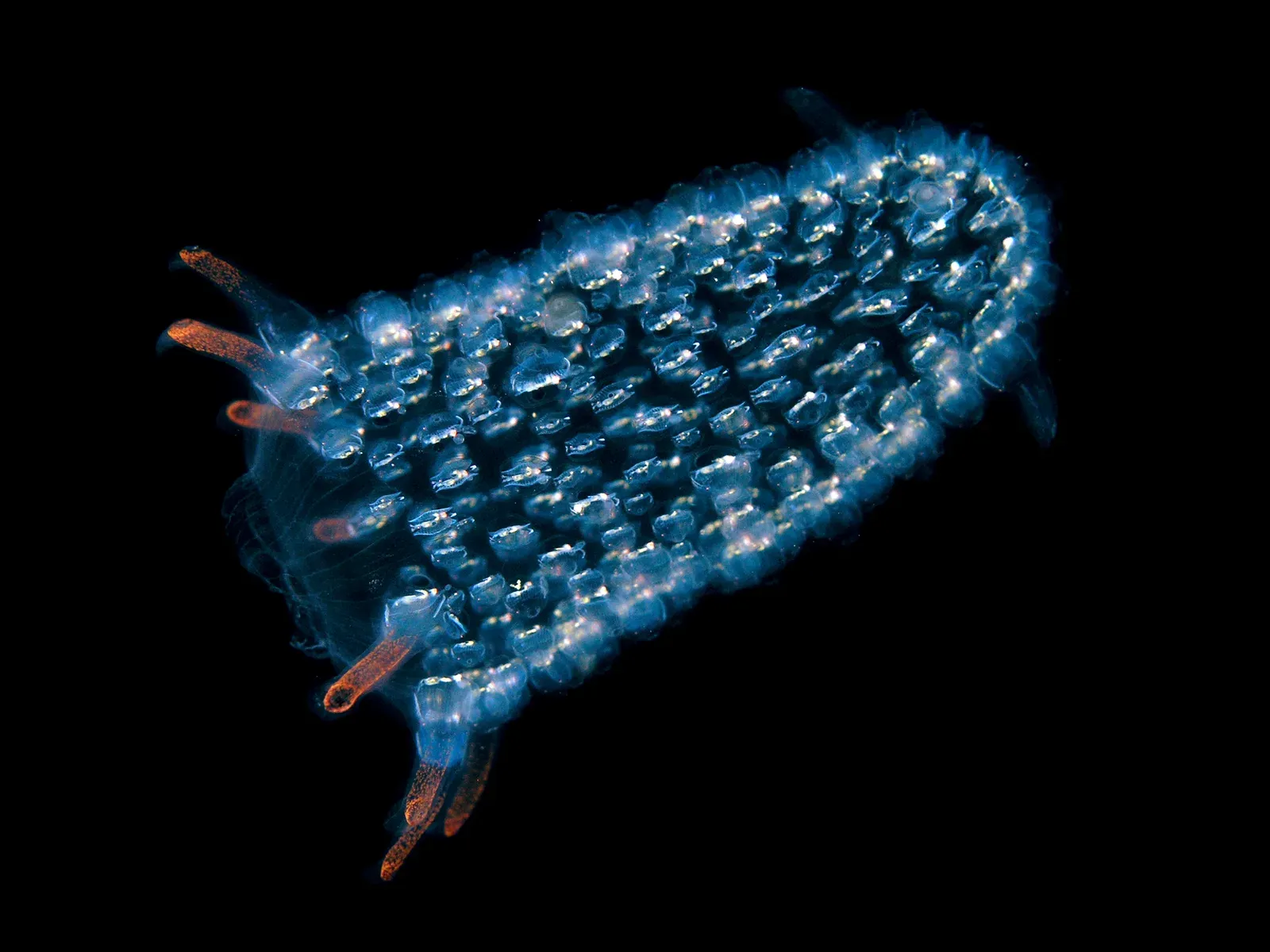
The cast divides roughly into the transparent, the larval and the cephalopod, and most of it is smaller than your hand. DAN’s Mike Bartick, who has spent more nights in it than almost anyone, reports that jellyfish and comb jellies are the creatures most often met, palm-sized or smaller, the comb jellies propelled by rows of cilia that throw small flashes of red, green and blue along the body. Then the colonial jellies: siphonophores, “long, thin, transparent floaters living in the pelagic zone”, 194 species described so far, each one a chain of specialised individuals behaving as a single animal. Then the tunicates, which look like jellies and are our closer relatives — salps, barrel-shaped filter feeders that move by pumping water through the body in “one of the most efficient examples of jet propulsion in the animal kingdom” and reproduce by budding chains of tens to hundreds; and pyrosomes, tube-shaped colonies of tiny zooids that flash pale blue-green light in waves, each zooid answering its neighbour. Riding inside the tunicates, occasionally, is a hollowed-out amphipod called Phronima, which eats the interior of a pelagic tunicate and moves in — Bartick calls them body snatchers, and nobody who has seen one disagrees.
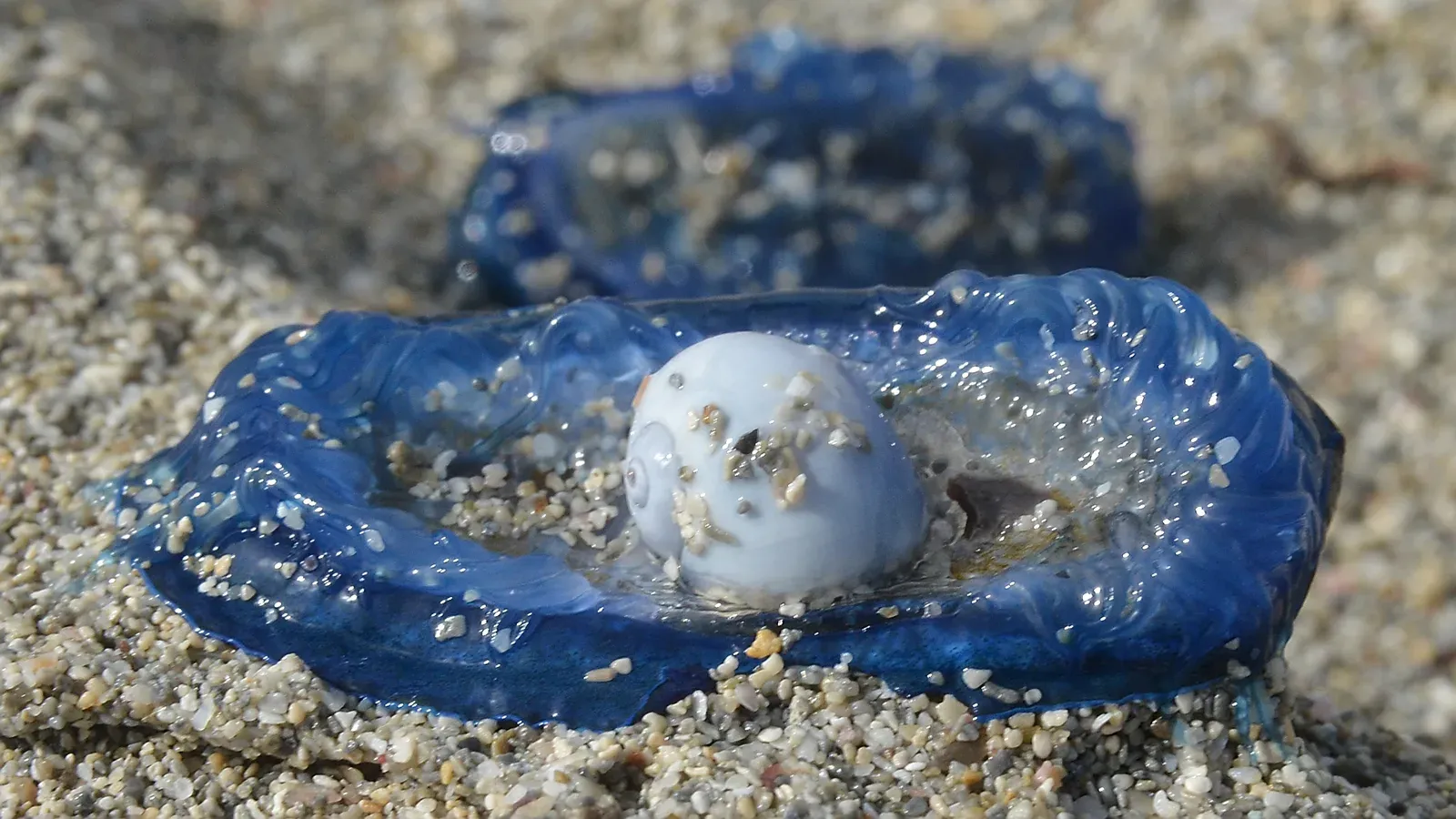
The pteropods are the smallest and the most numerous: free-swimming sea snails and sea slugs, most of them living in the top 10 metres and under a centimetre long, the shelled sea butterflies and the shell-less sea angels. Above them, in the last metre under the hull, is the neuston — the blue-and-clear surface community of by-the-wind sailors and the violet snails that eat them — which is why the first minute of the descent can be as busy as the last.
The larval fish are the marquee attraction, and the reason the photographers come. Reef fish spawn into open water and their young spend weeks in the plankton before settling; in the settling stage, as DAN’s article puts it, “Subjects in this stage of development look nothing like their adult selves.” Larval flounders with both eyes still on separate sides, eels as glass ribbons, dragonfish and anglerfish as things with trailing filaments longer than their bodies — the identifications happen afterwards, from the photographs, and often not even then. Our Kona record has the operator conceding that some of what passes is simply unidentifiable, which is the most honest line in the dataset.
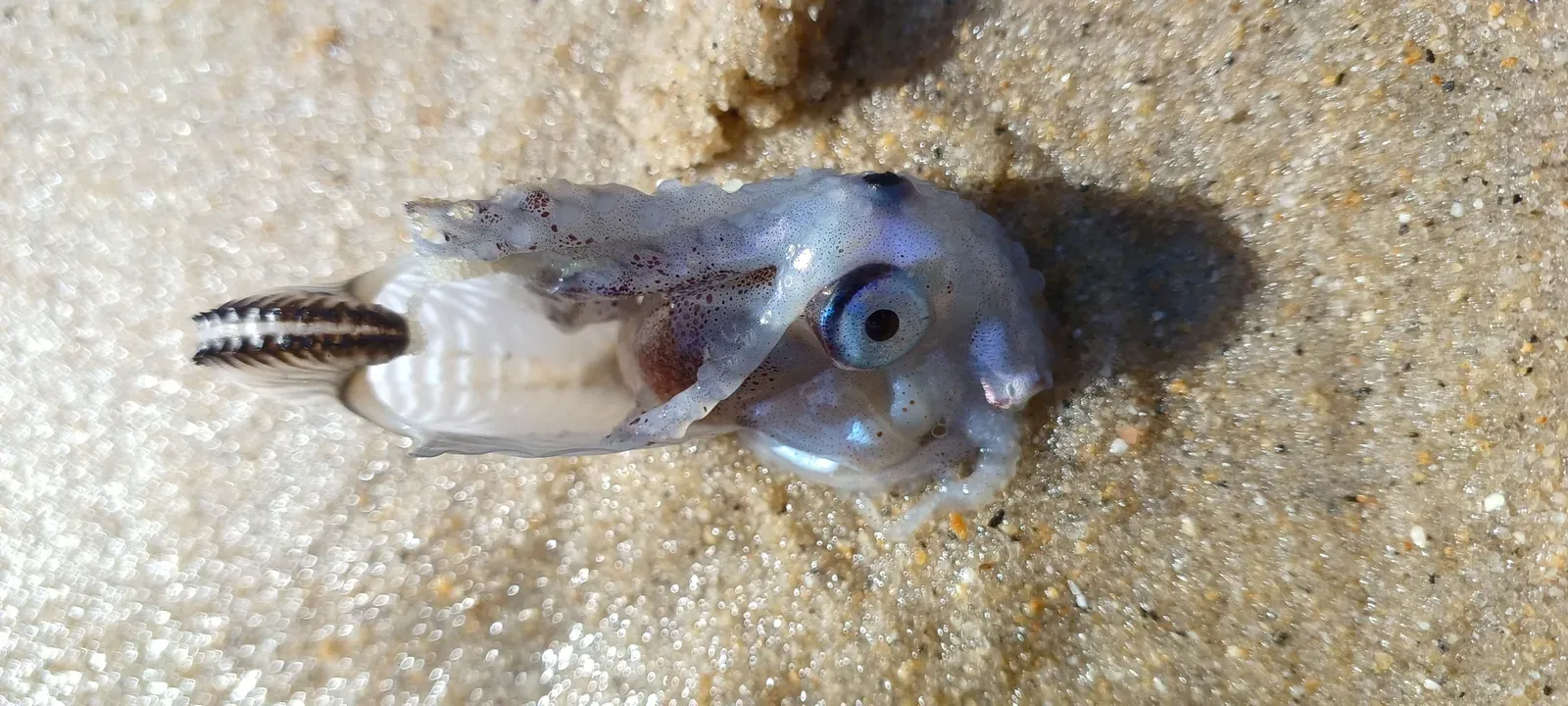
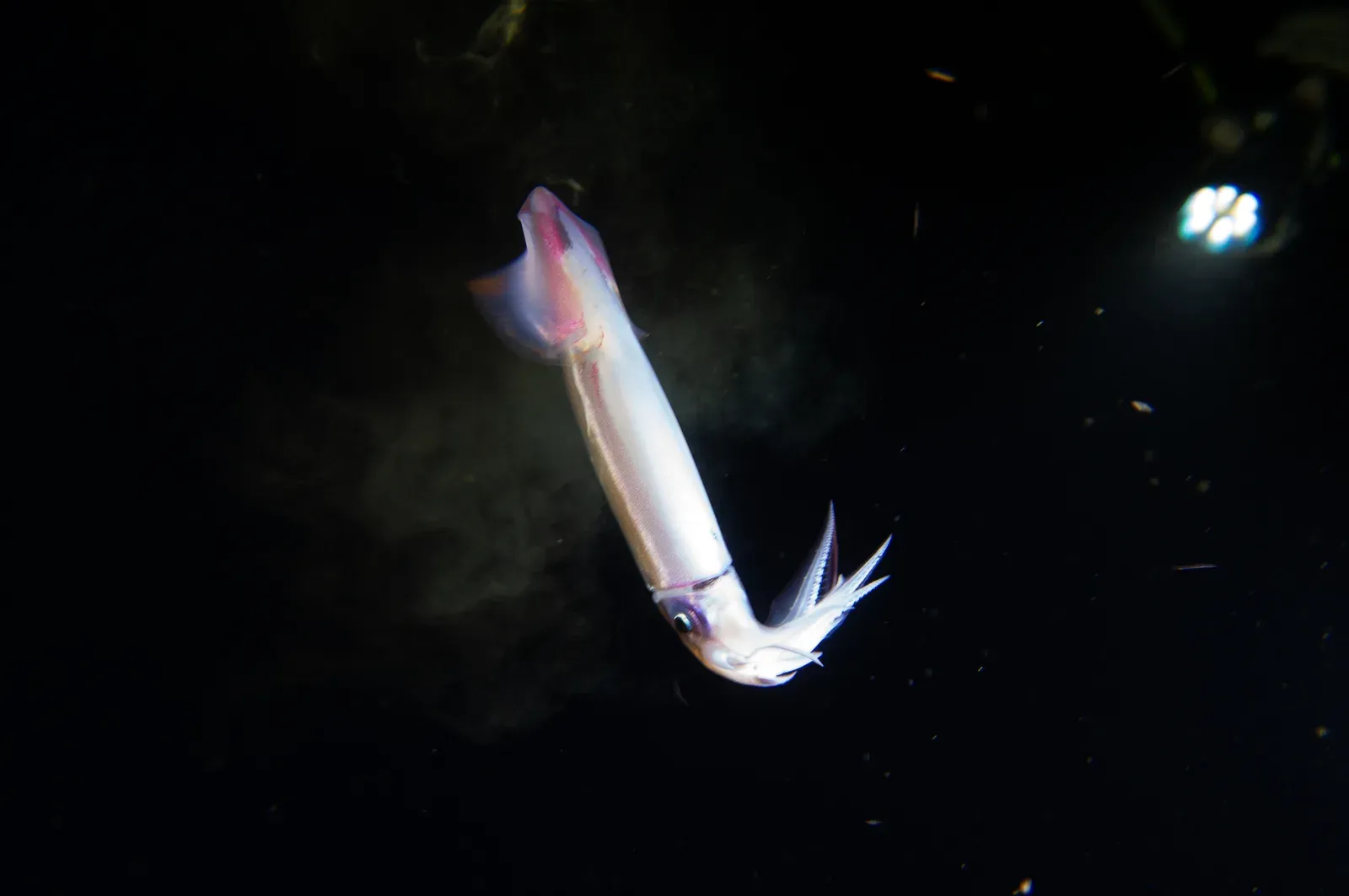
And the cephalopods, which are the only members of the cast that look back at you. Squid hunt through the beam; paralarval octopus drift with arms too short to be useful yet; and the two animals that have made whole destinations famous are the argonaut and the blanket octopus. The argonaut, or paper nautilus, is a pelagic octopus whose female secretes a paper-thin eggcase — not a shell, an “evolutionary innovation unique to the genus” — reaching 30 centimetres on a 10-centimetre animal, while the male rarely passes 2. It lives near the surface, in tropical and subtropical water worldwide, feeding on crustaceans, molluscs, jellyfish and salps, which means it is hunting the same column you are watching. The blanket octopus is a night-dive rumour until you meet one. DAN’s roundup credits the first female paper nautilus and blanket octopus found off Anilao to the same handful of divers who put that coast on the blackwater map.
Bonfire, blackwater, tethered, untethered
The genre has picked up four terms that are used loosely, and the differences are operational. Blackwater is the open-ocean drift described above — deep water, a moving boat, lights in the column. Bonfire diving is its shallow cousin: DAN’s editorial gloss is that “divers arrange strong lights in a stationary position on the seafloor to attract plankton and creatures that feed on plankton or are drawn by the lights.” It is a shore or reef dive with the lights doing the gathering, run in Japan’s Osezaki in the off-season and in plenty of muck bays, and it is where Anilao’s blackwater programme began — Bartick describes starting there with “shore-based blackwater-ish diving using stationary lights” before the guides worked out a downline method for the bay.
The other pair describes what keeps you with the boat. Tethered is Kona’s model: a harness or clip on a line under the hull, so that the diver cannot leave the light even if the current tries to insist. PADI’s summary — “Divers swim around the lights or are tethered by a line to stay close to the boat” — covers both. Untethered is the Florida and Anilao model, where the reference is a lit downline and the discipline is yours. Bartick’s own rig, described in DAN’s 2017 piece, is the standard: “a weighted 100-foot rope with a 10,000-lumen Kraken Solar Flare at the top and eight 1,000-lumen lights at various depths”, secured to the boat, with a sea anchor deployed to slow the drift. He prefers “the freedom of being untethered and relying on the lighted downline as a reference point”, and adds the line every untethered diver should have on a sticker: “keep one eye in the viewfinder and one on the downline.” Palau’s version is a hang-bar — a lit bar lowered to about 16 metres from a GPS-marked position, with the light itself as the only fixed thing in any direction.
None of the four is safer in the abstract. A tether removes the separation problem and adds an entanglement one; a downline trusts the diver’s buoyancy and attention. What the operators agree on is the direction of drift: the downline attracts the animals as well as the divers, so the reference and the subject are usually in the same place, and a diver who stays in sight of the light has, in the only sense that matters out there, not gone anywhere.
How the dive is run, and why the bar is high
The entry requirements are the steepest in recreational diving short of an overhead, and they are earned. Kona’s operator wants Open Water plus at least 25 logged dives, a night dive with their own crew within the past twelve months, nobody under 15, and the ability to climb a floating vertical ladder unassisted in full kit — the last of which, on a rolling boat at night, is the one people underestimate. Palau’s operators generally want 50 or more logged dives, comfort in current and the ability to deploy your own surface marker if you and the light part company. Look at what the requirements are protecting against and they stop looking like gatekeeping: the two hazards in our records are a diver who loses buoyancy with no reference to notice it, and a diver who loses the light.
Buoyancy is the whole skill. DAN’s night-diving guidance says it in one line — “Maintaining neutral buoyancy is crucial in the dark, where it can be especially challenging without as many points of reference” — and blackwater removes the few points a reef night dive still offers. Bartick’s advice is to descend slowly, stabilise, relax, and then watch your ears: “Depth can easily be misjudged because there are no points of reference. Pay close attention to your ears throughout the dive; they are often the first indicators of a depth change.” Weight yourself for the hang, not for a descent to a bottom you will never see; the weighting guide covers the arithmetic. Carry a backup light — DAN’s phrasing is that “a backup ensures you are not left in complete darkness if your primary light fails” — because on a reef, a dead torch leaves you with a reef, and out here it leaves you with nothing.
The boat side matters as much. Bartick’s pre-dive list is worth reproducing in spirit: a bailout plan “in case a diver drifts out of sight of the line”, an emergency recall system, a limit on the number of people in the water, a sea anchor ready, and an awareness that “it’s not uncommon for the wind to blow in one direction while the current pushes in another.” Agree light signals with your buddy on deck, as DAN’s night article recommends, then accept that your buddy for most of the dive will be a glowing rope.
Photography has its own etiquette, and it is mostly about restraint. Transparent animals spook at pressure waves and retract when lit; the technique is to swim slowly into the current, let the subject come to you, and cup your torch with your hand so only a little light leaks through your fingers. A tight beam on low power finds subjects; the full beam is for the moment of focus. Backscatter is the nature of the environment — DAN’s night guidance warns that “a very powerful light will actually be less effective than one with a more focused beam and less intensity”, and Bartick’s blackwater settings follow the same logic: a 60 mm macro lens for a short working distance, strobes turned in towards the housing, a higher ISO and lower strobe power so the strobes recycle fast, and white focus lights rather than red, which throw a colour cast that is hard to remove. His starting point is ISO 360 at f/14 and 1/200, strobes at half to three-quarter power. Whether you photograph or not, the same rule keeps everyone’s dive intact: nobody chases. The animal that is fleeing your fins is fleeing the whole group’s.
Where the boats go
The sport has one birthplace and a short list of places with the right geography. DAN’s history is that “Blackwater diving started more than 50 years ago, when a handful of adventurous divers in Kona, Hawai’i, began exploring the open ocean at night”, and that “Kona has become ground zero for blackwater diving” — it is the coast where the seabed falls to more than ten thousand feet within a few miles of the harbour, and where Jack’s Diving Locker, operating since 1981, still runs the dive under the name our record carries as its alias, Pelagic Magic. Palau is the other place the genre is built around: the trench beyond the barrier reef is more than 7,600 metres deep, and the Palau blackwater dive was pioneered there by the specialty arm of Sam’s Tours, hung from a lit bar at a GPS-marked position; the November-to-April dry season brings the calmest surface.
Anilao is the third name, and a different model. The area’s resorts run blackwater as an adjunct to the muck diving, drifting alongside a lit line offshore after dark; the geography that makes it work, per the divers who developed it, is a bay opening onto the Verde Island Passage, where deep water pushes in twice a day and the richest areas sit in less than a thousand feet. Beyond our records, DAN lists operators running the dive from Jupiter and Palm Beach in Florida, where the Gulf Stream does the delivering and the dives are untethered on a lit line, from British Columbia, and off Japan. The physics are portable — any open ocean with a few hundred feet of water below will produce a migration — but the famous sites are famous because the deep water is close, and a short run home at midnight is worth a great deal.
| Site | Depth | Level | Best months |
|---|---|---|---|
| Kona Blackwater Dive Kona · United States | to 15 m | Advanced | Dec–Apr |
| Palau Blackwater Dive Palau · Palau | to 16 m | Advanced | Dec–Mar |
Blackwater Diving Kona, Hawaii | Kona Honu Divers | In the Night Time Pelagic Magic Happens · Kona Honu Divers on YouTube
The other after-dark events — the manta feed, the mandarinfish minute, coral spawning — are sorted in the night-diving guide. The flashes you will see when you cover your torch out there belong to bioluminescence, which counts what fraction of the midwater can make its own light. And if the idea of an ocean that sorts itself into layers by density and light is new, the layered sea is where the lift shaft gets its floors.

