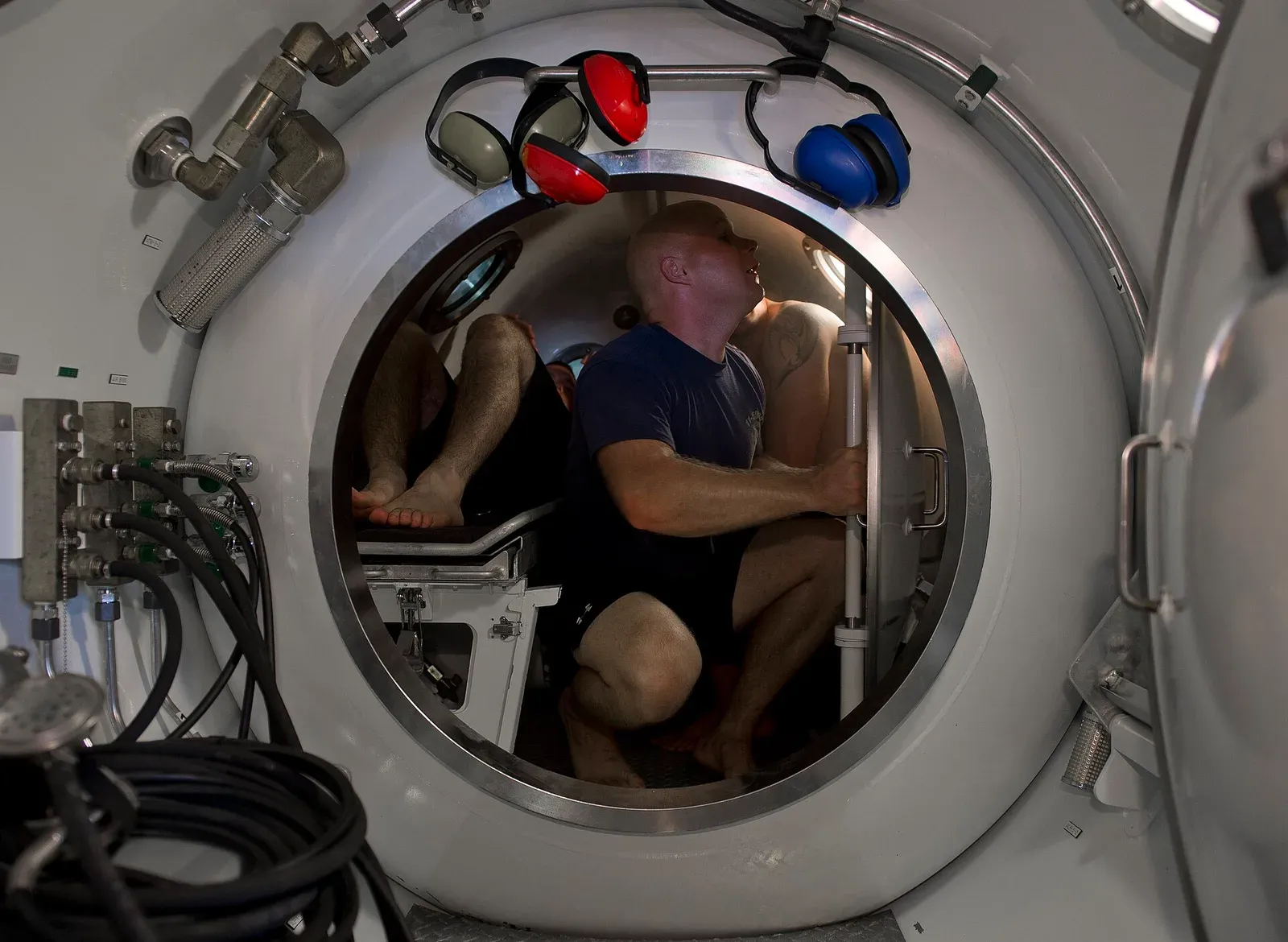
The whole thing in one paragraph
You breathe nitrogen under pressure and it dissolves into you, more of it the deeper and longer you go. On the way up the pressure falls faster than your blood can carry the gas back to your lungs, so for a while your tissues hold more nitrogen than the world around them will support. Bubbles come out of solution. This happens to most divers on most dives, and almost always nothing follows: the bubbles are small, they travel in the veins, and the lungs strain them out. Decompression sickness is what happens on the occasions when that filter is bypassed or overwhelmed, or when a bubble forms in a tissue instead of a vein and has nowhere to go. It lodges — in a shoulder, in the skin, in the inner ear, in the white matter of the spinal cord — and it presses, tears and inflames. The fix is to make the bubble small again and give its gas somewhere to leave: put the diver back under pressure and have them breathe oxygen. That is all a recompression chamber is.
The rest of this guide is the proof, the numbers, and the parts divers get wrong.
Where the gas goes in
Your dive computer models you as sixteen imaginary tissues, each taking up and shedding nitrogen at its own speed — a five-minute compartment that fills and empties inside a single dive, a ten-hour one that barely notices the dive happened. That machinery is unpacked properly in how your dive computer decides; what matters here is only that it is a model of dissolved gas, and that it stops describing you the moment a bubble forms.
Every figure below comes from the same model — Bühlmann ZH-L16C, the algorithm most recreational computers run — and from the same dive: 30 metres (100 feet) on air, nineteen minutes from leaving the surface, a direct ascent at 10 metres per minute and no stop. That dive is legal. The model’s no-stop limit at 30 metres is 19.5 minutes, so this profile is inside it, with half a minute to spare. It is the dive a computer would clear without a murmur.
It also surfaces at 94 per cent of the M-value — ninety-four per cent of the way into the gap between ambient pressure and the line the model was fitted against. That is the first uncomfortable thing. Staying inside the limit is not the same as staying far from the edge, and a limit that is a line has nothing on either side of it but arithmetic.
The window is smaller than the story
Here is what that dive leaves you carrying.
Read the zero line first: it is ambient pressure. Below it, your tissues hold less nitrogen than the air around you and are taking gas on. Above it, they hold more and are trying to get rid of it. During the dive everything is below, because at 30 metres the pressure around you is four times what it is at the surface. The crossing happens on the way up.
Supersaturation peaks at the instant you break the surface — 1.55 bar above ambient in the fastest compartment — and then falls off a cliff. Three quarters of it is gone within sixteen minutes. Thirty minutes after you climb the ladder the worst compartment is 0.15 bar over; at forty-five minutes it is 0.04. Fifty-four minutes after surfacing, no compartment in the model is above ambient pressure at all. The lead passes down the line as the hour runs — six compartments hold it in turn, from the five-minute one out to the 38.3 — each handing over as the faster tissue empties beneath it.
Which sets up the finding this guide exists for. The dissolved-gas window on an ordinary no-stop dive is not hours long. It is about an hour — and as the next chart shows, most cases of decompression sickness have not announced themselves by the time it has closed. The gas that caused the injury is long gone before the diver knows they are hurt.
That is not a flaw in the model. It is the boundary of it. Bühlmann’s arithmetic describes the cause: the supersaturation that lets a bubble grow. The disease is the bubble, and a bubble, once formed, outlives the gradient that made it. Everything a dive computer knows about you ends at the surface. Everything decompression sickness does to you starts there.
Bubbles in most divers, most dives
The word “silent bubbles” sounds like a euphemism. It is a measurement.
Between 1989 and 1991, the Divers Alert Network put Doppler ultrasound on recreational divers doing ordinary multi-day, repetitive, multi-level dives. Dunford and colleagues published the result in 2002: detectable venous gas emboli in 61 of 67 subjects and 205 of 281 dives — 91 per cent of people, 73 per cent of dives. More than a third of the dives scored at the higher bubble grades. Not one diver developed decompression sickness on a monitored day.
So bubbles are the norm and injury is the exception, and the thing standing between them is your lungs. Gas coming out of solution on the venous side arrives at the pulmonary capillaries, which are fine enough to trap it; it diffuses into the alveoli and leaves on the next breath. The lung is a bubble filter, and on a normal dive it wins easily.
It loses in three ways. It can be swamped, if enough bubbles arrive at once — that is “the chokes”, the presentation that kills. It can be bypassed: about one adult in five has a patent foramen ovale, a flap between the upper chambers of the heart that never fully sealed after birth, and a cough or a strain can push venous blood with its bubbles straight to the arterial side, bound for the brain and the spinal cord instead of the lungs. Or it can be irrelevant, because the bubble never entered a vein at all — gas can come out of solution inside a joint capsule, a tendon sheath or the fatty white matter of the cord, where there is no bloodstream to carry it anywhere and nothing to do but grow.
Where a bubble does harm
Joints. The commonest presentation and the one the disease is named after. Deep, dull, poorly located pain, often in a shoulder, sometimes eased by bending the limb. Bubbles forming in and around the joint capsule stretch tissue and press on nerves.
Skin. Itching, formication — the sensation of insects crawling — and, at the serious end, cutis marmorata: a mottled, marbled purple pattern usually over the shoulders, chest and abdomen. Marbling is not a mild skin symptom. It travels with more serious disease often enough that it is treated as a warning, not a rash.
Lymphatics. Local swelling and pitted, orange-peel skin where bubbles obstruct lymphatic drainage.
Spinal cord. The presentation divers fear, and rightly. Girdling tightness around the chest or abdomen, pins and needles, ascending weakness in the legs, loss of bladder or bowel control. The cord is vulnerable for structural reasons: the lesions turn up in the white matter, which is fatty and therefore holds nitrogen well, fed by small end vessels with poor collateral supply, so a blockage has no way around it.
Brain. Headache, visual disturbance, altered sensation, confusion, unexplained changes in mood or behaviour, and at the extreme, seizure.
Inner ear. Vertigo, nausea, hearing loss, loss of balance. It has its own mechanism on mixed gas: switching from a helium-rich mix to a nitrogen-rich one at a stop can make a well-perfused tissue take on more total inert gas at constant pressure, and the ear seems particularly sensitive to it.
Lungs. The chokes — dry cough, burning pain behind the sternum, breathlessness. Rare in divers, and the emergency.
The ladder and the clock
The curve above is the US Navy’s onset table, also published by TDI, and it does not separate types of sickness or types of symptom. Forty-two per cent of cases have shown their first symptom within an hour of surfacing. Sixty per cent within three hours. Eighty-three per cent within eight. Ninety-eight within twenty-four. More cases arrive in that first hour than in the following seven put together, and after the first day the curve is essentially flat.
One honest complication: StatPearls, drawing on a different series, puts about 75 per cent inside the first hour. Both figures are in print and neither is wrong; they count different populations. Military and commercial series are weighted towards deep, long, staged exposures that hit hard and fast, and recreational case mixes skew later and milder. Take the range as the useful fact — most cases inside three hours, nearly all inside a day.
The old split runs alongside that clock. Type I is skin, joint and lymphatic, about 85 per cent of cases and mostly uneventful recoveries. Type II is everything neurological, inner-ear and cardiopulmonary. Doctors increasingly drop the distinction and say “decompression illness”, for two good reasons: the initial treatment is identical either way, and neurological signs have an unpleasant habit of appearing after the first presentation, which turns yesterday’s Type I into today’s Type II.
Symptom tables are worth reading with an eye on whose divers they describe. The much-reproduced list giving joint pain at 89 per cent and arm symptoms at 70 comes from an older US Navy military series. DAN’s account of recreational cases looks different: pain and paraesthesia in nearly two thirds, constitutional symptoms — fatigue, malaise, headache — in about 40 per cent, dizziness and motor weakness in about 20 per cent, skin signs in about 10. The recreational picture holds far more fatigue and far more neurology than the military one, which matters when what you are deciding is whether to dismiss how tired you feel.
How often, and to whom
Roughly three cases per 10,000 sport dives, which sits comfortably inside the 1-to-4 range the safety stop guide already quotes; another published estimate gives 2.8 to 4. Commercial diving runs 1.5 to 10 per 10,000. DAN’s Project Dive Exploration logged 50,150 recreational dives between 1998 and 2002 against 28 recompressions — about one dive in two thousand, and that figure includes arterial gas embolism too.
Risk is not spread evenly, and the pattern is more interesting than the folklore. A 2005 study tested a long list of candidate factors and found no significant association with asthma, diabetes, cardiovascular disease, smoking or body mass index. Raising the risk: greater depth, a previous hit, more consecutive days of diving, and being male — a difference other sources size at roughly two and a half times. Associated with lower risk — the part nobody quotes — nitrox, drysuits, diving more often in the past year, greater age and more years since certification. Those are almost certainly not protective in themselves; they are proxies for training and experience, which looks like the strongest thing a diver actually controls.
Then the profile itself. DAN’s Nick Bird, writing in 2025, puts it exactly: “DCS is a probabilistic condition, in which injury risk increases with proximity to NDLs,” and a diver staying “within 50% of the allowable bottom time” has “a negligible risk of DCS with direct ascent to surface.” Not zero past that point, and not a cliff at the limit — a rising probability, with error bars either side of a number your computer prints to the minute.
Which is the sentence this guide exists for. Staying inside the limits lowers the odds; it does not zero them. A hit is not proof you made a mistake, and a clean profile is not proof that what you are feeling is not a hit. The physiologist Neal Pollock has written the cleanest demolition of the alternative — the “undeserved” hit: any dive in the recreational range approaching half the Navy no-stop limit “carries a non-zero risk of DCS,” and “‘Non-zero risk’ repudiates the claim of ‘undeserved.’” The word smuggles in a promise nobody made. Your computer never said you were safe; it said it had run out of arithmetic to object with.
Is this the bends?
This is the question divers actually have, and it usually arrives as a half-thought on a boat: my shoulder aches, and I did carry the tanks.
There is no blood test. Diagnosis is clinical — the history, the profile, the symptoms — and the confirmation is often the treatment: if recompression relieves it, that settles it. Plenty of things imitate decompression sickness, and doctors genuinely have to work to tell them apart: inner-ear barotrauma, contaminated gas, oxygen toxicity, musculoskeletal strain, marine envenomation, immersion pulmonary oedema, and coincidental problems like a stroke that happen to land on a dive day.
But the failure mode is almost never misdiagnosis by a physician. It is the hours before anyone is asked. DAN’s account of the problem is blunt about why: Type II symptoms can come on slowly, and fatigue and weakness “are common enough concerns… that they can be very easy to ignore.” Everyone on a dive boat is tired, everyone lifted something heavy, and the innocent explanation costs nothing to believe.
A trained first responder will run a field neurological assessment — a structured walk through orientation, eye movement, facial symmetry, strength, coordination, balance and sensation on both sides, where the point is the comparison, not the score. The principle behind it is usable without the training: decompression sickness is very often asymmetrical and very often duller than you expect. If one side is weaker, number or clumsier than the other after a dive, that is a finding. So is fatigue that makes no sense against the day you had.
The rule is short enough to carry: symptoms after a dive are diving-related until a doctor says otherwise. Nobody is embarrassed by a false alarm on a hotline that exists for exactly this, and the cost of being wrong in the other direction is measured in hours.
The next hour
What the chamber does
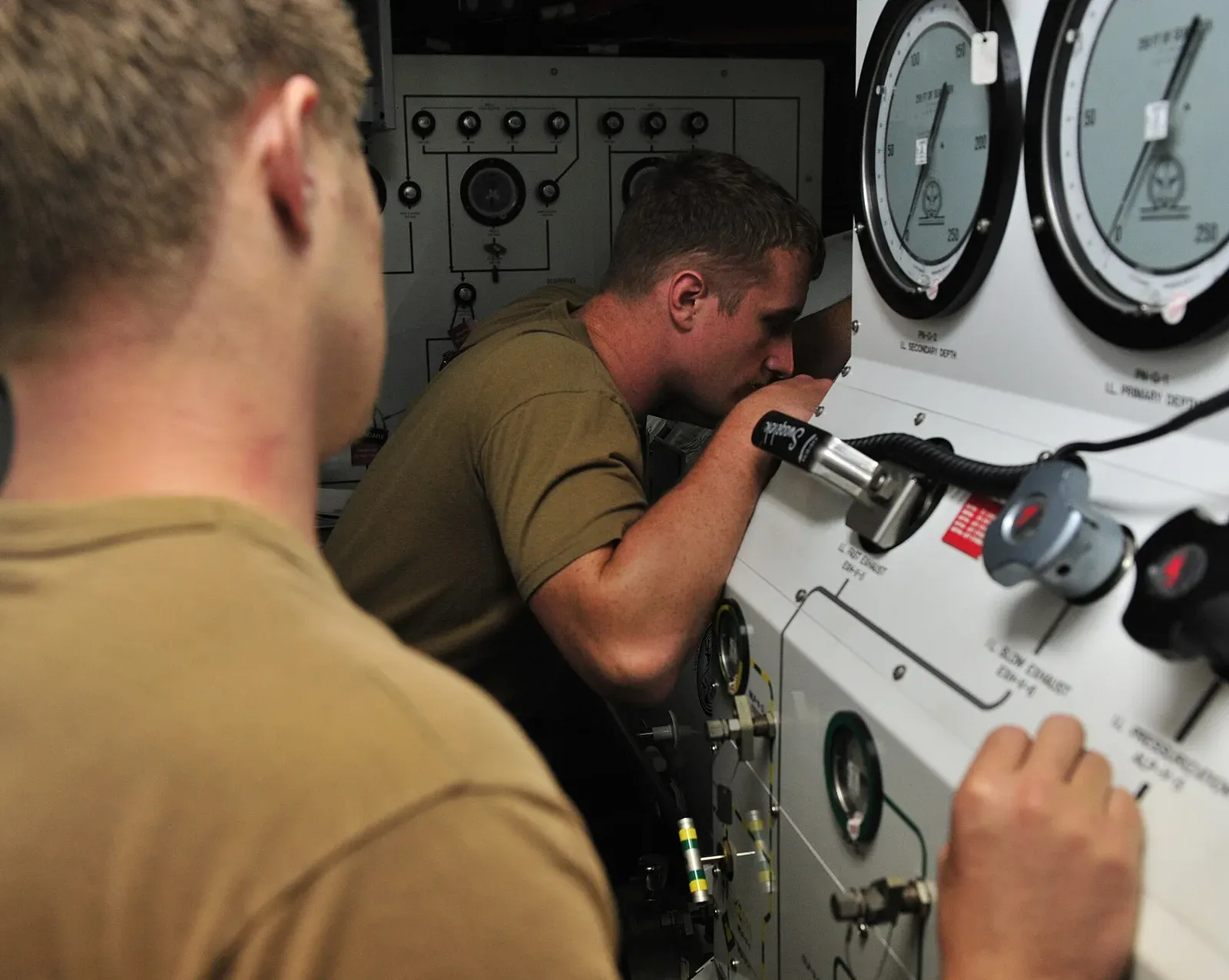
A recompression chamber does two things, and both of them are simple.
The first is Boyle’s law. At 18 metres the ambient pressure is 2.81 bar, nearly three atmospheres. A bubble taken from the surface to that depth is squeezed to 36 per cent of its volume. Because volume falls as the cube of the radius, the diameter only falls to 71 per cent — which is the useful asymmetry, since what a bubble blocks and stretches is governed by how wide it is, and what dissolves back is governed by surface area and pressure. Squeezing it does not cure anything by itself. It relieves the mechanical insult and buys time.
The second is the gradient. Breathing pure oxygen means there is no nitrogen going in, so the inspired nitrogen pressure is zero and the bubble’s gas has nowhere to go but out — into the surrounding tissue, into the blood, and away through the lungs. Pressure makes the bubble small; oxygen empties it. Everything else in the schedule is housekeeping around those two facts.
That schedule is US Navy Recompression Treatment Table 6, the standard of care. The chamber goes to 18 metres — 60 feet of seawater, which is why the gauges in the photograph above read in feet — for three twenty-minute oxygen periods, each followed by a five-minute air break. Then thirty minutes rising to 9 metres on oxygen, two hours of oxygen at 9 metres in two sixty-minute periods with fifteen-minute air breaks before each, and a final thirty-minute ascent to the surface, still on oxygen. 285 minutes in total: four hours and forty-five. Two hundred and forty of those minutes are on oxygen and forty-five are air breaks.
The air breaks are the one part that surprises people. They are there because oxygen at 2.8 atmospheres is itself a drug with a dose limit — the same central-nervous-system toxicity that sets the maximum operating depth of a nitrox mix — so the schedule interrupts the thing that is doing the healing in order not to cause a seizure inside a pressure vessel.
For pain-only cases that clear completely within ten minutes at 18 metres, there is a shorter schedule, Table 5, at two hours sixteen. Table 6 can be extended if the diver is not improving, and repeat treatments on following days are routine rather than a sign that something has gone wrong.
The lineage is worth a line. Recompression as a treatment dates to the 1800s; the US Navy’s first standard table was published in 1924 and had a 50 per cent relapse rate. The oxygen tables that replaced them were developed by Goodman and Workman in 1965, and the chamber a diver enters today still runs a variation of their schedule.
Getting better
Usually well, and the variable that matters most is time.
Immediate oxygen followed by recompression leaves most divers with no long-term effects, and Type I cases — the 85 per cent — mostly resolve completely. But permanent injury exists and is not vanishingly rare. Three-month follow-up of 268 divers whose accidents were reported to DAN in 1987 found 14.3 per cent still had symptoms of Type II decompression sickness and 7 per cent of Type I; a separate long-term follow-up found 16 per cent with permanent neurological sequelae. Those are old series and modern first aid is better than it was, so read them as an order of magnitude rather than a forecast.
Delay is the prognostic factor everyone agrees on. Outcomes are better after immediate recompression, and there is evidence that delays beyond about six hours produce slower or less complete recovery and need more treatments. For mild symptoms a delay is unlikely to change the long-term outcome — a genuine comfort to a diver on a liveaboard two days from anywhere — but it is not an argument for waiting, because nobody can reliably tell a mild case from an early serious one in the first hour.
When you can dive again is a diving physician’s decision and depends on what was injured and how completely it resolved. That is the whole correct answer; anything more specific from a guide would be a guess about someone we have not examined.
Where the words came from
Decompression sickness was an industrial disease before it was a diving one. In 1841 the mining engineer Jacques Triger documented pain and cramps in men working in pressurised mine shafts — the first recorded cases — and in 1854 caisson workers on the Royal Albert Bridge fell ill and one died.
Then the bridges. At the Eads Bridge in St Louis in 1871, 352 compressed-air workers went down; 30 were seriously injured and 12 died. The physician in charge, Alphonse Jaminet, developed the disease himself and wrote the first personal account of it, and DAN’s teaching material puts the origin of the word “bends” at that site. Two years later at the Brooklyn Bridge, Andrew Smith coined “caisson disease” for 110 cases among 600 workers; the chief engineer, Washington Roebling, was one of them and lived with the after-effects for the rest of his life. The nickname stuck for a reason that says a good deal about the nineteenth century: stricken men stooped forward at the hips in a posture resembling the Grecian Bend, a fashionable affectation of the day.
The science followed the injury by half a century. Haldane, Boycott and Damant published The Prevention of Compressed Air Illness in 1908 and gave the world staged decompression. Workman produced M-values in 1957 and the oxygen treatment tables with Goodman in 1965. Spencer showed in 1976 that Doppler could hear bubbles before a diver felt anything — which is how we know about the 73 per cent. Bühlmann published the model behind the charts above in 1984.
Where the margin is thinnest
None of this is an argument against diving deep, far out or for many days running. It is an argument for knowing which of those you are doing. Everything below is a real profile from our records where the depth is serious, the days repeat, or the nearest chamber is a very long way away — and the last of those is the one divers most often fail to check. DAN’s count of hyperbaric facilities in the United States runs to roughly 1,500, of which around 67 treat diving accidents; the rest do scheduled wound care, which pays better. Distance to a chamber is not the same as distance to a hospital.
| Site | Depth | Current | Level | Best months |
|---|---|---|---|---|
| San Francisco Maru Chuuk Lagoon · Micronesia | 27–64 m | Mild | Advanced | Nov–May |
| Jessie Beazley Reef Tubbataha Reefs · Philippines | 7–50 m | Strong | Advanced | Apr–May |
| Roca Partida Revillagigedo (Socorro) · Mexico | to 40 m | Moderate | Advanced | Jan–Mar |
| USS Saratoga Bikini Atoll · Marshall Islands | 27–38 m | Mild | Advanced | Apr–Nov |
| Punta Sur Cozumel · Mexico | 24–38 m | Moderate | Advanced | Jan–Apr |
| Big Brother Island Brothers & Daedalus · Egypt | 10–35 m | Strong | Advanced | May–Jun |
| Bajo Alcyone Cocos Island · Costa Rica | to 25 m | Strong | Advanced | Jun–Nov |
| Darwin's Arch Galápagos · Ecuador | 18–24 m | Strong | Advanced | Jun–Nov |
Two are past recreational limits by design. The San Francisco Maru still has her deck cargo of tanks and trucks aboard, with the stern at 64 metres and the seabed at 70 — past recreational limits for almost her whole length. The Saratoga at Bikini Atoll is dived on staged decompression from a self-sufficient liveaboard charter, with a deco bar rigged because the atoll requires one. Punta Sur is the opposite case and the more instructive one: an ordinary day-boat dive sitting right at the edge of recreational limits, the Devil’s Throat opening onto the wall at about 41 metres.
The rest are about remoteness and current. Bajo Alcyone starts with a fast drop to a 25-metre summit, at the end of a 32-to-36-hour crossing from Puntarenas. Darwin’s Arch holds divers between 18 and 24 metres in strong current, in water that can be as cold as 16 °C. Big Brother is a wall in current that runs more or less constantly, where operators ask for 50 logged dives before they will take you; Jessie Beazley is an isolated cay dropping past 50 metres, liveaboard-only; Roca Partida is a bare rock with vertical walls and nothing around it but open ocean.
On trips like these the precaution is a habit rather than a rule: run further inside the limits than the computer demands, keep the ascents slow and the days from stacking, and know before you board where the chamber is and whether it is open. The surface interval arithmetic governs the repetitive days and the flying-after-diving window is the same ledger over a longer clock — because the one thing the chart above makes unarguable is that the dive does not end when you climb out.


