
Africa · South Africa
Algoa Bay
Ragged-tooth sharks settle on the Bay's reefs from November to May
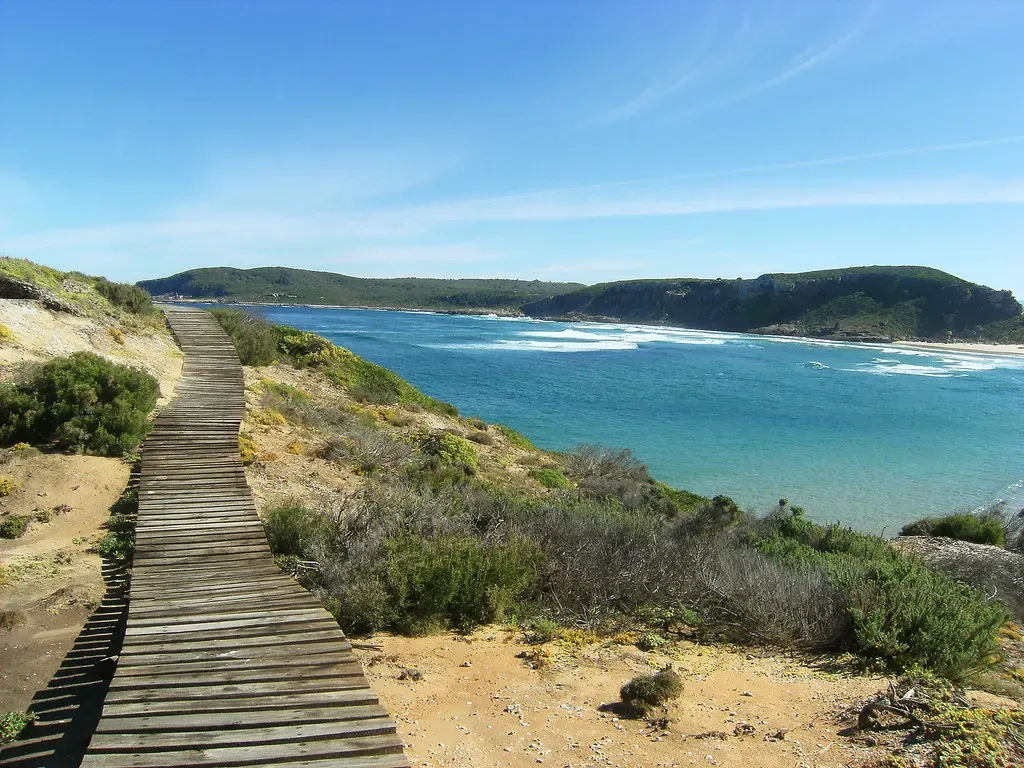
Photo: Mig Gilbert · CC BY-SA 2.0
Algoa Bay, off Gqeberha (Port Elizabeth), splits its diving between two areas: the Bay itself and the Wildside, the coast west of Cape Recife. Boats run out to colourful reefs, pinnacles and wrecks: Evans Peak and Riy Banks for walls and drop-offs, the scuttled navy vessel Haerlem, and Bell Buoy, popular with the dive shops and local divers. Ragged-tooth sharks make the Bay their home for seven months of the year, over reefs busy with nudibranchs, rays and fish.
About diving in Algoa Bay
Nearly every site is a boat dive. Bell Buoy and the Haerlem lie about ten minutes out from the harbour, or five from Hobie beach, while Riy Banks, a large shoal about 21 km east of Cape Recife, means a long trip each way. The Wildside sites around Noordhoek are reached from the slipway of the Noordhoek dive and boating club, a short distance east of Cape Recife. Some of the sites fall inside the Addo Elephant National Park Marine Protected Area, where every scuba diver needs a permit.
Underwater the reefs are dramatic rock formations, broken by pinnacles and drop-offs. The Bay is a transition zone between the warm current running down the east coast and the cold current from the west coast, which gives each side of the cape its own dive environment. The rocky reefs inside the Bay are covered in soft corals, sponges and sea fans, while the nutrient-rich water feeding the Wildside grows prolific false and hard corals, among them noble coral, the only hard coral in Southern Africa that grows in cold water. Shy sharks, several species of ray, nudibranchs and a wide variety of fish are common sightings, and great white sharks turn up now and then.
Port Elizabeth is a destination for macro photography, and the view stays short: visibility averages 5 to 8 m in the Bay and 10 to 15 m on the Wildside, and deeper Wildside dives meet thermoclines of 11 °C. Divers who leave the divemaster to dive on their own carry a DSMB and a reel or spool so the boat knows where they surface, particularly when a current is running. Nitrox is available at some filling stations, though the choice of mix may be limited.
Best time to dive Algoa Bay
| Jan | Feb | Mar | Apr | May | Jun | Jul | Aug | Sep | Oct | Nov | Dec | |
|---|---|---|---|---|---|---|---|---|---|---|---|---|
| Season | Good | Good | Good | Good | Good | Prime | Prime | Good | Good | Good | Good | Good |
| Sea surface | 21°C70°F | 20°C68°F | 20°C68°F | 19°C66°F | 18°C64°F | 18°C64°F | 17°C63°F | 17°C63°F | 18°C64°F | 18°C64°F | 18°C64°F | 19°C66°F |
| Daytime high | 27°C81°F | 28°C82°F | 29°C84°F | 27°C81°F | 27°C81°F | 24°C75°F | 24°C75°F | 25°C77°F | 25°C77°F | 26°C79°F | 26°C79°F | 26°C79°F |
| Rain | 34 mm1.3 in | 38 mm1.5 in | 46 mm1.8 in | 39 mm1.5 in | 32 mm1.3 in | 30 mm1.2 in | 35 mm1.4 in | 30 mm1.2 in | 31 mm1.2 in | 47 mm1.9 in | 38 mm1.5 in | 33 mm1.3 in |
| Jan | Feb | Mar | Apr | May | Jun |
|---|---|---|---|---|---|
| Good | Good | Good | Good | Good | Prime |
| Sea surface | |||||
| 21°C70°F | 20°C68°F | 20°C68°F | 19°C66°F | 18°C64°F | 18°C64°F |
| Daytime high | |||||
| 27°C81°F | 28°C82°F | 29°C84°F | 27°C81°F | 27°C81°F | 24°C75°F |
| Rain | |||||
| 34 mm1.3 in | 38 mm1.5 in | 46 mm1.8 in | 39 mm1.5 in | 32 mm1.3 in | 30 mm1.2 in |
| Jul | Aug | Sep | Oct | Nov | Dec |
|---|---|---|---|---|---|
| Prime | Good | Good | Good | Good | Good |
| Sea surface | |||||
| 17°C63°F | 17°C63°F | 18°C64°F | 18°C64°F | 18°C64°F | 19°C66°F |
| Daytime high | |||||
| 24°C75°F | 25°C77°F | 25°C77°F | 26°C79°F | 26°C79°F | 26°C79°F |
| Rain | |||||
| 35 mm1.4 in | 30 mm1.2 in | 31 mm1.2 in | 47 mm1.9 in | 38 mm1.5 in | 33 mm1.3 in |
2011–2025 averages. Sea surface: NOAA Coral Reef Watch, measured at the surface, so deeper water can run colder. Daytime high and rain: NASA POWER.
June and July bring the best visibility but also the coldest water; ragged-tooth sharks are in the Bay from November to May.
Algoa Bay water temperature and weather by month
The sea surface runs from 17 °C (63 °F) in August to 21 °C (70 °F) in January. Rain falls through the year, about 40 mm (1.6 in) a month on average, with October the wettest. Daytime highs reach 29 °C (84 °F) in March and drop to 24 °C (75 °F) in June. Below the surface the water can drop to about 14 °C (57 °F), so pack a 7 mm suit with a hood, or a semi-dry.
Dive types & marine life
Ragged-tooth sharks make the Bay their home between November and May. At Raggie Sands, south-west of Cape Recife, sharks of all sizes frequent the gullies and as many as 40 have been seen on a single dive, though not often. Above water, the bay's islands hold 43% of the world's African penguins, most of them on St Croix.
- Reef
- Wall
- Wreck
- Sand tiger sharks
- Nudibranchs
Best dive sites in Algoa Bay
- 1
Evans Peak
A large pinnacle close to St Croix Island, with drop-offs and abundant fish life.
- 2
Riy Banks
Massive walls and pinnacles rising from deeper than 30 m, with game fish, rays and raggies.
- 3
Bell Buoy
Overhangs, arches and pinnacles on a rocky bottom, with ragged-tooth sharks often in the gullies.
- 4
Haerlem
A navy vessel scuttled in 1987, with pyjama sharks often seen inside the wreckage.
Site guides
Reef
Ragged-tooth sharks in the gullies, minutes from the beach
Pinnacle
A large pinnacle with drop-offs, dived between 14 and 40 m
Wreck
A scuttled navy vessel small enough to cover in one dive
Reef
Ragged-tooth sharks over walls rising from below 30 m
How to get to Algoa Bay
Flights land at Chief Dawid Stuurman Airport (PLZ), often called the ten-minute airport because it is said to be less than ten minutes' drive from most major areas of Port Elizabeth. It has regular flights to Bloemfontein, Cape Town, Durban and Johannesburg.
Photos from Algoa Bay
Mig Gilbert · CC BY-SA 2.0
Mig Gilbert · CC BY-SA 2.0
Mig Gilbert · CC BY-SA 2.0
Dive videos
Evans Peak Scuba Diving 4K - Port Elizabeth - September 2023 · South Africa Underwater on YouTube
Shark Alley, Port Elizabeth, South Africa 🇿🇦- Raggy Shark Dive · Anthony Redpath on YouTube
Questions divers ask
Do divers need a permit to dive Algoa Bay?+
For some sites, yes: a permit is required to scuba dive in any MPA. Yearly permits, valid for all South African MPAs, are sold at some Post Office branches, and dive shops or boat operators may have temporary permits valid for a month.
Is Algoa Bay suitable for newly certified divers?+
Yes. The reefs make interesting dives for all levels, and Bell Buoy, at 12 to 18 m, needs no special skills. Evans Peak and Riy Banks continue to 40 m.
What exposure suit do divers wear in Algoa Bay?+
Wet or semi-dry suits are adequate for most divers most of the time. A dry suit is recommended for multiple dives of longer duration or for divers sensitive to the cold.
Sources
- Diving in Port Elizabeth — Wikivoyage
- Port Elizabeth — Wikivoyage
- Algoa Bay — Wikipedia
- Why Dive Port Elizabeth — Pro Dive
- Diving in Port Elizabeth — Nelson Mandela Bay Tourism
- South Africa Scuba Diving Guide — Diving Squad
Photo credits
- A bottlenose dolphin surfaces in Algoa Bay, its fin and eye breaking the water with spray by Mig Gilbert, CC BY-SA 2.0, via Openverse
- Two bottlenose dolphins swim together at the surface of Algoa Bay by Mig Gilbert, CC BY-SA 2.0, via Openverse
- A whale's tail fluke rises above the surface of Algoa Bay before a deep dive by Mig Gilbert, CC BY-SA 2.0, via Openverse
- A Cape fur seal floats with its flippers raised out of the water to warm in the sun, Algoa Bay by Mig Gilbert, CC BY-SA 2.0, via Openverse
Embed
Run a dive centre, club or blog? Embed this map of 4 dive sites near Algoa Bay on your own page.
In The Logbook
- Ships sunk on purpose, and where to dive themWrecks · 14 min read
- Where to dive with seals and sea lionsBig animals · 17 min read
Similar destinations
Shallow seal dives on the sand off the Robberg Peninsula colony

Ragged-tooth sharks congregate to mate from July to November

Equatorial volcanic pinnacles almost nobody has dived
Africa
Diani Beach
Kenya
Whale sharks from November to February and 29 sites within 40 minutes