Bimini · Bahamas · Wreck · Night
SS Sapona
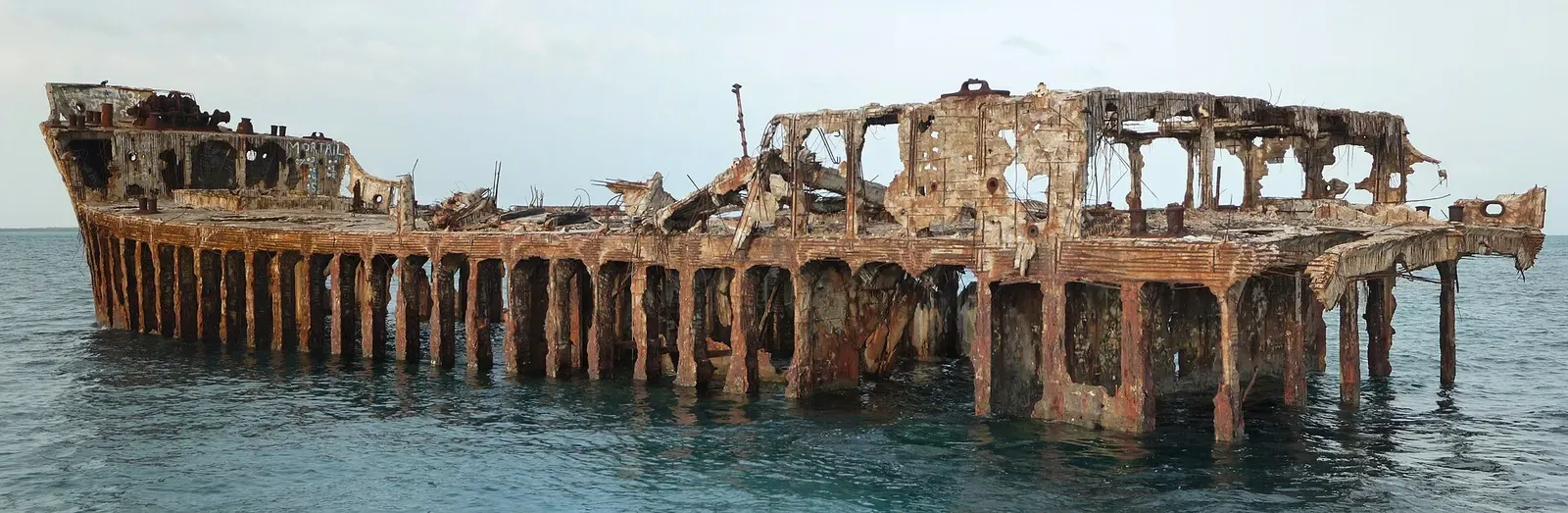
A concrete ship still standing above water in 6 m
Photo: Compsciscubadive · CC BY-SA 3.0
A concrete-hulled cargo steamer driven aground at Barnett Harbor in a hurricane in 1926, still standing with her top half in the air and the rest in 5 to 6 m of water. The broken stern and the fish holding inside the hull make a bright, undemanding wreck dive that works just as well on snorkel, and the same shallow hull is dived after dark.
Also known as Sapona.
Where it is and how deep
25.6507° N, 79.2932° WPublished position for this site.
The dive
There is nothing to search for. The upper hull of the Sapona stands clear of the water at Barnett Harbor and it is only 5 to 6 m down to the sand, so the dive starts the moment you are in. Drop down the flank and work in through the openings in the hull, where blackbar soldierfish, gobies, chromis and angelfish hold and morays sit back in the gaps.
Move forward to the bow, where orange cup corals grow on the concrete, then back along the outside to the broken stern, with nurse sharks resting underneath it. Groupers, chubs, sweetlips and mackerel pass along the flanks and turtles come through. At 5 to 6 m the wreck costs almost nothing in gas, so the length of the dive is set by the boat rather than by your air.
The Sapona is dived after dark as well, and the cast changes rather than thins: squid over the sand, octopus working the concrete and lobster out of the cracks in the hull. Keep the light off the swim-throughs you have not already looked into by daylight, and give the stern section room. She was driven aground here in 1926 and has stood in the open sea since, so the broken edges have had a century of weather.
The wreck
- Vessel
- SS Sapona
- Type
- Concrete-hulled Design 1070 cargo steamship
- Length
- 85.9 m (282 ft)
- Built
- 1919
- Sunk
- 1926
- Cause
- Driven aground in a hurricane, breaking her stern
- Lies
- Aground at Barnett Harbor in 5 to 6 m, upper hull above the surface, stern broken away
Launched on 11 October 1919 and completed in January 1920, the Sapona was one of the concrete Design 1070 cargo ships built at the end of the First World War, originally named Old North State. She passed to Carl G. Fisher and then to Bruce Bethel, who used her as liquor storage for Prohibition-era rum-running. A hurricane drove her aground at Barnett Harbor in 1926 and broke her stern, and she has stayed there ever since; during the Second World War she was used for bombing practice.
Marine life and season
- Groupers
- Sea turtles
- Octopus & cuttlefish
- Squid
- Reef fish swarms
| Jan | Feb | Mar | Apr | May | Jun | Jul | Aug | Sep | Oct | Nov | Dec |
|---|---|---|---|---|---|---|---|---|---|---|---|
| Prime | Prime | Prime | Good | Good | Fair | Fair | Fair | Fair | Fair | Good | Good |
Season follows Bimini: Great hammerheads are most consistent December–March; September–October bring peak hurricane risk to the northern Bahamas.
Know before you go
- The stern broke in the 1926 grounding and the wreck has stood in the open sea since; treat broken concrete edges as sharp and unsound.
- The hull is holed and easy to swim through, but the covered sections are still an overhead. Keep an exit in sight, particularly on the night dive.
Photos from SS Sapona
ForrestVoight · CC BY-SA 3.0
Dive videos
Explore & Dive a Famous Shipwreck in The Bahamas - SS Sapona · Gale Force Twins on YouTube
Going Inside the Wreck of the SS Sapona · Kim & Jon - Exploring the World on YouTube
Questions divers ask
How deep is the Sapona wreck?+
She lies in 5 to 6 m of water at Barnett Harbor with her top half above the surface, so the whole wreck sits inside Open Water limits and bottom time is set by the boat rather than by your gas.
Can you snorkel the Sapona?+
Yes. The top of the ship is exposed to the air and the bottom half is submerged in 5 to 6 m, so snorkellers see the hull, the fish holding inside it and the sand around the broken stern. It is a popular snorkelling site as well as a dive site.
Sources
- SS Sapona — Wikipedia
- Bimini — Wikipedia
- Diving sites Bahamas Bimini — Dive The World
Photo credits
- Rusted concrete hull of the SS Sapona wreck standing above the water off Bimini by Compsciscubadive, CC BY-SA 3.0, via Wikimedia Commons
- Skeletal rusted framework of the SS Sapona's starboard side at low tide by ForrestVoight, CC BY-SA 3.0, via Wikimedia Commons
In The Logbook
- Your first wreck dive: what to expect and whereFirst dives · 6 min read
More dive sites in Bimini
Reef
Coral heads standing 8 m off the sand, full of swim-throughs
Wreck
A 60 m barge upright on sand at the Gulf Stream's edge
Reef
Rows of beachrock slabs in 6 m, argued over since 1968
Reef
Resident female reef sharks over a maze of coral heads
Sand slope
Great hammerheads on open sand at roughly 6 m
Reef
Coral patches worked as a mild north-bound drift
Wreck
A shallow seagrass wreck with resident loggerhead turtles
Reef
Research cables and old anchors scattered over white sand
Similar dives elsewhere
Wreck
Oosterdiep
Anguilla · Anguilla
At least eight turtles counted asleep on one night dive
A shore-accessible wreck at 20 m, also dived after dark
Wreck
Blackadder
Salvador & Baía de Todos os Santos · Brazil
A 1905 clipper wreck at 9 m, dived every day of the year


Sponge-crusted cable winches on a ship named for the island's chamber doctor