What makes a good first wreck
Wreck diving has a reputation it only half deserves. The stories are about penetration, silt-outs and depth, and those are real, but they belong to a different dive from the one a first-timer should be doing. Your first wreck is an exterior dive on a ship you can see all of, in water shallow enough that gas and no-stop time are not the constraint, with a way back to the surface that does not depend on finding an exit. Four things make a wreck right for that.
It is shallow. The whole hull inside 20 m, ideally with the top of the structure at 5 to 10 m, so the dive can be long and the ascent is never far away. The wrecks below all top out at 30 m (100 ft) or less, and most are far shallower.
It is intact and upright. A ship that still looks like a ship is easier to read than a debris field. You can orient by the bow and stern, follow the rail, and know where you are. Purpose-sunk wrecks are often the best teachers because they were cleaned, opened up and put down level on purpose.
It is easy to reach and easy to leave. A short boat ride to a mooring, or a surface swim from a beach. No strong current, no long descent line into blue water.
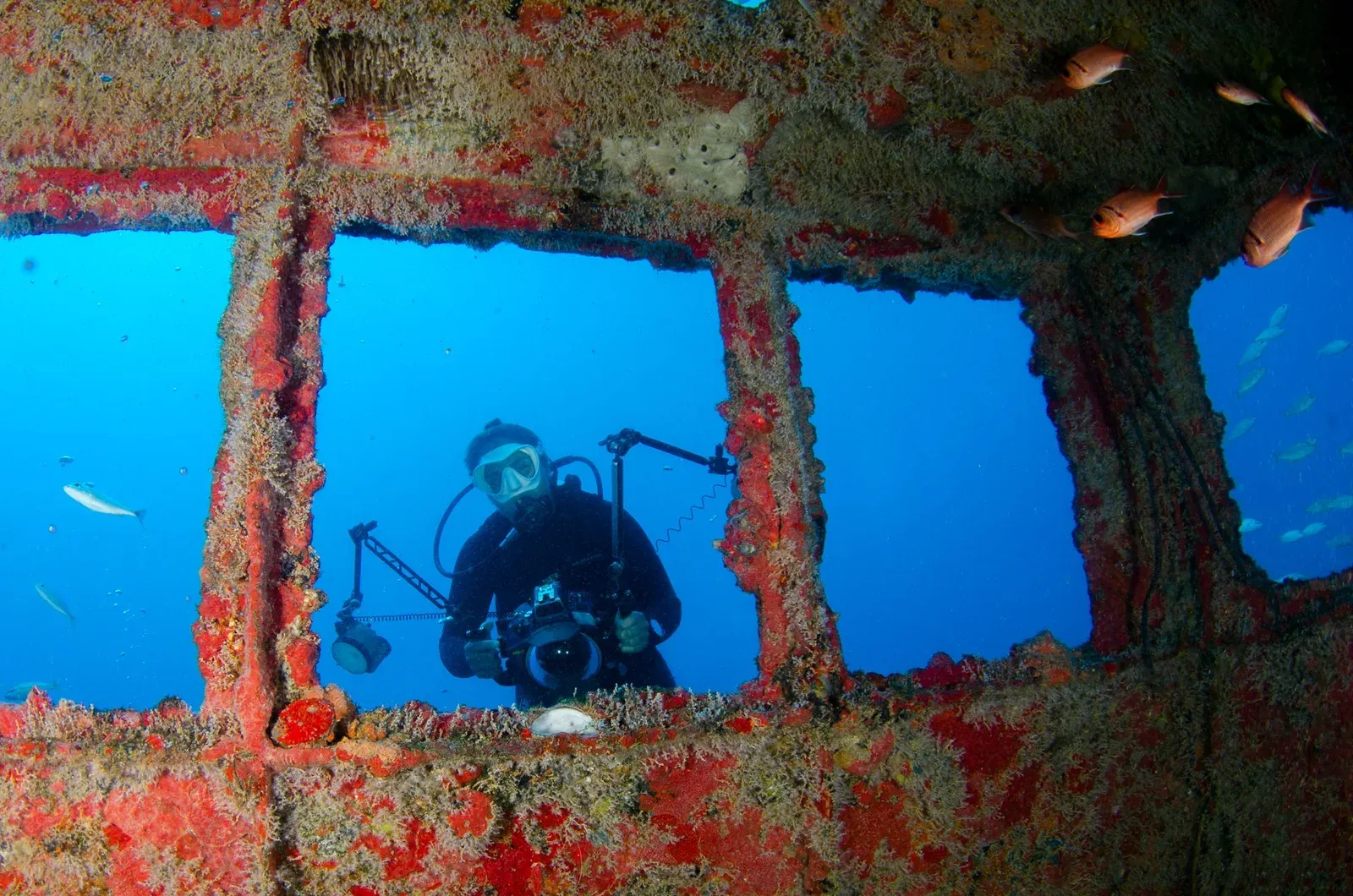
It does not need you to go inside. The interesting parts are on the outside or visible through openings large enough that daylight reaches the floor. Penetration is a separate skill with a separate course; a first wreck is about seeing one, not entering one.
Twenty-six first wrecks, by region
Each of these meets the four tests. They are grouped by region so you can match one to a trip you are already planning; every one links to its own page with the position, depth profile, hazards and sources.
In the Caribbean and Atlantic, Grand Cayman’s USS Kittiwake is the textbook first wreck: a 76 m submarine rescue ship sunk deliberately off Seven Mile Beach in 2011, cleaned and opened up, with her highest point 4.5 m below the surface and the sand at 18 m. Bimini’s SS Sapona is a concrete-hulled steamer standing in 5 to 6 m with her top half in the air, bright enough to snorkel. The stern of the RMS Rhone lies in 9 m off Salt Island with its 15-foot propeller still in place, the shallow half of one of the Caribbean’s most famous wrecks. Bermuda has hundreds of wrecks shallower than 20 m, and the debris field of the liner Cristóbal Colón and the blockade runner Mary Celestia are two of the gentlest. Nassau’s Ray of Hope is a 60 m freighter sitting upright with the whole hull inside Open Water depths, and Roatán’s Prince Albert is a resort house wreck a few fin kicks off the beach at 20 m.
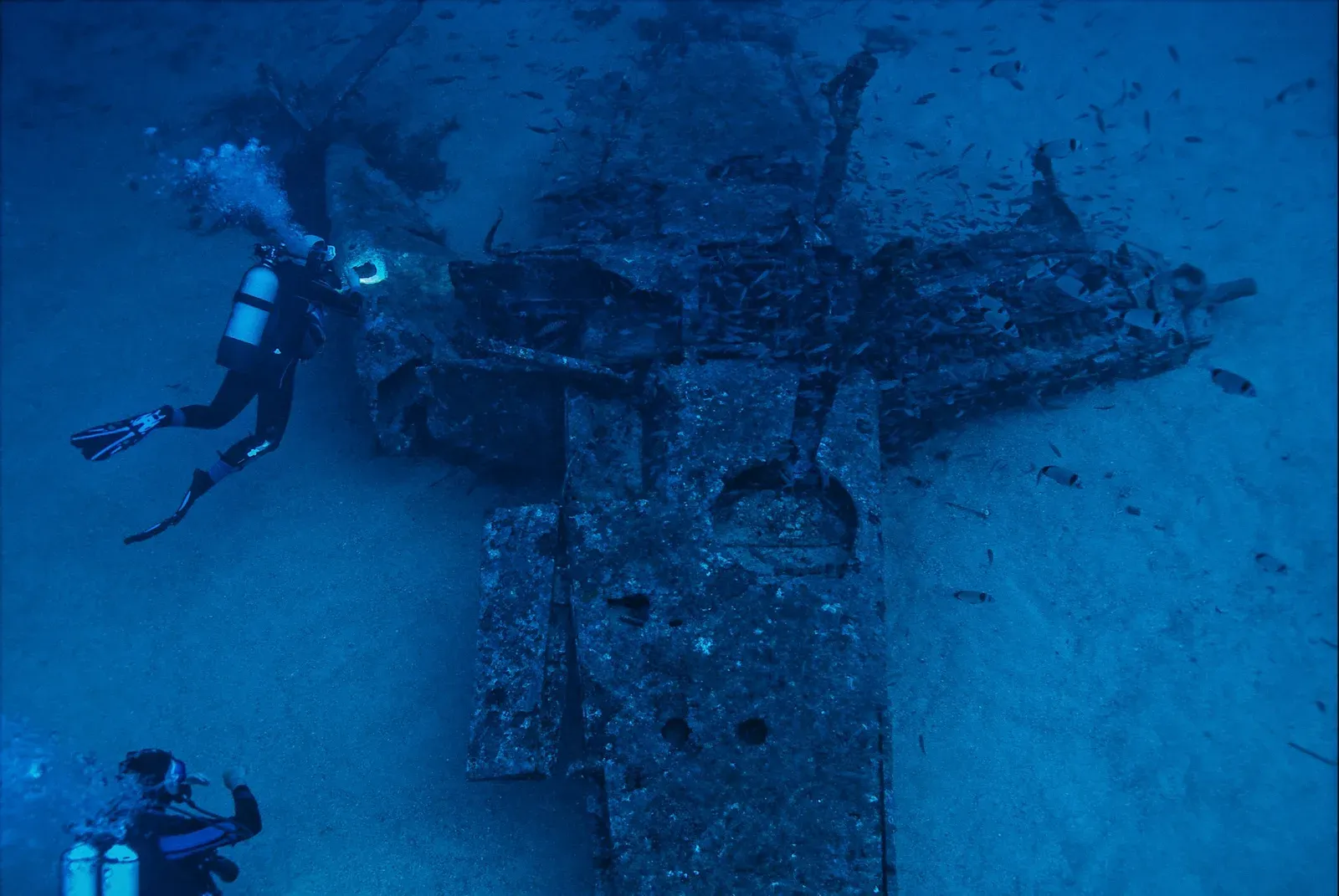
In the Red Sea and Mediterranean, the stern section of the Giannis D on Abu Nuhas reef is the classic Egyptian first wreck, with the mast reaching to 4 m and the hull at 24, and her neighbour the Carnatic, an 1869 P&O steamer, has rotted down to iron ribs you can look straight through. Aqaba’s C-130 Hercules is an aircraft on flat sand at 16 m put down in 2021 precisely for first wreck dives and wreck courses, and Eilat’s Satil is a missile boat 70 m off the beach. Crete’s SS Minnewaska, a First World War troopship in 16 to 20 m with no current, and the Dakota off Kaş in Turkey are the Mediterranean’s easiest.
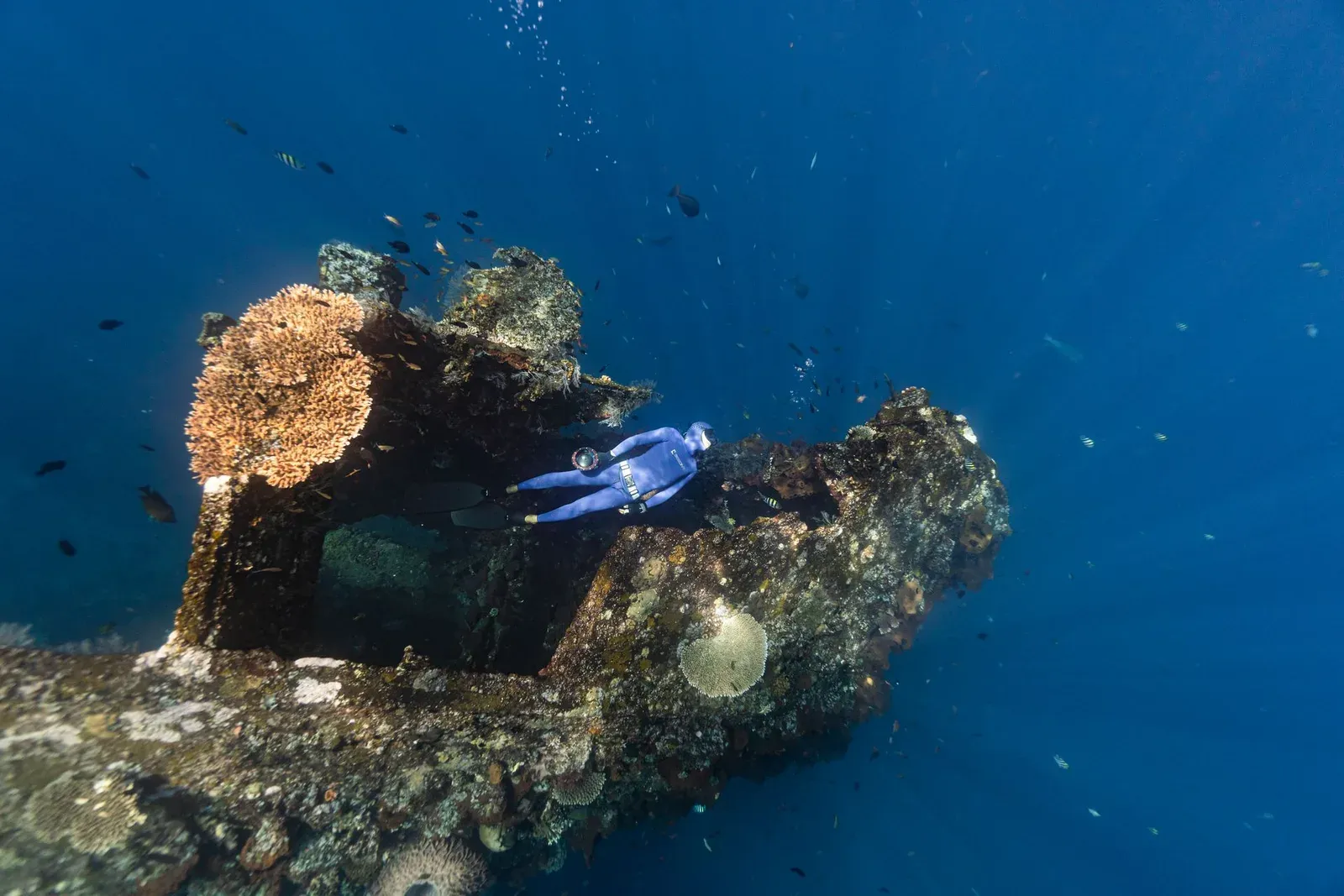
In the Indo-Pacific, Bali’s USAT Liberty is the wreck more divers have done first than any other: a 125 m cargo ship lying along a slope from 5 to 30 m, 30 m out from a beach, so you choose your depth by which part of her you visit. Coron’s Lusong Gunboat is a 25 m gunboat in 5 to 15 m with her stern above water at low tide, and East Tangat a submarine-chaser from 3 to 19 m, both far friendlier than the big Coron Bay ships. The Kashi Maru sits upright 20 m off the shore at Munda in 15 m, and Christmas Island’s Eidsvold is a torpedoed freighter the reef has taken over at 5 to 16 m.
In fresh and cold water, Tobermory’s Sweepstakes is an 1867 schooner lying almost intact in 6 m of clear Lake Huron water, one of the best-preserved nineteenth-century wrecks in the Great Lakes; the Nordmeer is a freighter at 12 m in the Thunder Bay sanctuary; and Florida’s Troy Springs has the ribs of a Confederate paddle steamer in a spring you can see the bottom of from the bank.
| Site | Depth | Level | Best months |
|---|---|---|---|
| USS Kittiwake Grand Cayman · Cayman Islands | 4.5–18 m | Beginner | Dec–Apr |
| SS Sapona Bimini · Bahamas | 5–6 m | Beginner | Jan–Mar |
| RMS Rhone — stern RMS Rhone & Salt Island · British Virgin Islands | to 9 m | Beginner | Dec–Apr |
| Cristóbal Colón Bermuda · Bermuda | 4.6–18.3 m | Beginner | May–Sep |
| Mary Celestia Bermuda · Bermuda | 16.8–18 m | Beginner | May–Sep |
| Ray of Hope Nassau & New Providence · Bahamas | 12–18 m | Beginner | Nov–May |
| Prince Albert Wreck Roatán · Honduras | to 20 m | Intermediate | Mar–Aug |
| Lesleen M St. Lucia · St. Lucia | to 20 m | Intermediate | Dec–Apr |
| C-53 Felipe Xicoténcatl Cozumel · Mexico | to 25 m | Intermediate | Jan–Apr |
| MV Captain Keith Tibbetts Cayman Brac · Cayman Islands | to 27 m | Intermediate | Dec–May |
| Giannis D Hurghada & El Gouna · Egypt | 4–24 m | Intermediate | Apr–May |
| Carnatic Abu Nuhas & Gubal Strait · Egypt | 16–24 m | Intermediate | Apr–Jun |
| C-130 Hercules Wreck Aqaba · Jordan | 12–17 m | Intermediate | May–Sep |
| Satil Eilat · Israel | 18–24 m | Intermediate | Mar–May |
| SS Minnewaska Crete · Greece | 16–20 m | Beginner | Jun–Oct |
| Sunken Aircraft Kaş · Turkey | to 22 m | Intermediate | Jun–Oct |
| HMS Louis Gallipoli · Turkey | to 13 m | Beginner | Jun–Sep |
| USAT Liberty Wreck Tulamben · Indonesia | 5–30 m | Intermediate | May–Oct |
| Lusong Gunboat Coron · Philippines | 5–15 m | Beginner | Dec–Apr |
| East Tangat Wreck Coron · Philippines | 3–19 m | Beginner | Dec–Apr |
| Kashi Maru Solomon Islands · Solomon Islands | to 15 m | Beginner | Jun–Sep |
| Eidsvold Christmas Island · Australia | 5–16 m | Beginner | May–Sep |
| Sabang Wrecks Puerto Galera · Philippines | to 20 m | Beginner | Jan–Apr |
| Sweepstakes Tobermory · Canada | to 6 m | Beginner | Jul–Sep |
| Nordmeer Thunder Bay · United States | to 12 m | Beginner | Jul–Sep |
| Troy Springs North Florida Springs · United States | to 21 m | Beginner | Nov–Apr |
What the dive feels like
The first thing most people notice is scale. A 76 m ship is much larger underwater than it sounds, and visibility of 20 m means you never see all of it at once; the Kittiwake reveals herself a deck at a time. The second thing is how quickly a wreck becomes a reef. The Liberty has been down long enough that her guns are coral-encrusted lumps, the Sapona’s holds are full of fish, and the Giannis D’s plating carries as much growth as the reef that sank her. You are diving a habitat, and the ship is the frame.
A good first wreck dive is a slow lap. Descend on the mooring or the shot line to the shallowest part of the structure, get neutral, and follow the rail around the outside at one depth, looking in through the openings rather than going through them. Turn at half your gas, not at the far end of the ship, and come back along the other side. The dive should end at the line you came down, with time for a long safety stop over the top of the structure, which on a shallow wreck is often the best part.
Navigation is simpler than on a reef, because the ship is the map. Note which way the bow points as you arrive, keep the hull on the same side of you for the whole lap, and you cannot get lost. What surprises most first-timers is the life: wrecks are the only hard structure on a sand seabed for hundreds of metres, so they collect everything, from the schooling fish that hang in the shade of the hull to the moray that has taken over a hawsepipe. Give the small things time. A first wreck dive spent hovering over one section of railing, watching what lives in it, teaches more than a fast lap of the whole ship.
What to skip on your first wreck
Going inside. Even a purpose-sunk, opened-up wreck like the Kittiwake or the Prince Albert is an overhead environment once you are past the doorway. The rule for a first wreck is daylight: if you cannot see open water from where you are, you are penetrating, and that is a skill for a later course.
The deep end. Many wrecks lie on a slope, and the interesting machinery is often at the bottom of it. The Liberty’s deep end is 30 m; the Carnatic’s hull is at 24 m; the Cozumel minesweeper sits at 25 m, where no-stop time runs out before the ship does. Pick a maximum depth on the boat and let the wreck be bigger than your dive.
Touching anything. Old hulls are sharp, unstable and often historic. The Rhone and the Sweepstakes are protected; the Sapona’s broken concrete is unsound; stonefish sit motionless on the Lusong Gunboat’s coral. Buoyancy is the skill wreck diving really tests, and the wreck will tell you exactly how good yours is.
Night dives and current. The Liberty and the Prince Albert are popular night wrecks and both are far harder to navigate in the dark. Save them for the second visit.


