Chuuk Lagoon · Micronesia · Wreck
Fujikawa Maru
The sole surviving A5M Claude, stacked in a cargo hold
Photo: Motoki Kurabayashi · CC BY-SA 4.0
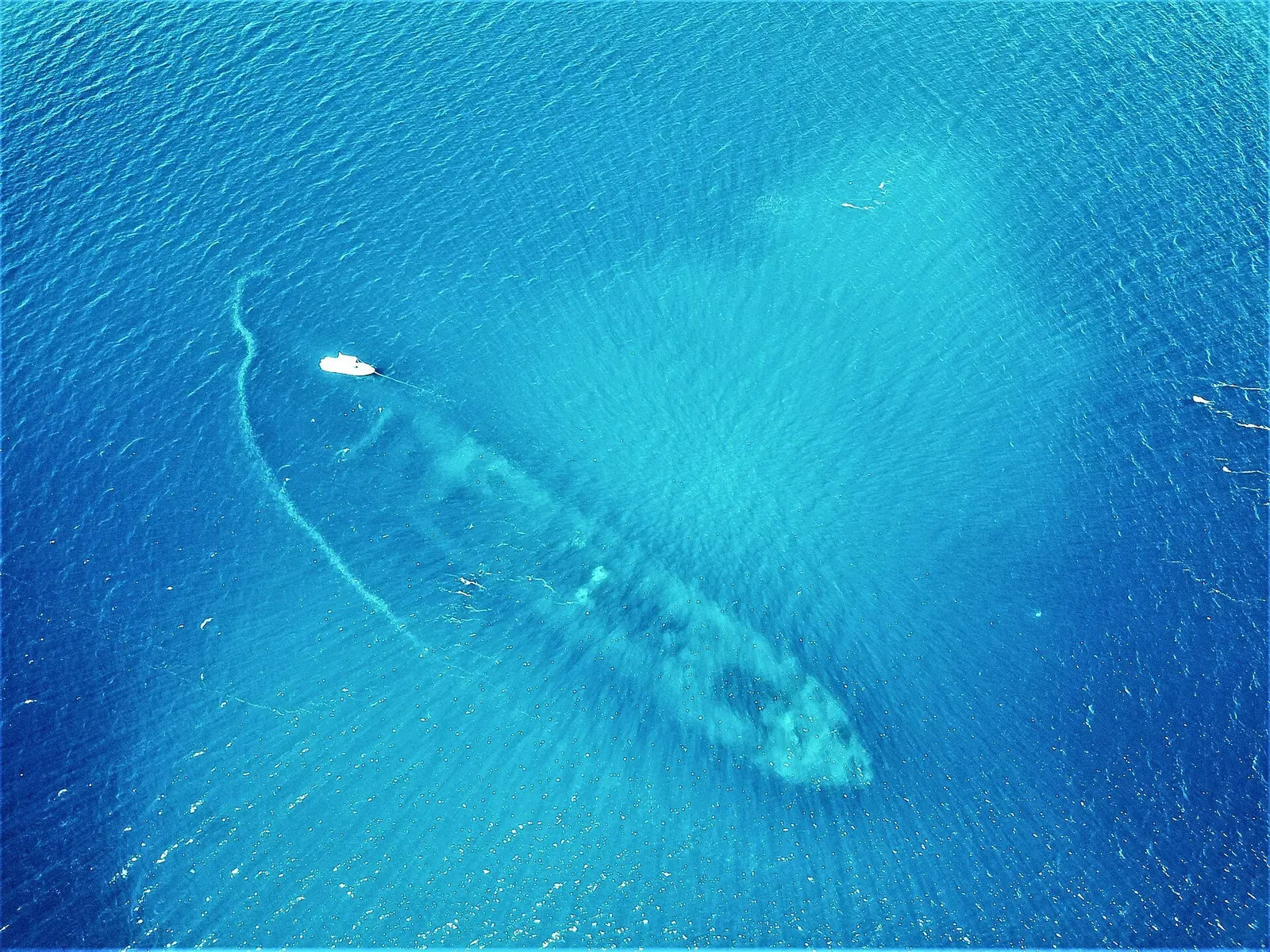
A 133-metre armed aircraft transport that went down under repeated US bombing on 18 February 1944 and settled upright on the lagoon floor, about 500 metres offshore in no more than 40 metres of water. One of her forward holds still contains at least nine disassembled Mitsubishi fighters, and the 6-inch gun retrofitted to her bow is still in place. She is regarded as the best dive site in Chuuk Lagoon.
Where it is and how deep
7.3467° N, 151.8900° EPublished position for this site.
The dive
You descend onto a hull sitting upright on the sand about 500 metres off the coast, 133 metres of it, and the shape still reads as the freighter she was built as in 1938 before the Imperial Japanese Navy took her over as an armed aircraft transport. The bridge sits around 15 metres down and the deepest part of the wreck is no more than 40, and a 6-inch gun, left over from the Sino-Japanese war and retrofitted to her, is mounted at the bow. The lagoon is calm enough that swimming the length of the decks costs almost nothing.
The reason to be here is one forward hold. Stacked inside it are at least nine disassembled Mitsubishi fighters: eight A6M Zeros and, among them, a single A5M Claude, the only known survivor of that type anywhere. Wings and fuselages sit as freight rather than as display pieces, the daylight falls off quickly once you are over the coaming, and a careless fin stroke will silt the space out for everyone behind you.
The wreck
- Vessel
- Fujikawa Maru
- Type
- Auxiliary armed aircraft transport
- Length
- 133.3 m (437 ft)
- Built
- 1938
- Sunk
- 1944
- Cause
- Bombed and torpedoed by US aircraft during Operation Hailstone
- Lies
- Upright on the lagoon floor
Built in 1938 for Toyo Kaiun Kisen Kaisha as a refrigerated cargo ship, Fujikawa Maru was requisitioned by the Imperial Japanese Navy and used as an auxiliary armed aircraft transport and ferry. On 17-18 February 1944 US bombers and torpedo bombers hit her repeatedly during Operation Hailstone, and she sank at about 7:15am on 18 February. The Times has since named her one of the top ten wreck dives in the world, and Aquaviews ranked her fourth.
Marine life and season
The sources we used don't single out particular species here.
| Jan | Feb | Mar | Apr | May | Jun | Jul | Aug | Sep | Oct | Nov | Dec |
|---|---|---|---|---|---|---|---|---|---|---|---|
| Prime | Prime | Prime | Good | Good | Fair | Fair | Fair | Fair | Good | Good | Prime |
Season follows Chuuk Lagoon: December to April is the dry season, driest from January to March; June to September brings the heaviest rain.
Photos from Fujikawa Maru
montereydiver · CC BY 2.0
montereydiver · CC BY 2.0
gratiartis · CC BY 2.0
Dive videos
Fujikawa Maru SwedTech Diving · wooflock on YouTube
Fujikawa Maru, Truk Lagoon · mokpot on YouTube
Questions divers ask
What is inside the Fujikawa Maru?+
One of the forward holds holds at least nine disassembled Mitsubishi fighter aircraft - eight A6M Zeros and one A5M Claude, the sole known survivor of that type. A 6-inch gun left over from the Sino-Japanese war and retrofitted to the ship is still mounted at the bow.
Sources
- Fujikawa Maru — Wikipedia
- Fujikawa Maru — Wikipedia (German)
- Chuuk — Wikivoyage
- Chuuk Lagoon — Wikipedia
Photo credits
- Aerial view of the Fujikawa Maru wreck outline visible through clear lagoon water by Motoki Kurabayashi, CC BY-SA 4.0, via Wikimedia Commons
- Coral-encrusted engine telegraph on the Fujikawa Maru wreck by montereydiver, CC BY 2.0, via Wikimedia Commons
- Deck gun of the Fujikawa Maru rising above a bed of coral by montereydiver, CC BY 2.0, via Wikimedia Commons
- Corroded gas masks and rifles resting inside the Fujikawa Maru wreck by gratiartis, CC BY 2.0, via Openverse
In The Logbook
- Deep wreck diving: where recreational stopsWrecks · 8 min read
- WWII wrecks you can dive, by theatreWrecks · 7 min read
- Liveaboard vs resort diving: which suits you?Trip planning · 6 min read
More dive sites in Chuuk Lagoon
A memorial monument on the deck of a deep, upright cruiser
Wreck
A swim through a bomber's fuselage from tail to cockpit
Bow and stern guns on a sunken Japanese destroyer
Shrimp and goby burrows in the sand under the propellers
Wreck
Soft and hard coral from a shallow mast to the stern
Wreck
Submarine periscopes still stacked in the holds
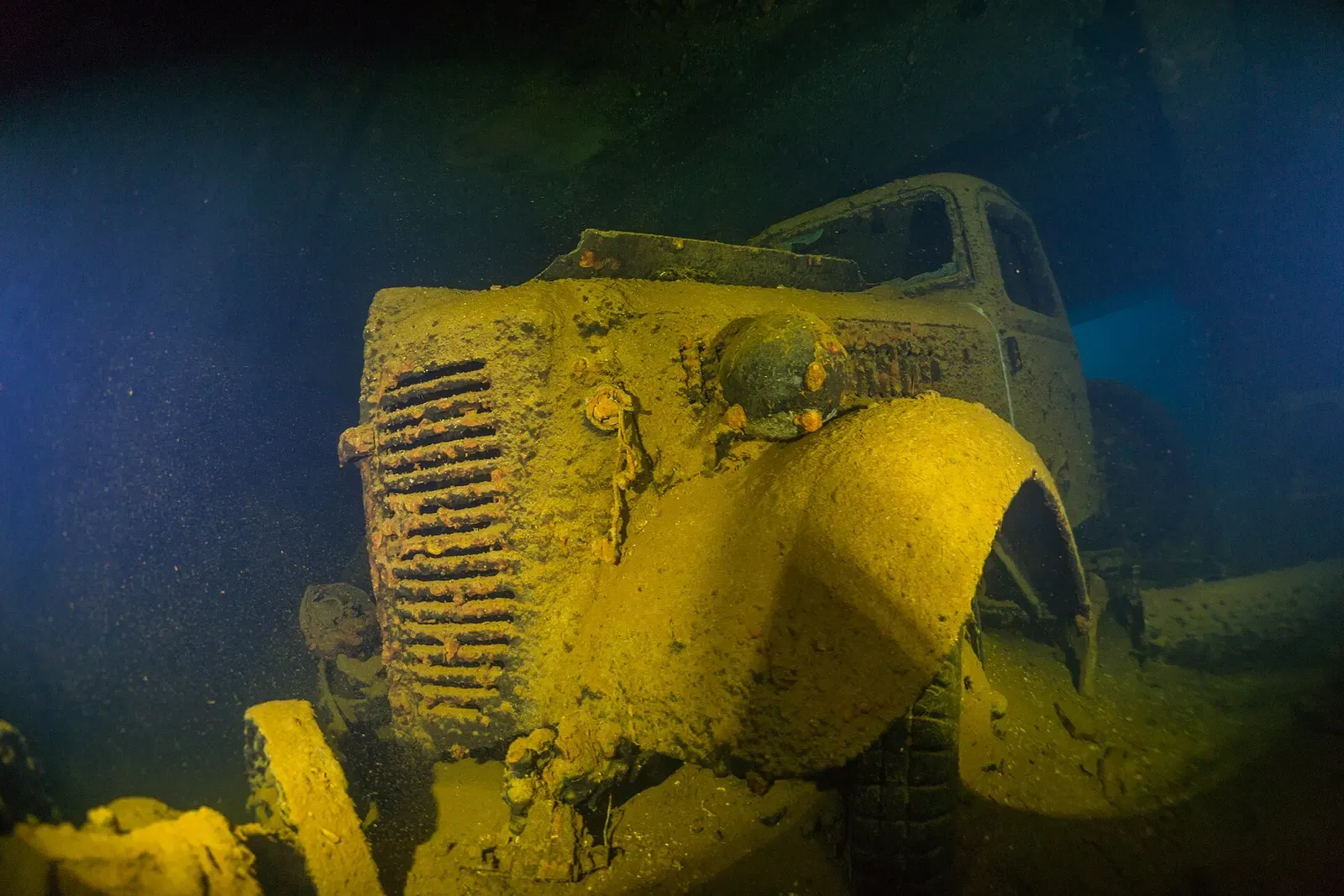
Trucks, a bulldozer and a tractor still parked in the hold
Wreck
A Japanese cruiser submarine sunk at its anchorage
Similar dives elsewhere

A freighter so thick with lionfish it took their name


A 122-metre Clan Line steamer (400 feet) that burnt out at Vava'u in 1927
Rifles, ammunition and helmets still aboard an upright mystery ship
Following the mooring line down to the forward tower of an upright fleet oiler