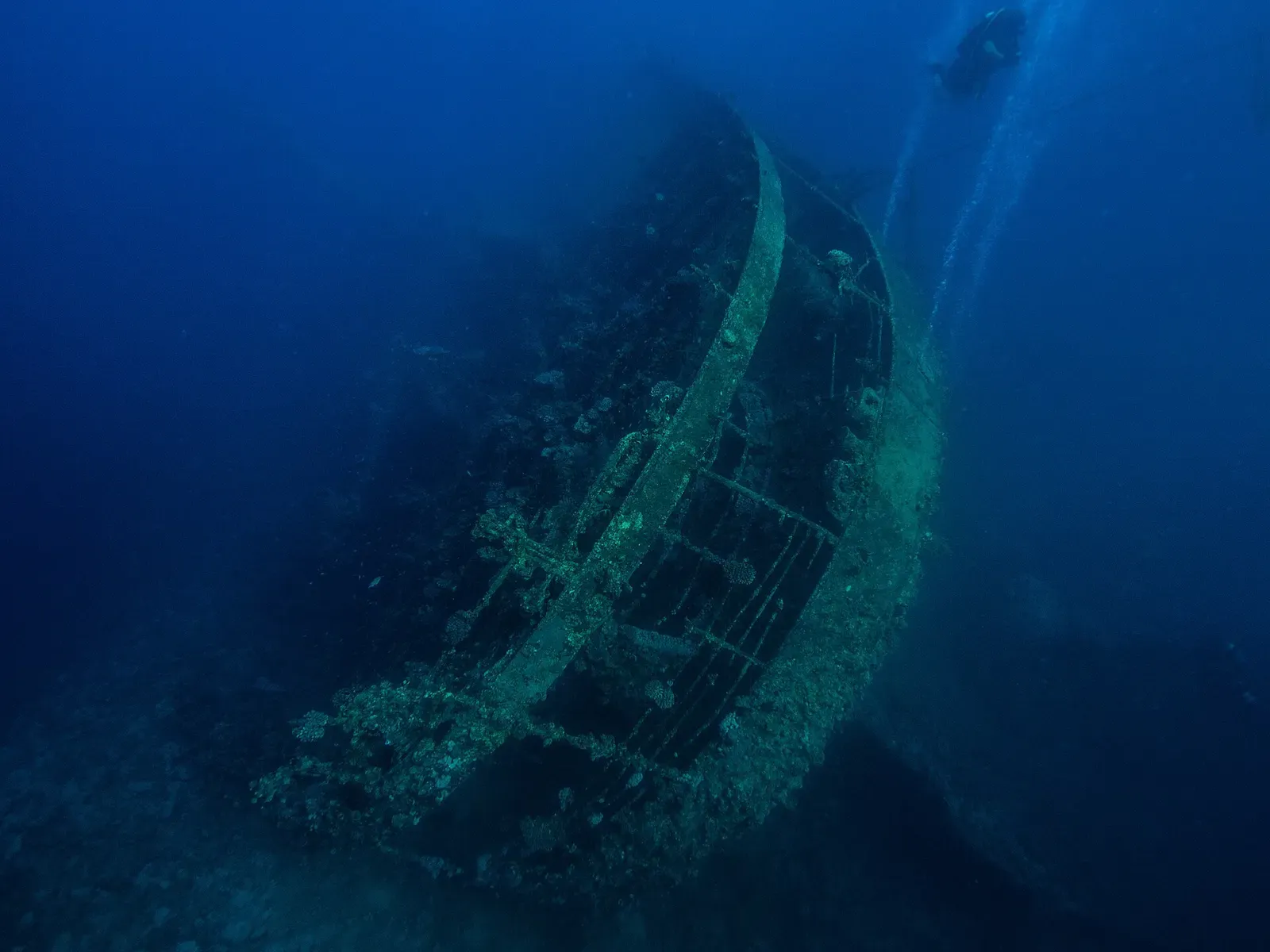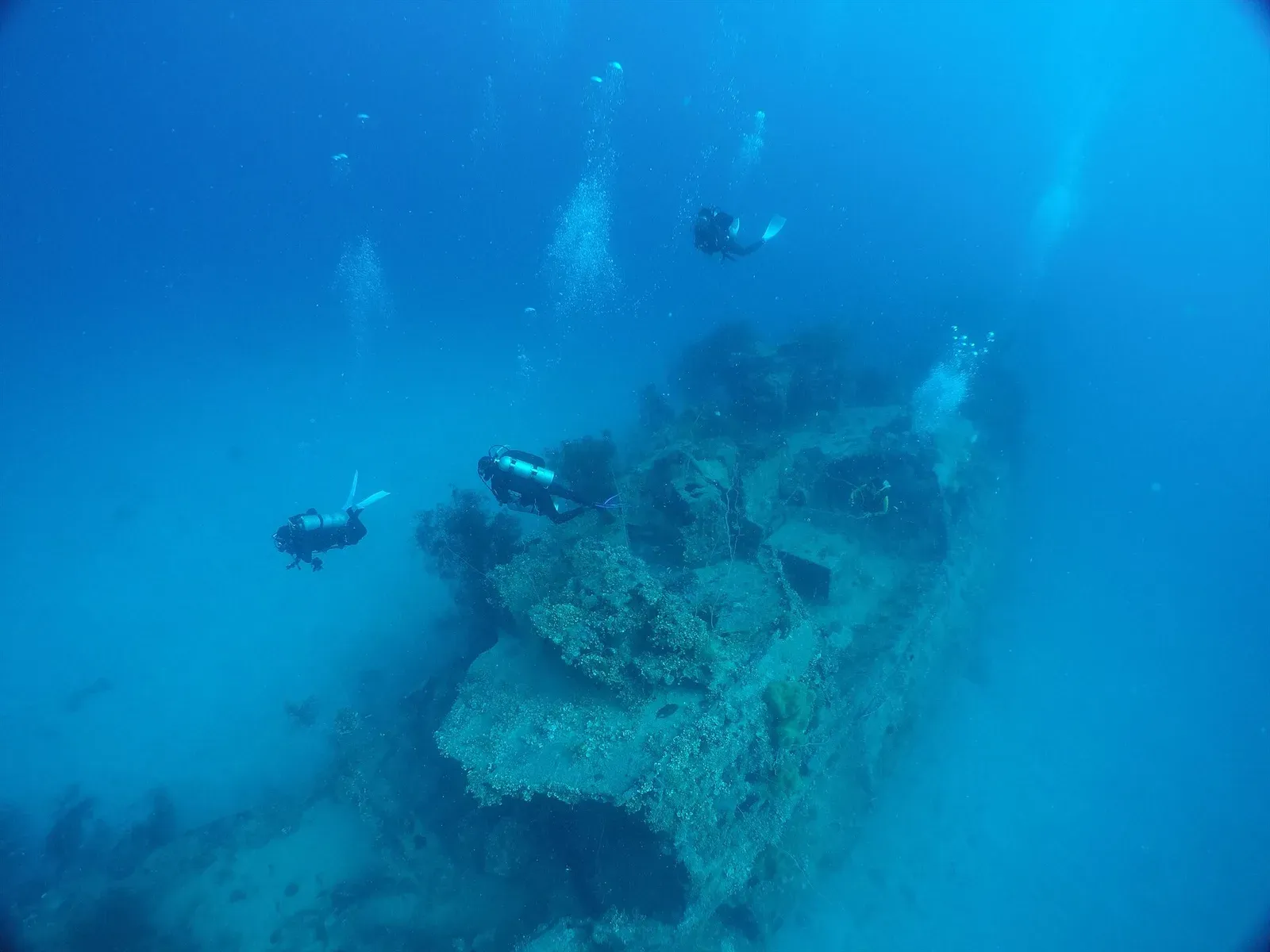
Why the war left so many wrecks
Between 1939 and 1945 merchant fleets were sunk faster than yards could replace them, navies lost warships by the dozen in a single night, and whole anchorages were bombed with the ships still moored. Most of that steel went down in cold, deep or restricted water and is dived by nobody. A minority sank where it happened to be shallow, warm and clear: the Red Sea convoy anchorages, the Japanese fleet bases in Micronesia and the Philippines, the invasion beaches of the Solomons, the fjords of Norway. Those became the wrecks divers cross oceans for.
They also became something else. Many of these ships went down with their crews, and several are designated war graves. That shapes how they are dived, and we come back to it at the end.
The 49 wrecks below are every Second World War loss in our guides. Each links to its own page, where you will find the position, depth profile, hazards and the published sources the entry was written from. Depth here is the range a typical dive works, not the deepest point of the hull.
Red Sea and Mediterranean
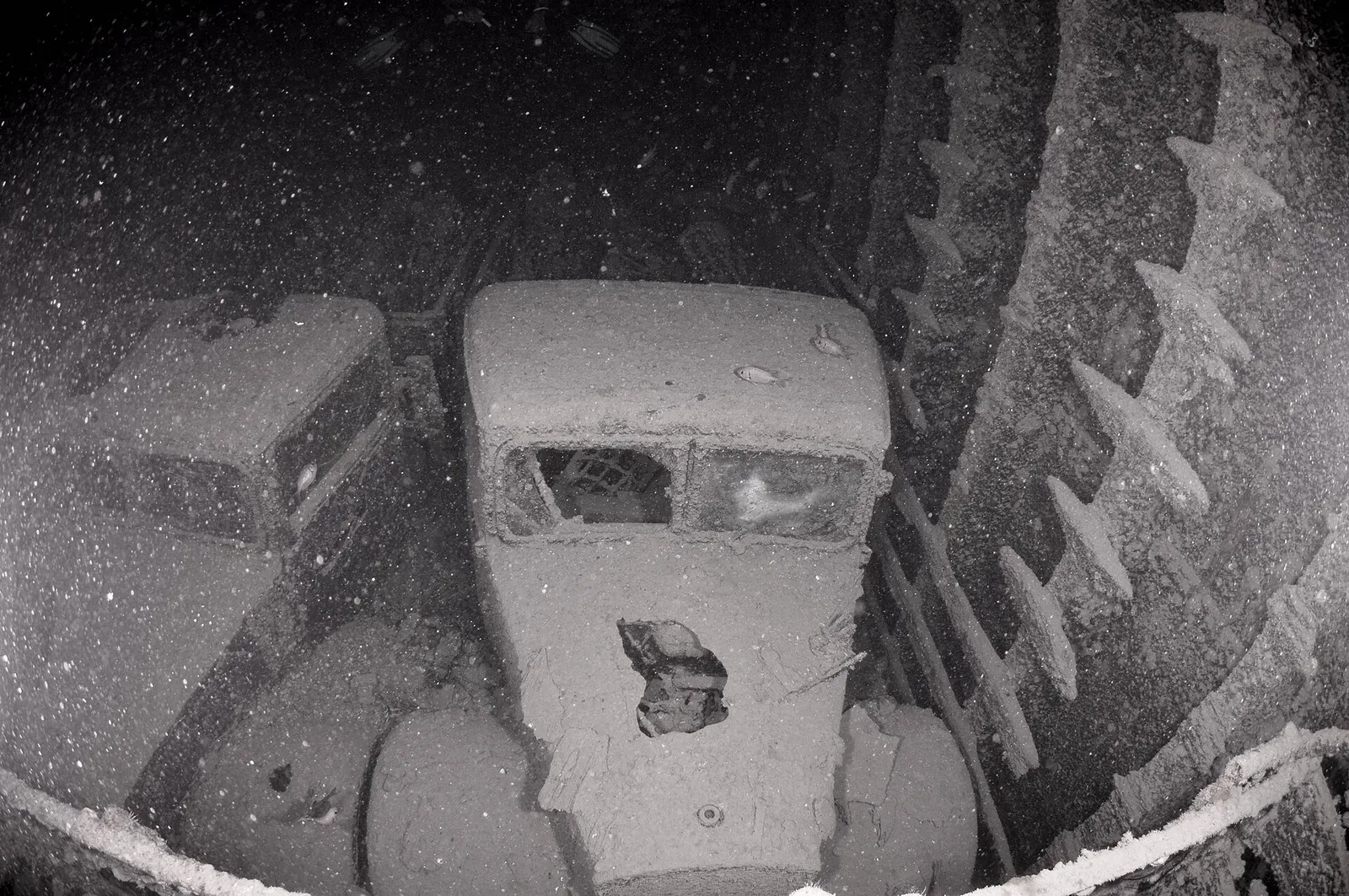
The Red Sea has the most famous wreck of the war and one of the most complete. SS Thistlegorm was an armed merchant ship bombed at anchor in October 1941 while waiting to pass through the Suez Canal, and she sits upright with her cargo of trucks, motorcycles, rifles and aircraft parts still stacked in the holds. The main deck runs between 18 and 30 m (100 ft), which is why she draws every level of diver from Sharm, and also why currents of up to two knots and a fragile, silting interior make her a guided dive rather than a casual one.
Her sister ship Rosalie Moller was bombed the following day in the Gubal Strait and is the Thistlegorm’s quieter, deeper counterpart: upright, virtually intact, but with the deck at 30 m and the sand at 50, so a decompression dive in dimmer water. Further south, the Italian steamer Umbria was scuttled by her own crew off Port Sudan on the day Italy entered the war. She lies on her side from 5 to 35 m with Fiat cars, cement and thousands of bombs still in her holds, and is reached only by liveaboard.
The Mediterranean losses in our guides are the French pair off Port-Cros & Îles d'Hyères, both mined in 1945 in the months after the war ended and both lying below 35 m, the Italian supply steamer Egle off Sardinia, and a Messerschmitt Bf 109 fighter that hit the sea nose-first off Crete and now sits in 24 to 30 m.
| Site | Depth | Level | Best months |
|---|---|---|---|
| SS Thistlegorm Sharm El Sheikh · Egypt | 16–30 m | Advanced | May–Oct |
| Rosalie Moller Abu Nuhas & Gubal Strait · Egypt | 18–50 m | Advanced | Apr–Jun |
| Umbria Wreck Sudanese Red Sea · Sudan | 5–35 m | Intermediate | Apr–May |
| Le Donator Port-Cros & Îles d'Hyères · France | 35–51 m | Advanced | Jun–Sep |
| Le Grec Port-Cros & Îles d'Hyères · France | 35–47 m | Advanced | Jun–Sep |
| Relitto Egle Capo Carbonara · Italy | to 35 m | Advanced | Jun–Sep |
| Messerschmitt Bf 109 Wreck Crete · Greece | 24–30 m | Advanced | Jun–Oct |
The Pacific: Chuuk, Coron and the Solomons
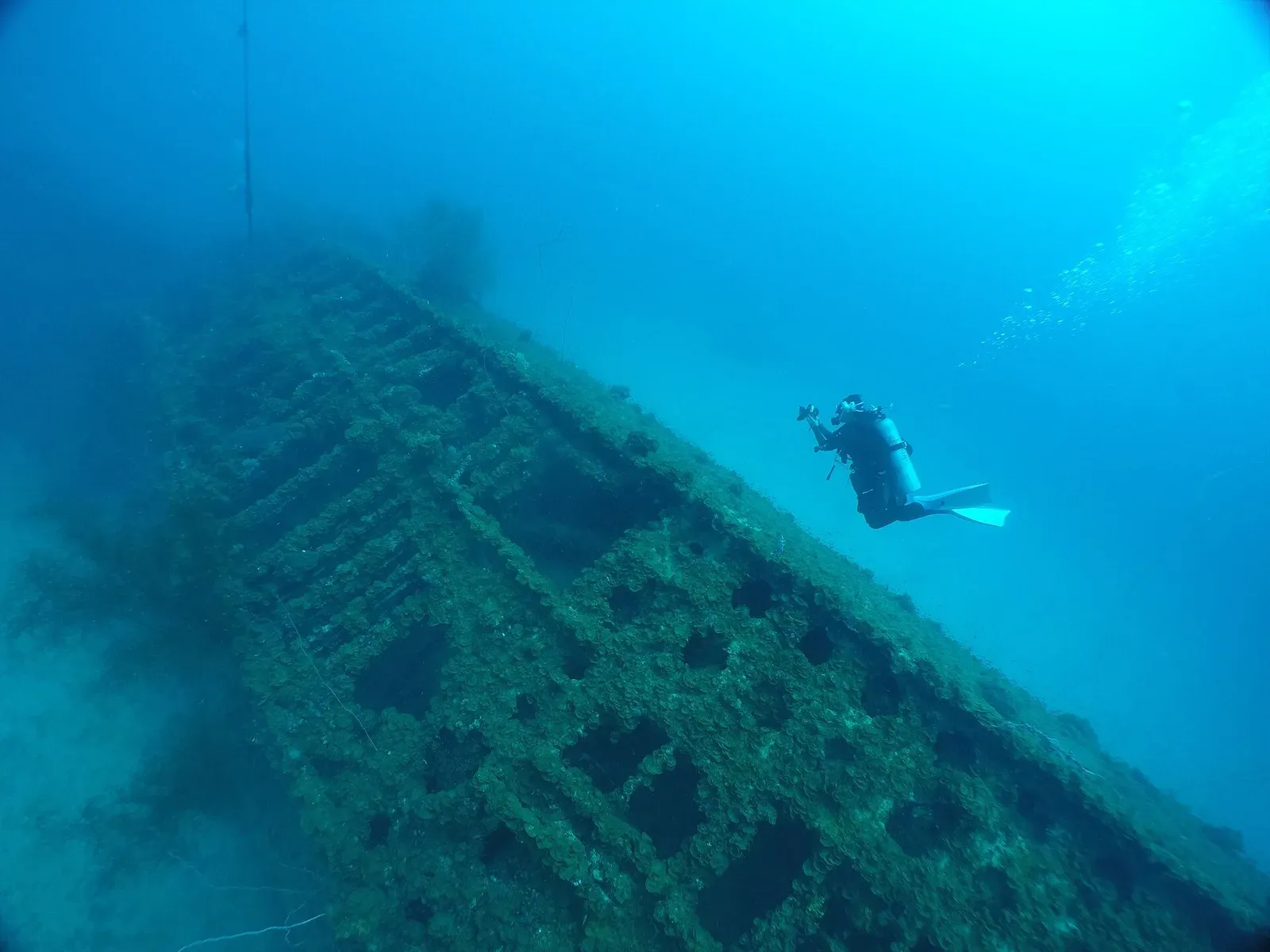
Chuuk Lagoon in Micronesia is the densest collection of diveable warship wrecks anywhere. On 17 and 18 February 1944, Operation Hailstone put American carrier aircraft over the Japanese fleet anchorage and sank dozens of ships in two days. Fujikawa Maru is the one to dive first: 133 m of armed aircraft transport, upright in no more than 40 m, with disassembled Mitsubishi fighters in a forward hold and the six-inch gun still on her bow. Shinkoku Maru and Heian Maru are the other two most people dive on a first trip; San Francisco Maru carries trucks and tanks on deck but her stern lies at 64 m, so she belongs to technical divers.
Coron in the Philippines was hit by the same carrier task force seven months later. The Coron Bay wrecks are bigger and darker than most divers expect. Irako, a 145 m provisions ship, has her decks between 28 and 35 m and an interior that needs wreck training and two lights; Okikawa Maru is the more forgiving tanker at 12 to 26 m; and the Lusong Gunboat and East Tangat gunboat are small enough and shallow enough to be a diver’s first wreck.
In the Solomon Islands, Guadalcanal’s Iron Bottom Sound holds two transports that were run onto the beach to land troops in November 1942 and destroyed where they lay. Bonegi I, the Hirokawa Maru, is dived straight off the sand: the bow is a short swim from the beach and the hull runs downhill to a stern at 55 m, so you choose your depth by how far along it you go. Off Munda, Kashi Maru was bombed by B-25s while unloading and lies in 15 m, and a ditched Corsair fighter sits at 54 m, missing only her propeller and canopy.
Papua New Guinea’s Tufi adds a B-17 Flying Fortress, Black Jack, ditched in 1943 and lying largely intact at 45 m with her nose crumpled by the impact. And off Espiritu Santo in Vanuatu is the largest accessible wreck of the war: the 199 m liner-turned-troopship SS President Coolidge, which struck two friendly mines in 1942 and now lies on her side from 21 m at the bow to 73 m at the stern, diveable from the shore.
| Site | Depth | Level | Best months |
|---|---|---|---|
| Fujikawa Maru Chuuk Lagoon · Micronesia | 15–40 m | Advanced | Nov–May |
| Shinkoku Maru Chuuk Lagoon · Micronesia | to 38 m | Advanced | Nov–May |
| Heian Maru Chuuk Lagoon · Micronesia | 12–33 m | Intermediate | Nov–May |
| Sankisan Maru Chuuk Lagoon · Micronesia | 5–30 m | Intermediate | Nov–May |
| Nippo Maru Chuuk Lagoon · Micronesia | 15–46 m | Advanced | Nov–May |
| San Francisco Maru Chuuk Lagoon · Micronesia | 27–64 m | Advanced | Nov–May |
| Irako Wreck Coron · Philippines | 28–35 m | Advanced | Dec–Apr |
| Okikawa Maru Coron · Philippines | 12–26 m | Intermediate | Dec–Apr |
| Akitsushima Wreck Coron · Philippines | to 35 m | Advanced | Dec–Apr |
| Lusong Gunboat Coron · Philippines | 5–15 m | Beginner | Dec–Apr |
| East Tangat Wreck Coron · Philippines | 3–19 m | Beginner | Dec–Apr |
| Bonegi I Iron Bottom Sound · Solomon Islands | to 55 m | Intermediate | Apr–Jun |
| Bonegi II Iron Bottom Sound · Solomon Islands | to 27 m | Intermediate | Apr–Jun |
| USS John Penn Iron Bottom Sound · Solomon Islands | 35–60 m | Advanced | Apr–Jun |
| Kashi Maru Solomon Islands · Solomon Islands | to 15 m | Beginner | Jun–Sep |
| Corsair Fighter Wreck Solomon Islands · Solomon Islands | to 54 m | Advanced | Jun–Sep |
| SS 's Jacob Tufi · Papua New Guinea | to 49 m | Advanced | Apr–Jun |
| Black Jack B-17 Tufi · Papua New Guinea | to 45 m | Advanced | Apr–Jun |
| The Bow Espiritu Santo · Vanuatu | to 21 m | Intermediate | Apr–Nov |
| The Stern Espiritu Santo · Vanuatu | to 73 m | Advanced | Apr–Nov |
| USS Emmons Okinawa · Japan | 34–46 m | Advanced | Mar–May |
| American Wreck Brunei Wrecks · Brunei | 22–32 m | Advanced | Apr–Aug |
| Australian Wreck Brunei Wrecks · Brunei | 28–34 m | Advanced | Apr–Aug |
Two more Pacific wrecks deserve a note. USS Emmons is a US destroyer hit by five kamikaze aircraft in April 1945 and lying on her side in 34 to 46 m off Okinawa; the US Navy retains custody of the wreck, and touching her is treated as desecration. Off Brunei, the American Wreck is the minesweeper USS Salute, lost to a Japanese mine during the pre-invasion sweeps of June 1945.
Indian Ocean and Atlantic
The Indian Ocean’s headline wreck is a technical dive. HMS Hermes was the first ship in the world designed from the keel up as an aircraft carrier; she was sunk by Japanese dive-bombers off Ceylon on 9 April 1942 with 307 men and lies at 53 m as a designated British war grave. The tanker British Sergeant went down in the same raid and is the recreational alternative at 24 m. Christmas Island’s Eidsvold, a freighter torpedoed by a Japanese submarine in Flying Fish Cove, is among the shallowest wrecks in this guide at 5 to 16 m.
The Atlantic is where the U-boat war was fought, and North Carolina’s U-352 is the wreck that shows it. A Type VIIC U-boat depth-charged by the Coast Guard cutter Icarus in May 1942, she lies almost intact at a 45-degree list on the sand at 35 m, having never sunk a ship herself; the freighter Caribsea, torpedoed by U-158 in the same spring of 1942, lies nearby. RFA Darkdale is a fleet oiler torpedoed by U-68 at St Helena, and SS Saganaga was one of four ore carriers sunk by U-boats inside Conception Bay in 1942.
| Site | Depth | Level | Best months |
|---|---|---|---|
| HMS Hermes Trincomalee & Kalpitiya · Sri Lanka | to 53 m | Advanced | Apr–Aug |
| British Sergeant Trincomalee & Kalpitiya · Sri Lanka | to 24 m | Intermediate | Apr–Aug |
| Eidsvold Christmas Island · Australia | 5–16 m | Beginner | May–Sep |
| Sophie Rickmers Pulau Weh · Indonesia | 37–45 m | Advanced | Oct–Apr |
| U-352 North Carolina Wrecks · United States | 27–34 m | Advanced | Sep–Oct |
| Caribsea North Carolina Wrecks · United States | 23–26 m | Intermediate | Sep–Oct |
| Constellation Bermuda · Bermuda | 7.9–9.1 m | Beginner | May–Sep |
| Daryaw Brockville · Canada | to 27 m | Advanced | Jul–Sep |
| SS Saganaga Bell Island & Conception Bay · Canada | 18–26 m | Intermediate | Jun–Aug |
| RFA Darkdale St Helena · United Kingdom | to 45 m | Advanced | Dec–Mar |
| Tacoma wreck Dakar & Ngor · Senegal | 13–14 m | Intermediate | Oct–Nov |
| Corveta Camaquã Recife Wrecks · Brazil | to 60 m | Advanced | Sep–Feb |
Cold water: Norway, Scotland, Ireland and Sweden
The Battles of Narvik in April 1940 left ten German destroyers in one fjord system, and Narvik is the only place in the world where you can dive several warships of the same class in a single afternoon. Wilhelm Heidkamp was torpedoed by HMS Hardy on the first night and lost her stern to her own magazine; she lies between 12 and 24 m as the middle of three destroyers close enough to be dived together. Hermann Künne was run aground by her own captain and can be reached from the shore.
Scotland’s Sound of Mull has the Breda, a Dutch cargo-passenger steamer bombed at anchor by Heinkels in 1940 and now one of the best-loved wreck dives in Britain at 26 m. Ireland’s SS Empire Heritage is a 70 m technical dive on a tanker carrying Sherman tanks, and Sweden’s Bohuslän coast has two freighters, Antares and S/S Amasis, both torpedoed by HMS Sunfish in 1940 and both below 35 m.
| Site | Depth | Level | Best months |
|---|---|---|---|
| Wilhelm Heidkamp Narvik · Norway | 12–24 m | Intermediate | Jun–Aug |
| Hermann Künne Narvik · Norway | 0–40 m | Intermediate | Jun–Aug |
| Neuenfels Narvik · Norway | 12–28 m | Advanced | Jun–Aug |
| Breda Sound of Mull · United Kingdom | to 26 m | Intermediate | Jun–Sep |
| SS Empire Heritage Malin Head · Ireland | to 70 m | Advanced | Jun–Aug |
| Antares Bohuslän & Gullmarsfjord · Sweden | 53–55 m | Advanced | Jul–Sep |
| S/S Amasis Bohuslän & Gullmarsfjord · Sweden | 35–44 m | Advanced | Jul–Sep |
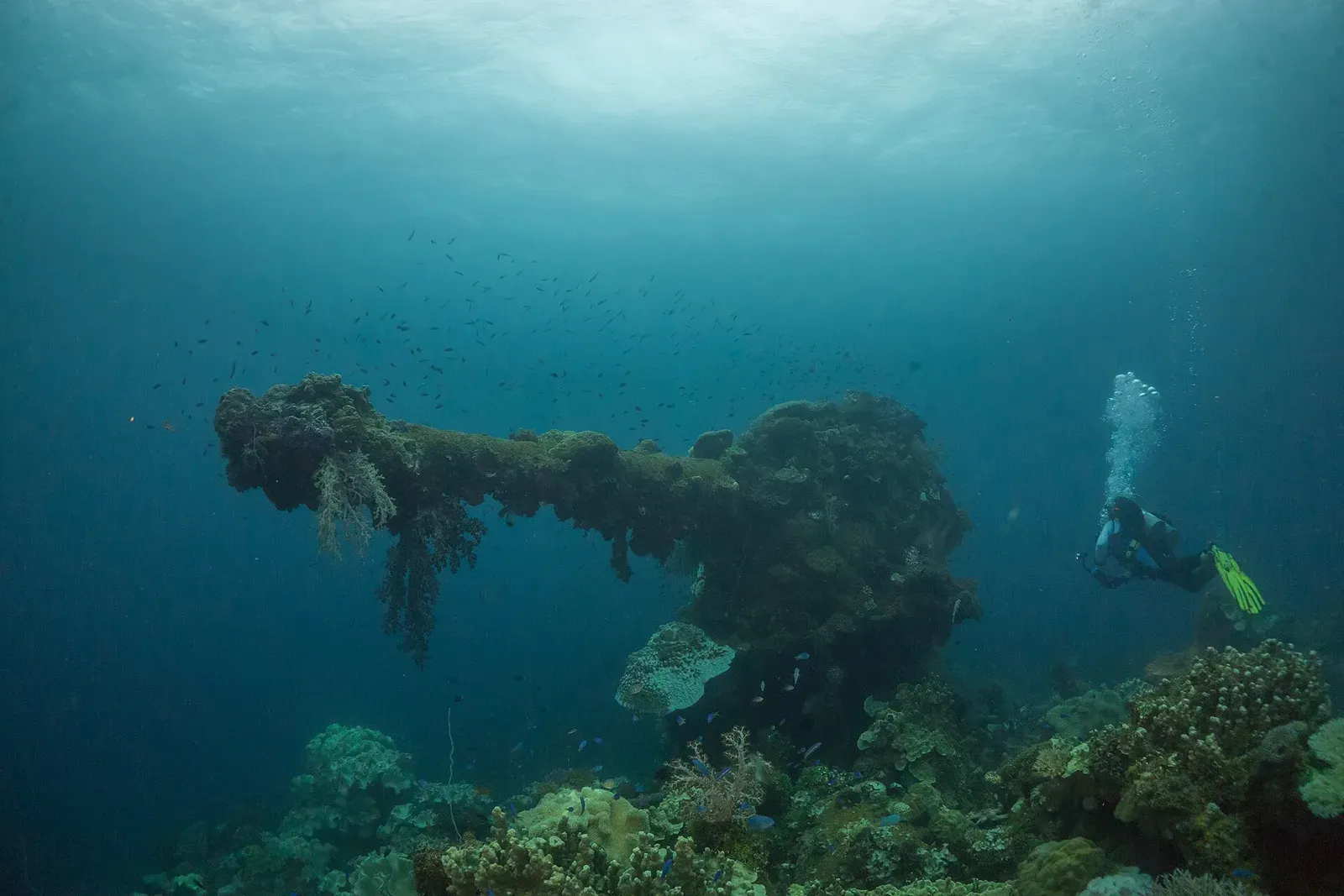
Diving a war grave
A few practical points hold across every theatre. Penetration is a separate skill from wreck diving, and the interior of the Thistlegorm has claimed divers who went inside without the training, the lights or the line; the Irako is darker still, and the Umbria’s engine room and deeper compartments are true overhead. Silt is the usual cause: a single fin kick in a hold can drop visibility to nothing for everyone behind you. The Umbria’s holds still contain live ordnance. And most of these ships were sunk by aircraft or torpedoes, so the shallow end is rarely the interesting end; the Rosalie Moller, the Coolidge stern, HMS Hermes and San Francisco Maru are all decompression dives, and the depth column above is the honest test of whether a wreck is yours to dive yet.
Best months at a glance
Season ratings for the ten wrecks most divers plan a trip around. Chuuk and Coron are dry-season destinations; the Red Sea is at its calmest from spring to autumn; Narvik and Scotland are summer dives.
| Site | Jan | Feb | Mar | Apr | May | Jun | Jul | Aug | Sep | Oct | Nov | Dec |
|---|---|---|---|---|---|---|---|---|---|---|---|---|
| SS ThistlegormSharm El Sheikh | Fair | Fair | Good | Good | Prime | Prime | Prime | Prime | Prime | Prime | Good | Fair |
| Rosalie MollerAbu Nuhas & Gubal Strait | Fair | Fair | Good | Prime | Prime | Prime | Good | Good | Prime | Prime | Good | Fair |
| Umbria WreckSudanese Red Sea | Fair | Fair | Good | Prime | Prime | Good | Fair | Fair | Good | Prime | Prime | Fair |
| Fujikawa MaruChuuk Lagoon | Good | Good | Good | Good | Good | Fair | Fair | Fair | Fair | Fair | Good | Good |
| Irako WreckCoron | Prime | Prime | Prime | Prime | Good | Fair | Fair | Fair | Fair | Fair | Good | Prime |
| Bonegi IIron Bottom Sound | Fair | Fair | Good | Prime | Prime | Prime | Good | Good | Good | Prime | Prime | Good |
| The BowEspiritu Santo | Fair | Fair | Fair | Good | Good | Good | Good | Good | Good | Good | Good | Fair |
| HMS HermesTrincomalee & Kalpitiya | Good | Good | Good | Prime | Prime | Prime | Prime | Prime | Good | Fair | Good | Good |
| U-352North Carolina Wrecks | Off-season | Off-season | Fair | Fair | Good | Good | Good | Good | Prime | Prime | Good | Off-season |
| Wilhelm HeidkampNarvik | Fair | Fair | Good | Good | Good | Prime | Prime | Prime | Good | Fair | Off-season | Off-season |