
A cargo ship wrecked in bad weather in January 1985 with 11,000 tons of sugar aboard, now lying in 12 to 16 m of water. The shallow depth is what makes her a wreck for divers of any level: no decompression pressure, good light and long bottom times, with no need to go inside to get the dive.
Where it is and how deep
34.9362° N, 24.8154° EPublished position for this site.
The dive
The wreck lies in 12 to 16 m, which is the whole reason she dives so easily: there is no depth to manage, the light is good all the way down, and a single tank goes a long way. You drop onto the wreck, get the shape of her, then work along the hull at whatever pace suits the group — with a profile this shallow there is usually gas left to go back over anything worth a second look.
What she carried is part of the story. The Byron I was a cargo ship with 11,000 tons of sugar aboard when bad weather in the area wrecked her in January 1985, and the cargo going into the water turned the salt sea temporarily sweet. None of that is left to see four decades on; what is left is the steel, and at this depth you have the gas to look at it properly.
The wreck
- Vessel
- Byron I
- Type
- Cargo ship
- Sunk
- 1985
- Cause
- Wrecked in bad weather
- Lies
- In 12-16 m of water, shallow enough for divers of all levels
The Byron I was a cargo ship carrying 11,000 tons of sugar. Bad weather in the area wrecked her in January 1985, and as the cargo went into the sea it briefly turned the salt water sweet. What remains is the hull, lying in 12 to 16 m of water and shallow enough that divers of any level can be shown around it.
Marine life and season
The sources we used don't single out particular species here.
| Jan | Feb | Mar | Apr | May | Jun | Jul | Aug | Sep | Oct | Nov | Dec |
|---|---|---|---|---|---|---|---|---|---|---|---|
| Fair | Fair | Fair | Good | Good | Prime | Prime | Prime | Prime | Prime | Good | Fair |
Season follows Crete: April to November is the season, warmest from July to September; the summer meltemi can blow out the exposed north-coast sites for a day or two at a time.
Questions divers ask
Do you need to be an experienced diver for the Byron I?+
No. The wreck lies in 12-16 m and is described as suitable for divers of all levels. There is no need to go inside the hull, so an Open Water certification and reasonable buoyancy cover it.
Sources
- Byron I Shipwreck — Scubago — Scubago
More dive sites in Crete
Cave & cavern
A fixed rope up a siphon into an air pocket inside the cliff
Reef
A tunnel entered at 14 m that lets you out at 8 m
Wall
A wall from the surface to past 60 m, in clear water
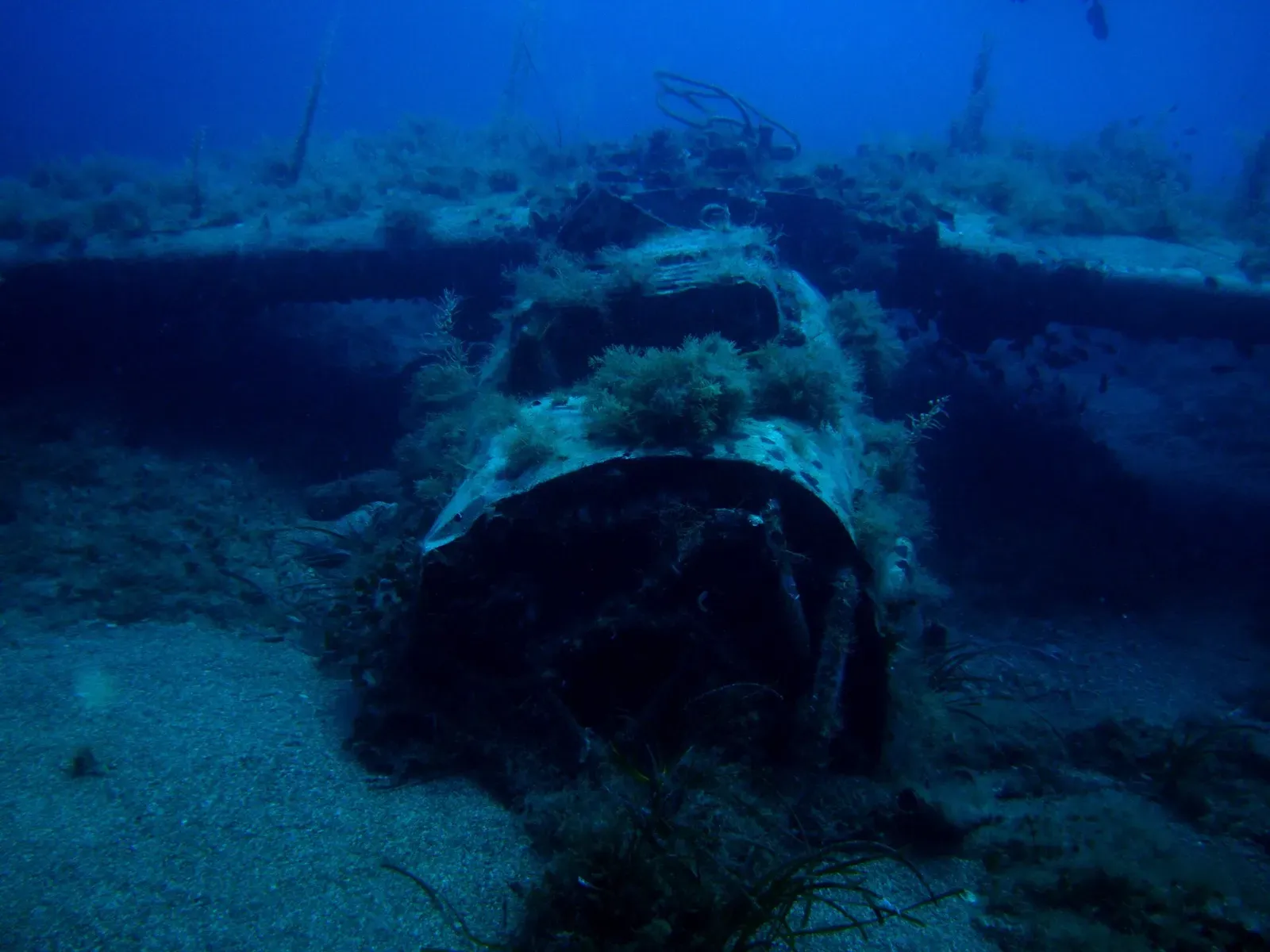
A Bf 109 upside down on sand, its guns and ammunition still in place
Reef
Amphorae and ancient wreck remains along a 300 m rock
Wall
Drop-off, canyons and a cavern on the Plakias coast
Seagrass, sand and rock in 7 m, straight off the beach
Reef
Cool, fresh-fed water over rocky patches to 15 m
Similar dives elsewhere
A burned wooden steamer on sand at 16–17 m, dived at Open Water level
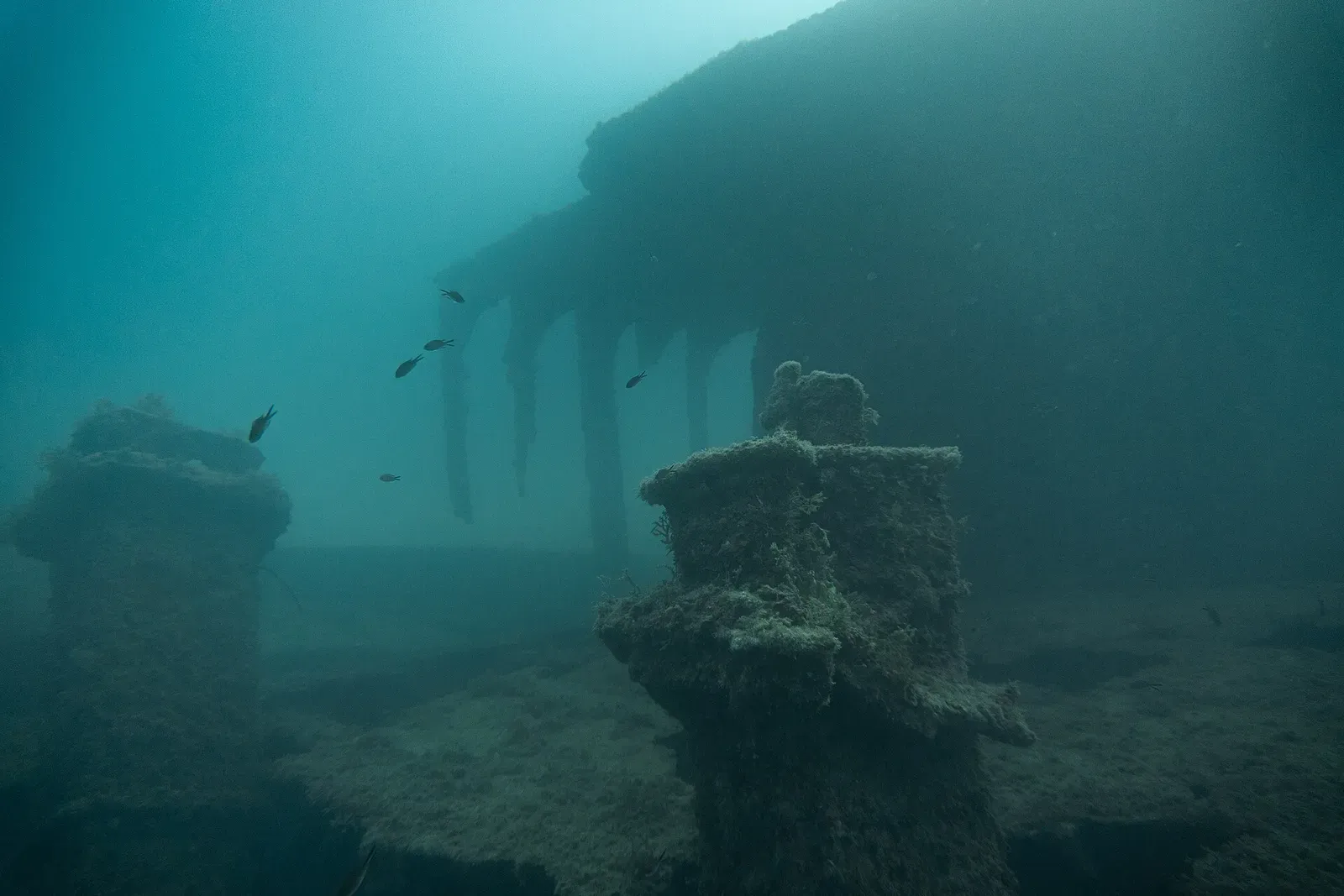
A wartime destroyer's bow in white sand below Fort Saint Elmo
Tarragona's signature wreck dive, an 18 m ship a few minutes from the quay
Wreck
Thor Star
Kos & the Kefalos Peninsula · Greece
A loading crane that leads across the wreck to the bridge and propeller