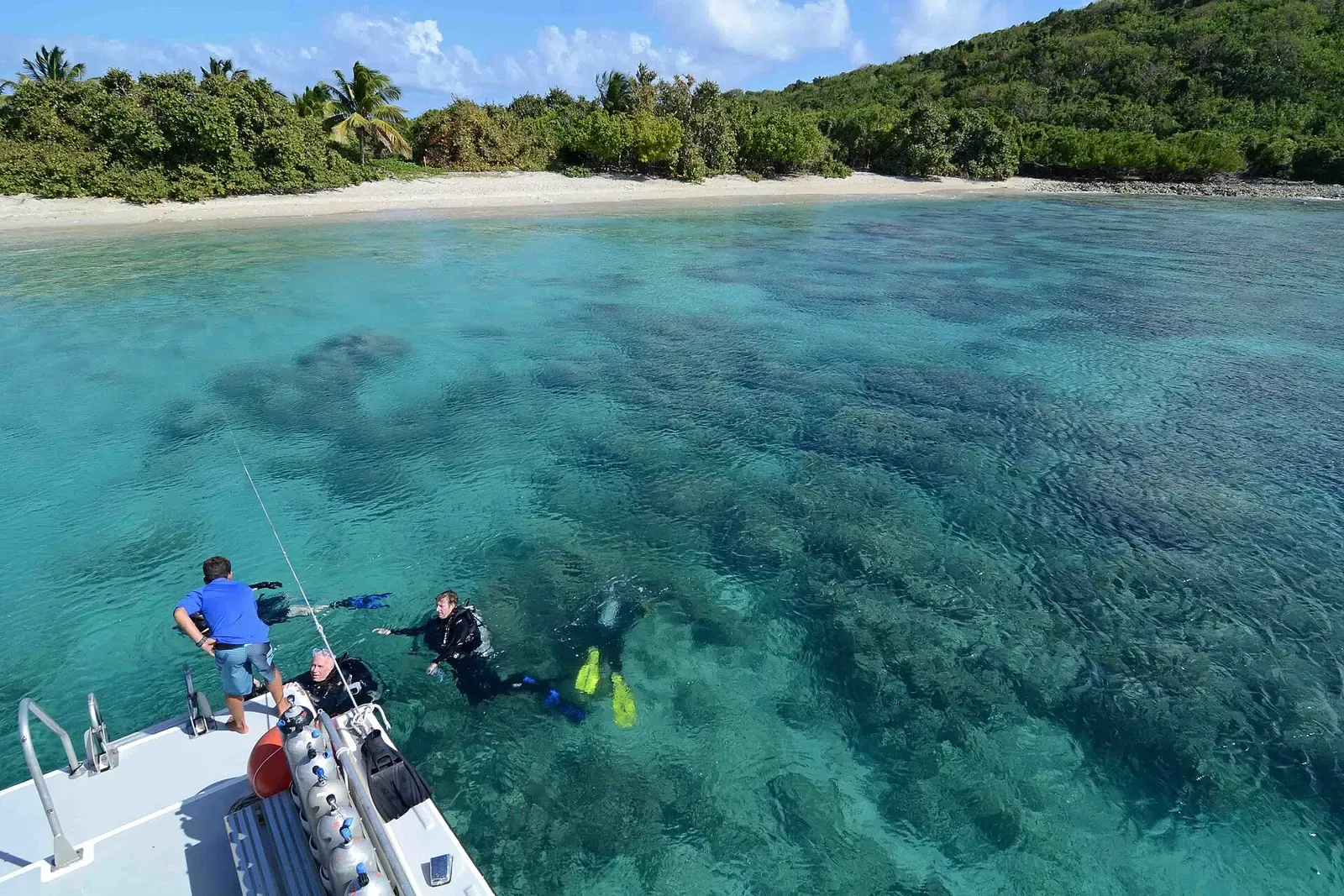
Culebra is an island on a plateau between mainland Puerto Rico, St. Thomas and Vieques, with about 50 dive sites, most under 20 minutes by boat. Most dives run 9 to 24 m (30 to 80 ft), and the best known include the long sea-fan reef at Carlos Rosario, the Wit Power tug sunk in 1984 and the cup-coral arch at Cayo Yerba. The Luis Peña Channel Natural Reserve is a no-fishing area, and the Cayo Ballena wall drops to 37 m (120 ft).
About diving in Culebra
Diving here is by boat. The island shop sits in town across the street from the ferry terminal and less than 1.6 km (1 mile) from the airport, and its guides pick the day's sites each morning from a list of about 50. Rides to and between sites are usually under 20 minutes, and entry is a giant stride, with sidemount and in-water kitting handled on request. Conditions permitting, a one-tank fluoro night dive leaves just before sunset and is back at the dock by 9 pm.
The island sits on a plateau, and its sites are reefs, walls and sometimes wrecks. A shallow dive runs 9 to 14 m (30 to 45 ft) and a deep one 15 to 24 m (50 to 80 ft); Cayo Ballena is the exception, a wall to 37 m (120 ft). Visibility averages about 18 m (60 ft) and the current is generally mild. The shallow reefs have been hit hard by warmer water, while deeper coral is still thriving. Carlos Rosario carries huge sea fans, Cayo Raton is known for the number and variety of its fish, and the Luis Peña Channel reserve is closed to fishing.
Culebra suits divers of all levels: rides are short, the current is mild and most sites stay inside 18 m (60 ft). From mainland Puerto Rico, Sea Ventures runs a full-day trip, which means a crossing of nearly 32 km (20 miles) each way in variable seas. The guidance is to wait 12 to 18 hours after diving before flying, and that includes the island-hopper flights off Culebra, so the last dive day needs planning.
Best time to dive Culebra
| Jan | Feb | Mar | Apr | May | Jun | Jul | Aug | Sep | Oct | Nov | Dec |
|---|---|---|---|---|---|---|---|---|---|---|---|
| Good | Good | Good | Fair | Fair | Fair | Fair | Fair | Fair | Fair | Fair | Good |
Dec–Mar is the high season, when dive trips should be booked from July; May–Oct is slower, needing about 2 weeks' notice. The sea averages 27–29 °C all year.
Dive types & marine life
Sea turtles, stingrays, pufferfish, angelfish and nurse sharks are common sightings across the reefs. Cayo Agua Rock draws barracuda, nurse sharks and turtles, Cayo Yerba is a good bet for stingrays, and its cup coral opens after dark. The no-fishing Luis Peña Channel reserve protects the fish population.
- Reef
- Wall
- Wreck
- Night
- Sea turtles
- Stingrays
- Barracuda
Best dive sites in Culebra
- 1
Carlos Rosario (Impact)
A long, healthy coral reef with huge sea fans, among the island's most popular dives.
- 2
Wit Power (Shipwreck)
The Wit Power, a tugboat sunk in 1984, dived as the site known as Shipwreck.
- 3
Cayo Agua Rock
A single rock 14 m (45 ft) tall, surrounded by sand, that draws barracuda, nurse sharks and sea turtles.
- 4
Cayo Ballena
A wall dive to 37 m (120 ft), known for its coral.
- 5
Cayo Yerba
An arch covered in yellow cup coral that opens at night, with a good chance of stingrays.
- 6
Lana's Cove
A small part of Lana's boat lies in about 6 m (20 ft) of water.
Site guides
Wall
A shore-parallel wall of huge sea fans topping out at 4 m
Pinnacle
A lone cube-shaped rock rising from sand, visited by nurse sharks
Wall
Culebra's deep exception: a coral wall to 37 m (120 ft)
Artificial reef
The remains of a scuttled tour boat in 6 m (20 ft) of water
How to get to Culebra
Culebra is reached by air, with three airport options, or by the one ferry from Fajardo, a crossing of 1 to 1½ hours. The ferry is cheap but very busy in the high season, holidays and summer. The island dive shop is across the street from the ferry terminal and under 1.6 km (1 mile) from the airport.
Photos from Culebra
Thomas Shahan · CC BY 2.0
Steven595 · CC BY-SA 4.0
Dive videos
Culebra, Puerto Rico Scuba Diving Highlights · Biggie Scubes on YouTube
From shark to puffer - Scuba diving in Culebra, PR with Culebra Divers · Culebra Divers on YouTube
Questions divers ask
What certification do the Culebra dives need?+
Most sites sit at 18 m (60 ft) or less and suit all levels, with boat rides usually under 20 minutes. Only the Cayo Ballena wall goes deeper, to 37 m (120 ft).
When should Culebra dive trips be booked?+
Dec–Mar is the high season, when trips should be booked from July. May–Oct is slower and needs about 2 weeks' notice. The sea averages 27–29 °C all year.
How do divers get to Culebra?+
Culebra is reached by air, with three airport options, or by the one ferry from Fajardo, a crossing of 1 to 1½ hours. The ferry is very busy in the high season, and the island dive shop is across the street from the terminal.
When do the cup corals open at Culebra's Cayo Yerba?+
The yellow cup coral on the Cayo Yerba arch opens after dark, and stingrays are a good bet there. Cayo Agua Rock draws barracuda, nurse sharks and turtles.
Sources
- Scuba Diving - Culebra Divers — Culebra Divers
- FAQs - Culebra Divers — Culebra Divers
- Getting Here - Culebra Divers — Culebra Divers
- Sea Ventures Dive Center — Sea Ventures Dive Center
- Culebra's Beaches: Diving, Snorkeling, and Kayaking — Moon Travel Guides
- Culebra, Puerto Rico — Wikipedia
- Culebra — Wikivoyage
- Water temperature in Culebra — seatemperature.info
- Lana's Cove — Scubago
Photo credits
- Two divers in black wetsuits descend beside a dive boat over clear turquoise water and dark reef patches off a green Culebra shore. by https://www.flickr.com/people/dejeuxx/, CC BY 2.0, via Wikimedia Commons
- A large brain coral with small fish and sea rods on a shallow Culebra reef, sunlight reaching the bottom. by Thomas Shahan, CC BY 2.0, via Wikimedia Commons
- Aerial view of Dewey village, its lagoon channel and the ferry landing, with reef-patched turquoise water beyond. by Steven595, CC BY-SA 4.0, via Wikimedia Commons
Embed
Run a dive centre, club or blog? Embed this map of 11 dive sites near Culebra on your own page.
Similar destinations
Swim-through rocks, a multi-level reef wall and two big wrecks
Easy shore diving at Mosquito Pier, a former military pier, to 12 m

Two dozen reef sharks circle a baited arena in 12 m of water


Cold upwelling makes Colombia's Caribbean coast unexpectedly productive